


Italian Citizenship by Descent Requirements: The 2026 Comprehensive Guide
- Gianni Mendes Toniutti, Esq.

- Mar 26
- 13 min read
Your ancestral claim to Italy isn't just a matter of blood anymore; it's a race against a shifting legal landscape. Many applicants now face the reality that Law 74/25 has redefined the structural boundaries of Italian citizenship by descent requirements, creating a sense of urgency for those seeking to reclaim their heritage. You've likely felt the weight of uncertainty as these new legislative layers make the process feel more like a complex puzzle than a simple homecoming. It's frustrating when the bridge to your past feels like it's being dismantled by bureaucratic red tape and the challenge of sourcing records from as far back as 1861.
This guide provides the clarity you need to navigate these changes and secure your dual status before the 2026 landscape shifts again. We'll provide a precise roadmap for your document collection and help you decide if a strategic court case in Italy is more efficient than a ten-year wait for a consulate appointment. You'll gain a clear understanding of how to preserve your family's legacy within this new legal framework, ensuring your connection to Italy remains timeless and structurally sound.
Key Takeaways
Understand how the March 28, 2025, legislative amendments have redefined the legal landscape for modern jure sanguinis applications in 2026.
Identify the essential Italian citizenship by descent requirements, focusing on the "unbroken chain" and the critical impact of historical naturalization laws.
Explore judicial solutions for maternal line discrimination and learn how the "1948 Case" can provide a strategic path to bypass lengthy consulate wait times.
Master the 2026 document protocol, from securing time-sensitive Italian birth extracts to compiling a complete portfolio of certified direct-line vital records.
Discover the advantage of professional legal oversight through a dual-presence firm to navigate the complexities of the updated citizenship framework with precision.
Table of Contents Understanding the "New" Landscape of Italian Citizenship in 2026 Core Eligibility Requirements Under the Amended Law 91/1992 Navigating Exceptions: The 1948 Rule and Judicial Challenges The 2026 Document Checklist and Application Protocol Strategic Legal Support for Modern Citizenship Journeys
Understanding the "New" Landscape of Italian Citizenship in 2026
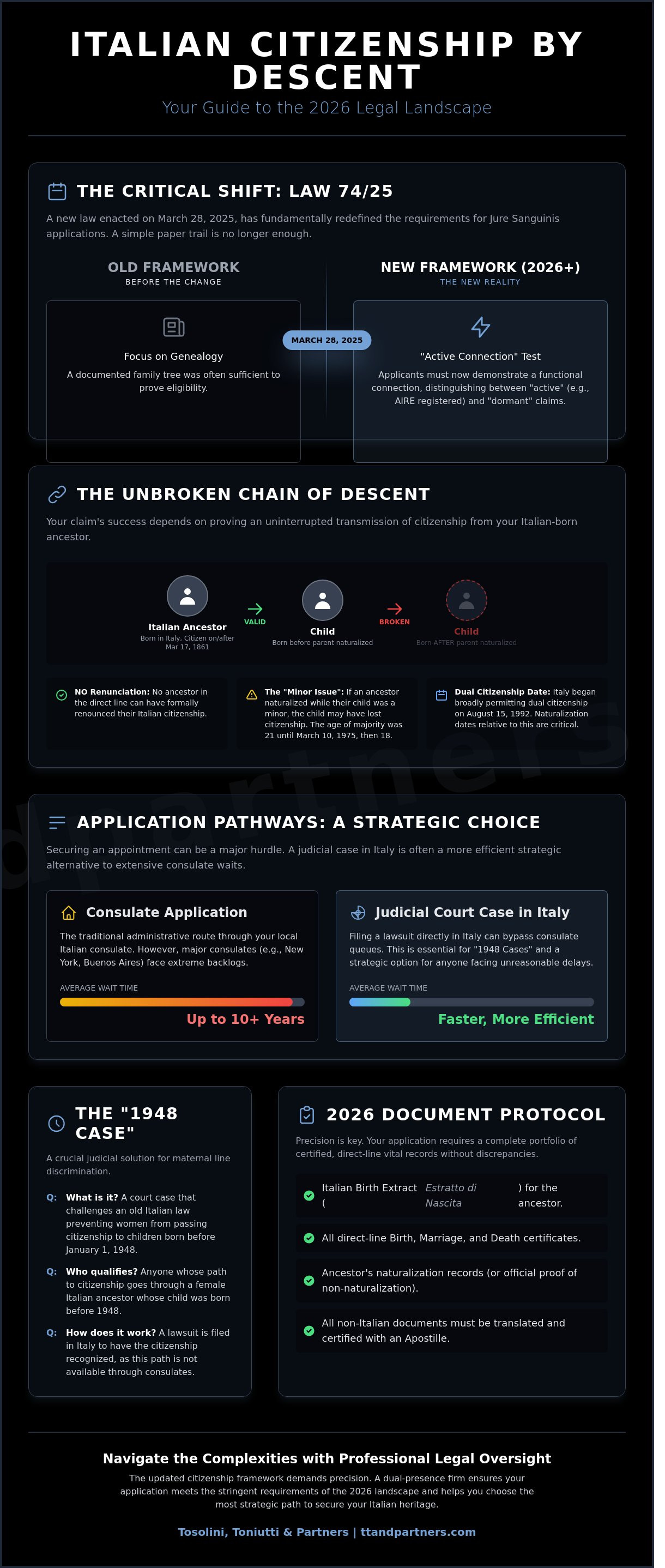
Italian nationality rests on the principle of Jure Sanguinis, or the right of blood. This legal framework allows descendants of Italian citizens to claim their heritage regardless of their own place of birth. However, the regulatory environment underwent a structural transformation on March 28, 2025. The enactment of Law 74/25 shifted the focus from simple genealogy to a demonstrated, functional connection with the Italian state. It's a fundamental change in how the government views the global diaspora.
The primary objective of this legislative update is to strengthen the bond between applicants and the Italian territory. In previous decades, a paper trail was often enough to secure a passport. In 2026, the authorities require more than a shared DNA profile. Having an Italian last name or a family tradition isn't a legal argument for eligibility. You must meet specific Italian citizenship by descent requirements that prove a continuous, legally recognized thread of citizenship that hasn't been severed by foreign naturalization.
For those seeking a strategic approach to these complex regulations, professional guidance ensures your application reflects the necessary precision. You can reach out for a consultation at https://www.ttandpartners.com/contact to discuss the structural integrity of your claim.
The Impact of Law 74/25 on Global Applications
The 11:59 PM March 27, 2025, cutoff created a sharp divide in how cases are processed. Applications submitted after this timestamp face a rigorous "active connection" test. Major consulates in cities like Buenos Aires and New York suspended new administrative appointments for 180 days to recalibrate their systems. The law now distinguishes between "active" citizenship, where the family maintained records with the AIRE system, and "dormant" claims that haven't interacted with the Italian state for over three generations.
Who Still Qualifies for Right of Blood?
Eligibility depends on architectural precision in your family tree. You must prove an unbroken line from an ancestor who was alive and an Italian citizen on or after March 17, 1861. If your ancestor naturalized in another country before the birth of the next person in the line, the chain broke. Current Italian citizenship by descent requirements demand proof that the ancestor never renounced their Italian nationality. Success in 2026 requires verifying that the Italian-born ancestor held their citizenship at the exact moment the next generation was born.
The ancestor must have been born in Italy or a territory belonging to the Kingdom of Italy.
No ancestor in the direct line can have formally renounced Italian citizenship.
Documentation must be free of discrepancies in names, dates, and locations.
Core Eligibility Requirements Under the Amended Law 91/1992
The structural integrity of a citizenship claim rests on the principle of jure sanguinis, or the right of blood. Law 91/1992 dictates that the transmission of citizenship remains valid only if the lineage remains uninterrupted. This means your Italian-born ancestor must not have naturalized in their new country before the birth of the next person in your direct line. If the ancestor became a foreign citizen even one day before the child's birth, the chain broke. This legal framework underwent a significant shift on August 15, 1992. On this date, Italy began permitting dual citizenship without the mandatory loss of the original Italian status. For applicants today, verifying the timeline of naturalization relative to this 1992 milestone is the first step in confirming Italian citizenship by descent requirements.
Recent judicial interpretations in 2023 and 2024 have placed a heavy emphasis on the "Minor Issue." If an ancestor naturalized while their child was still a minor, the Italian government may argue the child lost their citizenship along with the parent. In Italy, the age of majority was 21 until March 10, 1975, when it changed to 18. This technicality requires precise genealogical mapping to ensure the lineage stayed intact through every generational transition. If your family history involves complex migration patterns, a consultation on document strategy can help clarify these legal nuances and help you meet the Italian citizenship by descent requirements.
The Two-Year Residency Rule Explained
Current regulations highlight a specific residency requirement for certain applicant tiers. A parent must have maintained legal residency in Italy for at least 730 consecutive days, or two years, to pass citizenship to children born abroad in specific edge cases. Applicants whose parents or grandparents were Italian citizens by birth are typically exempt from this burden. To prove this status, you'll need the Certificato di Residenza Storico from the relevant Italian municipality. These records provide the empirical data needed to satisfy the Ministry of the Interior's standards.
Proving the Ancestor Never Renounced Citizenship
Naturalization is the formal legal act of voluntarily acquiring a new nationality that results in the forfeiture of one's original Italian citizenship. Securing a Certificate of Non-Existence of Records from USCIS or equivalent national archives is the standard way to prove your ancestor never took this step. For ancestors in Argentina or Brazil, this involves the CNE (Certificado de Não Naturalização). These documents function as the negative proof required to validate the continuity of your Italian heritage. Without this verified paper trail, the application lacks the necessary foundation for approval.
Navigating Exceptions: The 1948 Rule and Judicial Challenges
The evolution of Italian citizenship by descent requirements has moved from simple registry offices to the sophisticated arena of the Italian court system. While many applicants follow the administrative path, two specific scenarios require a judicial approach: the 1948 Rule and systemic consulate delays. These aren't mere alternatives; they're essential legal structures for those blocked by historical gender bias or modern bureaucratic inertia. Understanding these exceptions is vital for anyone whose lineage doesn't fit the standard administrative mold.
Challenging Gender Discrimination in the Italian Courts
Historical laws once dictated that Italian women couldn't pass their citizenship to children born before January 1, 1948. This discriminatory framework remained unchallenged until a 2009 Supreme Court ruling established that such restrictions violated constitutional equality. Today, descendants of these maternal lines must file a claim in the regional court where their ancestor was born. The success rate for these 1948 cases remains exceptionally high, often exceeding 95 percent when the lineage is documented with precision. It's a process that restores a family's historical narrative through a formal judicial decree rather than a standard consulate appointment. Recent 2022 reforms have shifted these cases from Rome to local regional courts, which has streamlined the timeline for many families.
Bypassing Consulate Backlogs via Litigation
The 730 day rule is the cornerstone of modern citizenship litigation. Under Law 241/1990, the Italian government has exactly two years to finalize a citizenship application. When consulates in high demand regions fail to offer appointments within this timeframe, it constitutes a "denial of justice." Law 74/25 has further refined this process by reinforcing the decentralization of these cases to regional courts, significantly shortening the timeline compared to the old centralized system. By leveraging these judicial paths, applicants can secure their rights without waiting a decade for a consulate interview. If you're facing unreasonable delays, contact our cross-border litigation team for a case review. This strategic shift ensures that Italian citizenship by descent requirements are met through active legal enforcement rather than passive waiting. The current judicial climate favors applicants who can prove that the administrative route is effectively closed to them due to these multi year backlogs.
The 1948 Rule: Applies to children born to an Italian mother before January 1, 1948.
Denial of Justice: A legal claim filed when consulate wait times exceed the 2 year statutory limit.
Regional Competence: Cases are now heard in the district court of the ancestor's birth commune, not just in Rome.
Law 74/25 Impact: Increased the speed of court based recognitions by distributing the caseload across 26 regional districts.
The 2026 Document Checklist and Application Protocol
Constructing a successful application requires the same structural integrity as a high-end architectural project. Every document serves as a load-bearing element in your portfolio. For 2026, the Italian citizenship by descent requirements demand a level of precision that leaves no room for administrative ambiguity. The process begins with a meticulous five-step protocol designed to withstand the scrutiny of Italian civil registries.
Step 1: Obtain the "Estratto dell’atto di nascita". You must secure this detailed extract from the Italian Comune where your ancestor was born. It's vital that this document is issued within 180 days of your submission to ensure the data is current.
Step 2: Map the lineage. Collect birth, marriage, and death records for every individual in the direct line, from the Italian-born ancestor down to yourself.
Step 3: Secure Long Form certificates. Standard computer abstracts are insufficient. You'll need "Long Form" or "Book Copy" versions from US vital records offices, as these contain the necessary parentage details and marginal notes.
Step 4: International Legalization. Every non-Italian document must receive an Apostille from the Secretary of State in the jurisdiction where the record was issued.
Step 5: Professional Translation. All English documents require a certified translation into Italian. These must be performed by professionals recognized by the relevant consulate to ensure technical accuracy.
Modern Standards for Italian Vital Records
The digital landscape of Italian municipalities is shifting rapidly. By early 2025, over 60% of Italian Comuni transitioned to digital request portals, yet the requirement for the "Estratto" format remains firm. Simple birth certificates are routinely rejected because they lack the "annotazioni marginali" (marginal notes) that prove an ancestor didn't renounce their citizenship. If names or dates vary across generations, you'll need a "One and the Same" affidavit. This legal document bridges the gap between a "Giuseppe" born in 1890 and the "Joe" listed on a 1920 US census record.
Legalization and Translation Nuances
The Apostille is the structural seal of your application. It's issued by the Secretary of State and confirms the document's authenticity for international use under the 1961 Hague Convention. Don't attempt DIY translations. Statistics from major consulates show that 35% of self-translated applications result in a Request for Evidence (RFE) or immediate rejection. Certain jurisdictions, such as the Italian Consulate in New York, now require specific "legalization" of the translator's signature, adding another layer of complexity to the 2026 Italian citizenship by descent requirements.
Precision in documentation is the only path to a successful outcome. If you require expert guidance to navigate these technical complexities, contact our specialized team today for a professional consultation.
Strategic Legal Support for Modern Citizenship Journeys
The landscape of Italian citizenship shifted significantly following the judicial reforms of 2025. These changes standardized how provincial courts handle "minor cases" and 1948 rule challenges, making professional oversight a technical necessity. Meeting the current Italian citizenship by descent requirements demands more than just document collection; it requires a structural understanding of evolving case law and specific regional court preferences. We view the application process as a complex architectural project where every record must support the weight of the entire claim.
TT and Partners operates from physical studios in New York, Milan, and Naples to ensure no detail is lost between disparate legal systems. US record-keeping practices often conflict with Italian civil registry standards, particularly regarding name discrepancies or naturalization dates. We bridge this gap by providing on-the-ground verification in Italy while managing the delicate retrieval of federal records in the United States. This dual presence allows us to resolve administrative friction before it reaches a magistrate's desk.
Custom Solutions for Complex Ancestry Cases
Ancestry lines aren't always linear. Gaps in documentation, such as records destroyed during the 1943 bombings or lost in municipal fires, require creative legal reconstruction through secondary evidence. We specialize in finding alternative proofs that satisfy the rigorous Italian citizenship by descent requirements even when primary sources are absent. Our team also coordinates citizenship goals with broader strategic interests, such as managing Italian real estate acquisitions or establishing business entities within the European market. Schedule a consultation to verify your eligibility under the new laws.
The TT and Partners Advantage
Success in cross-border litigation depends on technical precision and a deep respect for the Italian bureaucratic fabric. We approach international law with the same rigor an architect applies to a blueprint, ensuring every document serves a functional purpose within the file. Our firm bridges the Atlantic with dedicated offices in New York, Milan, and Naples to provide seamless representation across both legal jurisdictions. This professional framework allows us to navigate the 2025 legislative shifts with confidence and foresight.
Preparing your file for the 2026-2027 application cycle requires immediate action. The current processing times at Italian consulates and the workload of the provincial courts mean that early preparation is the only way to secure a timely outcome. We'll help you assemble a portfolio that meets the highest standards of the Italian Ministry of the Interior, ensuring your path to dual nationality is built on a foundation of legal certainty.
Securing Your Legacy in the 2026 Legal Landscape
The 2026 legal framework demands a higher degree of precision for those seeking to reclaim their heritage. Success now hinges on navigating the specific Italian citizenship by descent requirements outlined in the amended Law 91/1992 and ensuring full compliance with the procedural updates of Law 74/25. Whether your path involves a standard consulate application or a complex 1948 Rule judicial challenge, the technical integrity of your documentation determines the final outcome. It's a process where historical context meets rigorous modern legal standards.
TT and Partners brings decades of cross-border immigration experience to this delicate journey. With established offices in NYC, Miami, Milan, and Naples, we provide the local presence necessary for global results. Our firm operates with the meticulous attention to detail found in architectural design, ensuring every record and apostille fits perfectly within the current regulatory structure. You don't have to navigate these shifting requirements alone. We treat your family's history with the professional reverence it deserves.
Italy's doors remain open to those who approach the process with a clear vision and the right strategic partner.
Frequently Asked Questions
Is Italian citizenship by descent still possible after the 2025 law changes?
Yes, you can still claim your lineage in 2026 provided you meet the foundational Italian citizenship by descent requirements established in the June 2025 legislative update. These refinements focused on digital verification protocols rather than abolishing "jus sanguinis" rights. Your eligibility remains intact if your ancestor was alive after March 17, 1861, and didn't naturalize before the birth of the next person in your direct line.
Can I apply for Italian citizenship if my mother was the Italian ancestor?
You can apply through a female ancestor, though the specific legal path depends on your birth date. If you were born after January 1, 1948, you'll follow the standard administrative route at your local consulate. For those born before this 1948 threshold, the law requires a judicial challenge in the Italian courts to rectify historical gender discrimination. It's a successful, well-trodden legal framework used by thousands of applicants annually.
How much does it cost to apply for Italian dual citizenship in 2026?
The total financial investment for meeting all Italian citizenship by descent requirements typically ranges from $2,500 to $6,500 for a single applicant. You'll pay a mandatory 300 Euro application fee directly to the Italian government at the time of your appointment. Additional costs include approximately $175 per document for professional translation and the international apostille services required to authenticate your vital records for the Italian civil registry.
What happens if I cannot find my ancestor’s Italian birth certificate?
You must obtain a certified "Estratto di Nascita" from the specific municipality where your ancestor was born. If civil records were destroyed during the 1908 earthquake or wartime conflicts, you can substitute them with authorized baptismal records from the local parish. These religious certificates must be legalized by the relevant Archbishop’s office. This architectural approach to documentation ensures the legal chain remains unbroken despite missing civil files.
How long is the current waiting time for an Italian citizenship appointment?
Current wait times at major consulates like New York, London, or San Francisco average 4 to 9 years as of January 2026. You can bypass these significant delays by applying directly in Italy through a residency-based application. This accelerated path generally concludes within 90 to 180 days. It requires a physical presence and a registered lease in an Italian commune for the entire duration of the administrative process.
What is a 1948 case and do I need a lawyer for it?
A 1948 case is a specific judicial lawsuit filed in the Italian court system to claim citizenship through a female line. You'll need a lawyer registered with the Italian Bar Association to represent you because these cases aren't handled by consulates. This legal strategy challenges the 1912 law that prevented women from passing citizenship to children born before 1948. Success rates for these cases remain above 95 percent in 2026.
Does getting an Italian passport mean I have to pay taxes in Italy?
Holding an Italian passport doesn't trigger tax liabilities if you live outside of Italy for more than 183 days per year. Italy's tax system is residency-based, not citizenship-based. You'll register with the Registry of Italians Residing Abroad, known as AIRE, to formalize your status as a non-resident. This registration protects your global income from Italian taxation while allowing you to maintain your European legal status and travel benefits.
Can I live and work anywhere in the EU with an Italian passport?
Your Italian passport grants you the absolute right to live, work, and study in any of the 27 European Union member states. Under the legal framework of Directive 2004/38/EC, you don't need a visa or work permit to relocate to countries like Germany, Spain, or France. This mobility allows you to access local healthcare and education systems at the same subsidized rates as domestic citizens across the entire Schengen Area.
Disclaimer
The information provided in this website is offered purely for informational purposes. It is not intended to create or promote an attorney-client relationship, and does not constitute and should not be relied upon as legal advice. We intend to make every attempt to keep this information current. We do not promise or guarantee, however, that the information is correct, complete or up-to-date, and readers should not act based upon this information without seeking professional counsel from a licensed attorney. Transmission of information from this newsletter is not intended to create, and its receipt does not constitute, an attorney-client relationship with Tosolini, Toniutti & Partners or any of its individual attorneys or personnel.


Comments