


Italian Citizenship Guide: Paths, Requirements, and Legal Strategies for 2026
- Gianni Mendes Toniutti, Esq.

- Mar 25
- 12 min read
What if your family lineage wasn't merely a collection of faded records but a foundational blueprint for a life without borders? You've likely felt the weight of conflicting digital advice or the specific dread that a 1912 naturalization record might dismantle your entire ancestral claim. It's exhausting to face the 730-day average wait times at local consulates while worrying if the 1948 Rule or the recent 2023 judicial shifts regarding the "Minor Issue" will permanently block your path. We understand that securing Italian Citizenship isn't just a paperwork exercise; it's a deliberate act of heritage preservation and strategic planning.
This guide provides a rigorous legal framework to help you navigate these complexities with the precision of a master architect. You'll gain a clear understanding of your eligibility and a streamlined route to your EU passport through professional litigation and genealogical expertise. We're going to break down the exact hurdles you'll face and the specific litigation strategies required to bypass bureaucratic delays as we approach 2026. By placing your heritage in a modern legal context, we ensure that every detail aligns with current Italian law and your vision for an enduring, timeless legacy.
Key Takeaways
Evaluate the geopolitical significance of an Italian passport and the foundational legal framework of Ius Sanguinis in a 2026 context.
Determine the most viable route for your heritage, focusing on the specific requirements for obtaining italian citizenship through descent or marriage.
Overcome intricate historical hurdles, including maternal lineage cases and naturalization complexities, through expert judicial intervention.
Execute a rigorous documentation strategy that spans genealogical procurement to the final stages of international Apostille verification.
Align your legal status with broader lifestyle and investment objectives, including cross-border business and strategic tax planning.
Table of Contents Understanding Italian Citizenship: A Global Asset in 2026 Primary Paths to Italian Citizenship Recognition Navigating Complex Legal Hurdles: The 1948 Case and Beyond The Application Process: A Step-by-Step Roadmap for 2026 Strategic Legal Support for Your Italian Citizenship Journey
Understanding Italian Citizenship: A Global Asset in 2026
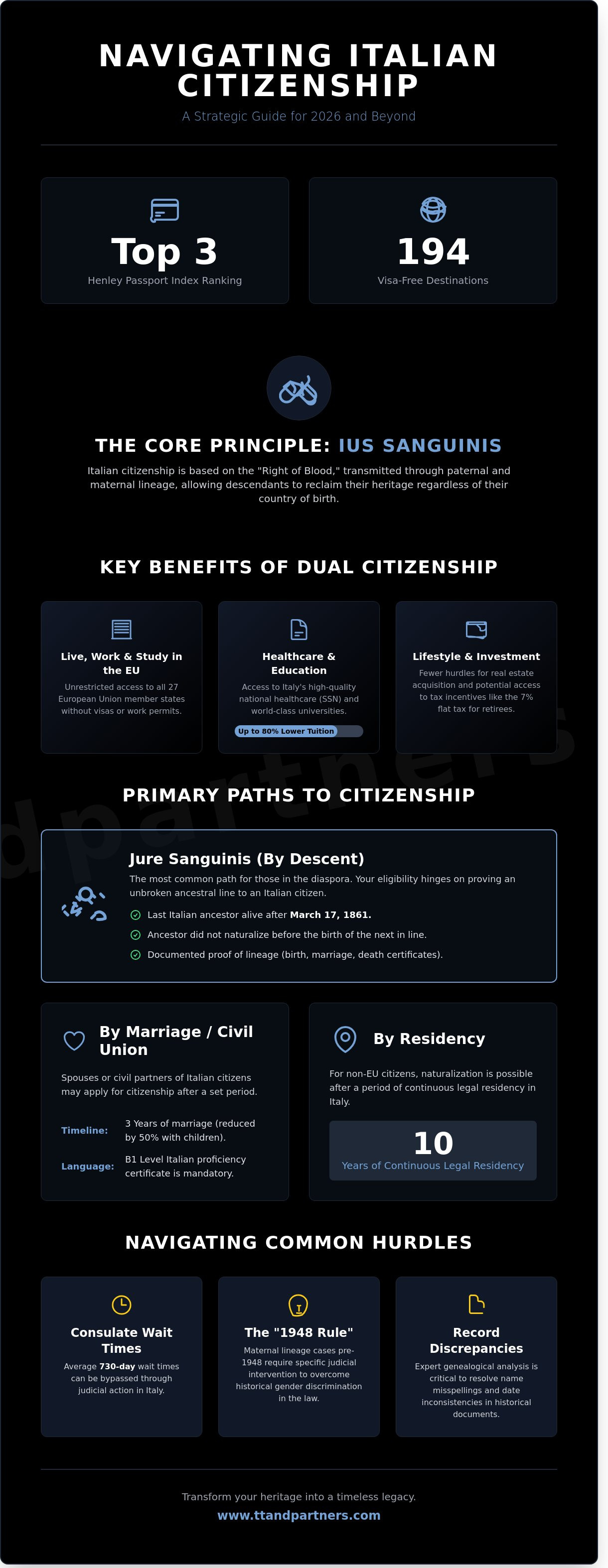
Italian citizenship, or Cittadinanza Italiana, represents more than a simple travel document; it's a structural foundation for a global lifestyle. The core principle governing this right is Ius Sanguinis, or the right of blood. Unlike systems based solely on birth territory, the legal foundation of this process rests on Italian nationality law, which prioritizes the transmission of citizenship through paternal and maternal lineages. This allows individuals of Italian descent to reclaim their ancestral rights, even if their family left Italy several generations ago.
In 2026, the geopolitical value of an Italian passport is at an all-time high. It consistently ranks in the top 3 of the Henley Passport Index, granting visa-free access to 194 destinations. For the modern professional, this status serves as a legal bridge between North America and the European Union. It facilitates seamless cross-border business operations and residency transitions. Tosolini, Toniutti & Partners operates from this perspective of technical precision. With offices in NYC, Miami, and Milan, we provide the architectural framework needed to manage complex citizenship portfolios across different legal jurisdictions.
The Benefits of Dual US-Italian Citizenship
Holding dual citizenship grants you unrestricted access to live, work, and study across all 27 EU member states without the need for restrictive visas or permits. It's a strategic advantage for international business expansion. Citizens can acquire real estate with fewer bureaucratic hurdles and may benefit from specific tax incentives, such as the 7% flat tax for retirees in certain southern Italian municipalities. You also gain access to the Servizio Sanitario Nazionale (SSN), Italy's high-quality healthcare system, and world-class university education at a fraction of US tuition costs. Current data shows that EU residents pay up to 80% less for postgraduate degrees compared to non-EU international students.
Citizenship as a Legacy for Future Generations
Securing your Italian citizenship today creates a timeless asset for your descendants. Once your lineage is officially recognized, the rights are automatically protected for your children and grandchildren. It's a gift of mobility and opportunity that doesn't expire. Beyond the functionality of the document, there's a profound cultural value in re-establishing your place within the Italian urban fabric. It transforms a distant family history into a tangible, legal reality. If you're ready to explore your eligibility, you can reach our team through our contact page to begin the evaluation of your ancestral records.
Primary Paths to Italian Citizenship Recognition
The legal framework for obtaining italian citizenship is built upon the principle of jus sanguinis, or the right of blood. This structure prioritizes ancestral connections over geographical birth. While most applicants in the diaspora focus on descent, the Italian Ministry of Foreign Affairs recognizes four distinct avenues for recognition. Understanding the specific Italian citizenship requirements for each path is the first step in constructing a successful application.
Jure Sanguinis: The Multi-Generational Link
Proving an unbroken line centers on your last Italian ancestor who was alive after March 17, 1861. The naturalization date is the critical pivot; if they became a US citizen before the birth of the next person in your line, the transmission ceased. For all 2026 applications, the core requirement is documenting that every ancestor in the chain maintained their Italian status until the birth of their descendant.
Citizenship by Marriage and Civil Union
Spouses of Italian citizens can apply after three years of marriage. This duration is reduced by 50 percent if the couple has biological or adopted children under 18. Since December 4, 2018, applicants must provide a certificate of B1 level Italian language proficiency. All documentation is submitted digitally through the Ministry of the Interior's ALI portal, which serves as the primary gateway for these requests.
Residency and Limited Birth Criteria
Naturalization through residency requires a significant commitment to living within the Italian social fabric. Non-EU citizens generally need 10 years of continuous legal residency; this is reduced to 5 years for refugees and 4 years for EU nationals. Jure Soli, or citizenship by birth on the soil, remains extremely restricted in Italy. It applies only to children born to unknown or stateless parents, or those whose parents' national laws don't grant citizenship to children born abroad. This path is rare, as the Italian state prioritizes the preservation of cultural and familial ties over geography. If you're unsure which path fits your family history, contact our team for a precise evaluation of your lineage.
Navigating Complex Legal Hurdles: The 1948 Case and Beyond
The path to italian citizenship often mirrors the restoration of a historic structure; it requires a deep understanding of the original framework and the modern interventions that preserve its integrity. While most applicants follow the administrative route, specific historical anomalies create "broken" lineages that only a court can repair. The most prominent of these is the 1948 Rule. Before the Italian Constitution took effect on January 1, 1948, women didn't have the legal standing to pass citizenship to their children. This gender-based discrimination created a gap in the law that the Italian Ministry of Foreign Affairs and local consulates cannot bridge through standard administrative channels.
Because consulates are bound by the literal text of old statutes, they must reject applications involving a female ancestor who gave birth before 1948. These cases require a judicial petition to bypass the discriminatory law. It's a process of legal architecture where a specialized Italian citizenship lawyer files a lawsuit against the Italian Ministry of the Interior. Success in these cases is high because the Italian Supreme Court ruled in 2009 that the 1948 restriction is unconstitutional. However, the remedy exists only within the courtroom, not the consulate window.
Winning the 1948 Case in Italian Courts
The judicial process has become more decentralized and efficient recently. Since the reform on June 22, 2022, cases are no longer concentrated in Rome. Instead, they're heard in the "Court of the Ancestor," which is the regional court with jurisdiction over the municipality where your Italian forebear was born. This shift has balanced the workload across Italy's legal system. You don't need to travel to Italy for these proceedings. Your legal representative handles all filings and hearings, allowing the court to recognize your italian citizenship through a formal decree that carries the same weight as an administrative certificate.
The 'Minor Issue' Controversy in 2026
A new legal challenge, often called the "Minor Issue," has gained momentum leading into 2026. This stems from conflicting interpretations of Law n. 555 of 1912. Some recent court rulings, including high-profile decisions from the Court of Cassation in 2023 and 2024, suggest that if an Italian parent naturalized in another country while their child was still a minor, that child may have lost their Italian status automatically. This interpretation contradicts decades of established practice. A specialized attorney must now evaluate the specific dates of naturalization and the child's age to navigate this evolving risk. It's a technical hurdle that requires precise timing and a strategic defense of your family's heritage.
The Application Process: A Step-by-Step Roadmap for 2026
Securing italian citizenship demands the same structural integrity as a heritage restoration project. Each document serves as a load-bearing element in your application. For 2026, the roadmap consists of five precise phases designed to bridge your family's history with modern legal requirements.
Phase 1: Deep genealogical research to procure birth, marriage, and death records from both Italy and your home country.
Phase 2: International document legalization via the Apostille process to ensure global recognition.
Phase 3: Professional translation into Italian by certified experts to maintain linguistic accuracy.
Phase 4: Submission of the completed portfolio to the competent Italian Consulate or the regional Italian Courts.
Phase 5: Recognition of status followed by mandatory registration in the Registry of Italians Residing Abroad (AIRE).
Document Procurement and the 'Non-Naturalization' Proof
The foundation of your claim rests on proving your ancestor never renounced their Italian heritage before the next generation was born. You must coordinate with NARA and USCIS to obtain certified records. In 2024, USCIS reported average processing times exceeding 280 days for genealogy searches; early action is vital. Discrepancies in 19th-century records, such as a name changing from "Giovanni" to "John" in 1915, require "One and the Same" affidavits to maintain the chain of identity. An Apostille is required for all non-Italian documents in 2026 because it serves as the definitive international certification of a public official's signature under the 1961 Hague Convention.
Consular vs. Judicial Paths: Which is Faster?
Choosing your venue is a strategic decision based on current administrative capacity. Consulates in major hubs like New York or Miami currently face waitlists spanning 8 to 10 years. If you can't secure an appointment within a reasonable timeframe, the "Against the Queue" lawsuit offers a judicial alternative. This path bypasses consular delays by filing directly in the Italian courts, citing the 730-day legal limit for administrative processing established by Italian law. This judicial route often resolves cases within 18 to 24 months, providing a more predictable timeline for those seeking italian citizenship through their lineage.
Expert guidance ensures your application meets the highest standards of professional precision. Consult with our strategic partners to discuss your path to recognition.
Strategic Legal Support for Your Italian Citizenship Journey
Attaining italian citizenship requires more than just gathering birth certificates; it demands a legal framework built to withstand the complexities of international law. Document-prep services often fail when faced with the nuanced requirements of Italian consulates or the 2022 jurisdictional shifts in Italian courts. A cross-border law firm provides the structural integrity necessary for a successful application. We manage the entire lifecycle of your file, ensuring every document fits perfectly within the legal landscape. Our approach treats your lineage not as a checklist, but as a foundation for your future global mobility.
Beyond the Passport: Living and Investing in Italy
Your journey doesn't end when you receive your passport. For family members who don't qualify via Jure Sanguinis, we provide assistance with the Permesso di Soggiorno for family reasons, ensuring your household remains together. If your vision includes entrepreneurship, our team facilitates LLC incorporation and manages real estate closings with 100% legal oversight. We also guide you through the 1999 US-Italy tax treaty. This ensures you optimize your financial position and avoid double taxation on global assets. It's about creating a sustainable lifestyle in the Italian urban fabric.
The TT and Partners Advantage
We offer direct access to the Italian judicial system through our specialized teams in Milan and Naples. This local presence is vital since the 2022 reform moved citizenship cases from Rome to regional courts. We coordinate your US immigration needs with your new rights as a dual citizen, providing a seamless transition between two legal worlds. Our commitment to architectural precision means every filing is triple-checked for consistency. We don't just process papers; we design a legacy. We invite you to contact our offices in New York, Miami, or Milan for a preliminary evaluation of your case.
Direct representation in 26 Italian judicial districts.
Comprehensive support for the 1999 US-Italy Double Tax Treaty.
Full-service coordination for real estate acquisitions and business startups.
Choosing the right partner determines the longevity of your success. Whether you're reclaiming your heritage or planning a strategic investment, we ensure your italian citizenship is a secure, lifelong asset. Our team bridges the gap between vision and reality, providing the professional confidence you need to move forward.
Architecting Your Future in the 2026 Global Landscape
Building a life that spans continents requires structural precision and a deep understanding of the legal fabric. By 2026, the path to italian citizenship will rely heavily on navigating the 1948 judicial precedent and managing complex cross-border documentation across international jurisdictions. Success isn't found in shortcuts; it's found in the meticulous assembly of records and the strategic foresight of a global legal partner. Our team operates from five strategic hubs in New York, Miami, Orlando, Milan, and Naples to provide the professional framework your journey demands.
We've refined our specialized expertise in 1948 judicial cases to ensure every application meets the highest standards of technical accuracy. Beyond the courtroom, we provide comprehensive real estate and cross-border support to integrate your legal status with your lifestyle goals. You're not just filing paperwork. You're designing a legacy that bridges generations and creates a permanent connection to your heritage. Every verified document serves as a foundation stone for your new European horizon. Schedule a Consultation with our Italian Citizenship Attorneys to begin constructing your path forward with confidence.
Frequently Asked Questions
How do I know if I qualify for Italian citizenship by descent?
You qualify if you can prove an uninterrupted line of descent from an Italian ancestor who was alive and a citizen after March 17, 1861. This specific date marks the unification of Italy and the legal foundation of modern citizenship. Your ancestor must not have naturalized in another country before the birth of the next person in your direct lineage, ensuring the bloodline remains legally valid.
Can I apply for Italian citizenship if my ancestor naturalized as a US citizen?
You can still apply if your ancestor naturalized after the birth of their child, ensuring the Italian bloodline remained intact at the time of birth. If the naturalization occurred before June 14, 1912, specific laws regarding minor children might apply. Records from the USCIS or National Archives provide the necessary proof of these dates to confirm your eligibility for italian citizenship.
What is the B1 language requirement and who does it apply to?
The B1 language requirement applies only to individuals seeking citizenship through marriage or residency, as established by Decree Law No. 113 in 2018. It doesn't apply to Jure Sanguinis applicants. You must prove intermediate proficiency through a recognized institution like the Dante Alighieri Society if you're a spouse of an Italian citizen. This ensures a functional integration into the cultural fabric of the nation.
How long does the Italian citizenship process take in 2026?
Processing times in 2026 typically range from 18 to 36 months depending on the specific consulate's backlog. While Italian law sets a 730-day limit for administrative processing, high demand in cities like New York or Sao Paulo often extends this window. Judicial paths through Italian courts often resolve within 12 to 24 months, providing a more predictable timeline for complex cases seeking structural efficiency.
Do I need to speak Italian to apply through Jure Sanguinis?
No, you don't need to speak Italian to claim italian citizenship through descent. The legal framework recognizes the inherent right of blood, which exists independently of linguistic skill. While speaking the language enriches your connection to your heritage, the administrative process focuses strictly on the documentary evidence of your lineage and the historical context of your ancestors' lives within the Italian state.
What is the 1948 Rule and how does it affect my application?
The 1948 Rule addresses a historical gender inequality where Italian women couldn't pass citizenship to children born before January 1, 1948. If your lineage involves a female ancestor whose child was born before this date, you must file a case in the Italian court system. Recent rulings by the Court of Cassation consistently favor applicants, overturning this discriminatory practice through precise judicial intervention.
Can I live in Italy while my citizenship application is being processed?
You can live in Italy during the process if you apply via the reconstruction path at a local town hall. This requires you to establish legal residency, which involves a 45-day verification period by the local police. Once registered, you obtain a Permesso di Soggiorno in Attesa di Cittadinanza. This document allows you to reside legally until the final decree is issued by the authorities.
What are the costs associated with applying for Italian dual citizenship?
Total costs generally range from $3,000 to $10,000 depending on the complexity of your family tree and document procurement needs. The Italian consulate charges a fixed application fee of 300 Euros, approximately $325, as of 2024. Additional expenses include professional translations, apostilles for each vital record, and potential legal fees if your case requires a judicial hearing in a regional Italian court.
Disclaimer
The information provided in this website is offered purely for informational purposes. It is not intended to create or promote an attorney-client relationship, and does not constitute and should not be relied upon as legal advice. We intend to make every attempt to keep this information current. We do not promise or guarantee, however, that the information is correct, complete or up-to-date, and readers should not act based upon this information without seeking professional counsel from a licensed attorney. Transmission of information from this newsletter is not intended to create, and its receipt does not constitute, an attorney-client relationship with Tosolini, Toniutti & Partners or any of its individual attorneys or personnel.


Comments