

US Subsidiary for Italian Firms: 2026 Strategic Guide

What if the primary obstacle to your American expansion isn't the market competition, but the legal architecture you choose to support it? Many Italian enterprises hesitate to cross the Atlantic because they fear the complexities of US litigation and the confusing choice between LLC and C-Corp taxation. It's natural to feel concerned about the technicalities of securing an E-2 visa for employees of Italian company. You've built a legacy in Italy; you shouldn't have to risk it on administrative hurdles or compliance errors.
This 2026 strategic guide offers a comprehensive legal framework for Italian firms to establish a secure, shielded US presence. We'll show you how to build a resilient entity that facilitates executive mobility, allowing your essential team members to lead operations on the ground. By following this roadmap, you'll gain clarity on incorporation strategies and the latest consular requirements. We'll break down the transition from Italian civil law to US common law. This ensures your transatlantic bridge is both stable and visionary. From tax structures to the new visa integrity fees, we've mapped the path for your international growth.
Table of Contents
Strategic Entity Selection: LLC vs. C-Corporation for Italian Parents
The Immigration Nexus: Aligning Corporate Structure with Treaty Visas
Practical Incorporation: From Registered Agents to EIN Procurement
Navigating the Legal Gap: Protecting the Italian Parent Company
Strategic Execution: Why Italian Enterprises Partner with TT&P
Strategic Entity Selection: LLC vs. C-Corporation for Italian Parents
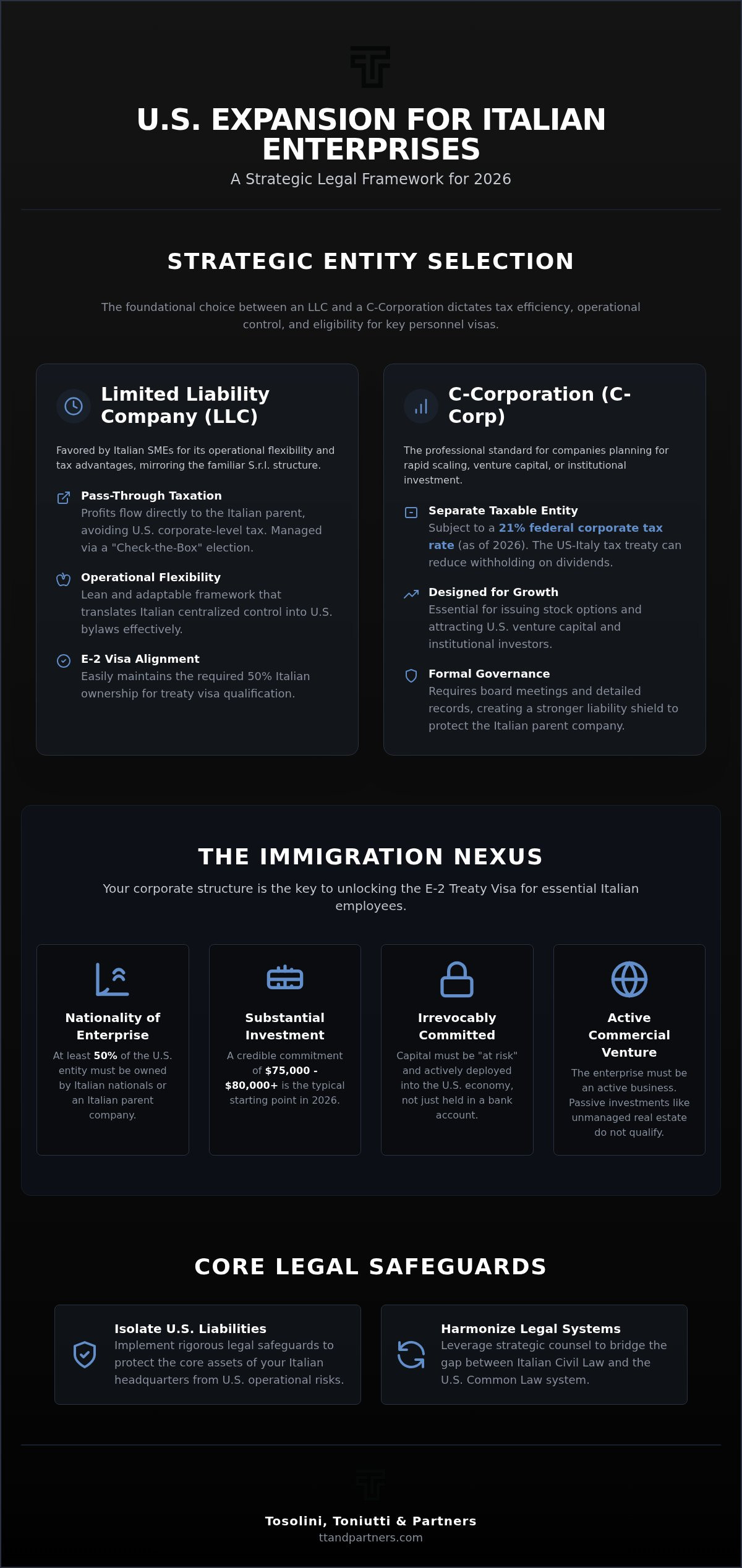
The foundation of a successful US entry lies in selecting a corporate structure that balances liability protection with fiscal efficiency. For an Italian firm, this isn't merely an administrative task; it's a strategic maneuver that dictates the future of the E-2 Investor Visa Overview and the ability to transfer key personnel. The decision between a Limited Liability Company (LLC) and a C-Corporation (C-Corp) fundamentally alters how the Italian parent interacts with its American subsidiary. This choice must be architected with precision, ensuring the US entity acts as a robust shield for the Italian headquarters.
The LLC: Operational Flexibility and Pass-Through Taxation
Italian Small and Medium Enterprises (SMEs) frequently gravitate toward the LLC because its structure mirrors the familiar operational control of an S.r.l. Its primary appeal is the pass-through taxation model. In this setup, the entity's profits flow directly to the Italian parent company, avoiding the corporate-level tax typical of other structures. This is particularly effective when managed through a "Check-the-Box" election, a mechanism that allows the firm to choose how it's treated for tax purposes under US law. For a firm pursuing an E-2 visa for employees of Italian company, the LLC offers a lean, adaptable framework. It allows the Italian mindset of centralized control to translate smoothly into US bylaws while maintaining the 50% Italian ownership required by treaty rules.
The C-Corporation: Scalability and Institutional Investment
If your vision involves rapid scaling or securing US venture capital, the C-Corporation is the professional standard. Unlike the LLC, a C-Corp is a separate taxable entity. As of 2026, the US federal corporate income tax rate stands at a flat 21%. While this introduces the possibility of double taxation on dividends, the US-Italy tax treaty often provides relief through reduced withholding rates. High-growth Italian tech firms find this structure essential for issuing stock options and attracting institutional investors. It requires more formal governance, such as board meetings and detailed corporate records. This rigor is vital; it ensures the liability shield remains impenetrable, preventing US legal risks from reaching the Italian headquarters. Whether you choose the flexibility of an LLC or the institutional weight of a C-Corp, the Italian parent must remain the majority stakeholder to ensure the E-2 visa for employees of Italian company remains valid. Precision in these early stages prevents costly re-structuring later.
The Immigration Nexus: Aligning Corporate Structure with Treaty Visas
Establishing a US presence is a dual-purpose endeavor. While the legal structure provides a shield, it also serves as the qualifying vehicle for executive mobility. The "Nationality of the Enterprise" is the cornerstone of this process. To qualify for treaty status, at least 50% of the US entity must be owned by Italian nationals or an Italian parent company. This ownership chain must be transparent and documented with precision. If the Italian parent is a publicly traded S.p.A., the firm must prove that the majority of its stock is held by Italian citizens residing in Italy. The process of LLC incorporation should be made with these immigration goals in mind. A poorly structured operating agreement can inadvertently dilute ownership or complicate the proof of control required by the U.S. Embassy in Rome. Securing an E-2 visa for employees of Italian company requires this structural foundation to be flawless from day one.
E-2 Treaty Investor Visas for Italian Employees
For many firms, the E-2 visa for employees of Italian company is the most viable path for long-term growth. The investment must be "substantial" relative to the business's needs. While federal law doesn't set a hard floor, a commitment of $75,000 to $80,000 is often viewed as a credible starting point in 2026. This capital must be "irrevocably committed" and at risk. It's not enough to simply hold funds in a bank account; they must be deployed into the US economy. According to the Official USCIS E-2 Visa Criteria, the enterprise must also be an active commercial venture. Passive investments, such as residential real estate holdings without management services, won't suffice. Italian specialists transferred under this category enjoy a five-year validity period, though renewals now face increased scrutiny regarding job creation and financial growth. The U.S. Embassy in Rome now utilizes the E-Navigator system, requiring digital submissions to adhere to a strict 5MB limit. This technical constraint demands a highly curated application package.
The E-1 Treaty Trader Visa: Leveraging US-Italy Trade
Firms focused on the exchange of goods or services may prefer the E-1 visa. This requires proving that more than 50% of the subsidiary's international trade is between the US and Italy. This includes digital services, intellectual property, and physical exports. Precise documentation of trade volume is mandatory. For firms with complex cross-border flows, a strategic consultation can help clarify how to structure these transactions to meet the "substantial trade" threshold. Whether you're moving physical products or high-tech solutions, the link between your corporate ledger and your visa petition is absolute.
Practical Incorporation: From Registered Agents to EIN Procurement
Transitioning from strategic planning to physical execution requires a shift toward technical precision. The structural integrity of your US subsidiary depends on the meticulous handling of state filings and administrative requirements. Selecting the optimal jurisdiction is the first step. While many Italian firms gravitate toward Delaware for its sophisticated legal climate and established case law, it's essential to account for recurring costs. For instance, the state filing fee for a Delaware LLC is $110, but the annual franchise tax has increased to $400 as of August 2026. Beyond the financial aspect, the chosen state must offer a privacy framework that aligns with the Italian parent company's global compliance standards. Every US entity must also appoint a Registered Agent. This individual or service acts as the official point of contact for legal service of process, ensuring the firm never misses critical judicial or state notices.
The EIN Application Process for Italian Entities
Securing an Employer Identification Number (EIN) is a prerequisite for opening a US bank account and hiring staff. For Italian enterprises, this process involves a specific hurdle: the lack of a US Social Security Number (SSN) for the parent company's representatives. While US residents can apply online, foreign-owned entities must navigate a manual application via Form SS-4. Errors in this filing can lead to significant delays, stalling the operational timeline and the deployment of personnel under an E-2 visa for employees of Italian company. Professional legal oversight ensures that the "responsible party" is correctly identified and that the application reflects the entity's cross-border nature, preventing the common pitfalls of automated DIY services.
Corporate Governance and Documentation
The Operating Agreement or Corporate Bylaws serve as the blueprint for your US operations. These documents must be architected to reflect the Italian parent company's control while satisfying US state laws. In the context of an E-2 visa for employees of Italian company, these records must clearly delineate ownership and the roles of Directors, Officers, or Members. It's vital to maintain corporate formalities, such as regular meetings and distinct financial records, to protect the liability shield. This prevents the "piercing of the veil," a doctrine that could otherwise expose the Italian headquarters to US litigation. A well-drafted agreement doesn't just manage daily business; it creates a legally fortified environment that supports long-term immigration and commercial goals. For personalized guidance on structuring these governance documents, you may reach out through our contact page.
Navigating the Legal Gap: Protecting the Italian Parent Company
The transition from Italy's Civil Law traditions to the US Common Law system represents more than a change in geography; it's a fundamental shift in legal liability. Italian executives often assume that the corporate veil is an absolute barrier. However, the US doctrine of "Piercing the Organizational Veil" allows courts to bypass the subsidiary and hold the Italian parent company liable if corporate formalities aren't strictly maintained. This risk is particularly acute for firms securing an E-2 visa for employees of Italian company, as the visa requires a real and active enterprise. If this enterprise is treated merely as an administrative extension of the headquarters rather than a distinct legal entity, the Italian parent's global assets could be exposed to US judgments.
Employment law presents another significant friction point. While Italy offers robust labor protections, the US operates primarily on an "at-will" basis. This flexibility is beneficial for scaling, but it requires carefully drafted offer letters that don't inadvertently create Italian-style permanent contracts. When disputes arise, having a partner specialized in international litigation is essential to bridge these two disparate legal philosophies and protect the interests of the parent firm.
Contract Drafting and Civil Law vs. Common Law Friction
Standard Italian contracts often lack the granular detail required by US courts. In a Common Law system, what isn't written in the contract often doesn't exist. Provisions regarding "Choice of Law" and "Dispute Resolution" must be architected to favor the parent company's long-term security. When transferring technology or proprietary methods to support an E-2 visa for employees of Italian company, Intellectual Property protections must be explicitly redefined under US statutes to prevent unauthorized use or loss of trade secrets. Relying on Italian templates in a US context is a high-stakes gamble that rarely pays off.
Liability Isolation and Risk Mitigation Strategies
Isolating risk requires a proactive approach to corporate hygiene. Italian firms should secure comprehensive General Liability and Directors & Officers (D&O) insurance specifically tailored for the US market. Maintaining separate financial accounts is non-negotiable; commingling funds is the most common reason US courts allow creditors to reach a parent company's assets. Regular legal audits serve as a vital check, ensuring the subsidiary maintains its independent status and complies with all state regulations. If you're ready to architect a legally shielded expansion, you can consult with our specialized team to ensure your US structure is as resilient as your Italian heritage.
Strategic Execution: Why Italian Enterprises Partner with TT&P
Navigating the American market requires a partner who speaks the language of both the Italian Civil Code and US Common Law. Automated platforms often fail to capture the delicate nuances of a cross-border expansion, leaving firms vulnerable to compliance gaps. At Tosolini, Toniutti & Partners, we act as a strategic bridge. We ensure that your Italian heritage and corporate legacy are protected while your American subsidiary is architected for long-term growth. Our expertise isn't limited to filing paperwork; it's rooted in a deep understanding of how an Italian S.r.l. or S.p.A. must evolve to thrive within the US legal framework. This dual perspective is essential for securing an E-2 visa for employees of Italian company, as it requires a narrative that satisfies both consular officers and corporate stakeholders.
A Holistic Approach to US Market Entry
Market entry is a multi-dimensional challenge that demands the simultaneous coordination of corporate structuring, real estate acquisition, and visa processing. For a firm seeking an E-2 visa for employees of Italian company, these elements are inextricably linked. A commercial lease must often be executed before a visa can be secured, and a US entity must be fully operational before personnel can be transferred. Our firm simplifies this complexity by providing a unified ecosystem of services. We manage the relocation of executives and their families, ensuring that the transition is seamless and that the US entity is legally fortified from day one. This holistic approach allows your leadership to focus on market dominance rather than administrative friction. By integrating these services, we build a foundation that supports your vision for the future.
Initiating Your US Subsidiary and Visa Strategy
Success in the US begins with a clear, professional assessment of your firm's eligibility. A preliminary consultation is the vital first step to tailoring the E-2 Visa strategy to your specific capital and operational goals. Consolidating your legal needs with a single specialized firm prevents the fragmentation that often leads to costly errors. You gain direct access to attorneys who understand the specific hurdles Italian companies face in the 2026 regulatory environment, from the new visa integrity fees to digital submission limits at the US Embassy in Rome. To begin your expansion with precision and confidence, you can Contact Tosolini, Toniutti & Partners. We'll help you navigate the path from your Italian headquarters to a successful US subsidiary with visionary insight and engineering precision.
Architecting Your Transatlantic Future
Establishing a US subsidiary is more than a legal requirement; it's a strategic investment in your firm's global legacy. By selecting the right corporate structure and maintaining rigorous governance, you protect your Italian headquarters from US litigation risks. Success requires a professional bridge between two distinct legal cultures. We've explored how a meticulous approach to LLC or C-Corp formation creates the necessary foundation for an E-2 visa for employees of Italian company. This alignment ensures your key personnel can lead your American operations with confidence and legal security.
Tosolini, Toniutti & Partners provides the specialized US-Italy cross-border legal expertise needed to navigate this transition. From comprehensive support for E-1, E-2, and O-1 visas to strategic corporate and real estate services, we offer a holistic ecosystem for your expansion. Don't leave your international growth to automated services or fragmented advice. Instead, choose a partner that understands the Italian mindset and executes with American precision.
Schedule a consultation for your US-Italy business expansion to begin architecting your vision today. Your American journey is a bold step toward a visionary future; with the right legal framework, your success is within reach.
Frequently Asked Questions
Can an Italian company own 100% of a US subsidiary?
An Italian firm can certainly hold 100% ownership of its US subsidiary. This structure is frequently utilized to maintain absolute control over the American arm while satisfying the nationality requirements for treaty visas. Whether you establish an LLC or a C-Corp, the Italian parent company can serve as the sole member or shareholder. This centralized ownership is a standard professional practice for Italian enterprises expanding into the US market.
How long does it take to set up a US subsidiary for an Italian firm in 2026?
The initial state filing for a US subsidiary typically takes between three to ten business days depending on the jurisdiction. However, the complete setup for a foreign-owned entity requires more time. Obtaining an Employer Identification Number (EIN) without a US Social Security Number can take four to six weeks via manual processing. Opening a corporate bank account and finalising governance documents usually adds another two weeks to the overall timeline.
Do I need to visit the US to incorporate my subsidiary?
You don't need to be physically present in the United States to incorporate your subsidiary. Most state filings and the procurement of an EIN can be managed remotely through a specialized law firm. Professional legal counsel acts as your representative, handling the necessary administrative submissions and coordinating with registered agents. While physical travel isn't required for incorporation, visiting the US is often beneficial when finalising complex real estate closings or high-level banking relationships.
What is the best state for an Italian company to incorporate in?
Delaware remains a premier choice for Italian firms due to its sophisticated Chancery Court and established corporate case law. However, the best state depends on your specific business nexus and operational goals. Some firms prefer states with lower annual franchise taxes or specific privacy protections for their members. We analyze your commercial footprint to determine if the legal stability of Delaware or the fiscal environment of another state offers the most strategic advantage.
Can I get an E-2 visa by setting up a US subsidiary?
Setting up a US subsidiary is a primary step toward eligibility, provided the Italian parent company maintains at least 50% ownership. You must demonstrate a substantial investment and an active commercial enterprise to qualify. This structure allows you to secure an E-2 visa for employees of Italian company, enabling you to transfer essential managers and specialists. The subsidiary acts as the petitioning entity, proving its ability to support the employees' roles within the American market.
What are the main tax obligations for a US subsidiary owned by an Italian parent?
A US subsidiary faces federal corporate income taxes, which stand at a flat 21% for C-Corporations in 2026. LLCs often operate as pass-through entities where profits are taxed at the owner level. Additionally, firms must account for state-level taxes and annual franchise fees, such as the $400 fee in Delaware. Under the US-Italy tax treaty, specific withholding rates on dividends and interest may apply, requiring careful cross-border planning to ensure fiscal efficiency.
How much capital investment is required to start a US subsidiary?
There is no fixed legal minimum for starting a US subsidiary, but the investment must be substantial relative to the business's operational needs. For those pursuing treaty visas, a typical recommended investment is approximately $75,000 to $80,000. This capital must be irrevocably committed to the enterprise and at risk. The proportionality test assesses whether the funds are sufficient to ensure the business's successful operation and growth in its specific industry.
Does a US subsidiary protect my Italian company from US lawsuits?
A US subsidiary serves as a legal shield, isolating liabilities within the American entity to protect the Italian parent company. This protection remains intact only if you strictly observe corporate formalities and avoid the commingling of funds. If the subsidiary is treated as a separate, independent legal person, US lawsuits generally cannot reach the assets of the headquarters in Italy. Maintaining distinct financial records and governance protocols is essential to prevent the piercing of the organizational veil.


Comments