

Italian Citizenship Through Marriage Process: The 2026 Strategic Guide
- Gianni Mendes Toniutti, Esq.

- May 3
- 12 min read
Your Italian passport is more than a travel document; it's a structural integration into a legal framework that demands the same meticulous planning as a high-end architectural project. You likely understand that the Italian citizenship through marriage process often feels like a labyrinthine puzzle where one missing piece can stall your progress for years. It's natural to feel anxious about the B1 language mandate or the strict 180-day validity window for international background checks. These bureaucratic hurdles often create a sense of friction that obscures the ultimate goal of legal harmony within the European Union.
We'll show you how to master these administrative requirements with the precision of a blueprint, ensuring your submission is error-free and strategically aligned with 2026 regulations. This guide provides a clear overview of the linguistic benchmarks, document timelines, and legal shifts that will define your path to a successful acquisition. By the end of this article, you'll possess a reliable strategy to secure your cross-border status and finally hold the key to your new legal identity.
Key Takeaways
Determine your eligibility timeline based on residency to ensure the administrative foundation of your application is structurally sound.
Navigate the Italian citizenship through marriage process by meeting the B1 language proficiency requirement through one of the four recognized certification bodies.
Streamline the document collection phase by following a precise protocol for FBI background checks and apostilled vital records to avoid bureaucratic friction.
Understand the final security clearance and decree issuance stages to anticipate the transition to your new legal status as a dual national.
Table of Contents The Legal Framework of Italian Citizenship by Marriage (Jure Matrimonii) Eligibility Criteria and the Strategic Application Timeline Navigating the B1 Language Proficiency Requirement The Step-by-Step Application Protocol via the ALI Portal Finalization: The Security Clearance, Decree, and Oath
The Legal Framework of Italian Citizenship by Marriage (Jure Matrimonii)
Jure Matrimonii represents the legal architecture of naturalization through a marital bond. While many applicants initially confuse this with Jure Sanguinis, the distinction is fundamental to your strategy. Jure Sanguinis acknowledges a pre-existing right based on ancestry; conversely, the Italian citizenship through marriage process is a proactive legal integration that requires specific administrative milestones and a demonstrated connection to the Italian state. As of 2026, the bilateral relationship between the United States and Italy remains firm, ensuring that dual nationality continues to be a viable and secure option for those looking to expand their global legal footprint. This status functions like a permanent zoning permit for European life, offering rights that extend far beyond simple residency.
Statutory Basis: Law No. 91 of 1992
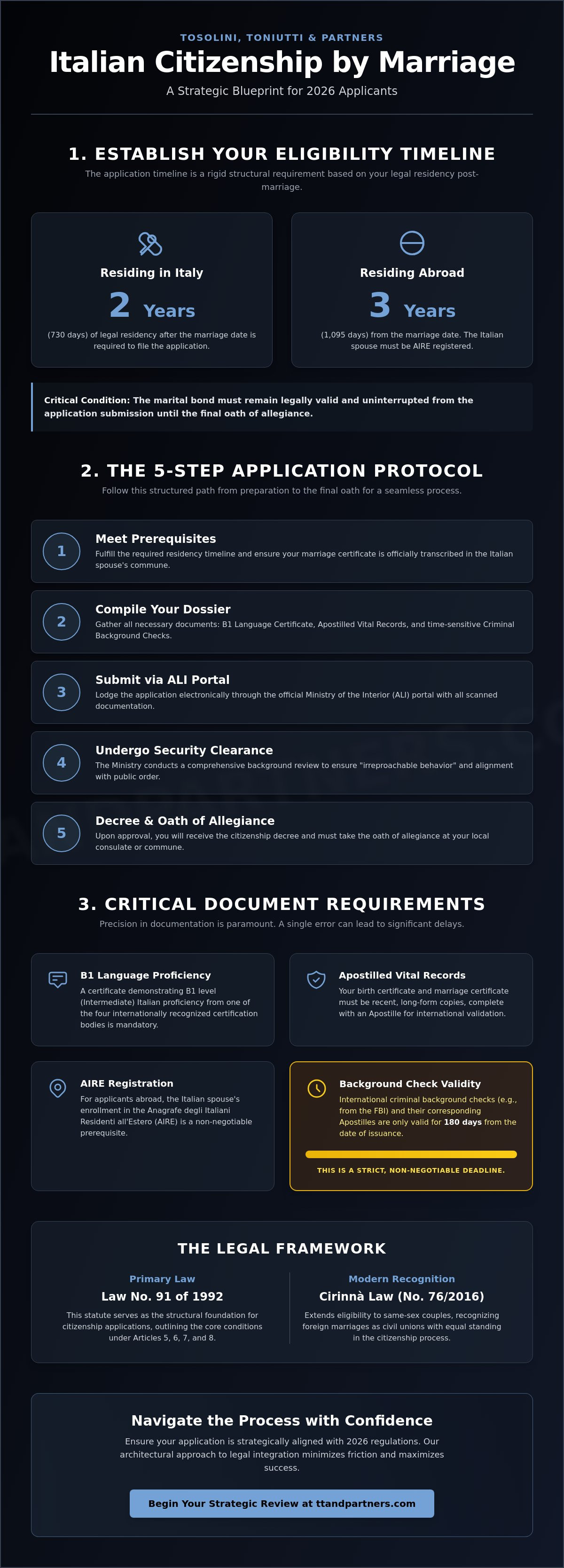
Law No. 91 of 1992 serves as the structural foundation for these applications. Specifically, Articles 5, 6, 7, and 8 dictate the conditions under which a spouse may request citizenship. This legal framework has evolved significantly since the 1983 reform, moving toward a more standardized, security-focused approach. For a comprehensive Italian Nationality Law Overview, one can see how these shifts reflect Italy's commitment to both European integration and domestic security. In the 2026 regulatory climate, the Ministry of the Interior places heavy emphasis on "irreproachable behavior." This isn't a vague qualifier; it involves a comprehensive background check through Interpol and national security databases to ensure the applicant's history aligns with Italian public order. Success in this process depends on the precise alignment of your personal history with these statutory requirements.
Civil Unions and Same-Sex Marriage Recognition
The 2016 Cirinnà Law (Law No. 76/2016) fundamentally reshaped the Italian legal landscape by providing a path for same-sex couples. Under current 2026 standards, same-sex marriages performed outside of Italy are transcribed into the Italian Vital Records Registry as civil unions. These unions hold equal legal standing in the Italian citizenship through marriage process. It's essential that the union is properly registered in the Italian municipality where the spouse is enrolled. Without this formal transcription, the administrative clock cannot begin. This level of precision ensures that your legal status is as durable as a well-designed structure. If you need a strategic partner to audit your specific documentation or marriage transcription status, you can reach out through our contact page to begin a dialogue regarding your long-term legal goals.
Eligibility Criteria and the Strategic Application Timeline
The timeline for your application is a rigid structural requirement rather than a flexible suggestion. If you reside within the Italian territory, the law permits you to initiate the Italian citizenship through marriage process after 730 days of legal residency post-marriage. For those residing outside the Italian borders, this period extends to 1,095 days from the date of the ceremony. It's crucial to understand that the marital bond must remain intact and legally valid from the moment of submission until the final oath of allegiance. Any legal separation or divorce during this window effectively collapses the administrative structure of your request.
Residency Requirements and AIRE Registration
For applicants living abroad, the Italian spouse's registration in the Anagrafe degli Italiani Residenti all'Estero (AIRE) is the non-negotiable cornerstone of the file. According to the Italian Consulate General requirements, your marriage certificate must be transcribed in the Italian commune of the spouse's registration before you can proceed. Moving between Italy and the United States while the application is pending can complicate the jurisdictional review. You'll need to update your residency records immediately to ensure the file transfers correctly between the Consulate and the local Prefecture. Consider this checklist for verifying your foundation:
Verification of the "Atto di Matrimonio" in the Italian civil registry.
Consistency between AIRE records and current physical address.
Alignment of names across all international identity documents.
The Role of Children in Expediting the Process
The Italian legal system prioritizes family cohesion by offering a 50% reduction in the waiting period for couples with children. This applies to both biological and legally adopted children who are under 18 at the time of application. This reduction reflects a pro-family legal architecture that accelerates the integration of the non-Italian spouse into the national fabric. You'll need to provide birth certificates or adoption decrees, translated and apostilled, to trigger this expedited timeline. If you're unsure how your family structure impacts your specific filing date, you can consult with our strategic thinkers to map out your path. This precision ensures your application remains on the fastest possible track toward approval.
Navigating the B1 Language Proficiency Requirement
The 2018 Salvini Decree introduced a structural shift in the Italian citizenship through marriage process by establishing a mandatory linguistic threshold. Since December 4, 2018, every applicant must prove a B1 level of proficiency on the Common European Framework of Reference for Languages (CEFR). This isn't a mere formality; it's a legal pillar intended to ensure social integration within the Italian fabric. The B1 certification must be issued by an institution approved by the Italian Ministry of Education or Ministry of Foreign Affairs. Specifically, four bodies are recognized under the CLIQ (Certificazione Lingua Italiana di Qualità) framework:
CILS (Università per Stranieri di Siena)
CELI (Università per Stranieri di Perugia)
PLIDA (Società Dante Alighieri)
Roma Tre (Università degli Studi Roma Tre)
Certain profiles are exempt from this testing requirement. If you hold an Italian educational qualification from a state-recognized school or a specific long-term EU residency permit, you may bypass the exam. However, most cross-border applicants will need to upload their digital certificates to the official ALI application portal during the submission phase. This step is critical; without the scan of the original certificate, the portal will reject the entire dossier, causing significant delays in your timeline.
Choosing the Right Certification Body
For US-based applicants, CILS and CELI are the most accessible options due to their wide network of testing centers in major metropolitan areas. CILS offers a specific "B1 Cittadinanza" exam. This version is more streamlined than the standard B1 academic test; it focuses on essential communication but carries a significant caveat: if you fail one section, you must retake the entire exam. In contrast, standard exams like PLIDA often allow for partial retakes within a specific timeframe. Most exams are held on fixed dates, typically in June and December, though some major cities offer sessions in March or October. Selecting the right body depends on your local testing center's availability and your comfort with the specific test structure.
Strategic Preparation and Validity
Developing B1 fluency typically requires a 6-12 month preparation window for beginners. This linguistic foundation is as vital as the legal one. Unlike some language certifications used for employment, these certificates don't expire when used for citizenship purposes. This requirement distinguishes the marriage path from other routes like Italian citizenship through descent, where language tests are not currently mandated. Starting your language journey early prevents the linguistic requirement from becoming a bottleneck in your overall timeline. A well-prepared applicant treats language acquisition like a structural blueprint; once the foundation is set, the rest of the project can rise with confidence.
The Step-by-Step Application Protocol via the ALI Portal
Transitioning from eligibility to execution requires a shift from strategic planning to technical precision. The Italian citizenship through marriage process culminates in a digital submission that acts as the final blueprint for your legal integration. This protocol isn't merely a collection of papers; it's a sequence of verified data points that must align perfectly with Italian administrative standards. Any structural weakness in your documentation can lead to a collapse of the entire application.
The sequence follows five critical phases:
Document Procurement: Gather birth and marriage certificates, ensuring each carries an Apostille from the issuing Secretary of State.
Criminal Background Checks: Secure both FBI and State-level reports for every jurisdiction where you've resided since age 14.
Linguistic Verification: Finalize your B1 certificate, as detailed in the previous section.
Digital Submission: Upload all components to the Ministry of the Interior's ALI portal.
Financial Settlement: Pay the €250 government fee via the integrated PagoPA system.
Document Procurement and the Apostille Process
In the international legal context, an Apostille is the only mechanism that grants a US document legal weight in Italy. You must respect the strict 180-day validity window for criminal background checks. If your FBI report is 181 days old at the time of submission, the portal will trigger an immediate rejection. Accuracy in translation is equally vital. You must use translators recognized by the Italian consulate or have the translations legalized in an Italian court. This ensures the linguistic architecture of your file is sound and durable.
Managing the Digital ALI Portal
The ALI portal is the primary interface for the Italian citizenship through marriage process. Technical errors often arise from file size limits; each PDF must be optimized for clarity while remaining under the portal's specific megabyte threshold. Once submitted, your file moves through four distinct phases: ricezione (receipt), istruttoria (processing), parere (opinion), and finally, decreto (decree). If you receive a pre-avviso di rigetto, don't panic. This is a formal notice of intent to deny, usually due to a missing document or an expired check. You have a 10-day window to respond with the corrected information.
Precision at this stage prevents years of bureaucratic delay. If you're ready to ensure your documentation meets these exacting standards, contact our legal strategists to review your file before submission.
Finalization: The Security Clearance, Decree, and Oath
Once your digital dossier passes the initial administrative audit on the ALI portal, the Italian citizenship through marriage process enters a phase of rigorous state scrutiny. This isn't a passive waiting period but a multi-layered security clearance conducted by the Italian Ministry of the Interior in coordination with Interpol and national law enforcement agencies. This structural inspection verifies that your personal history aligns with the public order and national security interests of the Republic. In the 2026 regulatory environment, these checks are more integrated than ever, utilizing cross-border digital databases to ensure the integrity of every new citizen's background.
Upon the successful completion of these clearances, the Ministry issues the 'Decreto di Cittadinanza'. If you reside abroad, this decree is traditionally signed by the President of the Republic; for those residing within Italy, the Prefect of the local province holds this authority. This document is the formal recognition of your new legal status. It signifies that the Italian state has accepted your integration into the national fabric, moving your application from a pending file to a finalized legal reality.
The Oath of Allegiance Ceremony
The issuance of the decree triggers a critical 6-month deadline. You must take the Oath of Allegiance within 180 days of being notified that your decree is ready. Missing this window effectively nullifies the entire Italian citizenship through marriage process, requiring a complete restart of the administrative journey. The ceremony takes place at the Italian Consulate with jurisdiction over your residence or at the local Town Hall (Comune) if you live in Italy. You'll swear loyalty to the Italian Republic and observe the Constitution. Immediately following the oath, you'll update your status in the AIRE registry and can then apply for your Italian passport, granting you full mobility within the European Union.
Broader Implications for Cross-Border Strategy
Acquiring Italian citizenship is often a cornerstone of a much larger international legal framework. For investors and entrepreneurs, this status can significantly simplify the requirements for E-2 visas or other treaty-based residency programs. Furthermore, dual nationality provides a more robust shield in matters of international litigation and property rights, as you'll navigate these issues as a citizen of the European Union rather than a foreign national. This integration ensures that your assets and legal standing are protected by a dual-layered jurisdictional approach. For complex cases involving multi-jurisdictional assets or unique family histories, you should contact our cross-border legal team to ensure your transition is as seamless as a perfectly executed architectural plan.
Securing Your Legacy within the Italian Fabric
Mastering the Italian citizenship through marriage process is an exercise in meticulous planning and legal foresight. From the B1 linguistic mandate established in December 2018 to the strict 180-day validity window for FBI background checks, every detail serves as a structural component of your final application. You've navigated the complexities of the ALI portal and understood the strategic importance of AIRE registration for those residing abroad. Our firm brings decades of experience with the Ministry of Interior to your dossier, providing specialized expertise in US-Italy cross-border law and bespoke document procurement. We ensure that your translations and apostilles meet the highest standards of architectural precision, leaving no room for bureaucratic friction or administrative delays. If you're ready to move beyond the blueprint and finalize your submission with absolute confidence, schedule a strategic consultation for your Italian citizenship application today. Your path to a European passport is a visionary journey toward a more expansive and secure future for your family.
Frequently Asked Questions
How long does the Italian citizenship through marriage process take in 2026?
The processing window generally spans 24 to 36 months following the formal acceptance of your dossier on the ALI portal. This timeframe is governed by Decree Law No. 130 of 2020, which standardized the evaluation period for marital naturalization. While some consulates may process files more efficiently, you should plan for a multi-year administrative journey to ensure your legal transition is handled with the necessary precision.
Can I apply for Italian citizenship if I don't speak Italian?
You cannot successfully apply without demonstrating intermediate Italian proficiency. Since the implementation of the 2018 Salvini Decree, a B1 level certification is a non-negotiable statutory requirement for all spouses. This linguistic foundation ensures you can integrate into the Italian social fabric; it must be verified by a certificate from an approved body like CILS or CELI before your submission is considered valid.
Do I need to live in Italy to get citizenship through marriage?
Residing in Italy isn't a prerequisite for obtaining citizenship through your spouse. The law provides a clear path for those living abroad, provided the Italian spouse is correctly registered in the AIRE system. The primary difference lies in the eligibility timeline; those living outside Italy must wait 3 years post-marriage to apply, whereas residents within the Italian borders can initiate the process after only 2 years.
What happens if we get divorced while the citizenship application is pending?
Legal dissolution of the marriage effectively collapses the application at any point before the final oath of allegiance. The marital bond must remain structurally intact and legally valid throughout the entire processing window. If a divorce, legal separation, or the death of the Italian spouse occurs before you swear loyalty to the Republic, the Ministry of the Interior will terminate the file without further review.
Is there a difference between citizenship for a husband vs. a wife?
Current regulations for the Italian citizenship through marriage process are entirely gender-neutral. While historical laws prior to the 1983 reform treated men and women differently, modern statutes apply identical requirements to all spouses. Every applicant, regardless of gender, must meet the same residency, linguistic, and security standards to integrate into the Italian national community under the current legal framework.
What are the costs involved in applying for Italian citizenship by marriage?
The standard administrative fee required by the Italian government is €250, payable at the time of your digital submission. Beyond this fixed state fee, you'll need to budget for the procurement of vital records, state-level and FBI background checks, and the necessary apostilles. Professional translation services and the cost of the B1 language exam also represent essential investments in the structural integrity of your application.
Can my children get Italian citizenship if I apply through marriage?
Minor children who are under age 18 and residing with you at the time you take the oath of allegiance will automatically acquire citizenship. This automatic integration reflects the pro-family architecture of Italian law, ensuring that the household's legal status remains unified. You'll need to provide birth certificates or adoption decrees during the initial filing to document these family ties and trigger the 50% reduction in the eligibility timeline.
Do I have to renounce my US citizenship to become Italian?
You aren't required to renounce your United States citizenship when you become an Italian national. Dual nationality is fully recognized by both the Italian Republic and the United States, allowing you to maintain your original identity while gaining the rights of a European citizen. This dual status provides a robust legal framework for global mobility and cross-border asset management without requiring you to sever ties with your home country.


Comments