

Italian Elective Residency Visa Requirements: The Complete 2026 Strategic Guide

Having substantial capital in the bank won't secure your relocation to Italy if a single euro stems from active professional work. Understanding the Italian elective residency visa requirements requires recognizing that consular authorities look far beyond top-line wealth; they demand pure, self-sustaining passive continuity and permanent domestic roots. You're likely already experiencing the friction of deciphering unwritten income thresholds, conflicting guidance on residential lease obligations, and rigid healthcare stipulations before departure.
That ambiguity often transforms what should be an inspiring life transition into an exercise in administrative anxiety. This strategic guide ensures you master every legal, financial, and procedural requirement for securing an Italian Elective Residency Visa in 2026. Ahead, we break down verifiable passive revenue streams, clarify long-term accommodation standards, and deliver the clear framework needed to compile an airtight dossier that satisfies strict consular discretion.
Table of Contents
Understanding the Italian Elective Residency Visa: Purpose and Core Thresholds
Qualifying Financial Requirements: Passive Income Verification Standards for 2026
Accommodation and Comprehensive Healthcare Requirements for Italian Residency
The Consular Application Process: Document Compilation and Filing Protocols
Post-Arrival Compliance: Securing the Permesso di Soggiorno and Ongoing Status
Understanding the Italian Elective Residency Visa: Purpose and Core Thresholds
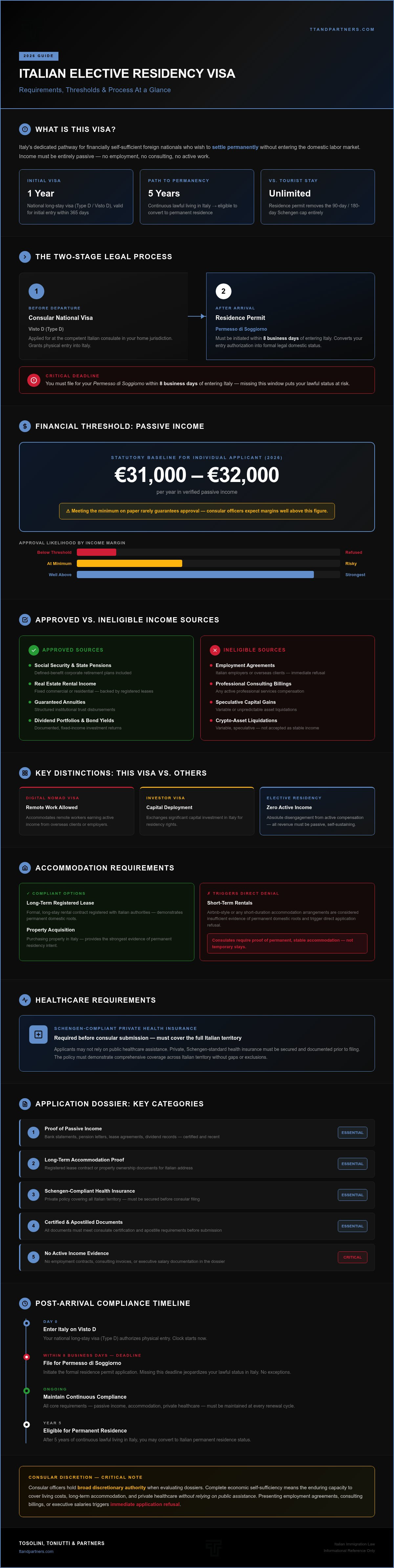
The elective residency route serves as Italy's dedicated pathway for foreign nationals who possess substantial economic self-sufficiency and wish to settle permanently in the country without entering the domestic labor market. Distinct from typical visitor permissions, this framework grants an initial one-year national long-stay visa that can be converted into Italian permanent residence after five years of continuous living. Meeting the Italian elective residency visa requirements demands recognizing that Italian immigration law treats this category not as an open remote-work channel, but as an exclusive status for individuals whose financial stability is entirely disconnected from ongoing labor.
Applicants frequently confuse this long-standing mechanism with other residency routes. While digital nomad visas accommodate remote workers and investor pathways exchange capital deployment for residency rights, elective residence mandates absolute disengagement from active compensation. Neither Italian entities nor overseas clients may employ you under this status.
The Legal Intent: Living in Italy Without Accessing Local Labor
Statutory immigration provisions structure this visa to attract private capital while strictly safeguarding domestic employment. Consulates define complete economic self-sufficiency as the enduring capacity to cover living costs, long-term accommodation, and private healthcare without relying on public assistance. Consequently, presenting ongoing employment agreements, professional consulting billings, or executive salaries triggers an immediate application refusal. The legal mechanism requires that all incoming revenue remains completely passive, originating from capital preservation assets such as pensions, annuities, real estate leases, or established investment dividends.
National Visa Versus Permesso di Soggiorno: The Two-Stage Structure
Securing legal status in Italy involves a precise two-stage administrative transition. Consulates abroad issue a Type D entry authorization, which permits entry under the broader Visa Policy of Italy governing sovereign border access. This document does not grant ongoing residency by itself. To establish lawful residence, you must complete the required post-arrival procedural sequence:
Phase 1: Consular National Visa (Visto D): Secured through the competent Italian consulate in your jurisdiction before departure; valid for initial physical entry within 365 days.
Phase 2: Formal Residence Permit (Permesso di Soggiorno): Initiated within eight business days of entering the country, transforming your consular entry authorization into formal legal domestic status.
Unlike standard short-stay Schengen tourist limits that cap access at 90 days within any 180-day window, a validated residence permit confers full long-stay rights. Retaining this status allows you to reside across the Italian territory indefinitely, provided you maintain ongoing compliance with all core Italian elective residency visa requirements at every renewal cycle.
Qualifying Financial Requirements: Passive Income Verification Standards for 2026
Statutory Italian immigration regulations establish a baseline passive income threshold of approximately €31,000 to €32,000 per year for an individual applicant. Meeting this baseline on paper rarely guarantees an approval. In practice, consular officers hold broad discretionary authority to assess whether an applicant's wealth provides absolute economic continuity. Because officials evaluate whether your revenue will comfortably absorb inflation and regional cost-of-living fluctuations, satisfying the Italian elective residency visa requirements generally necessitates presenting financial margins well above the legal minimum.
Approved Passive Income Streams Versus Ineligible Financial Resources
Consular scrutiny focuses entirely on the origins and reliability of your incoming funds. Eligible passive income sources include:
Social Security, state pensions, and defined-benefit corporate retirement plans
Fixed commercial or residential real estate rental income backed by registered leases
Guaranteed annuities and structured institutional trust disbursements
Documented dividend portfolios and fixed-income bond yields
Conversely, speculative capital gains, variable crypto-asset liquidations, and active distributions from closely held businesses face swift rejection. Any income tethered to your ongoing labor, such as remote digital employment or recurring advisory retainers, disqualifies the dossier.
Consular Discretion and the Burden of Evidentiary Continuity
A frequent misstep involves presenting substantial cash savings in standard bank accounts. Consular reviewers do not accept static liquidity as a substitute for recurring, autonomous cash flow; an account balance can be exhausted, whereas passive streams endure. As demonstrated in evidentiary standards maintained by the Italian Consulate in New York, applicants must prove continuity through multiple years of filed tax returns, verified banking deposits, and official brokerage summaries. Structuring these exhibits to eliminate ambiguity often benefits from cross-border legal guidance before official submission.
Financial Calculations for Spouses and Dependent Household Members
Adding family members increases statutory financial obligations proportionally. Sponsoring a legal spouse elevates the required passive baseline to approximately €38,000 to €40,000 annually. For each dependent child included in the dossier, authorities expect an additional 5% to 20% increase, which translates to roughly €6,200 in verified recurring income per dependent. Joint assets must be titled clearly, ensuring that document packets confirm unencumbered, permanent access to household funds without relying on Italian public infrastructure.
Accommodation and Comprehensive Healthcare Requirements for Italian Residency
Securing elective residency requires establishing deep physical roots before your consular interview. Italian authorities demand concrete proof that you won't burden municipal housing or emergency public facilities upon arrival. Meeting these Italian elective residency visa requirements hinges on executing two binding pre-departure commitments: securing verifiable long-term accommodation and purchasing compliant medical protection.
Documenting Permanent Lodging: Purchase Contracts and Registered Leases
Consular officers expect indisputable evidence of a genuine domestic home. You satisfy this requirement by presenting an executed purchase deed confirming property ownership, or a binding residential lease contracted for a minimum duration of 12 months. Temporary holiday rentals, guesthouses, and Airbnb bookings trigger immediate application refusal because they fail to prove permanent residential intent.
Crucially, every residential lease must be officially registered with the Italian Revenue Agency. Consulates verify this tax registration receipt to confirm the agreement is legally enforceable under Italian property law. Because securing lodging requires financial outlays before obtaining your visa, coordinating property contracts with bi-jurisdictional counsel helps structure protective clauses. Aligning immigration planning directly with legal assistance during your real estate closing minimizes financial risk if consular processing times shift.
International Health Insurance Coverage and National Health System Access
Healthcare self-sufficiency forms the second structural pillar of your domestic file. Consulates mandate private international health insurance providing comprehensive medical coverage across Italy and the entire Schengen area. The policy must satisfy explicit criteria:
A guaranteed minimum medical coverage limit of €30,000
Unrestricted coverage for inpatient hospitalization and emergency room procedures
Full coverage for emergency medical evacuation and medical repatriation
A zero-deductible policy structure for the initial 12-month duration, as preferred by most consular desks
Your international private policy serves as the required coverage baseline during your initial year in Italy. After you complete your arrival protocols and register as a domestic resident with your local municipality, statutory immigration frameworks permit voluntary enrollment into the Italian national health service through an annual contribution fee. Until that municipal registration concludes, your private international policy remains the definitive shield proving you satisfy ongoing Italian elective residency visa requirements.
The Consular Application Process: Document Compilation and Filing Protocols
Filing your application demands rigorous procedural discipline long before you present yourself to an Italian consular officer. Every diplomatic mission enforces strict jurisdiction over specific territories, meaning you must apply solely at the consulate governing your permanent legal residence. Proving that domicile requires authoritative documentation, such as a state driver's license, voter registration card, or utility invoices. Navigating the Italian elective residency visa requirements means your application folder must stand up to rigorous administrative scrutiny without relying on supplemental explanations during the interview.
Jurisdictional Filing Rules and Assembling the Formal Dossier
Dossier compilation requires coordinating certified documents across multiple civil registries. Every non-Italian record submitted to the consulate must follow an exact legalization protocol:
Certified vital records (marriage certificates, birth certificates) issued within designated recency windows
Federal criminal background checks accompanied by official verification seals
Hague Apostilles affixed to every foundational civil and legal document
Certified, complete translations into the Italian language performed by recognized legal translators
Omitting an apostille or submitting an informal translation results in immediate administrative rejection. Consular staff will not hold an incomplete file open while you gather missing stamps.
Drafting the Motivational Statement and Attending the Interview
Your motivational cover letter operates as the strategic centerpiece of your application. This statement shouldn't simply express an admiration for Italian culture; it must articulate an unshakeable narrative of passive financial independence. Clearly outline your prospective lifestyle, your ties to the selected municipality, and confirm your absolute renunciation of any active employment, consulting, or remote work activities while resident in Italy.
During the in-person interview, consular officials will test your financial claims and housing commitments. Any suggestion that you intend to manage a remote enterprise, freelance for overseas clients, or monetize your stay triggers a visa denial. You must also settle the consular application fee of €116 per applicant during this appointment. Consular processing times generally take up to 90 days. If your circumstances involve complex international assets or cross-border filings, you can contact our legal team to review your portfolio and help mitigate consular discretion risks before your formal submission.
Post-Arrival Compliance: Securing the Permesso di Soggiorno and Ongoing Status
Touching down in Italy marks the beginning of an operational phase rather than the end of your administrative journey. The consular visa foil in your passport simply authorizes entry; acquiring true legal residency depends entirely on completing subsequent domestic filings. Maintaining compliance with Italian elective residency visa requirements means shifting your focus immediately from consular review to local immigration authorities and municipal registries.
The Eight-Day Mandate: Postal Filing and Immigration Police Appointments
Italian statutory provisions require submitting your application for a formal residence permit within eight working days of arrival. You initiate this by filing the standardized application packet, known as the yellow-stripe postal kit, at an authorized post office branch. Total state filing costs range between €76 and €176, which includes a €16 revenue stamp, postal processing fees, and mandatory government permit contributions.
Upon submission, the postal clerk provides a registered receipt printed with security tracking codes. Keep this receipt alongside your passport at all times; it legally certifies your lawful presence while you await your appointment at the provincial police headquarters. During that formal appearance, immigration officers record your biometric fingerprints and cross-examine the original physical documentation that formed your application.
Municipal Residency Registration and Physical Presence Rules
Once police authorities grant your physical residence permit card, you must register your domicile at the municipal town hall registry. This municipal declaration confirms your status as a registered resident, unlocking vital domestic services and establishing a timeline toward permanent settlement. Foreign nationals can apply for permanent residency after five continuous years of lawful status, establishing eligibility for Italian citizenship after ten years.
Preserving this pathway requires consistent physical presence. Remaining outside Italy for continuous periods exceeding six consecutive months puts your annual permit renewal at risk. Because spending more than 183 days per calendar year in the country establishes domestic tax residency, you should coordinate financial planning early to leverage preferential frameworks, including elective flat-tax regimes for qualifying retirees.
Strategic Cross-Border Legal Guidance for Italian Relocation
Harmonizing real estate transactions, local municipal filings, and immigration deadlines demands synchronized execution. Inconsistencies between your property lease dates, municipal registrations, and permit renewal filings can undermine an otherwise spotless immigration record. Working alongside a bi-jurisdictional Italian immigration lawyer ensures your domestic documentation aligns with consular precedents, mitigating discretion risks throughout your transition.
Securing Your Italian Future with Strategic Precision
Navigating the Italian elective residency visa requirements successfully boils down to strategic preparation rather than guesswork. It isn't just about meeting statutory minimums on paper; it's about establishing verifiable passive continuity, securing registered long-term lodging, and executing post-arrival filings without administrative delay. When you eliminate evidentiary vulnerabilities early, consular scrutiny transforms from an intimidating barrier into a predictable, manageable legal process.
Our bi-jurisdictional practice bridges US and Italian legal frameworks to help you overcome consular discretionary hurdles before they compromise your plans. We deliver integrated legal support spanning document compilation, real estate closing, and ongoing residence permit compliance. You don't have to navigate foreign administrative complexities alone. Schedule a consultation with our Italian immigration team to build an airtight dossier, protect your investments, and embark on your Italian transition with absolute confidence.
Frequently Asked Questions
Can I work remotely for a US employer while living on an Italian Elective Residency Visa?
No, you cannot perform any remote work for a US employer under this category. Italian law strictly forbids all active labor, regardless of whether the employer or client base is situated abroad. If you intend to work remotely, you must examine alternative paths, such as the digital nomad visa category. Any indication of ongoing professional activity violates core Italian elective residency visa requirements and results in immediate application refusal.
What is the minimum passive income requirement for the Italian Elective Residency Visa in 2026?
The statutory baseline passive income requirement is approximately €31,000 to €32,000 per year for an individual applicant. However, Italian consulates exercise broad administrative discretion and frequently look for substantial margins above this baseline to confirm financial safety. Sponsoring a spouse increases the annual benchmark to approximately €38,000 to €40,000, while each dependent child requires an additional continuous financial cushion of 5% to 20%.
Can I use investment portfolios and capital gains to satisfy the income requirement?
Yes, investment portfolios can satisfy the criteria, but consular officers draw a strict distinction between recurring yields and capital gains. Predictable dividend distributions and fixed bond interest qualify as acceptable passive revenue. In contrast, speculative capital gains or irregular withdrawals from liquid assets fail the test. Consulates require proven recurring continuity, verified through multi-year tax filings, brokerage records, and institutional statements demonstrating uninterrupted income generation.
Do I have to buy property in Italy before applying for the Elective Residency Visa?
No, purchasing real estate isn't mandatory, though property ownership does provide convincing evidence of permanence. You can satisfy the housing condition by executing a registered residential lease agreement for a minimum term of 12 months. Short-term vacation rentals, hotels, or month-to-month leases are completely prohibited. Whatever property you secure, the contract must be formally registered with the Italian Revenue Agency prior to your consular interview.
What happens within the first 8 days of arriving in Italy on this visa?
You must submit your formal application for a residence permit within eight working days of arrival. This procedure requires filing the designated application packet at an authorized post office branch and paying administrative fees between €76 and €176. The post office issues an official registered receipt that certifies your lawful domestic status while you await your biometric appointment and document audit with local immigration police.
Can my spouse and dependent children be included on the same elective residency application?
Yes, spouses and dependent minor children can relocate with you, but each person requires separate consular vetting. Every family member must submit an individual application dossier accompanied by apostilled civil certificates, international health coverage, and proof of adequate accommodation. Crucially, your passive income must expand to meet the higher household financial criteria established for every dependent relative joining your relocation.
Are Italian Elective Residency Visa holders required to pay taxes in Italy?
Yes, spending more than 183 days in Italy during any 12-month period establishes formal tax residency, making your worldwide income subject to Italian taxation. Italy taxes international pensions, foreign rental receipts, and global investment returns. You can, however, explore statutory incentive programs, such as the preferential 7% flat-tax regime available to qualifying retirees who establish legal residency in designated southern municipalities.
Does the Elective Residency Visa lead to permanent residence and Italian citizenship?
Yes, this long-stay visa initiates a direct statutory path toward settlement and citizenship. Maintaining continuous lawful status and renewing your residence permit enables you to apply for permanent residency after five uninterrupted years. After completing ten full years of registered legal residence in the country, you can formally apply for Italian citizenship, provided you have satisfied all ongoing tax, presence, and Italian elective residency visa requirements.


Comments