

Italian Immigration Attorney New York: Strategic US-Italy Cross-Border Counsel 2026
- Gianni Mendes Toniutti, Esq.

- May 11
- 12 min read
The most enduring cross-border transitions are not built on paperwork, but on the architectural integrity of a unified legal strategy. Many entrepreneurs moving between Italy and the United States find that fragmented advice from separate firms creates structural vulnerabilities, often leading to a costly Request for Evidence or complications with international property holdings. Securing a specialized Italian immigration attorney from a firm like Tosolini, Toniutti & Partners is essential to ensure that your U.S. visa status, Italian citizenship claims, and corporate governance function as a single, harmonious system. It's about moving beyond simple filing and toward a master-planned approach to international mobility.
You likely recognize that navigating the 2026 $250 Visa Integrity Fee and the $315 E-2 treaty fee requires precise timing and expert execution. This guide promises to show you how to master these complexities by integrating immigration law with sophisticated corporate and property counsel. We'll preview the strategic requirements for O-1 and E-2 visa approvals, the impact of the 2025 Italian citizenship law changes, and the steps to successful LLC formation to ensure your global interests remain protected and functional.
REQUIREMENTS:
Key Takeaways
Learn how a strategic Italian immigration attorney New York bridges the structural gap between Italian civil law and U.S. common law for a unified relocation strategy.
Identify the specific 2026 criteria for E-1 and E-2 treaty visas to ensure your investment or trade volume meets the necessary thresholds for approval.
Discover why aligning LLC incorporation with strategic real estate acquisitions serves as the essential foundation for both U.S. visa petitions and asset security.
Explore the legal pathways for reclaiming Italian citizenship through descent, including specialized strategies for maternal line and 1948 cases.
Understand how an architectural approach to legal counsel proactively identifies risks to prevent costly Requests for Evidence and investment delays.
Table of Contents
Navigating the US-Italy Legal Gap: The Role of a Strategic Italian Immigration Attorney New York
Building a bridge between two distinct legal philosophies requires more than just administrative filing. It demands an architectural understanding of how Italian civil law interacts with the American common law tradition. An Italian immigration attorney New York serves as the master planner for this transition. While the history of Italian immigration to the US was often defined by mass movement, the modern era is defined by strategic precision. Treaty-based options like E-1 and E-2 visas aren't merely forms; they're reflections of a bilateral economic relationship that requires a dual-nation perspective to execute successfully. We don't just process applications. We design the legal framework that supports your professional and personal life across borders.
The Interplay Between US Visas and Italian Residency
U.S. business investments don't exist in a vacuum. They echo back to Italy. When an entrepreneur secures an E-2 visa, the capital flow and physical presence can trigger complex Italian tax residency rules. Similarly, securing a Permesso di Soggiorno for a non-EU spouse requires a firm that understands the documentation standards of both the Questura and the U.S. Department of State. We operate on a partnership model where legal counsel isn't a one-time transaction but a continuous dialogue. This ensures that your American business structure and your Italian residency status remain in a state of functional harmony, preventing the fragmented advice that often leads to investment loss.
A National Strategy for International Clients
Although our practice is centered in a New York legal hub, immigration law is inherently federal. This allows us to represent clients across all fifty states with the same level of architectural precision. We draft petitions that anticipate the scrutiny of USCIS officers, treating every document as a load-bearing element of your future. Whether you're navigating the 2026 increase in treaty investor fees to $315 or managing the new $250 Visa Integrity Fee, our national reach ensures consistent quality. In 2026, the strategic advantage of US-Italy legal fluency lies in the ability to synchronize corporate formation with immigration eligibility before the first dollar is even invested.
Treaty-Based Visa Strategies: E-1, E-2, and O-1 for Italian Nationals
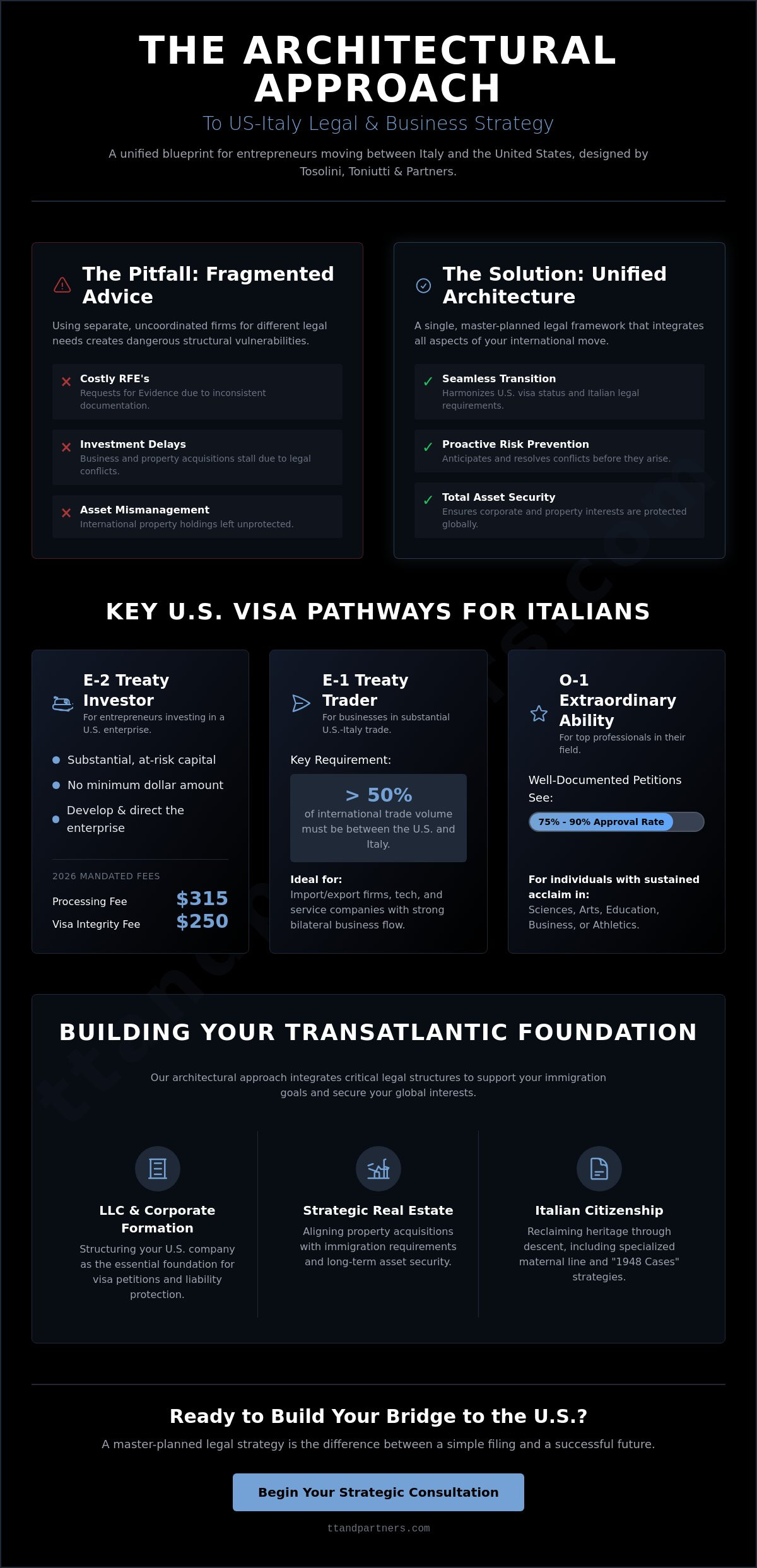
The legal framework governing US-Italy relations offers unique pathways for professionals and investors that aren't available to many other nations. These treaty-based options facilitate economic flow, but they require a high degree of technical mastery to execute. An Italian immigration attorney New York can help you determine whether your business model aligns better with the E-1 Treaty Trader visa or the E-2 Treaty Investor category. For those involved in significant import-export activities, the E-1 requires that at least 50% of the company's international trade volume occurs between the United States and Italy. This isn't just a numerical threshold; it's a structural requirement that must be documented with precision.
E-2 Visa: The Strategic Framework for Italian Investors
Italian entrepreneurs often favor the E-2 Treaty Investor visa because it doesn't mandate a specific minimum dollar amount. Instead, the law requires a substantial investment. This investment must be at-risk, meaning the capital is committed to the business and subject to partial or total loss if the venture fails. As of May 30, 2026, the processing fee for this visa is $315, in addition to the mandatory $250 Visa Integrity Fee. Understanding how to present these funds is critical for a successful petition. You can explore our E-2 Visa Guide 2026 to see how we structure these investments for maximum approval probability.
O-1 Visas and Extraordinary Ability in 2026
For those who possess extraordinary ability in science, business, or the arts, the O-1 visa provides a powerful alternative to the H-1B lottery. With well-documented petitions seeing approval rates between 75% and 90%, it's a highly reliable path for Italian innovators. Securing counsel from an Italian immigration attorney New York is particularly beneficial when comparing agent-based vs. employer-based sponsorship, as each offers different levels of flexibility for your career trajectory. If speed is essential, the $2,965 premium processing fee guarantees a USCIS response within 15 business days. Our O-1 Visa for Entrepreneurs guide details the specific benchmarks required for 2026.
While these visas are non-immigrant in nature, they often serve as the foundation for a permanent residency or Green Card strategy. Some clients also find that securing Italian citizenship by descent (jure sanguinis) provides an even more robust platform for their global lifestyle. If you're ready to design your cross-border future, we invite you to reach out to our partners for a strategic consultation.
The Intersection of Immigration, Corporate Law, and Real Estate
A successful relocation isn't just about the visa; it's about the legal structure that houses your professional ambition. Think of the visa as the occupancy permit and the corporate entity as the foundation. An Italian immigration attorney New York understands that without a robust LLC incorporation, your immigration strategy lacks a stable base. We view these legal disciplines as interconnected layers of a single project. This holistic approach ensures that your business governance doesn't just meet administrative requirements but actively strengthens your case for residency by demonstrating a permanent commitment to the market.
LLC Incorporation as a Strategic Asset
Choosing the correct U.S. jurisdiction is a decision that defines your legal context for years. Whether you select the privacy-focused laws of Delaware or the commercial density of New York, the jurisdiction must align with your long-term visa goals. Governance isn't a static formality. You must maintain specific operational standards to remain compliant with treaty investor regulations and avoid structural vulnerabilities. Our LLC Incorporation Guide details how to design an entity that serves both your commercial interests and your immigration petition with mathematical precision.
Real Estate Closings and Residency Intent
Acquiring property is often the most tangible way to prove a substantial investment for an E-2 visa. It demonstrates a commitment to the American landscape that goes far beyond a simple balance sheet. Real estate holdings provide a physical anchor, yet they also introduce cross-border complexities. Italian nationals selling U.S. property must navigate FIRPTA withholding rules, which can lock up 15% of the gross sales price if not managed with foresight. The synergy between property investment and E-2 visa viability lies in the ability to show that your capital is fully committed and operational within the U.S. economy. We handle real estate closings with the same architectural precision we apply to immigration law, ensuring title transfers are seamless across international borders.
Disputes are an inevitable part of the international business landscape. When conflicts arise, having cross-border litigation support is vital to protect your assets. You need a team that understands how a legal battle in one country might impact your standing or visa status in another. A strategic Italian immigration attorney New York anticipates these friction points, building safeguards into your initial corporate structure. This proactive mindset protects your investment from the risks of fragmented counsel and ensures that your vision for a life in the United States remains structurally sound and resilient against unforeseen challenges.
Reclaiming Heritage: Italian Citizenship and Dual Residency
Restoring a connection to your Italian roots is a process that requires the same structural integrity as a major architectural renovation. For many, the path to an Italian passport is paved through Jure Sanguinis, or citizenship by descent. However, recent regulatory shifts have tightened these requirements significantly. As of May 2025, new legislation restricts citizenship by descent to those who can prove a direct line from a parent or grandparent who was an Italian citizen at birth and didn't take on dual nationality. An Italian immigration attorney New York provides the necessary oversight to verify these narrower eligibility criteria before you commit to the lengthy documentation process.
Jure Sanguinis: The Documentation Architecture
The success of a citizenship claim rests on the precision of your historical records. Discrepancies in names, dates, or places between Italian birth certificates and U.S. naturalization records can stall an application for years. We approach these inconsistencies by seeking declaratory judgments or administrative corrections to ensure every document fits perfectly into the legal narrative. Beyond the emotional value, an Italian passport offers functional benefits, including unrestricted business mobility across the European Union. For those who lost their citizenship before the 1992 law, a special provision active from July 1, 2025, to December 31, 2027, allows for reacquisition without the usual residency requirements.
The 1948 Case: Challenging Historical Gender Discrimination
When the line of descent passes through a female ancestor whose child was born before January 1, 1948, the path to citizenship moves from the consulate to the Italian courts. These cases challenge historical gender discrimination that prevented women from passing citizenship to their children. Unlike standard administrative filings, these require specialized litigation in Italy to overturn the discriminatory application of old laws. This is a complex legal maneuver that demands a firm capable of handling International Litigation 2026 standards. We represent clients in these judicial proceedings to ensure their maternal heritage is legally recognized.
Retaining your Italian dual nationality while naturalizing as a U.S. citizen is a cornerstone of modern global citizenship. It allows you to maintain property, vote, and reside in both nations without compromise. If your family history suggests a potential claim through a maternal line or a grandparent, you should consult with an Italian immigration attorney New York to evaluate the structural viability of your case under the latest 2026 standards. We specialize in transforming fragmented family histories into a legally recognized legacy.
The TT and Partners Approach: A Visionary Legal Partnership
Legal excellence is not found in the volume of filings, but in the architectural integrity of the strategy behind them. At Tosolini, Toniutti & Partners, we approach every case with a commitment to precision, harmony, and intellectual depth. This philosophy ensures that your relocation is not a series of disconnected administrative hurdles but a unified transition. A strategic Italian immigration attorney New York acts as a lead architect, ensuring that every legal component-from visa eligibility to corporate governance-supports the weight of your international ambitions. We don't just react to the law; we build within it to create lasting results.
Fragmented advice is the primary cause of the Request for Evidence (RFE), a complication that can stall investments and disrupt lives. By adopting a multi-disciplinary approach that synchronizes immigration, corporate structure, and tax residency, we eliminate the structural gaps where RFEs typically reside. When your LLC incorporation and your E-2 investment narrative are designed in tandem, the resulting petition possesses a level of functional clarity that USCIS officers can easily validate. This proactive counsel is essential for managing the increased $315 treaty investor fees and the $250 Visa Integrity Fee mandated for 2026.
Intellectual Rigor in Cross-Border Practice
Our experience in international litigation provides a unique vantage point for drafting contracts and visa petitions. We understand how a single phrase in an operating agreement can impact your long-term residency goals or your ability to claim 1948-case citizenship. We view the international commercial landscape as an urban fabric, where every business entity and property holding must be woven together to create a sustainable professional ecosystem. Our firm’s philosophy is built on the belief that visionary legal planning is the art of anticipating future regulatory shifts while maintaining the functional precision required by current statutes.
Initiating Your US-Italy Relocation
The transition to a dual-nation lifestyle requires early-stage strategic planning to be effective in 2026. Preparing for an initial cross-border assessment involves more than gathering vital records; it requires an audit of your global assets and professional objectives. We recommend beginning this process at least six months before your intended move to account for the processing times of petition-based work visas and the complexities of Italian citizenship documentation. If you are ready to begin this dialogue, you can Contact Tosolini, Toniutti & Partners to schedule a strategic consultation. We believe in a partnership that respects the past while building a technologically advanced and environmentally conscious future for your family and your business.
Architecting Your Global Future Across Borders
A successful transition between the United States and Italy is not merely an administrative achievement; it's a deliberate act of legal engineering. We've seen how integrating corporate governance with visa strategy creates a foundation that withstands the scrutiny of federal agencies. Whether you're leveraging the 75% to 90% approval rates of the O-1 visa or reclaiming heritage through maternal citizenship lines, the integrity of your documentation remains the most critical factor. By aligning your LLC incorporation with your long-term residency intent, you transform a complex relocation into a seamless professional evolution.
Engaging a specialized Italian immigration attorney New York provides the intellectual depth necessary to navigate the 2026 regulatory landscape with confidence. Our decades of experience in US-Italy cross-border law ensure that your E-1, E-2, or O-1 treaty visa petitions are drafted with architectural precision. We invite you to Schedule a Strategic US-Italy Legal Consultation to begin designing your international legacy. Your vision for a life across two cultures deserves a legal framework that is as ambitious and enduring as the goals you've set for your family and your business.
Frequently Asked Questions
Is it more difficult for Italians to get an E-2 visa in 2026?
The eligibility criteria remain stable under the existing treaty of commerce and navigation, but the administrative landscape has become more complex. You must now account for the $250 Visa Integrity Fee and the updated $315 processing fee that took effect in May 2026. Success depends on the architectural precision of your business plan and proving that your investment is substantial and fully committed to the U.S. market.
How much does a Green Card cost when managed by an Italian immigration lawyer?
Total costs depend on your specific eligibility path, whether through investment, extraordinary ability, or family sponsorship. While an Italian immigration attorney New York provides a transparent fee structure for professional counsel, you must also budget for federal filing fees and medical examinations. Government fees are subject to adjustment, so it's essential to verify the current USCIS fee schedule at the start of your petition process.
Can I apply for Italian citizenship if my ancestor was a woman born before 1948?
Yes, you can still seek citizenship, but this requires a judicial appeal in the Italian courts instead of a standard consular application. These 1948 cases challenge historical laws that discriminated against women's ability to pass citizenship to their children. This litigation path is highly successful when handled by counsel who understands the intersection of Italian constitutional law and historical vital records.
What is the substantial trade requirement for an E-1 visa?
Substantial trade is defined by a continuous flow of international trade items between the United States and Italy. At least 50% of your company's total international trade volume must involve these two nations. There is no fixed dollar minimum, but the trade must be frequent and significant enough to support the visa holder and their family while justifying the business's existence.
Do I need to be physically in the US to incorporate an LLC?
No, you don't need to be physically present in the United States to incorporate an LLC. Most jurisdictions allow for remote formation through a registered agent, which serves as the foundational step for your immigration strategy. This allows you to build your corporate architecture and open necessary business bank accounts before you even attend your visa interview at the consulate.
How long does the Jure Sanguinis process take for US-based Italians?
The timeline typically ranges from 18 to 36 months depending on the specific Italian consulate's backlog and the complexity of your document trail. Recent changes in May 2025 have tightened the requirements to focus on parents or grandparents who held citizenship at birth. Ensuring your vital records are free of discrepancies is the most effective way to prevent administrative delays during this period.
Can an Italian immigration lawyer assist with US real estate closings?
Yes, a multi-disciplinary Italian immigration attorney New York can manage real estate closings to ensure the acquisition supports your E-2 investment narrative. This integrated approach is vital for navigating FIRPTA withholding rules and ensuring the property title is structured correctly for both tax and residency purposes. It provides a single point of structural integrity for your professional and personal assets.
What should I do if my US visa application receives an RFE?
You must immediately conduct a technical audit of your petition to address the specific concerns raised by USCIS. A Request for Evidence often targets the at-risk nature of your capital or requires more documentation regarding your company's hiring plans. Responding with a detailed, architecturally sound brief can resolve these doubts and keep your relocation project on its original timeline.


Comments