

Italian Real Estate Due Diligence Services: A Strategic Guide for US Investors in 2026
- Gianni Mendes Toniutti, Esq.

- May 19
- 12 min read
What if the greatest threat to your overseas legacy isn't the market price, but a single unauthorized window installed decades ago? For US investors in 2026, the dream of a historic estate must be balanced with a disciplined, intellectual approach to risk. You likely feel the tension between a poetic vision and the practical anxiety of hidden debts or undisclosed planning violations. It's common to feel confused by the role of the local public official who acts as a neutral party rather than your personal legal advocate. Engaging professional Italian real estate due diligence services is no longer just a recommendation; it's a strategic necessity to ensure your investment remains a secure asset.
You deserve a clean title and a property that fully aligns with the strict requirements of the 2026 national building code. This guide provides a professional framework to master the complexities of property acquisition while protecting your global wealth. We'll explore how to achieve a smooth closing and integrate your purchase into a sophisticated tax strategy that respects the latest international treaty regulations. By the end, you'll understand how to transform a complex cross-border transaction into a seamless transition to your new lifestyle.
Key Takeaways
Understand why the inherent neutrality of an Italian Notary necessitates independent legal advocacy to protect your specific interests as a foreign buyer.
Discover the essential technical and administrative checks that form the core of professional Italian real estate due diligence services to ensure your asset is legally marketable.
Learn how to navigate the "stato legittimo" doctrine and cadastral compliance to prevent unauthorized construction issues from halting your transaction.
Identify the strategic advantages of structuring your property acquisition through LLC incorporation to harmonize with your broader US-Italy tax and asset protection goals.
Explore how a dual-jurisdiction approach facilitates a smooth real estate closing by bridging the gap between American expectations and Italian regulatory requirements.
Table of Contents
Beyond the Notary: Why US Investors Need Independent Due Diligence
Acquiring property in the Italian real estate market is an exercise in both aesthetic appreciation and intellectual rigor. For the discerning US investor, success depends on a professional framework that extends far beyond the surface of a transaction. Italian real estate due diligence services represent the exhaustive legal and technical verification of a property’s status before any binding contract is signed. This process isn't a mere formality; it's a strategic defense mechanism designed to protect US-based assets from the nuances of a foreign legal system. While the vision of a historic estate is inspiring, the reality of its legal standing requires a cold, analytical eye.
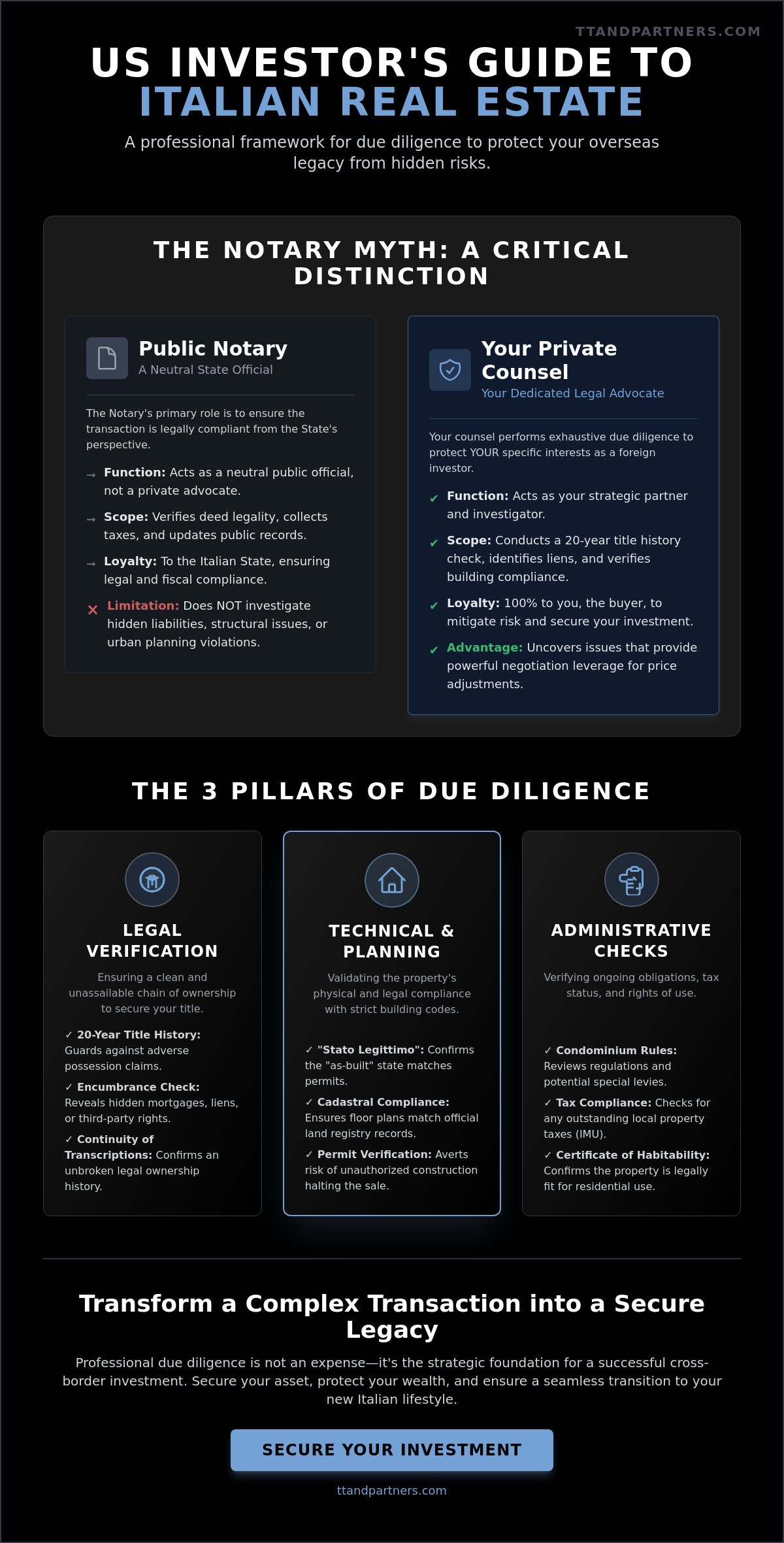
A common misconception among international buyers is the belief that the Public Notary serves as their personal advocate. This "Notary Myth" can lead to catastrophic financial oversights. In the Italian system, the Notary is a neutral public official whose primary loyalty lies with the State. They ensure the deed is legal, taxes are collected, and public records are updated. They don't, however, conduct deep-dive investigations into the property’s structural integrity or its compliance with evolving urban planning laws. Relying solely on the Notary leaves significant gaps in risk mitigation, particularly regarding hidden liabilities that fall outside their standard scope of title verification.
Due diligence findings serve as a powerful tool for strategic negotiation. When a professional audit reveals undisclosed debts or minor planning discrepancies, these facts become leverage. They allow the buyer to demand price adjustments or include specific contingencies in the preliminary contract. This proactive approach transforms the acquisition from a leap of faith into a calculated business move.
The Role of the Public Notary vs. Your Private Counsel
The Notary focuses on the accuracy of public records and the collection of registration taxes. In contrast, your private counsel acts as your dedicated advocate, performing forensic investigations into the ownership history and potential litigation risks. They scrutinize the "Continuity of Transcriptions" over the last twenty years to ensure no break in the chain of title exists. Relying on the seller’s documentation is a critical error. Independent verification is the only way to ensure the property you're buying is truly the property the seller has the right to convey.
Cross-Border Risks for the Unprotected Buyer
An unvetted purchase can quickly spiral into complex international litigation, involving jurisdictions and legal costs that far outweigh the initial investment. Undisclosed liens or historic mortgages can trigger complications that impact your global credit standing and broader investment portfolio. US-based investors are frequently targeted with non-compliant properties because sellers often assume foreign buyers won't perform the necessary technical checks. Without a bilingual, dual-jurisdiction team, you risk inheriting a legal nightmare that could have been avoided with a few weeks of professional scrutiny.
The Essential Framework: Legal, Technical, and Administrative Checks
A sophisticated investment strategy requires more than a cursory glance at property listings. It demands a structured audit that synchronizes legal, technical, and administrative data into a single intelligence report. Professional Italian real estate due diligence services provide this clarity by dissecting the history and current standing of the estate. For the high-net-worth investor, this framework isn't just about finding flaws; it's about validating the long-term viability of an asset within a global portfolio. Without this deep-dive analysis, you're essentially buying into a legal vacuum.
Legal Verification: Title and Encumbrances
The cornerstone of legal security is the twenty-year look-back period of ownership history. This is the legal standard because it covers the timeframe required to clear any potential claims of adverse possession or historic disputes. We scrutinize the continuity of public records to ensure every previous transfer of title was legally sound and correctly registered. Beyond the title, we identify mortgages or foreclosures that could complicate the transaction. As highlighted by the U.S. Department of State on Italian investment, navigating the local regulatory environment demands a high degree of diligence due to the complexities of administrative bureaucracy. This includes checking for pre-emption rights, where the state or even neighboring owners might have the legal priority to purchase the property at your agreed price.
Technical Inspection: Structural and Utility Compliance
Technical due diligence involves a rigorous on-site inspection by a qualified engineer or architect. Their primary task is to verify the legal building status, ensuring the physical structure matches the historical permits and the floor plan filed at the land registry. Discrepancies here can halt a sale or lead to significant fines. We also evaluate the habitability certificate; without it, the resale value and utility of the property are severely compromised. In 2026, energy efficiency is a critical valuation driver. Following the European energy directive, we assess the building’s performance to ensure it can meet the upcoming 2030 standards. Utility systems must also be certified to modern safety codes to prevent post-purchase liabilities. For those moving toward a real estate closing, these technical details are the difference between a sound investment and a recurring expense.
The culmination of this process is the due diligence report. This executive summary provides a transparent view of environmental hazards, historical preservation restrictions, and any administrative hurdles. It's the definitive document that allows you to move forward with absolute confidence, knowing that every square meter of your investment is accounted for and compliant with the law.
Navigating Urban Planning Compliance and Cadastral Discrepancies
The architectural harmony of a historic estate often masks a discordant history of administrative shortcuts. While previous sections focused on title continuity and general technical audits, the heart of a secure acquisition lies in urban planning compliance. Under the 2026 national building code, the lawful state doctrine has become the uncompromising standard for marketability. This principle dictates that a property is only legally transferable if its current physical state aligns perfectly with every building permit issued since its original construction. For the American investor, an unauthorized terrace or an internal wall moved decades ago is not merely a cosmetic issue; it's a legal barrier that can halt a transaction entirely.
Engaging professional Italian real estate due diligence services is the only way to expose building violations before they become your financial burden. In the most severe cases, major unauthorized works can trigger mandatory demolition orders that remain attached to the property regardless of ownership changes. When discrepancies are minor, an administrative legalization process may allow for compliance through the payment of fines and fees. Determining who bears these costs and ensuring the process is completed before the final deed is signed is a critical component of a sophisticated purchase strategy.
The Step-by-Step Verification Process
Precision in verification follows a logical, three-stage progression. First, we retrieve the complete historical record of building permits from the municipal archive. This provides the only true legal baseline for the property. Second, we perform a comparative analysis between these permits, the current land registry maps, and the actual physical layout of the estate. Third, we quantify the cost of any necessary regularizations. This data allows you to negotiate from a position of intellectual strength, ensuring that the seller resolves all non-compliance issues prior to the closing.
Why Land Registry Records Are Not Proof of Legality
It's a common trap for international buyers to assume that a property is legal simply because it appears correctly in the land registry. This is a dangerous misconception. The land registry is primarily a fiscal tool used to determine property taxes; it doesn't certify that the building complies with local planning laws. As global standards shift toward the OECD framework on tax transparency, the accuracy of these records has become a matter of international fiscal importance. However, for the purpose of a sale, the municipal archives always supersede the land registry maps. Signing a deed with non-compliant records in 2026 can lead to the immediate nullity of the contract, leaving the buyer with an unusable asset and a complex legal dispute.
Strategic Cross-Border Considerations: Tax and Asset Protection
Securing a property through rigorous Italian real estate due diligence services is only the first layer of a resilient investment. For US investors, the true complexity lies in how that asset interacts with their domestic financial ecosystem. A Mediterranean villa shouldn't become a liability for your US-based wealth. In 2026, the intersection of Italian property law and IRS reporting requirements demands a sophisticated architectural approach to ownership. You need a structure that harmonizes your lifestyle goals with global tax efficiency while maintaining the highest standards of legal compliance.
A primary decision involves choosing between personal ownership and LLC incorporation. While direct ownership is simpler, an LLC can provide a vital layer of liability protection, shielding your American assets from potential Italian real estate disputes. This choice also has profound implications for estate planning. A well-designed holding structure can simplify Italian succession processes and mitigate inheritance taxes, ensuring a seamless transfer of your legacy to future generations. This intellectual approach to asset management is what separates a casual purchase from a strategic international investment.
Holding Structures for Italian Real Estate
Using a US-based LLC for Italian acquisitions offers a familiar framework for asset protection. It allows you to manage the property within a legal entity that your US advisors already understand. This strategy is particularly effective for high-net-worth individuals who want to isolate real estate risks from their broader portfolio. It also provides a clear path for managing rental income and expenses in a way that aligns with US corporate tax standards, providing a much-needed buffer against foreign legal nuances.
Tax Reporting and Compliance for US Persons
Compliance is a multi-jurisdictional obligation that requires constant vigilance. Under FATCA, US persons must report foreign financial assets on Form 8938 if they meet specific thresholds, which vary based on residency and filing status. Italian property is not directly reportable on the FBAR, but the associated bank accounts are. Failing to disclose the euro-denominated accounts used for utility payments or property management can lead to significant IRS penalties. The US-Italy Tax Treaty remains a critical tool for avoiding double taxation on rental income and capital gains. The 2026 updates to the treaty and the increase in the lump sum tax for new residents to €300,000 per year highlight the need for precise planning. If you are ready to align your Italian ambitions with a secure fiscal strategy, we invite you to contact our cross-border specialists for a tailored consultation.
Securing Your Investment with Expert US-Italy Legal Counsel
Navigating the Italian property market requires more than a translator. It demands a strategist who understands the inherent friction between American corporate expectations and the nuances of the Italian civil code. A bilingual, dual-jurisdiction firm serves as this essential bridge. At Tosolini, Toniutti & Partners, we don't just process paperwork; we translate reality. Our approach ensures that the findings from your Italian real estate due diligence services are interpreted through the lens of your global financial interests. By the time you reach the final Rogito (Deed of Sale), every variable has been accounted for, from technical compliance to cross-border tax liability.
In 2026, technology has streamlined the acquisition process, yet the human element of advocacy remains paramount. We manage complex transactions remotely through the strategic use of a Power of Attorney (Procura). This allows you to secure your investment without the need for constant international travel. Our digital closing processes ensure that every document is verified and every fund transfer is secure, providing a level of oversight that a local, single-jurisdiction firm simply cannot offer. This intellectual rigor ensures that your transition into the Italian market is as seamless as it is secure.
The Value of Integrated Legal Support
Successful acquisition relies on a synchronized team. We coordinate directly with Italian architects and engineers to handle the technical pillars of due diligence discussed in previous sections. This integrated model extends to the financial side, where we manage escrow accounts and secure fund transfers to protect your capital from unnecessary risk. For many clients, this property purchase is a foundational step toward broader goals, such as securing an E-2 Visa. We ensure that your real estate closing is structured to support these long-term immigration and investment objectives without creating friction with your US-based assets.
Schedule Your Strategic Consultation
The most effective time to engage professional Italian real estate due diligence services is before you sign a binding Proposta d’Acquisto (Purchase Proposal). Once a proposal is accepted, your ability to negotiate contingencies or price adjustments based on technical flaws diminishes significantly. We provide customized risk assessments for residential estates, commercial developments, and agricultural investments, ensuring the strategy fits the specific nature of the asset. To protect your interests and ensure a sophisticated transition into the Mediterranean landscape, contact our team today for a professional consultation.
Master Your Mediterranean Legacy with Strategic Precision
Investing in the Italian landscape is a transformative decision that requires a sophisticated legal framework to ensure long-term harmony. We've explored why the neutral role of the Notary necessitates private advocacy and how the "stato legittimo" doctrine defines the marketability of your asset in 2026. By aligning technical compliance with a robust cross-border tax strategy, you protect your global wealth from the friction of a foreign jurisdiction. Professional Italian real estate due diligence services are the foundation upon which secure legacies are built; they transform a complex acquisition into a controlled, intellectual process.
Our firm specializes in high-net-worth cross-border transactions, offering dual-jurisdiction expertise in both the US and Italy. We provide comprehensive legal and tax structuring to ensure your property purchase remains a secure pillar of your portfolio. Secure your Italian investment with expert cross-border due diligence. Your vision of an Italian lifestyle is within reach; let us provide the engineering precision to make it a reality.
Frequently Asked Questions
What is the difference between a Notary and a real estate lawyer in Italy?
The primary difference lies in their legal duty: the Notary is a neutral public official representing the State, while a real estate lawyer acts as your private advocate. While the Notary ensures the deed’s formal legality and collects registration taxes, they don't negotiate contract terms or investigate deep-seated structural risks on your behalf. Engaging a lawyer ensures your specific interests are protected throughout the complex acquisition process.
Can I perform real estate due diligence remotely from the United States?
You can absolutely perform the entire process remotely by granting a Power of Attorney, known as a Procura, to your legal counsel in Italy. This legal instrument allows your representative to access municipal archives, sign preliminary contracts, and attend the final closing on your behalf. Modern digital communication and secure document sharing make it possible to manage your investment without the need for frequent international travel.
How long does the real estate due diligence process typically take in Italy?
The timeline for professional Italian real estate due diligence services generally ranges from four to eight weeks. This duration depends heavily on the responsiveness of the local Municipal Archive in providing historical building permits. Historic estates or properties in larger cities may require additional time due to the complexity of the archival searches and the volume of records that experts must scrutinize.
What happens if the due diligence reveals unauthorized construction work?
If unauthorized work is discovered, you have the right to demand that the seller regularizes the situation through a Sanatoria before the closing. If the violation is too severe to be legalized, the findings allow you to withdraw from the purchase without losing your deposit. This discovery serves as a vital safeguard, preventing you from inheriting mandatory demolition orders or significant administrative fines after the deed is signed.
Is it mandatory to have a lawyer for property due diligence in Italy?
While Italian law doesn't strictly mandate hiring a lawyer for property purchases, it's a critical step for risk mitigation in cross-border transactions. Relying solely on a real estate agent or a Notary often leaves American investors exposed to undisclosed liabilities. A specialized attorney provides the intellectual rigor needed to synchronize technical reports with legal title verifications, ensuring a secure and transparent real estate closing.
Do I need to report my Italian property to the IRS or on my US tax return?
You don't report the physical property on an FBAR, but you must disclose any associated Italian bank accounts used for property management or utility payments. If the value of your foreign financial assets exceeds specific thresholds, you'll need to file IRS Form 8938 under FATCA regulations. It's essential to coordinate with a tax professional to ensure your Italian investment aligns with US reporting requirements and the latest tax treaty updates.
What is a Stato Legittimo and why is it vital for my property purchase?
Stato Legittimo is the legal doctrine requiring a property to match all historical building permits to be marketable. It's vital because any discrepancy between the physical structure and the archived permits can render a sale null and void under the 2026 national Building Code. This standard is the primary benchmark for property valuation, ensuring that your investment is fully compliant with national and local urban planning laws.
Can I use a US LLC to purchase real estate in Italy?
You can use a US LLC to purchase Italian real estate, though this strategy requires precise legal and tax structuring to be effective. An LLC provides a layer of liability protection for your American assets, but it must be correctly registered in Italy to be recognized for the transaction. This approach is often favored by high-net-worth investors looking to harmonize their Mediterranean holdings with their existing US-based wealth protection strategies.


Comments