

US-Italy Cross-Border Contract Disputes: A Strategic Legal Guide for 2026
- Gianni Mendes Toniutti, Esq.

- May 20
- 13 min read
Could the meticulous detail of your American contract be the very thing that complicates its enforcement in Rome? Many legal professionals feel the weight of uncertainty when facing US-Italy cross-border contract disputes, especially when the definition of a 'breach' shifts between common law and civil law traditions. It's exhausting to manage the high costs of dual-country litigation while wondering if a foreign court will even recognize your jurisdiction. You likely recognize that a lack of procedural harmony can quickly turn a strategic partnership into a significant financial liability.
This guide serves as a visionary manual to help you master these complexities and implement robust enforcement strategies. You'll gain a clear understanding of 'Choice of Law' implications and a structured roadmap for resolving conflicts through arbitration or specialized international litigation. We'll examine how to navigate the 2026 Italian procedural landscape, where case durations have significantly decreased due to recent reforms, and deploy precise tactics for cross-border asset recovery. By the end of this article, you'll have the intellectual tools to protect your commercial integrity and ensure your legal structures remain resilient across the Atlantic.
Strategic Takeaways
Identify the structural differences between US Common Law and the Italian Civil Code to anticipate jurisdictional challenges before they escalate.
Distinguish between Choice of Law and Choice of Forum clauses to ensure your legal protections remain enforceable under the latest 2026 public policy standards.
Master the nuances of US-Italy cross-border contract disputes by comparing American Force Majeure with the Italian doctrine of Eccessiva Onerosità Sopravvenuta.
Navigate the technical requirements of the Exequatur process and the Uniform Foreign-Country Money Judgments Recognition Act for efficient global asset recovery.
Implement a strategic approach to international litigation that harmonizes US procedural aggression with the refined precision required by Italian courts.
Table of Contents
The Jurisdictional Divide: Navigating US-Italy Legal Collisions
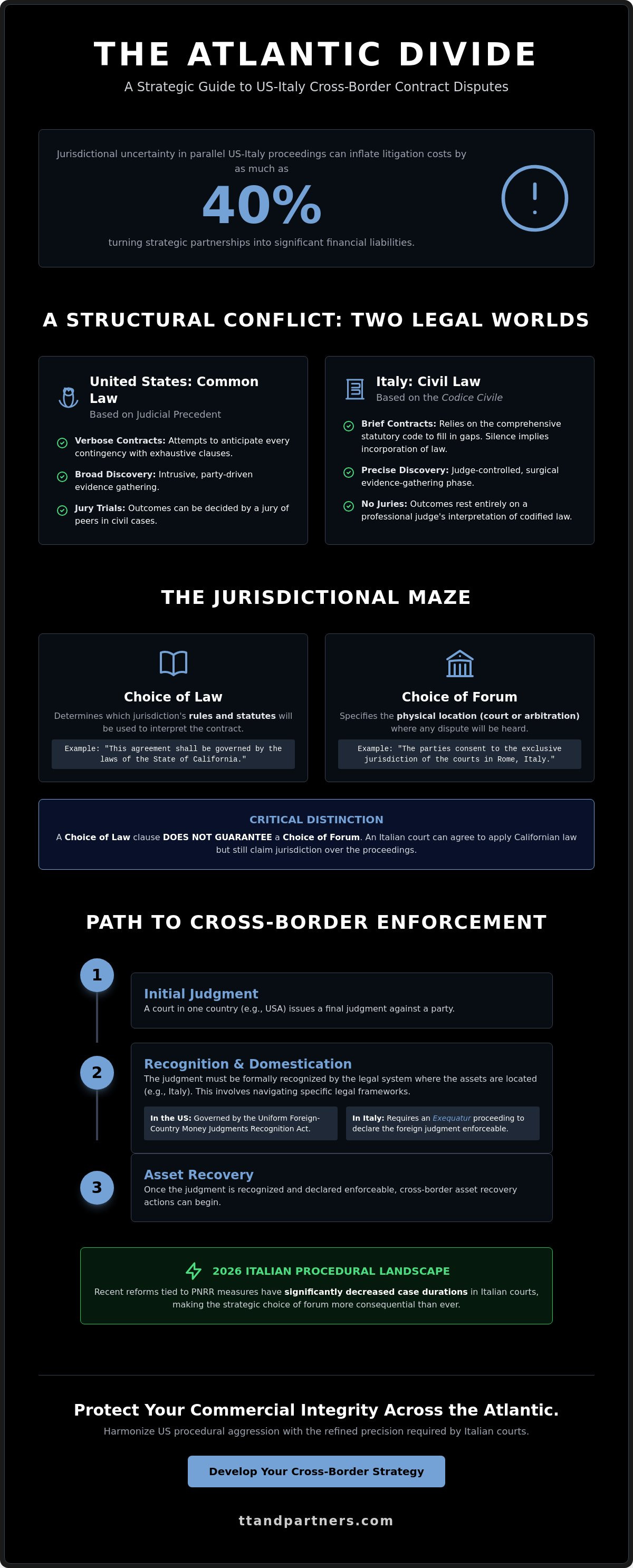
The foundation of any commercial relationship between the United States and Italy rests on a delicate architectural balance between two divergent legal philosophies. When this balance shifts, US-Italy cross-border contract disputes often descend into a "battle of the forums." This is not merely a procedural hurdle; jurisdictional uncertainty can inflate litigation costs by as much as 40 percent as parties engage in parallel proceedings across different continents. At the heart of these collisions lie Conflict of laws principles, which dictate which nation's sovereignty governs the substance of the breach. In 2026, with the PNRR measures pushing Italian courts toward greater efficiency, the strategic choice of forum has never been more consequential for asset protection.
Common Law vs. Civil Law: A Structural Conflict
The American system relies on the organic growth of judicial precedent, while Italy operates within the intellectual framework of the Codice Civile. This creates a significant gap in contract drafting. American contracts tend to be verbose, attempting to anticipate every contingency through exhaustive clauses. Conversely, Italian agreements are often deceptively brief. This brevity isn't a lack of detail. It's a reliance on the statutory code to fill the gaps. When an Italian contract is litigated in a US court, that silence is often interpreted as an omission rather than an incorporation of law. The discovery process further complicates matters. The broad, intrusive nature of US discovery clashes with the restrictive Italian approach, where professional judges control the evidence-gathering phase with surgical precision. There are no juries in Italian civil trials; the outcome rests entirely on the judge's interpretation of codified statutes.
Determining the Forum: Where Will the Battle Occur?
Establishing jurisdiction requires navigating the "Minimum Contacts" standard in the US and the "Foro Competente" rules in Italy. For an Italian entity, merely shipping goods to a New York warehouse might trigger US jurisdiction, leading to a heavily contested motion of forum non conveniens. Italian courts prioritize the place of performance or the defendant's domicile. Initiating these claims effectively requires strict adherence to the Hague Service Convention. Without this, even a valid claim can be dismissed on technical grounds before the merits are ever considered. In 2026, the UN Convention on Contracts for the International Sale of Goods (CISG) continues to act as a vital bridge. It provides a uniform set of rules that can supersede domestic law, provided the parties haven't explicitly opted out. Successfully managing US-Italy cross-border contract disputes depends on recognizing these procedural triggers during the initial drafting phase.
Choice of Law Clauses: Determining the Rules of Engagement
Selecting the governing law for a contract is a foundational decision, yet many executives mistake a Choice of Law clause for a Choice of Forum guarantee. While you might agree that Californian law applies, an Italian court could still claim jurisdiction over the proceedings. In the context of US-Italy cross-border contract disputes, this distinction is critical. By 2026, Italian courts have refined their application of the Public Policy exception. They often invoke it to nullify foreign contractual terms that clash with fundamental European legal principles or mandatory domestic statutes. This creates a landscape where your preferred legal framework might be sidelined by the local judge's mandate.
One significant risk involves "Floating" choice of law clauses. These provisions, which allow the governing law to change based on the party initiating the suit, often lead to unpredictable outcomes. Such ambiguity is particularly dangerous when dealing with the U.S. Department of Commerce guidance on Italy, which highlights the specific regulatory hurdles foreign entities face. Without a fixed legal anchor, businesses risk being blindsided by Italian mandatory rules that override their carefully drafted American terms. This can lead to a scenario where the law you thought would protect you is deemed inapplicable at the moment of crisis.
Consideration vs. Causa: The Validity Trap
The structural integrity of a contract depends on its underlying justification. In US jurisdictions, enforceability requires Consideration, a bargained-for exchange of value. However, an Italian judge examines the agreement through the lens of Causa. Causa is the social-economic function of the contract in Italian law. If a contract lacks this objective economic purpose, it may be declared null and void in Italy, regardless of whether the American parties exchanged nominal value. This validity trap is a common pitfall in complex financial instruments or speculative agreements that don't translate well into a civil law framework. It's not enough to trade value; you must prove the contract serves a recognized social function.
Mandatory Rules and Overriding Statutes
Certain areas of Italian law are non-negotiable. Employment and agency agreements are prime examples where the "weaker party" receives statutory protection that no contract can waive. For instance, an Italian commercial agent is entitled to specific termination indemnities under the Italian Civil Code, even if the contract specifies US law. Similarly, the Uniform Commercial Code (UCC) in the US imposes specific warranties that Italian exporters must navigate. To protect the overall agreement, you must draft robust Severability clauses. These ensure that if a specific provision is deemed unenforceable by an Italian court, the remainder of the contract survives. For those managing high-stakes agreements, seeking strategic international litigation counsel is essential to harmonize these conflicting mandates.
Substantive Conflicts: Force Majeure and Hardship in 2026
When unforeseen economic shifts occur, the divergence between American contractual rigidity and Italian judicial flexibility becomes a primary flashpoint in US-Italy cross-border contract disputes. In the United States, Force Majeure is generally a creature of contract. If an event is not explicitly listed within the four corners of the agreement, courts are often reluctant to grant relief. Italy, however, provides a statutory safety net through the doctrine of Eccessiva Onerosità Sopravvenuta under Article 1467 of the Civil Code. This allows a party to request the termination of a contract if their performance has become "excessively onerous" due to extraordinary and unpredictable events. In the volatile economic climate of 2026, where supply chain disruptions and cyber-enabled crimes are frequent, this distinction determines whether a business is tethered to a failing agreement or granted a legal exit.
Resilience in 2026 requires more than standard boilerplate language. Strategic drafting now incorporates price indexation and specific hardship clauses that define exactly what constitutes an "extraordinary event" to bridge the gap between these two systems. Central to the Italian approach is the principle of Buona Fede, or Good Faith. Unlike the limited application of good faith in many US jurisdictions, Italian law mandates that parties act with fairness throughout the life of the contract. This principle allows Italian judges to intervene and potentially rebalance obligations that have become fundamentally unfair, a concept that often surprises American litigators accustomed to strict textualism.
Interpreting Breach: Intent vs. Textualism
The US legal system follows the "Four Corners" rule, focusing almost exclusively on the written text to determine the parties' obligations. Italian courts prioritize Comune Intenzione, or the common intent of the parties. To find this intent, judges actively examine pre-contractual negotiations, known as trattative, as primary evidence. Italian companies litigating in the US often find themselves disadvantaged by the Parol Evidence rule, which frequently bars the introduction of these crucial external discussions. Understanding how these interpretive lenses differ is vital for any entity involved in international litigation.
Remedies for Breach: Specific Performance vs. Damages
Remedies reveal another deep structural divide. US courts favor monetary damages and impose a strict "duty to mitigate" on the non-breaching party. In contrast, Italian law views Adempimento Coattivo, or specific performance, as a primary remedy. The Italian system prefers that the contract be fulfilled as promised rather than simply compensated in cash. Additionally, while US courts often strike down "penalty clauses" as unenforceable, Italian law permits them under Article 1384. However, an Italian judge retains the power to equitably reduce the penalty if the amount is clearly excessive, ensuring the punishment remains proportionate to the harm.
Enforcement and Recovery: Moving Beyond the Judgment
Securing a favorable verdict in a courtroom is often only the midpoint of a legal journey. In the complex arena of US-Italy cross-border contract disputes, a judgment is merely a piece of paper until it is successfully enforced against assets in a foreign jurisdiction. This phase requires a transition from the intellectual rigors of trial to the technical mechanics of international treaties. Whether you are seeking to recognize an American award in the Italian Republic or enforce an Italian order within the United States, the strategy must be as precise as the initial litigation. Without a clear path to recovery, even the most decisive legal victory remains a hollow achievement.
Strategic asset tracing is a vital component of this process. It involves identifying liquid assets, real estate holdings, and intellectual property across both nations to ensure that enforcement efforts are targeted and effective. In 2026, the integration of digital financial tracking and more transparent corporate registries has made this task more manageable, yet it still requires deep local knowledge of both the US and Italian systems. If you are facing a situation where a counterparty is shielding assets across borders, you should consult with our international litigation team to initiate a coordinated recovery plan.
The Exequatur Process in Italian Appeals Courts
For a US judgment to have legal effect in Italy, it must undergo a procedure known as Exequatur. The Italian Court of Appeal conducts a delibazione, a review process that does not re-examine the merits of the case but verifies four critical requirements. First, the US court must have had jurisdiction according to Italian principles. Second, the defendant must have been properly served in compliance with the Hague Service Convention. Third, the judgment must be final and conclusive under US law. Finally, the award must not conflict with Italian ordine pubblico (public policy). A significant hurdle here is the US concept of punitive damages. Because Italian law views damages as strictly compensatory, Italian courts often block the enforcement of the punitive portion of an American judgment, recognizing only the amount that covers actual losses.
Arbitration: The Preferred Path for Cross-Border Certainty
Many sophisticated entities bypass the unpredictability of court recognition by opting for international arbitration. The New York Convention, ratified by both the United States and Italy, makes arbitral awards significantly more portable than court judgments. With over 170 signatory countries, the convention limits the grounds for a court to refuse enforcement, providing a level of global certainty that traditional litigation cannot match. Selecting a neutral seat, such as the International Chamber of Commerce (ICC) or the American Arbitration Association (AAA), allows parties to avoid the perceived home-court advantage of their opponent. Drafting a multi-tier dispute resolution clause that includes mandatory mediation before arbitration can further streamline the process and reduce the overall duration of the conflict.
Strategic Litigation Management with TT&P
Resolving US-Italy cross-border contract disputes requires more than just legal knowledge; it demands a synthesis of two distinct legal cultures. Success in this arena isn't achieved through aggressive posturing alone. It requires a refined understanding of how American litigation tactics translate into the precise procedural environment of Italian courts. Our approach focuses on bridging this gap, ensuring that the 'lost in translation' errors that often plague international cases are neutralized before they can impact the outcome. By maintaining a dual-qualified perspective, we provide a unified front that manages the friction between common law expectations and civil law realities.
Strategic structural decisions made at the inception of a business relationship often dictate the leverage available during a conflict. For instance, proper LLC incorporation serves as a primary shield, containing potential liabilities within a specific corporate structure and preventing domestic assets from being exposed to foreign judgments. When disputes arise, managing simultaneous proceedings in two different languages requires a coordinated defense that anticipates how an action in a New York court might be perceived by a judge in Milan. This foresight is what separates a reactive defense from a strategic victory.
Dual-Jurisdiction Defense Strategies
Our team utilizes deep international litigation experience to protect Italian assets from overreaching foreign claims. We understand that a corporate dispute isn't merely a financial risk. For many stakeholders, it directly impacts their immigration standing. We manage the delicate intersection of commercial conflict and visa maintenance, ensuring that your E-1 or E-2 visa status remains secure even when your business interests are under threat. Learn about our International Litigation services and how we harmonize these complex legal needs to preserve both your capital and your right to operate globally.
Proactive Risk Mitigation for 2026
The 2026 trade environment demands a proactive stance on contract auditing. We analyze your US-Italy agreements to ensure they are resilient against the latest regulatory shifts and supply chain volatilities discussed throughout this guide. Effective risk management relies on the harmony between a strong local presence and an expansive global legal network. This dual-layered approach allows for rapid response and strategic foresight. If you are currently navigating a conflict or seeking to fortify your international agreements, Contact Tosolini, Toniutti & Partners for a dispute strategy session to secure your commercial future and establish a robust legal architecture.
Architecting Resilience in Transatlantic Partnerships
The 2026 legal landscape demands more than just reacting to conflicts. It requires a visionary approach to contract architecture. Successfully managing US-Italy cross-border contract disputes depends on your ability to harmonize the rigidity of American common law with the codified precision of the Italian civil system. You've seen that a victory in court is only half the battle. True resolution comes from technical mastery of the New York Convention and the Hague Treaties to ensure global asset recovery. This holistic perspective prevents procedural gaps from becoming financial liabilities.
At Tosolini, Toniutti & Partners, our dual-qualified attorneys in the US and Italy provide the intellectual depth needed for high-stakes international litigation. We don't just bridge the gap between two nations; we build a resilient framework for your commercial success. Our proven track record in complex recovery and enforcement ensures your interests remain protected regardless of the forum. Don't leave your transatlantic partnerships to chance. Secure your cross-border interests with a strategic legal consultation and move forward with the confidence that your legal structure is as ambitious as your business goals.
Frequently Asked Questions
Can a US court judgment be enforced against an Italian company's assets in Italy?
Yes, you can enforce a US judgment in Italy through the Exequatur process. The Italian Court of Appeal must verify that the US court had jurisdiction and that the defendant was properly served under the Hague Service Convention. It's a technical review that ensures the foreign decision doesn't violate Italian public policy. This procedure is essential for resolving US-Italy cross-border contract disputes involving asset recovery.
What is the difference between 'Force Majeure' and 'Hardship' in US-Italy contracts?
Force Majeure usually refers to an event that makes performance impossible, while Hardship focuses on events that make performance excessively burdensome. In US law, these protections must be explicitly written into the contract. In Italy, the Civil Code provides statutory relief for "Eccessiva Onerosità Sopravvenuta." This allows a judge to terminate or modify a contract if extraordinary events fundamentally alter the economic balance of the agreement.
How long does it typically take to resolve a cross-border contract dispute?
Resolution timelines vary based on the complexity and the chosen forum. Data from 2023 indicates that first-instance civil cases in Italy averaged 511 days. However, recent 2026 procedural reforms and PNRR measures have increased efficiency. Italian Courts of Appeal reported a 24 percent reduction in pending cases between 2021 and 2024. Arbitration often provides a faster alternative, typically concluding within 12 to 18 months.
Do I need a lawyer in both the US and Italy for a contract dispute?
Engaging counsel with expertise in both jurisdictions is highly recommended. Each system has unique procedural requirements that can derail a case if ignored. Dual-qualified professionals provide a unified strategy for US-Italy cross-border contract disputes, preventing conflicting arguments in parallel proceedings. This coordinated approach ensures that evidence gathered in one country remains admissible and effective in the other.
Are punitive damages awarded by US courts enforceable in Italy?
Italian courts generally refuse to enforce the punitive portion of a US judgment. Under the principle of "ordine pubblico," Italian law views civil damages as purely compensatory. A judge will likely recognize the part of the award that covers actual financial losses but strip away the "punishment" element. It's vital to structure your claims with this limitation in mind if you anticipate enforcing the result in Europe.
What is the New York Convention and why does it matter for my contract?
The New York Convention is a global treaty that facilitates the enforcement of arbitration awards across 170 nations. It's the primary reason many international businesses prefer arbitration over traditional litigation. Because both the US and Italy are signatories, an arbitral award is often much easier to recognize than a standard court judgment. It provides a level of predictability that's essential for high-value transatlantic partnerships.
Can I use an Italian Choice of Law clause in a contract with a US entity?
Parties are free to select Italian law as the governing framework for their agreement. A US court will generally respect this choice unless it violates a fundamental policy of the state where the suit is filed. You should be aware that choosing the law doesn't automatically determine the forum. You must pair a Choice of Law clause with a clear Forum Selection clause to avoid jurisdictional confusion.
How does the 'Hague Service Convention' affect my ability to sue an Italian company?
The Hague Service Convention is the mandatory international protocol for delivering legal documents to a defendant in Italy. You can't simply send a summons via standard certified mail. If you fail to follow these specific service requirements, any judgment you obtain in the US will be considered void by Italian courts. Adhering to these formal steps is the only way to ensure your legal action has international standing.


Comments