

Italian Real Estate Lawyer for Foreigners: The 2026 Strategic Investment Guide
- Gianni Mendes Toniutti, Esq.

- May 17
- 12 min read
Can you truly secure a legacy when the only legal professional in the room is required by law to remain neutral? Many international investors mistakenly assume the Notary acts as their personal advocate; yet, this public official serves the state, not your specific financial interests. While the allure of a historical estate is undeniable, the hidden liabilities within centuries-old titles require a more surgical approach. Engaging an Italian real estate lawyer for foreigners isn't just a safety measure; it's a strategic necessity for those viewing property as a pillar of their global residency goals.
Deciphering foreign tax codes and property encumbrances often feels like a daunting barrier to your Mediterranean vision. This 2026 guide promises to clarify the complexities of the legal system, from managing 3.5% to 5.5% non-resident mortgage rates to securing your path toward a residency permit. You'll gain a clear roadmap for a secure real estate closing that protects your capital and aligns your investment with your long-term aspirations for citizenship.
Key Takeaways
Understand why the neutrality of the public official necessitates an independent Italian real estate lawyer for foreigners to advocate strictly for your individual investment interests.
Master the 2026 step-by-step purchase framework, including the immediate legal binding power of the formal purchase offer and the significance of the confirmatory deposit.
Explore how property acquisition strategically aligns with residency goals such as the elective residency visa or obtaining a long-term residency permit.
Discover how to uncover hidden liabilities and complex inheritance encumbrances through rigorous due diligence before finalizing any cross-border transaction.
Learn to navigate the tax treaty between the United States and Italy to ensure your property investment remains a compliant and efficient component of your global asset portfolio.
Table of Contents
Navigating the Italian Property Market: Why Foreigners Need Independent Counsel
Investing in Italy is an exercise in both vision and discipline. While an Italian real estate market overview reveals a landscape rich in historical value and modern potential, the legal mechanics of acquisition remain distinct from Anglo-American traditions. Many international buyers enter the market through real estate agencies, often accepting the services of a lawyer recommended by the broker. This creates a potential conflict of interest. The agent’s primary goal is the transaction’s completion; your goal is the protection of your capital. You need a partner whose loyalty isn't divided between the sale and the safety of the buyer.
An Italian real estate lawyer for foreigners serves as your dedicated fiduciary, providing the necessary friction to ensure every claim about a property is verified before funds move. Unlike local buyers who might rely on informal networks, foreign investors need a bilingual legal partner who understands the nuances of cross-border asset reporting and international compliance. This expertise prevents hidden liabilities from becoming permanent financial burdens. If you're ready to secure your investment with professional precision, you can explore our tailored legal support to begin the process.
The Role of the Public Notary vs. Your Private Attorney
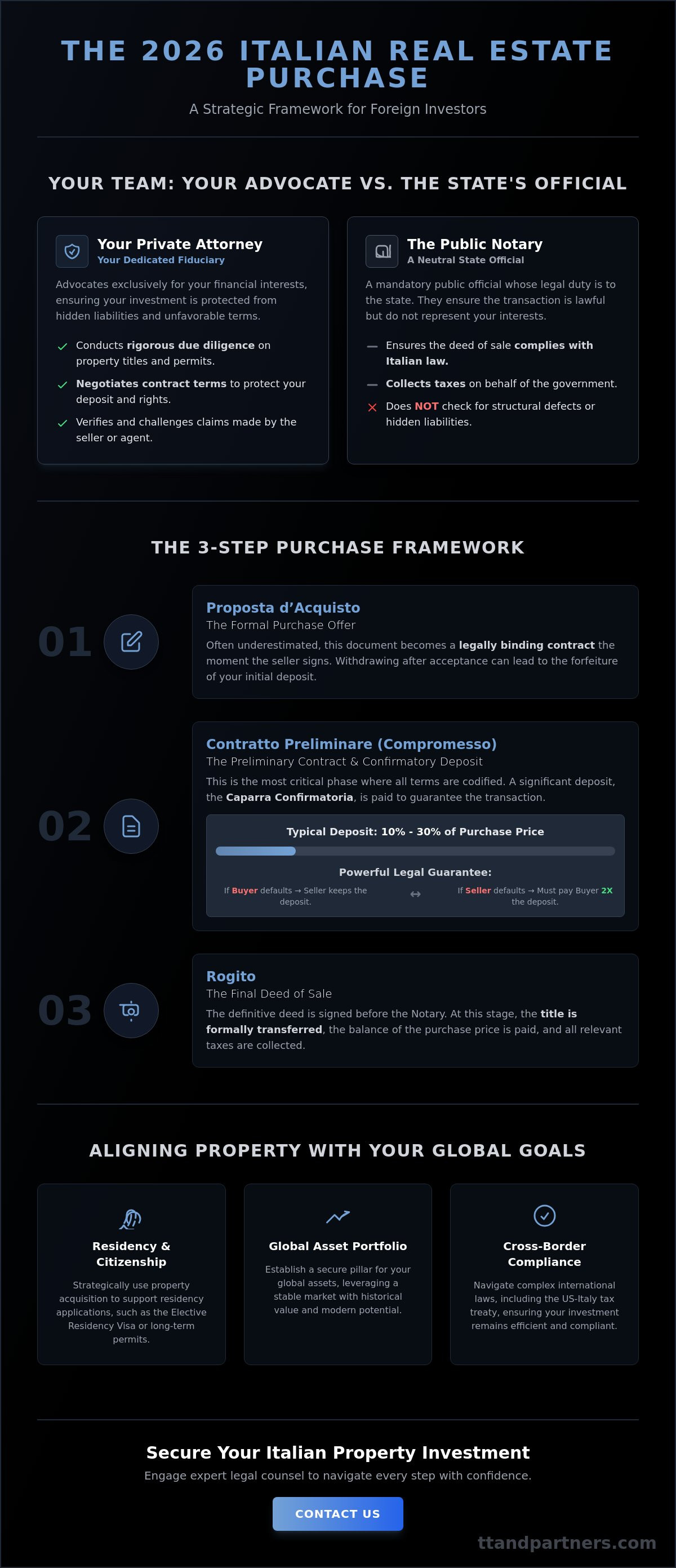
In the Italian system, the public notary is an official of the state. Their presence is mandatory, but their mandate is limited to ensuring the deed complies with the law and that the government receives its taxes. They don't represent you. They won't negotiate a lower price or check if the roof has structural defects. Your private attorney fills this void. They conduct the deep due diligence that a notary simply isn't tasked with, such as verifying planning permissions or negotiating terms in the preliminary contract to protect your deposit. Without independent counsel, you're essentially navigating the final stages of a real estate closing without an advocate.
Bridging the Cross-Border Legal Gap
Managing a transaction from thousands of miles away requires more than just digital signatures; it requires a legal framework that stands up to 2026 standards. Documents must meet both Italian and international legal requirements to ensure long-term validity. A special power of attorney is the essential legal instrument that grants your lawyer the specific authority required to sign deeds and manage administrative filings in Italy on your behalf. This allows your Italian real estate lawyer for foreigners to handle the technical complexities of the closing while you remain focused on your broader residency or investment goals. By bridging these legal cultures, you transform a complex international purchase into a seamless strategic investment.
The 2026 Italian Real Estate Purchase Process: A Step-by-Step Framework
Every successful property acquisition in Italy begins with a precisely defined framework that prioritizes legal certainty over administrative speed. The journey starts with the Proposta d’Acquisto. This document is often underestimated by international buyers who view it as a mere expression of interest. In reality, once the seller accepts and signs, it becomes a legally binding contract. Any attempt to withdraw without a justified legal cause can result in the loss of your initial deposit or even legal action to enforce the sale.
Transitioning to the Contratto Preliminare, commonly known as the Compromesso, marks the most critical phase for an Italian real estate lawyer for foreigners. This is where the specific terms of the transfer are codified. You'll typically provide a Caparra Confirmatoria, a deposit that often ranges from 10% to 30% of the purchase price. This sum acts as more than a down payment; it's a legal guarantee. If you default, the seller keeps the funds. If the seller defaults, they're legally required to pay you double the amount. This mechanism ensures both parties remain committed to the timeline established for the final deed.
The final milestone is the Rogito. This is the definitive deed of sale signed in the presence of the Notary. While the Notary oversees the formal transfer of title and the collection of mortgage taxes, which are 0.25% for primary residences or 2% for second homes, your attorney ensures that the 2026 requirements for the Attestato di Prestazione Energetica (APE) and the Certificato di Agibilità are fully met. These documents are non-negotiable for properties intended for modern living or the high-end rental market.
Contractual Milestones and Financial Security
Financial security hinges on the "specific performance" clause within your contracts. If a seller attempts to back out of a deal after the Compromesso, Italian law allows you to seek a court order to force the transfer of the property. To further mitigate risk, we recommend using the Notary’s dedicated escrow account for the final balance. This ensures funds are only released once the deed is registered, providing a layer of protection that mirrors the standards of a sophisticated Real Estate Closing.
Technical and Administrative Due Diligence
Beyond the contracts, your investment’s value rests on its physical and administrative integrity. Conformità Catastale ensures the property's physical state matches the official floor plans on file with the Land Registry. Discrepancies can delay sales or lead to fines. For those pursuing historical villas, checking for the Vincolo Belle Arti is essential, as these restrictions dictate what renovations are permitted. In 2026, aligning your project with energy efficiency standards is also vital to qualify for the 50% renovation tax deduction, which is currently capped at €96,000 per property.
Strategic Integration: Real Estate, Taxes, and Residency
Property acquisition in Italy often serves as the cornerstone of a broader life-design strategy. For many, the purchase is the primary catalyst for obtaining an Elective Residency Visa (ERV) or the increasingly popular Digital Nomad Visa. An Italian real estate lawyer for foreigners ensures that your chosen residence meets the specific "suitable housing" requirements mandated by Italian consulates. These standards go beyond mere aesthetics; they require documented proof of habitability and sufficient square footage relative to the number of residents. It's not just about finding a home; it's about anchoring your legal status.
Strategic investors often look beyond personal use, integrating their assets into a more robust corporate structure. Utilizing LLC incorporation can offer significant advantages for those managing a portfolio of rental properties. This approach provides a layer of liability protection while aligning with international business standards. When property investment is linked to a commercial enterprise, it may even support the E-2 Visa framework for those looking to balance their Italian assets with US-based business interests. This dual-market approach creates a resilient global architectural plan for your wealth.
Real Estate as a Foundation for Residency
Securing a home is just the first step toward Italian residency. To successfully apply for an ERV, you must demonstrate that your housing is permanent and legally sound. This means the final deed must be registered without any pending administrative disputes. For treaty investors, the property must be part of an active investment strategy rather than a passive asset. Your legal counsel will help you navigate these distinctions to ensure your real estate portfolio supports your path to a Permesso di Soggiorno or eventual citizenship.
Cross-Border Tax Compliance
The US-Italy Tax Treaty is a vital tool for preventing double taxation on rental income and global asset reporting. While non-resident owners are subject to local taxes like IMU (Property Tax) and TARI (Waste Tax), the treaty provides a framework for claiming credits on your US tax returns. In 2026, retirees moving to specific southern regions or small towns can opt for a 7% flat tax on all foreign-sourced income for up to ten years. This specific incentive makes regional investment particularly attractive for long-term residency planners.
Understanding these obligations early prevents the risk of tax non-compliance in both jurisdictions. For instance, the "Prima Casa" benefits can significantly reduce your purchase taxes if you commit to establishing residency within 18 months. An Italian real estate lawyer for foreigners will analyze your global tax footprint to determine if these benefits outweigh the potential long-term reporting requirements. This holistic view ensures your Italian dream remains a sound financial reality, protected by both law and strategic foresight.
Avoiding Legal Pitfalls in Cross-Border Transactions
Securing a property in Italy requires a defensive legal posture that anticipates risks long before the final deed is signed. One of the most significant yet overlooked areas is pre-contractual liability. Under Article 1337 of the Italian Civil Code, parties must act in good faith throughout the negotiation phase. If a seller pulls out of a deal without a valid reason after you've already spent funds on surveys or legal fees, they can be held liable for your losses. An Italian real estate lawyer for foreigners documents these interactions meticulously, establishing a paper trail that protects your capital during the delicate period between the initial offer and the preliminary contract.
Beyond the negotiation table, the absence of title insurance in Italy makes the Visura Ipotecaria a non-negotiable step. This mortgage and lien search is the only way to uncover hidden debts or historic seizures that could jeopardize your ownership. Without this deep dive into the registry, you risk inheriting the financial failures of a previous owner. Relying on the Notary for this is a mistake; their search is often limited to the immediate history. Your attorney conducts a more exhaustive investigation to ensure the property is delivered free of any encumbrances that might disrupt a smooth Real Estate Closing.
Inheritance and Succession Risks
Italian law's adherence to forced heirship creates a unique layer of risk for international buyers. Certain relatives are legally entitled to a portion of an estate, and if a property was inherited by the current seller, missing a single heir's signature can invalidate the entire sale. These disputes often cross borders, requiring international litigation to untangle the title. To avoid these multi-generational legal traps, we verify the entire chain of succession. We also advise clients on drafting an Italian Will to prevent similar complications for their own heirs in the future.
Structural and Urban Planning Compliance
Restored farmhouses often hide Abuso Edilizio, or unauthorized building works, which can lead to severe administrative penalties. While the Sanatoria process allows for the legalization of minor discrepancies, major structural changes without permits are often impossible to rectify. You shouldn't trust an "as-is" clause to shield you from these issues; the liability for restoring the property to its legal state often falls on the current owner. An Italian real estate lawyer for foreigners will identify these technical gaps before you commit your deposit. Purchasing within a Condominium also brings a share of the building's collective debts or pending legal actions. Comprehensive vetting of the building's financial health is a prerequisite for any safe investment. If you're currently reviewing a property and need to verify its legal standing, you can request a comprehensive due diligence review from our team.
The TT&P Advantage: Comprehensive Cross-Border Legal Support
Successful international investment requires more than local knowledge; it demands a dual-perspective expertise that bridges the legal cultures of the United States and Italy. At TT&P, we don't view a property purchase as an isolated event. Instead, we treat it as a foundational element of your global legal architecture. Our firm provides a holistic approach that integrates Real Estate Closing services with sophisticated Italian Immigration and corporate law strategies. This ensures that your Mediterranean assets don't just exist in a vacuum but are actively supporting your long-term residency or citizenship goals.
For clients who maintain complex international lives, we offer specialized guidance on the intersection of US and Italian law. We understand that relocating permanently involves navigating the administrative nuances of both jurisdictions. For instance, we help families understand how much is a green card and the strategic costs involved in maintaining US status while building a life in Italy. By aligning your property investment with your broader mobility needs, an Italian real estate lawyer for foreigners from our team protects your global standing while securing your local interests.
Beyond the Closing: Long-Term Asset Management
Our commitment to your investment extends well beyond the final signature at the Notary's office. We provide ongoing support for high-net-worth individuals and corporate entities who require disciplined asset management. This includes:
Strategic LLC Incorporation for managing multi-property portfolios.
Integration of Italian holdings into comprehensive global estate plans.
Ongoing compliance monitoring for rental structures and local tax obligations.
Legal oversight of property management contracts to ensure your vision is maintained.
Whether you're managing a single luxury villa or a diverse portfolio of urban apartments, our team ensures your Italian assets remain compliant, profitable, and secure for future generations.
Secure Your Italian Investment Today
The most significant risks in the Italian market are often introduced in the very first stages of negotiation. Waiting until you have a signed Proposta to seek counsel is a gamble that rarely pays off. Early intervention allows us to perform the necessary due diligence and negotiate terms that provide genuine financial security. If you're ready to transform your Mediterranean vision into a legally sound reality, we invite you to schedule a strategic consultation with our experts. Let's build a secure path to your Italian future together, grounded in professional precision and a shared vision of excellence.
Designing Your Future in the Italian Landscape
The acquisition of Italian property is far more than a simple exchange of title; it's the creation of a sanctuary and a strategic pillar for your global lifestyle. By recognizing the critical distinction between the Notary's public role and the advocacy of an Italian real estate lawyer for foreigners, you ensure your interests remain the priority throughout every stage of the 2026 purchase process. Whether you're navigating the complexities of historical preservation or aligning your investment with a path toward a Permesso di Soggiorno, the key remains proactive, independent due diligence.
Our firm brings decades of US-Italy cross-border legal expertise to your side, offering a seamless bridge between two distinct legal cultures. We provide the comprehensive support necessary to manage everything from initial LLC incorporation to high-stakes international litigation and secure real estate closings. Your investment deserves the precision of a master-planned structure, ensuring that your capital is protected and your residency goals are fully realized.
Secure your Italian real estate investment with a strategic consultation. Italy is waiting for those ready to build their future with confidence and legal certainty.
Frequently Asked Questions
Do I need to be physically present in Italy to buy a property?
No, you don't need to be physically present in Italy to complete a purchase. You can grant a Power of Attorney, known as a Procura Speciale, to an Italian real estate lawyer for foreigners who will sign the contracts and the final deed on your behalf. This legal instrument allows for a completely remote closing while ensuring your interests are represented with professional precision.
What is the role of the Italian Notary in a real estate transaction?
The Italian Notary is a neutral public official who represents the State rather than the buyer or the seller. Their primary mandate is to verify the identity of the parties, collect mortgage taxes, and ensure the deed complies with national laws. Because they don't advocate for your individual financial interests or conduct structural due diligence, hiring independent legal counsel is essential for your protection.
Can I get a mortgage in Italy as a foreign citizen in 2026?
Yes, foreign citizens can access the Italian mortgage market in 2026. Fixed interest rates for non-residents currently range from 3.5% to 5.5%. Most Italian banks will typically finance between 50% and 60% of the property's appraised value for international buyers, provided you can demonstrate stable foreign income and possess a valid tax code.
Does buying a house in Italy automatically give me residency?
Purchasing property in Italy doesn't automatically grant residency or a path to citizenship. While owning a home supports applications for an Elective Residency Visa or a Digital Nomad Visa by proving "suitable housing," you must still meet specific income and health insurance requirements. Residency is a separate administrative process that requires 10 years of legal stay to eventually qualify for citizenship.
What are the closing costs for a property purchase in Italy?
Closing costs generally include the mortgage tax, which is 0.25% for a primary residence and 2% for a second home, along with notary fees and agency commissions. You must also budget for registration taxes and the professional fees of your Italian real estate lawyer for foreigners. These costs are often calculated based on the property’s cadastral value rather than the actual purchase price.
What is a Codice Fiscale and why do I need one for real estate?
A Codice Fiscale is a mandatory Italian tax identification number used for all legal and fiscal transactions. You'll need this code to sign a purchase offer, open a local bank account, and set up utility contracts for your new home. It's issued by the Italian Revenue Agency, and your legal representative can usually obtain it for you before the transaction begins.
How long does the typical property purchase process take in Italy?
The typical timeline for a property purchase in Italy ranges from three to six months. This period covers the initial negotiation and Proposta, the mandatory due diligence phase, the signing of the preliminary contract, and the final Rogito at the Notary's office. Complexities involving historical preservation or non-resident mortgage approvals can occasionally extend this window.
What happens if I discover structural issues after signing the preliminary contract?
If you discover undisclosed structural issues after signing the preliminary contract, your rights depend on the specific "conformità" and "as-is" clauses drafted into the agreement. If the seller acted in bad faith by concealing unpermitted works, you may be legally entitled to a price reduction or the return of double your deposit. This risk is exactly why we insist on technical surveys before the Compromesso is finalized.


Comments