

Italian Residency by Investment Program: The 2026 Strategic Guide

Updated: Sep 21
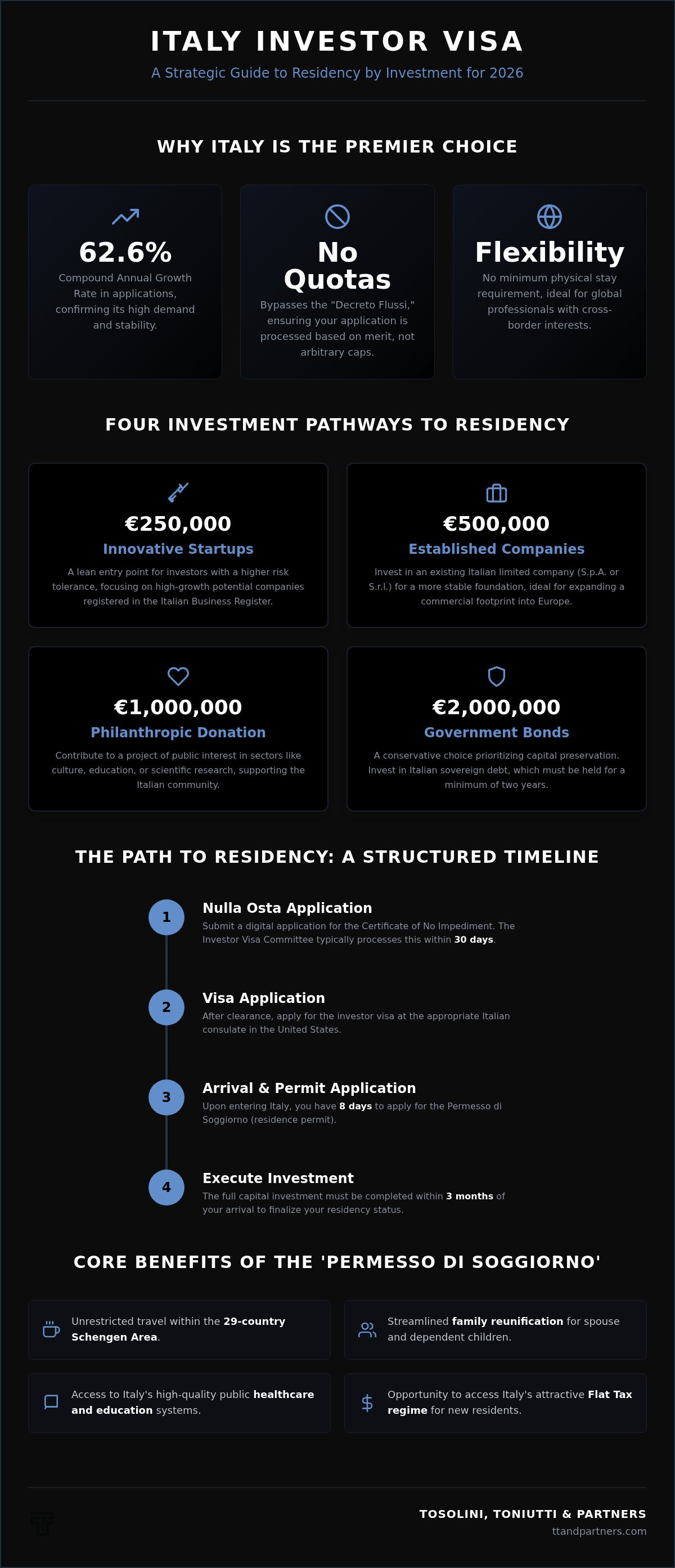
While many European golden visas are tightening their borders, applications for Italy's Investor Visa have maintained a remarkable compound annual growth rate of 62.6%. This surge confirms that the Italian residency by investment program has become the definitive choice for those seeking a sophisticated lifestyle backed by legislative stability. You're likely drawn to the promise of the Mediterranean, yet the reality of Italian bureaucracy and the fear of rejection due to technical paperwork errors can be overwhelming. It's a common concern for high-net-worth individuals who must balance their global ambitions with rigorous legal compliance.
This strategic guide offers the expert precision you need to secure your Permesso di Soggiorno and align your cross-border interests with confidence. We'll explore the 2026 investment thresholds, ranging from innovative startups to government bonds, and detail the path to Italy’s attractive Flat Tax regime for new residents. You'll learn how to bridge the gap between US and Italian legal jurisdictions through a structured, visionary approach that respects both the heritage of the past and the opportunities of the future.
Table of Contents
Understanding the Italian Investor Visa for 2026
The Italian residency by investment program, legally codified as the Visto per Investitori, is a strategic instrument for high-net-worth individuals seeking a foothold in Europe. It's distinct from other immigration pathways because it bypasses the Decreto Flussi, the annual decree that limits the number of foreign workers entering Italy. This "no-quota" status ensures that your application is processed based on the merit of your capital and the precision of your documentation, rather than being subject to arbitrary numerical caps. For US citizens, this program offers a clear, legal bridge to a Mediterranean lifestyle without the uncertainty of lottery-style systems.
When Understanding Investor Visas in the current 2026 landscape, Italy stands out for its lack of a minimum physical stay requirement. You don't need to spend six months of the year in the country to maintain your status. This flexibility is ideal for professionals who maintain active business interests in the United States while building a long-term presence in Italy. The initial permit is valid for two years; provided the investment is maintained, it can be extended for an additional three years, leading toward permanent residency.
The Legal Framework of the Permesso di Soggiorno
The Permesso di Soggiorno is more than a residence card; it's a gateway to European rights. Holders enjoy unrestricted travel within the Schengen Area, allowing for seamless movement across 29 countries for business or leisure. Beyond travel, the permit provides access to Italy’s high-quality public healthcare and education systems. Family reunification is streamlined under this program. You can include your spouse and dependent children in the application, ensuring the entire family benefits from the same residency rights and the eventual path to permanent status.
The 2026 Residency Timeline
Acquiring residency through the Italian residency by investment program follows a structured timeline that demands legal exactness. The first phase is the digital application for the Nulla Osta, a certificate of no impediment issued by the Investor Visa Committee. This typically takes 30 days. After receiving this clearance, you'll apply for the visa at the appropriate Italian consulate in the US. Upon entering Italy, you have eight days to apply for the actual residence permit. The capital investment must be fully executed within three months of your arrival. For complex cases involving international asset structures, contact a specialized legal advisor to ensure every document aligns with Italian regulatory standards.
The Four Investment Pathways to Italian Residency
Selecting the right entry point for the Italian residency by investment program requires a balance between capital preservation and strategic growth. The Italian government prioritizes investments that bolster the "Made in Italy" brand, particularly in sectors like technology, manufacturing, and high-end services. This alignment ensures your capital doesn't just buy residency but contributes to the nation's economic fabric. Each pathway carries distinct legal and financial implications that require a visionary approach to portfolio management to ensure a seamless transition between jurisdictions.
Corporate Investments: Limited Companies and Startups
For investors with a higher risk appetite, the €250,000 threshold for innovative startups offers a lean entry point. While the potential for high returns exists, startups carry inherent volatility and strict eligibility requirements regarding their "innovative" status. These companies must be registered in the special section of the Italian Business Register to qualify for the program. Alternatively, a €500,000 investment in an established Italian limited company, such as an S.p.A. or S.r.l., provides a more stable foundation. This route often aligns with a broader LLC incorporation strategy, allowing US entrepreneurs to integrate their Italian venture with their domestic business architecture. It's an ideal choice for those looking to expand their commercial footprint while securing their long-term residency status.
Government Bonds and Philanthropic Donations
Conservative investors often favor the security of sovereign debt to anchor their relocation. For the 2026 fiscal year, the Italian residency by investment program requires a minimum of €2,000,000 in Italian government bonds, which must be held for at least two years. This path prioritizes capital preservation over high yields, offering a predictable outcome for your residency status. Conversely, the €1,000,000 philanthropic donation is a non-refundable contribution to Italian culture, education, or heritage management. It's a direct way to build a legacy while securing your status without the complexities of managing a corporate portfolio. This option is frequently chosen by those who value social impact and cultural preservation as highly as their legal standing in the European Union. If you're unsure which vehicle best suits your cross-border interests, consulting with a strategic legal partner can clarify the risk profiles and long-term benefits of each option.
The Application Process: From Nulla Osta to Relocation
The Italian residency by investment program is defined by a digital-first approach that prioritizes efficiency and transparency. Your journey begins with the application for the Nulla Osta, a certificate of no impediment issued by the Investor Visa Committee. This inter-ministerial body evaluates the legitimacy of your capital and the strategic value of your intended investment. Unlike traditional bureaucratic paths, this phase is conducted entirely through a dedicated online portal, with a statutory processing window of 30 days. This rapid turnaround is designed for the modern investor who requires certainty before committing significant capital.
Documenting the source of funds is the most critical hurdle for US-based applicants. The Committee requires an exhaustive trail that proves your capital was acquired through legitimate professional or investment activities. For US residents, this typically involves presenting certified tax returns, audited financial statements, or documented evidence of inheritance or asset liquidation. It's not enough to simply demonstrate the presence of funds; you must articulate their provenance with a level of detail that aligns with Italian anti-money laundering regulations. Precision at this stage prevents the delays that often plague less prepared applications.
Document Preparation and Legal Verification
Success in the approval process depends on the structural integrity of your legal dossier. All US financial records and bank letters must be translated and, in many cases, authenticated to meet Italian diplomatic standards. Beyond the financial requirements, you'll need to provide a clean criminal record from every jurisdiction where you've resided. This involves securing FBI background checks and ensuring all certifications are current. To navigate these requirements without administrative friction, engaging specialized legal counsel ensures your documentation is beyond reproach before it reaches the Committee's desk.
Post-Arrival Requirements in Italy
Once your visa is finalized at the Italian Consulate in the United States, your relocation enters its final legal phase. You must enter Italy and visit the local Questura within eight days of arrival to register your presence and apply for the physical Permesso di Soggiorno. This triggers a critical three-month window during which the full investment amount must be transferred and executed. Failure to complete the investment within this 90-day period will result in the revocation of your permit. Maintaining this residency status requires a commitment to the investment for its entire duration, forming the foundation for your eventual transition to permanent residency after five years.
Strategic Advantages: Tax Incentives and Business Synergy
Beyond the legal right of abode, the Italian residency by investment program serves as a sophisticated fiscal architecture for high-net-worth families. It doesn't just grant a permit; it unlocks a suite of exemptions that protect global assets from traditional Italian progressive taxation. For the international investor, this means the ability to consolidate wealth while enjoying the cultural depth of the Mediterranean. This structural advantage is particularly potent for those who view their relocation as a long-term strategic maneuver rather than a simple change of scenery.
The Italian Lump Sum Tax for HNWIs
The cornerstone of Italy’s fiscal appeal is the substitute tax on foreign-sourced income, often called the "Flat Tax." For an annual fee of €100,000, new residents can exempt all non-Italian income from local taxation. This benefit extends to family members for an additional €25,000 per person. Unlike many European programs, this regime is guaranteed for 15 years, providing long-term predictability for cross-border families. However, US citizens must navigate this alongside their domestic obligations. While the Flat Tax simplifies Italian liabilities, it doesn't eliminate US reporting requirements under FATCA or FBAR. Balancing these two jurisdictions requires a legal bridge that understands how Italian substitute taxes interact with US foreign tax credits to avoid double taxation.
This residency also offers a strategic platform for those managing active trade between the two nations. Investors can synergize their Italian status with an E-1 Treaty Trader or E-2 Visa to maintain operational fluidness in both markets. It's a holistic approach that treats residency not as an isolated permit, but as a component of a global business strategy. This synergy allows for the seamless movement of both capital and talent across the Atlantic.
Real Estate and Corporate Integration
Acquiring a primary residence is often the next step after securing status. Having a residency permit simplifies the administrative hurdles of a real estate closing in Italy, as it streamlines the local tax code (Codice Fiscale) and banking requirements. New residents also benefit from significant exemptions on wealth taxes (IVIE and IVAFE) on foreign assets and favorable inheritance tax rates. These exemptions are vital for preserving the integrity of a global estate. If disputes arise during these complex cross-border acquisitions or corporate setups, a law firm capable of handling international litigation is essential to protect your interests. To ensure your fiscal and property interests are fully optimized, you should speak with our cross-border legal specialists today.
Choosing Your Legal Partner for Italian Residency
Success within the Italian residency by investment program demands a partner who operates with equal proficiency in both the United States and Italy. Most migration consultancies lack the authority to handle international litigation or oversee the intricate corporate structures necessary for high-value investments. Choosing a law firm like Tosolini, Toniutti & Partners provides a strategic advantage, as we serve as the essential legal bridge for US investors. Our firm offers deep expertise in Italian immigration and the technical nuances of the Permesso di Soggiorno, ensuring that your transition is handled with professional precision.
Unlike standard agencies that focus solely on document submission, a specialized law firm addresses the underlying financial and corporate architecture. We manage the entire lifecycle of your investment, from the initial LLC incorporation to the final real estate closing. This holistic approach is vital because residency is rarely an isolated goal. It's often part of a broader strategy involving wealth preservation and business expansion. By providing comprehensive support in both jurisdictions, we eliminate the friction that occurs when multiple unrelated service providers try to manage a single cross-border relocation. Our team ensures that your US financial records and Italian corporate filings are perfectly aligned, preventing the technical errors that lead to application rejections.
The Cross-Border Legal Bridge
Managing the legal gap between the United States and Italy requires more than just translation; it requires a deep understanding of how two distinct legal systems interact. We provide professional representation in both jurisdictions to ensure seamless processing of your capital transfers and residency documents. This dual presence allows us to anticipate regulatory hurdles before they become obstacles. We don't just react to bureaucratic requests; we proactively structure your application to meet the highest standards of the Investor Visa Committee. This foresight is what separates a successful relocation from a costly administrative delay.
Secure Your Italian Future
Your journey begins with a bespoke consultation to assess your eligibility and select the most efficient investment pathway. We don't just file papers; we design a vision for your future in Italy. This includes full-service management of the residency application, from the online Nulla Osta request to the final registration at the local Questura. Beyond the permit, we provide ongoing legal support for your Italian business operations and lifestyle needs. Whether you're navigating the Flat Tax regime or managing international litigation for cross-border disputes, our presence in both markets offers the security you need. Contact our team to begin building your strategic legacy in Italy with a partner who understands the weight of your global interests.
Secure Your Strategic Legacy in Italy
The 2026 landscape for the Italian residency by investment program offers a rare combination of legislative stability and significant fiscal advantages. By selecting a pathway that aligns with your capital goals, whether through corporate investment or government bonds, you're building more than just residency; you're establishing a permanent European foundation. Success requires navigating the technicalities of the Nulla Osta and the Flat Tax regime with legal exactness. Our firm serves as your essential bridge, providing national coverage for US-based clients and specialized expertise in the Permesso di Soggiorno and Italian Citizenship.
We manage the complexity of cross-border immigration so you can focus on the opportunities of your new Mediterranean lifestyle. Our approach ensures your interests are protected through every phase of the transition, from the initial application to long-term relocation. Consult with our US-Italy legal experts to begin your residency journey. The opportunity to harmonize your lifestyle with a sophisticated global strategy is within reach. Italy's future is waiting for those ready to take the first step with confidence.
Frequently Asked Questions
What is the minimum investment for the Italian residency by investment program in 2026?
The Italian residency by investment program offers four distinct entry points for the 2026 fiscal year. You can invest €2,000,000 in Italian government bonds, €500,000 in an Italian limited company, or €250,000 in an innovative Italian startup. A fourth option involves a €1,000,000 philanthropic donation to projects in the public interest. Each pathway requires the capital to be held for the duration of the permit to maintain your legal status in Italy.
Can I include my family in my Italian Investor Visa application?
You can include your spouse and dependent children in your application to ensure a collective transition for the entire household. These family members receive their own residency permits linked to your primary investor status, granting them the same rights to live, study, and access healthcare. It's essential to provide documented proof of family relationships, such as marriage and birth certificates, which must be translated and legalized for the Italian authorities.
Do I need to live in Italy full-time to maintain my residency permit?
There is no minimum physical presence required to maintain your residency status under this specific program. Unlike many other residency permits, you don't need to reside in Italy for a set number of days each year to renew your status. This flexibility allows you to continue managing your global interests and US-based operations while enjoying the benefits of an Italian residency permit. It's an ideal structure for international professionals who travel frequently.
How does the Italian Investor Visa differ from the Golden Visa programs in other EU countries?
Italy's program remains stable with unchanged investment thresholds, while many other European nations have recently restricted or closed their golden visa pathways. For international investors comparing alternative European business residency opportunities, find out more to evaluate which framework best matches your long-term goals. The Italian residency by investment program also bypasses the annual Decreto Flussi quotas, ensuring your application is processed based on merit rather than numerical caps. Additionally, the digital application process for the Nulla Osta is significantly faster than traditional routes, often providing a decision within 30 days of submission.
What are the main tax benefits for US citizens moving to Italy under this program?
New residents can access a favorable tax regime featuring a €100,000 annual flat tax on all foreign-sourced income. This substitute tax simplifies your Italian fiscal obligations and provides exemptions from wealth taxes on foreign assets. For US citizens, this requires careful coordination with US global taxation rules to optimize foreign tax credits. This regime is guaranteed for 15 years, offering a predictable and attractive environment for long-term wealth preservation and family planning.
Can I convert my Investor Visa into permanent residency or Italian citizenship?
Investors can apply for permanent residency after five years of continuous legal residence in Italy. This status provides long-term security and greater ease of movement within the European Union. While citizenship is a possibility after ten years of residency, it's not an automatic right and involves a separate application process with specific language and integration requirements. Our firm provides specialized support for those transitioning from a temporary permit toward permanent status and eventual citizenship.
What happens if my investment loses value after I receive my residency?
The legal requirement focuses on the maintenance of the investment rather than its market performance. You must keep the original capital committed to the approved vehicle throughout the duration of your permit. If you divest or withdraw the funds before the permit expires, your residency status will be revoked. However, standard market fluctuations in the value of bonds or company shares don't typically impact your eligibility, provided the underlying investment remains active and unchanged.
Is it possible to manage my US business while holding Italian residency?
You can absolutely manage your US-based business while holding Italian residency. The lack of a minimum stay requirement means you can divide your time between jurisdictions as your professional needs dictate. Many of our clients use Italian residency to facilitate business expansion through LLC incorporation and real estate acquisitions while maintaining their primary commercial footprint in the United States. This cross-border synergy allows for a seamless integration of your Mediterranean lifestyle and your international professional interests.


Comments