

Italian SRL for Foreigners: 2026 Incorporation Guide

In 2026, the Italian corporate landscape offers a sophisticated architectural tool for global asset protection that far exceeds the benefits of a simple business entity. You likely recognize the immense value of entering this market, yet the prospect of managing complex bureaucracy without a physical local presence often creates a sense of hesitation. Establishing an Italian SRL for foreigners requires a delicate balance of legal precision and strategic foresight to ensure the entity remains compliant across borders while protecting your international interests.
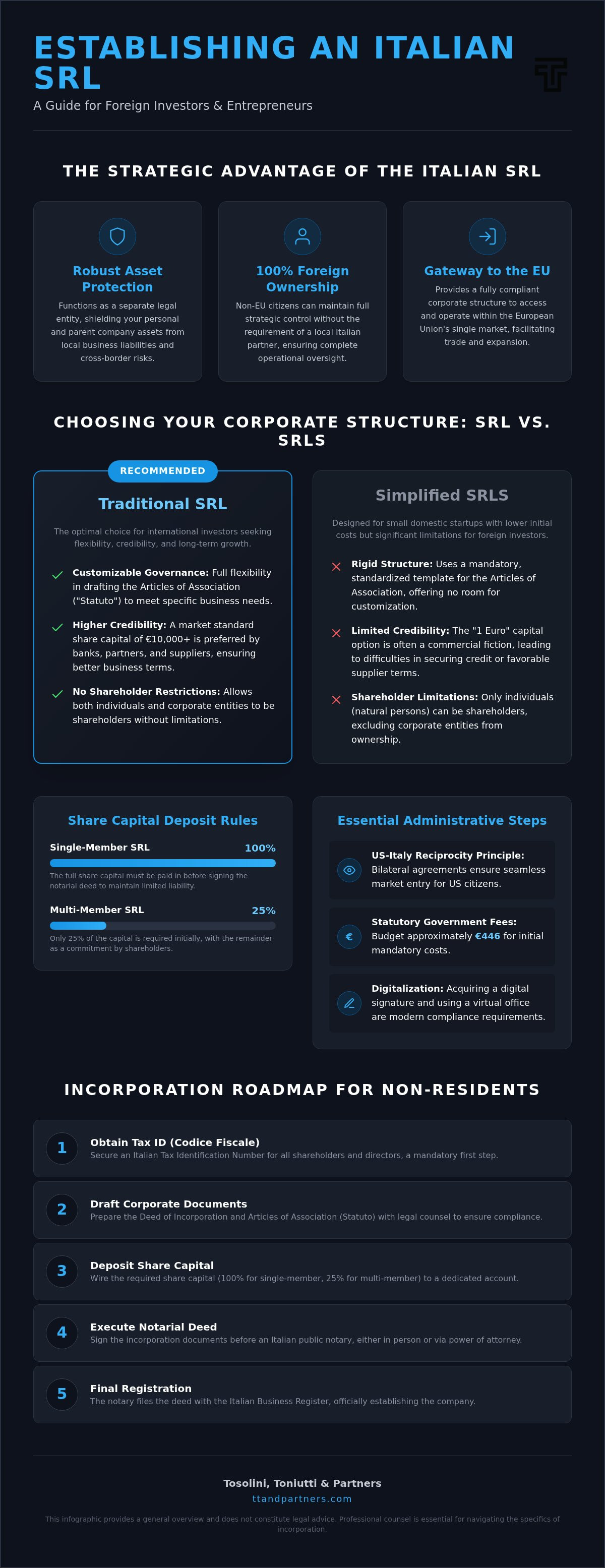
This guide provides the clarity needed to master the intricate nuances of Italian corporate law, from understanding statutory government fees of approximately €446 to selecting the right share capital structure. We explore the technical distinctions between traditional and simplified models, the essential role of virtual offices, and the modern requirements for digital signatures. Our analysis offers a clear roadmap for building a resilient business presence that serves as a foundation for residency or future investment visas. You will gain the intellectual framework necessary to transform a complex regulatory process into a streamlined strategic advantage.
Table of Contents
Understanding the Italian SRL: The LLC Equivalent for Foreigners
The Italian limited liability company structure represents the cornerstone of modern corporate architecture. It functions as the primary vehicle for international investment, providing a sophisticated bridge between local market opportunities and global capital. For many investors, the Italian SRL for foreigners serves as a robust structure that balances operational flexibility with rigorous legal protection. Unlike a branch office, which remains a direct extension of a parent firm, this corporate form is a separate legal entity. This distinction is vital; it ensures that the parent company's assets remain insulated from the liabilities of the local subsidiary, a critical factor for firms managing cross-border risk.
A fundamental consideration for non-EU investors is the principle of reciprocity. This legal doctrine dictates that a foreign citizen can incorporate in the country if an Italian citizen enjoys the same rights in the investor's home nation. Since the United States and Italy maintain long-standing bilateral agreements, American entrepreneurs face few barriers to entry. It's a relationship built on mutual recognition, allowing for a seamless transition into the regional business ecosystem.
The Strategic Benefits of an SRL in 2026
Establishing an Italian SRL for foreigners offers 100% ownership and control, allowing non-EU citizens to maintain full strategic oversight without the need for a local partner. Beyond simple ownership, the entity provides a compliant gateway to the European Union's single market. In 2026, the structural integrity of this model also allows for sophisticated asset protection. By creating a separate legal personality, you shield personal wealth and international holdings from local commercial disputes. It's a professional layer of security that matches the needs of high-stakes international commerce.
Shareholders and Management Roles
Management structures are remarkably adaptable. You can choose to appoint a Sole Director for streamlined decision-making or a Board of Directors for more complex governance needs. Shareholders can be individuals or corporate entities, though the rules change slightly for a single-member entity. While a one-person structure offers limited liability, you must fully pay in the share capital at incorporation and fulfill specific disclosure requirements to maintain that protection. If these technical parameters aren't met, the sole shareholder might face unlimited liability. Navigating these requirements demands a partner who understands the intersection of US and Italian law. You can reach out through our contact page to discuss your specific corporate architecture.
SRL vs. SRLS: Choosing the Right Corporate Structure
Selecting the appropriate corporate architecture is a strategic decision that defines the trajectory of your Italian venture. When evaluating an Italian SRL for foreigners, the choice typically narrows down to the traditional Società a Responsabilità Limitata or its simplified version, the SRLS. While the simplified model attracts attention for its lower initial costs, the traditional SRL offers the structural integrity required for sophisticated international operations. Insights from the U.S. International Trade Administration suggest that Italy's market environment demands a clear, compliant presence to ensure long-term success and credibility with local stakeholders.
The "1 Euro" SRL remains a legal reality in 2026, yet it's often a commercial fiction for serious investors. While you can technically incorporate with minimal capital, banks and suppliers usually require a more substantial foundation to grant credit or favorable terms. The market standard of €10,000 remains the benchmark for professional credibility. For a single-member Italian SRL for foreigners, 100% of the share capital must be deposited before the notarial deed is signed. If you opt for a multi-member structure, you only need to pay in 25% initially, though the full amount remains a commitment of the shareholders.
When to Choose a Traditional SRL
The traditional SRL provides total flexibility in drafting the "Statuto" or Articles of Association. This allows you to customize governance rules, voting rights, and exit strategies to match the specific needs of a US parent company or a diverse group of investors. Crucially, this model allows corporate entities to serve as shareholders, which is a fundamental requirement for most international holding groups. Banks view this structure with greater favor; they often grant interest rates that are significantly lower than those offered to less formal structures because the traditional SRL signals a long-term commitment to the Italian market.
The Limitations of the Simplified SRL (SRLS)
An SRLS is frequently a "trap of economy" for the unwary entrepreneur. It relies on standardized, non-customizable bylaws that cannot be adjusted to include cross-border protections or complex management tiers. Only individuals can be shareholders in an SRLS, which effectively blocks US LLCs or Corporations from owning the Italian entity. Most foreign investors who start with an SRLS eventually find themselves converting to a traditional SRL as they scale. This conversion requires a notary and additional fees, often exceeding the costs they initially sought to avoid. If you're weighing these two paths, a professional review of your business goals can clarify the most efficient path forward for your investment.
The Step-by-Step Incorporation Process for Non-Residents
Transforming a strategic vision into a legal reality requires a disciplined approach to the Italian administrative landscape. The journey begins with obtaining a Codice Fiscale (Tax Code) for every shareholder and director involved in the venture. This identification number is the essential key that unlocks all subsequent interactions with Italian authorities. While the process is administrative, its timing is critical; without it, you cannot sign the notarial deed or open the necessary financial channels. Drafting the Memorandum and Articles of Association follows, a task that demands a dual-jurisdiction perspective to ensure the Italian entity integrates seamlessly with the governance standards of a US-based parent company.
The central figure in this process is the Italian Notary. Unlike in common law jurisdictions, the Italian Notary is a high-level public official who bears the responsibility of verifying the legality of the company's structure and the identity of its founders. They oversee the formal act of incorporation, ensuring all statutory requirements are met before the company is registered. Once the deed is signed, the final milestones involve obtaining a VAT number (Partita IVA) and completing the registration with the Chamber of Commerce. This entire sequence typically spans three to six weeks, provided all international documentation is properly apostilled and translated.
Digital Compliance: PEC and Digital Signatures
Operating an Italian SRL for foreigners in 2026 requires a robust digital infrastructure. Every entity must establish a Certified Email (PEC) address, which serves as the official, legally binding channel for all government communications. For non-resident directors, obtaining a compatible digital signature is a modern necessity. This tool allows for the remote execution of corporate documents and ensures compliance with the mandatory 'Beneficial Owner' (Titolare Effettivo) registry. This registry is a critical component of Italy's transparency framework, requiring clear disclosure of the individuals who ultimately control the entity.
Banking and Capital Deposit
Securing a corporate bank account is often the most complex phase for international investors. You must deposit the required share capital before the notarial deed can be signed. For a single-member SRL, the law requires 100% of the capital to be paid in advance. In contrast, multi-member structures only require a 25% initial deposit of the standard €10,000 capital. This stage involves rigorous Anti-Money Laundering (AML) checks, particularly for funds arriving from US accounts. If you're managing a complex cross-border expansion, you can discuss your specific banking and architecture needs with us through our contact page.
Strategic success for an Italian SRL for foreigners depends on how effectively it bridges two distinct legal environments. It's not just a matter of signing documents; it's about building a sustainable fiscal and legal architecture that survives scrutiny. Leveraging the US-Italy Tax Treaty is a fundamental step in this process. This treaty provides the necessary framework to avoid double taxation on corporate profits, ensuring that your Italian venture remains financially viable in a global context. Professional investors must also prepare for the complexities of cross-border friction. A proactive stance on International Litigation ensures that your corporate interests are protected if disputes arise during the expansion phase. Protecting your intellectual property and contractual rights requires a firm that understands the nuances of both the Italian Civil Code and US commercial law.
The integration of corporate formation and immigration law is where most international ventures either thrive or falter. It's essential to recognize that an SRL isn't just a container for business activity; it's a legal person with rights that can extend to its directors and employees. By aligning your corporate bylaws with residency requirements, you create a seamless path for key personnel. This strategic foresight prevents the common delays associated with mismatched visa applications and corporate registrations, allowing your team to focus on market penetration rather than administrative friction.
The SRL as a Gateway to Residency
For many entrepreneurs, the corporate entity serves as a vital link to the Permesso di Soggiorno (Residency Permit). An active SRL can satisfy the "active business" requirements necessary for the Intra-Company Transfer or the Self-Employed Visa. If you're a US entrepreneur moving to Italy, the director's visa offers a structured path to residency. This foundation is also a strategic precursor for dual-nationals interested in the E-2 Visa framework. You don't just want a company; you want a legal presence that supports your long-term residency goals and protects your family's future.
Ongoing Compliance and Annual Obligations
Maintaining an Italian SRL for foreigners requires diligent attention to annual obligations. Every entity must file annual financial statements, a task that requires a qualified Commercialista to ensure compliance with local accounting standards. You'll also need to manage corporate social security contributions, known as INPS, for directors who actively work within the company. A registered office, or Sede Legale, is a mandatory requirement for all official government correspondence. This address must be a physical location or a compliant virtual office service that meets legal standards. These aren't just administrative tasks; they're the pillars of your company's legal standing in Europe. Our legal team can help you design a tailored expansion strategy when you contact us for a professional consultation.
Why Professional Legal Counsel is Essential for Foreigners
Establishing an Italian SRL for foreigners is an exercise in structural harmony. It's not enough to simply register an entity; you must ensure the Italian "Statuto" aligns with the operational requirements of your home jurisdiction. Many investors stumble when their Articles of Association lack the specific clauses needed to maintain US parent company control. Coordinating between your existing LLC Incorporation and the new Italian structure requires a deep understanding of how these two legal systems interact. Without this foresight, you risk administrative gridlock when trying to consolidate accounts or authorize major corporate actions across the Atlantic.
Precision in documentation serves as the second pillar of a successful expansion. Every certificate and power of attorney must be properly apostilled and translated by certified professionals to meet the exacting standards of the Italian Chamber of Commerce. Minor errors in translation can lead to significant delays at the notary's office, often stalling the entire incorporation timeline. Beyond the initial setup, professional counsel provides the framework for future liquidity events. Whether you're planning an international merger or an eventual exit, your corporate foundation must be built with these long-term objectives in mind to ensure a seamless transition of assets.
The TT&Partners Advantage
Our firm offers a distinct perspective by operating at the intersection of US and Italian law. We don't just provide translations; we provide a bridge for your business vision. Our bilingual team specializes in the US-Italy corridor, offering a holistic approach that integrates corporate law with tax efficiency and immigration strategy. This duality ensures that every decision made in Italy supports your broader global interests, providing a level of coordination that single-jurisdiction firms cannot match. We believe in building structures that are as resilient as they are elegant.
Next Steps for Your Italian Venture
Beginning your expansion starts with a clear assessment of the Italian market's regulatory landscape. We recommend conducting a preliminary feasibility study to ensure your business model is optimized for local tax and compliance requirements. Once you've gathered your initial corporate records, the next stage is a professional review of your architecture. We invite you to schedule a strategic briefing with our team to refine your roadmap and ensure your Italian SRL for foreigners is built for enduring success in the European market.
Mastering Your Expansion into the Italian Corporate Landscape
Establishing an Italian SRL for foreigners isn't merely an administrative task; it's a foundational step in your global investment strategy. By selecting the traditional SRL over simplified models, you ensure the structural flexibility needed for corporate shareholders and future scaling. Success in 2026 demands a holistic approach that synchronizes your business architecture with residency permits and international tax treaties. A well-constructed entity serves as a resilient bridge between your US-based interests and the European Union's single market.
Our firm provides the specialized expertise required to navigate the US-Italy cross-border legal gap. We offer full-service support from the initial drafting of your Articles of Association to the final integration of E-1, E-2, or O-1 visas. This integrated perspective ensures your expansion remains compliant, secure, and aligned with your broader vision. You can secure your US-Italy business expansion with a professional legal consultation today. Italy offers a unique environment for innovation and growth, and with the right legal architecture, your venture is positioned to thrive.
Frequently Asked Questions
Can a US citizen own 100% of an Italian SRL?
Yes, a US citizen can maintain 100% ownership of an Italian SRL for foreigners. This is possible due to the principle of reciprocity between the United States and Italy, which grants American investors the same corporate rights as Italian citizens. You can act as the sole shareholder, known as a Socio Unico. While this offers full control, it requires you to pay in 100% of the share capital at the time of incorporation to maintain limited liability.
What is the minimum capital required for an Italian SRL in 2026?
Legally, you can form an Italian SRL for foreigners with a minimum share capital of just €1. However, the market standard for a professional entity remains €10,000. This higher amount is often necessary to secure credit from banks or favorable terms from suppliers. For a standard multi-member SRL, you must deposit at least 25% of this capital into an Italian bank account before signing the incorporation deed with a notary.
Does opening an SRL in Italy grant me a residency permit?
Opening an SRL does not automatically grant residency, but it serves as a critical foundation for various visa paths. An active company can support applications for an Intra-Company Transfer or a Self-Employed Visa. These permits are the precursors to obtaining a Permesso di Soggiorno. Strategic alignment between your corporate bylaws and immigration requirements is essential for ensuring your business presence translates into a legal right to reside in the country.
What is the difference between an SRL and an SRLS for a foreigner?
The traditional SRL offers full flexibility in drafting bylaws and allows corporate entities, such as a US LLC, to be shareholders. In contrast, the Simplified SRL (SRLS) is restricted to individual shareholders and uses non-customizable, standardized statutes. While the SRLS has lower initial notary fees, most international investors choose the traditional SRL to ensure their corporate structure can adapt to complex cross-border governance and future expansion needs.
How long does it take to incorporate an SRL in Italy as a non-resident?
The incorporation process generally takes between three to six weeks to complete from the initial preparation to final registration. This timeline depends on how quickly you obtain the necessary Italian Tax Codes and ensure all foreign documents are properly apostilled and translated. Delays often occur during the opening of the mandatory corporate bank account, so having professional legal guidance to coordinate these steps is vital for maintaining your project's momentum.
Do I need to visit Italy in person to open an SRL?
You don't necessarily need to be physically present in Italy to incorporate your company. Many investors choose to finalize the process through a Power of Attorney, allowing a legal representative to sign the notarial deed on their behalf. However, you must still obtain a compatible digital signature and a Certified Email (PEC) address. These digital tools allow you to manage official communications and fulfill transparency requirements from your home jurisdiction.
What are the annual maintenance costs for an Italian SRL?
Annual recurring costs typically include the Chamber of Commerce fee of approximately €100 and a corporate books tax of €309.87. You must also budget for professional accounting services, which often start around €3,000 per year, and balance sheet filing fees ranging from €60 to €130. Maintaining a registered office and a PEC address adds further modest costs. These expenses ensure your entity remains in good standing with Italian regulatory and tax authorities.
How does the US-Italy Tax Treaty affect my SRL's profits?
The US-Italy Tax Treaty is a strategic tool that prevents your corporate profits from being taxed in both jurisdictions. It provides specific rules for how dividends, interest, and royalties are handled between the two nations. By correctly applying treaty benefits, you can optimize your fiscal footprint and ensure that your Italian venture supports your overall global financial health. This coordination requires a deep understanding of both Italian and US tax residency rules.



Comments