

Italy Elective Residency Visa: 2026 Guide for US Citizens
- Gianni Mendes Toniutti, Esq.

- 2 minutes ago
- 12 min read
The Italian Elective Residency Visa is often mistaken for a simple retirement permit; instead, it represents a profound legal commitment to a life of leisure that requires the complete cessation of all professional activity. You likely envision a lifestyle defined by the architectural legacy of Rome or the environmental harmony of the Italian countryside. Yet, securing the italy elective residency visa for us citizens is a process paved with rigorous financial scrutiny and exacting documentation. It's natural to feel a sense of hesitation when faced with the strict definitions of passive income or the critical distinction between a consulate visa and the Italian residency permit.
This 2026 guide provides the master roadmap for your relocation. We'll explore the strategic application process, from documenting the required €31,000 minimum annual passive income to securing your legal status within eight days of arrival. By bridging the gap between US documentation and Italian law, you'll gain the clarity needed to move forward with absolute confidence and professional peace of mind.
Table of Contents
The Framework of the Italy Elective Residency Visa (ERV)
The Visto per Residenza Elettiva serves as the premier legal instrument for individuals desiring a permanent presence in Italy without the intent to enter the local labor market. In the 2026 legal landscape, this visa functions as a specialized Type D Long-stay authorization. It aligns with the broader Schengen Area visa policies, yet it maintains a unique domestic character centered on financial self-sufficiency. Unlike standard tourist visas that limit stays to 90 days within a 180-day period, the italy elective residency visa for us citizens provides a stable bridge toward permanent residency. It's designed specifically for retirees, high-net-worth individuals, and those whose wealth is generated through significant passive assets located outside of Italy.
The "No-Work" Rule: A Strict Legal Boundary
The core philosophy of the ERV is the absolute prohibition of any work activity within the country. You cannot finance your stay through subordinate employment, freelance professional services, or any business activity conducted on Italian soil. This restriction is a foundational requirement that Italian consulates monitor with increasing precision during the 2026 application cycle. The legal consequences of violating this work prohibition are severe; they typically include the immediate revocation of your residency permit and potential exclusion from future visa applications. For individuals who still wish to operate a business or maintain an active professional presence, the E-2 Visa or an Investor Visa may offer a more appropriate strategic framework. The ERV demands a total pivot toward a lifestyle of leisure or private study, funded entirely by existing wealth.
ERV vs. Other Residency Pathways
Choosing the correct relocation path requires a holistic view of your long-term goals and heritage. While some applicants may find a faster route through Italian Citizenship via ancestry, the Elective Residency Visa serves those without ancestral ties who seek an immediate and legal way to call Italy home. It's a strategic choice for individuals who value the harmony of Italian life and don't require the legal right to work locally. The ERV is a residency pathway specifically designed for individuals who can support their lifestyle through documented private income from foreign sources. This visa acts as a preliminary step toward long-term integration, allowing US citizens to establish a physical and legal presence while maintaining their global financial structures. It ensures a seamless transition for those whose primary objective is to enjoy the cultural and environmental richness of the Italian peninsula.
Proving Substantial and Steady Passive Income
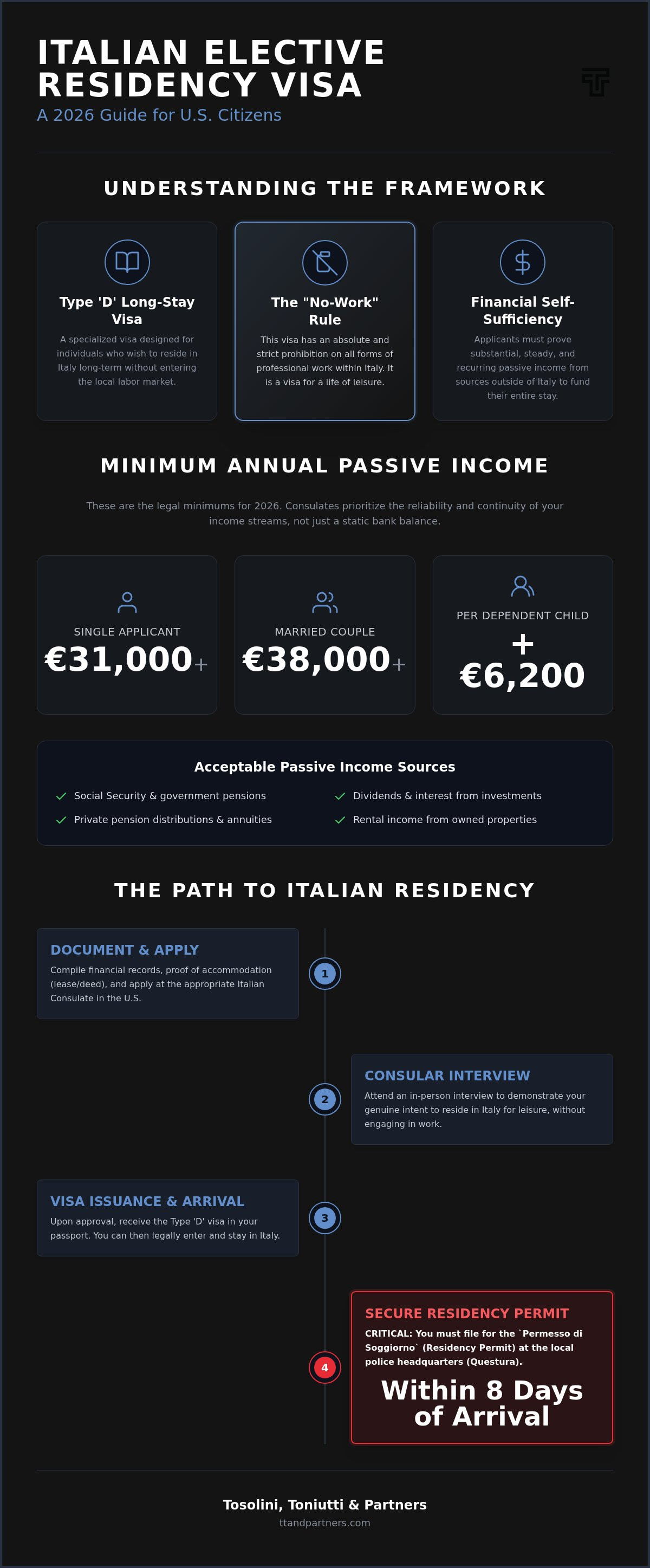
Securing approval for the italy elective residency visa for us citizens requires a shift in perspective; you aren't just showing wealth, you're proving a lifestyle. The legal standard of "steady and adequate" income is the cornerstone of the entire application. While the baseline requirements for 2026 sit at approximately €31,000 for a single applicant and €38,000 for a married couple, these figures represent a legal floor rather than a guarantee of success. Consulates prioritize the continuity and reliability of the revenue stream over a static sum of capital. A significant bank balance, while helpful for supplemental proof, rarely satisfies the requirement on its own. The authorities seek evidence of a recurring, self-sustaining financial architecture that functions entirely independently of your physical presence or active labor. Organizing your financial portfolio involves more than just printing statements. You need a cohesive narrative supported by official bank letters that explicitly state the monthly or annual amount of the distribution. Consulates often look for an additional €6,200 in annual passive income for each dependent child to ensure the family's needs are met without strain.
Acceptable sources of passive income include:
Social Security benefits and government pensions.
Fixed annuities and private pension distributions.
Dividends and interest from diversified investment portfolios.
Documented rental income from owned real estate.
Investment Income and Global Assets
Applicants must demonstrate income from stable economic activities outside Italy. The Italian Consulate General Visa Requirements specify that the income must be documented through the last two years of federal income tax returns. This provides a longitudinal view of your financial health. For business owners, a strategic LLC incorporation in the US can serve as a vehicle for generating qualifying distributions, provided the income is clearly categorized as passive and non-operational.
The Role of Real Estate in Financial Proof
Rental income from US properties remains one of the most persuasive forms of proof. You must provide verified lease agreements and property deeds to establish the legitimacy of these payments. This financial stability often creates a natural synergy with your relocation goals. Many successful applicants choose to solidify their commitment to Italy by transitioning from a US-based portfolio to a real estate closing on an Italian villa or apartment. Documenting these assets with precision ensures the consulate views your application for the italy elective residency visa for us citizens as a permanent, well-funded lifestyle shift. If you're navigating these complex cross-border financial requirements, our specialized immigration department can help align your documentation with consular expectations.
Accommodation and Healthcare: The Physical Requirements
Establishing a physical presence in Italy involves more than simply choosing a scenic location; it requires a documented commitment to a specific residence that meets national standards of suitability. For the italy elective residency visa for us citizens, the consulate demands proof of "suitable accommodation" that ensures you won't become a burden on the state's housing resources. This requirement is strictly defined. You must present either a registered property deed or a long-term lease agreement that has been officially recorded with the Agenzia delle Entrate. Short-term rentals, hotel bookings, or airbnb-style arrangements are insufficient and typically result in an immediate denial. The authorities look for a home that reflects a permanent lifestyle change, emphasizing the architectural and social integration of the applicant into the local community.
Healthcare compliance is equally rigorous. Applicants must secure a private health insurance policy that provides comprehensive coverage without limitations on emergency or routine care. A common pitfall for many US citizens is presenting a standard travel insurance policy. These policies are designed for short-term accidents and medical evacuations; they don't meet the legal threshold for residency. Your policy must offer a minimum coverage of €30,000 per year and be valid across the entire Schengen Area. Without a policy that explicitly covers residency-related medical needs, the legal framework of your application remains incomplete.
Securing a Permanent Home in Italy
The timing of your property search is a critical strategic element. Italian immigration law requires a lease duration of at least 12 months, and this contract must be active at the time of your consular interview. Your chosen address determines which local Questura (police headquarters) will have jurisdiction over your residency permit once you arrive. If you're navigating the complexities of a real estate closing alongside your visa application, ensuring the deed is finalized and translated is paramount for a smooth approval process.
International Healthcare Compliance
For the 2026 application cycle, your insurance documentation must clearly state that coverage is active from the moment you enter the country. While ERV holders may eventually apply for voluntary registration in the Italian National Health Service (SSN), the initial visa requires a private solution. You must ensure that your private health insurance covers the entire duration of the one-year visa to satisfy consular scrutiny. This dual focus on housing and health creates the physical foundation for a successful relocation, providing the peace of mind necessary to enjoy your new Italian life.
The Step-by-Step Application Journey for 2026
The transition to an Italian lifestyle is a structured legal evolution that demands a high degree of organizational discipline. For the italy elective residency visa for us citizens, the process is divided into three distinct phases. Phase 1 focuses on the preparation of a comprehensive dossier at the appropriate US Consulate. This isn't merely a collection of forms; it's a curated presentation of your financial and personal commitment to Italy. Phase 2 involves the Consular Interview, where the primary objective is to demonstrate a "real necessity" for residency. Officers look for a genuine intent to integrate into the Italian social fabric rather than a desire for temporary travel. Finally, Phase 3 begins the moment you land. You have exactly eight working days to register your presence and initiate the residency permit process, a deadline that remains non-negotiable under current immigration protocols.
Consular Jurisdictions and Appointments
Your application must be filed at the consulate that holds jurisdiction over your permanent US residence. In the competitive 2026 landscape, securing an appointment has become a strategic exercise in timing. We recommend monitoring the booking portals at least six months before your planned departure. It's also vital to account for the "Passport Retention" period. Consulates typically keep your physical passport while processing the visa, which can last several weeks. Planning your global business or personal travel around this window is essential to avoid logistical conflicts.
Avoiding Common Application Pitfalls
The most frequent cause for a Request for Evidence (RFE) or an outright denial is the failure to distinguish between "permanent residency" and "extended tourism." If your documentation suggests you're simply looking for a long-term vacation, the application will likely fail. Precision in translations and the inclusion of proper apostilles for every US-issued document are mandatory requirements. When consular decisions appear arbitrary or legally flawed, our firm's experience in International Litigation provides a robust framework for challenging denials and protecting your relocation rights. If you've encountered a setback or wish to ensure your initial filing is beyond reproach, please reach out to our legal team for a professional review.
Securing the Permesso di Soggiorno and Long-Term Residency
Arriving in Italy marks the transition from a visionary goal to a physical reality. While the italy elective residency visa for us citizens grants you entry, the Permesso di Soggiorno (residency permit) is what legally anchors you to Italian soil. Within eight working days of your arrival, you must initiate this process by filing the "Kit Giallo" at an authorized Italian Post Office. This application packet is the first step in a sequence that includes a formal appointment at the Questura for fingerprinting and document verification. During this appointment, you'll sign an Integration Agreement, a legal commitment to acquire basic linguistic skills and respect the social values of the Italian Republic. This receipt you receive at the post office serves as your temporary legal standing until the physical card is issued.
Maintaining your status requires ongoing vigilance. Renewal applications must be submitted at least sixty days before your current permit expires. At each renewal, you must prove that your passive income and housing arrangements remain consistent with the standards established during your initial application. It's a continuous process of legal compliance that ensures your stay remains uninterrupted and secure. Failure to maintain these financial thresholds or a change in the passive nature of your income can lead to renewal denials, making professional oversight of your documentation a necessity.
The Path to Permanent Residency and Citizenship
The Elective Residency Visa is a gateway to long-term integration. After five years of continuous legal residence, you become eligible to apply for a long-term residence permit, which offers greater stability and fewer renewal requirements. After ten years of legal residency, the path to naturalization and Italian citizenship opens. To maintain "stabile residenza," you must be mindful of your time spent outside the country. Generally, permit holders shouldn't be absent from Italy for more than six consecutive months, as prolonged absences can jeopardize your renewal or your path to permanent status. Holding this permit also facilitates seamless travel within the Schengen Area, allowing you to experience the broader European context while maintaining your home base in Italy.
Legal Compliance for Cross-Border Expats
True relocation involves several administrative layers beyond the residency permit. You must register with the local Anagrafe (Registry Office) to establish your formal residence and obtain a Codice Fiscale, which functions as your tax identification number. For those who eventually pursue Italian Citizenship, understanding the role of AIRE (Registry of Italians Residing Abroad) becomes essential if you ever relocate again. The complexity of managing assets and legal status across two jurisdictions makes it vital to consult with a cross-border attorney to ensure your long-term legal health and tax compliance remain in perfect harmony.
Realizing Your Italian Vision in 2026
Relocating to Italy is an architectural feat of legal and personal planning. It requires more than just a desire for the Mediterranean lifestyle; it demands a precise alignment of financial documentation and physical residency standards. Mastering the italy elective residency visa for us citizens ensures that your transition from a US-based life to an Italian life of leisure is both seamless and legally sound. By focusing on the strict requirements for passive income and the critical transition to the Permesso di Soggiorno, you're building a foundation for long-term residency or even future citizenship.
Our firm specializes in the delicate gaps of US-Italy cross-border immigration. We provide comprehensive support that spans from initial consular filings to complex real estate closings and corporate structuring. To ensure your relocation meets the highest standards of legal precision, schedule a consultation with our US-Italy legal experts today. Your future in Italy is a well-designed structure waiting for you to step inside.
Frequently Asked Questions
Can I work remotely for a US company on an Italian Elective Residency Visa?
You cannot legally work remotely for a US company while holding this visa. The Italian Elective Residency Visa is designed for those who have completely withdrawn from the workforce. Consulates strictly interpret the "no-work" rule to include digital nomad activities or remote consulting. If you intend to work while residing in Italy, you should explore the Digital Nomad Visa or an alternative legal pathway that permits professional activity. This ensures you maintain full legal compliance.
What is the minimum passive income required for a couple applying for the ERV?
For a married couple, the minimum required passive income is approximately €38,000 per year. This figure is a baseline established by Italian authorities to ensure that residents don't become a burden on the public welfare system. Consulates often look for higher amounts to guarantee financial security. This income must be entirely passive, derived from sources like Social Security, pensions, or rental dividends, rather than active employment or business operations.
How long does the Italy Elective Residency Visa process take for US citizens in 2026?
Processing times for the italy elective residency visa for us citizens vary depending on the specific US consulate's current workload. Generally, you should expect the entire process to take between three to six months. This includes the time needed to secure an appointment and the subsequent 90-day window allowed for the consulate to issue the visa. Planning your departure at least six months in advance is a strategic necessity for a smooth relocation.
Do I need to buy property in Italy to qualify for the Elective Residency Visa?
You aren't required to purchase real estate to qualify for the visa. However, you must provide proof of suitable accommodation through either a deed of ownership or a registered long-term rental contract. This contract must be for at least one year and registered with the Italian tax authorities. Short-term rentals or hotel reservations are insufficient and will likely lead to an immediate rejection of your application during the consular interview phase.
Can I travel to other European countries with an Italian residency permit?
Yes, you can travel freely within the Schengen Area with your Italian residency permit. Your Permesso di Soggiorno allows you to visit other member countries for up to 90 days within any 180-day period for tourism purposes. It's essential to carry both your valid passport and your physical residency card when crossing borders. This flexibility is one of the primary benefits for US citizens establishing a long-term home base on the Italian peninsula.
What happens if my Elective Residency Visa application is denied?
If your application is denied, you have the right to file a formal appeal through the Italian administrative courts. This process often requires the expertise of a law firm experienced in international litigation to challenge the consulate's decision. Alternatively, you may choose to address the specific reasons for the refusal and submit a new application. Common reasons for denial include insufficient proof of passive income or housing arrangements that don't meet suitability standards.
Is the Elective Residency Visa a direct path to Italian citizenship?
The Elective Residency Visa provides a structured path toward Italian citizenship through naturalization. You're eligible to apply for citizenship after ten years of continuous legal residence in the country. Before reaching that milestone, you can apply for a long-term residence permit after five years. This progression requires you to maintain your legal status, pay local taxes, and demonstrate continued financial self-sufficiency throughout your decade of residency in Italy.
Do I need to pay taxes in both the US and Italy as an ERV holder?
As a US citizen residing in Italy, you'll likely have tax obligations in both jurisdictions. The United States taxes its citizens on their worldwide income regardless of where they live. Simultaneously, becoming a legal resident of Italy typically makes you an Italian tax resident. While a bilateral tax treaty exists to prevent double taxation, you must file annual returns in both countries. Consulting with a cross-border legal team is vital for managing these complex financial structures.


Comments