

Serving Legal Documents in Italy from the US: A 2026 Strategic Guide

A US judgment is only as resilient as the procedural foundation that supports it. When you're serving legal documents in Italy from US jurisdictions, you aren't merely delivering notice; you're navigating a sophisticated intersection of two distinct legal heritages. It's natural to feel a sense of unease regarding the 3 to 6 month processing window at the Italian Central Authority or the strict requirement to translate every single exhibit into Italian. You recognize that a single administrative oversight can render a hard-won judgment completely unenforceable abroad.
This guide promises to demystify the Hague Service Convention, providing you with the technical precision required for total jurisdictional validity. We'll explore the strategic nuances of the 2026 landscape, including the specific role of the Rome Court of Appeals and the necessity of comprehensive linguistic accuracy. You'll gain a clear roadmap to securing a valid certificate of service while maintaining compliance with both international treaties and local Italian mandates. Our objective is to help you build a secure framework for successful international litigation that respects the past while leveraging modern procedural efficiencies.
Table of Contents
The Framework for Serving Process in Italy: The Hague Service Convention
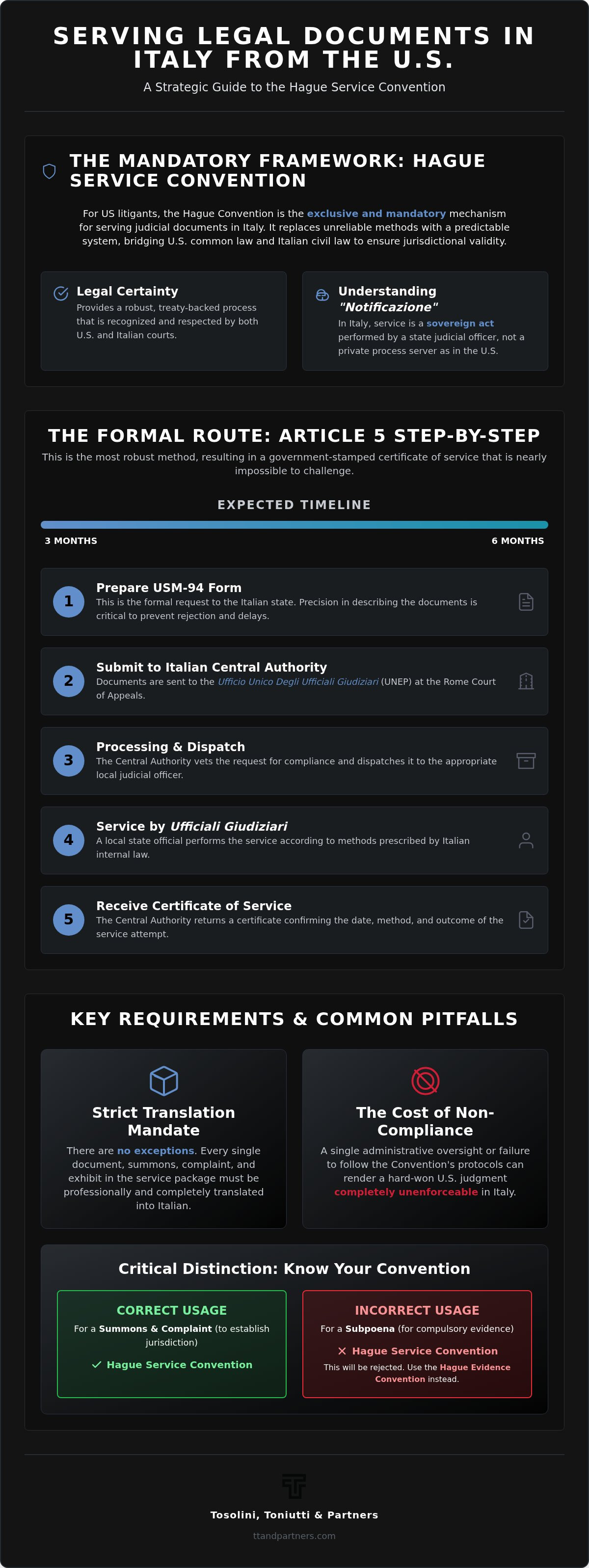
The architecture of international litigation rests upon the integrity of procedural notice. For those serving legal documents in Italy from US courts, the primary structural framework is the Hague Service Convention. Established in 1965 and ratified by Italy in 1981, this treaty provides the exclusive mechanism for transmitting judicial documents between these two nations. It replaces the archaic and often unreliable methods of letters rogatory with a centralized, predictable system. This treaty ensures that legal certainty isn't sacrificed for speed, creating a bridge between the common law traditions of the US and the civil law requirements of Italy.
Exclusivity is the cornerstone of this framework. US courts generally view the Convention's protocols as mandatory when the recipient's address is known. If a litigant attempts to use private process servers or informal delivery methods that contradict the treaty, they risk a total collapse of their case. This isn't just a technicality; it's a matter of international sovereignty. In the Italian civil law tradition, service is termed notificazione. Unlike the US system, where a private citizen can often hand over a summons, notificazione is a sovereign act performed by a state official. Failing to respect this distinction can lead to a US judgment being declared unenforceable in Italy, effectively neutralizing any victory achieved in a US courtroom.
The Role of the Italian Central Authority
Italy has designated the Ufficio Unico Degli Ufficiali Giudiziari (UNEP) at the Court of Appeal in Rome as its primary channel for international service. This office functions as the Central Authority, vetting incoming requests for technical compliance before distributing them to local judicial officers, known as Ufficiali Giudiziari. Under Article 5, the Central Authority's mandate is to facilitate the service of documents either through methods prescribed by Italian internal law or through a specific, compatible process requested by the applicant. This centralized oversight ensures that the defendant's due process rights are maintained according to Italian constitutional standards.
Summons vs. Subpoenas: A Critical Distinction
A frequent pitfall for US attorneys is the failure to distinguish between a summons and a subpoena. The Hague Service Convention governs the delivery of notice, such as a summons or a complaint, to establish jurisdiction over a party. It doesn't apply to the compulsory production of evidence or the scheduling of depositions. For these discovery-related tasks, practitioners must utilize the Hague Evidence Convention. Attempting to serve a subpoena through the service treaty channels is a strategic error that often results in immediate rejection by the Roman authorities, causing significant delays in the litigation timeline.
The Formal Route: Step-by-Step Article 5 Service
Article 5 remains the most robust method for serving legal documents in Italy from US jurisdictions because it provides a government-stamped certificate that is nearly impossible to challenge in later enforcement proceedings. The process begins with the preparation of the USM-94 form. This document acts as the formal request from the US applicant to the Italian state. Practitioners often stumble by failing to specify the exact nature of the documents or by leaving the summary section too vague. Precision at this stage prevents the Italian Central Authority from returning the package for clarification, a mistake that can add months to an already lengthy process.
While the Italian government doesn't charge a fee for service requested through the Central Authority as of late 2026, the real investment is time. You should prepare for a timeline of 3 to 6 months. Once your documents reach the Single Office of Judicial Officers at the Rome Court of Appeals, they're queued for processing and eventually dispatched to local officials. Monitoring this timeline requires a deep understanding of how Italian administrative cycles function. If you're managing a complex case with tight deadlines, it's often wise to consult with cross-border counsel to ensure your filing doesn't sit idle due to minor clerical discrepancies.
Document Preparation and Authentication
Acceptance by the Italian authorities requires more than just a photocopy of the complaint. You must provide authenticated copies of the summons and all associated filings. Every page, including every exhibit, must be accompanied by a certified Italian translation. A common failure point is the signature on the USM-94 form. While some jurisdictions allow an attorney to sign as a competent authority, Italian officials frequently prefer the seal of the court clerk. Verifying these specific preferences before mailing your package can save months of wasted effort and prevent the risk of a non-service return.
The Italian Judicial Officer's Process
Once the Central Authority approves the request, it's forwarded to a local judicial officer. This officer is responsible for the physical delivery of the documents to the defendant. If the defendant isn't present at the time of delivery, Italian law allows for substituted service. This might involve leaving the documents with a capable family member or a neighbor, followed by a registered letter of notification to the defendant. The final proof of this act is the Certificate of Service. This document, once returned to you, serves as your definitive evidence that notice was properly given under international law, allowing the US court to proceed with full jurisdictional confidence.
Alternative Methods: Article 10 and Informal Service
While the Central Authority route is the most traditional path, Article 10 of the Hague Convention provides alternative channels that can significantly alter the pace of your litigation. Italy's decision not to formally object to Article 10(a) or 10(b) creates a procedural opening for those serving legal documents in Italy from US courts. However, this lack of objection shouldn't be mistaken for a blanket endorsement of informal methods. Choosing an alternative route requires a calculated assessment of the risks to future enforcement and the intellectual rigor of your overall strategy.
The Risks of Service by Mail
Article 10(a) permits service through international registered mail. While US federal courts often find this method sufficient to establish jurisdiction, the reality on the ground in Italy is far more complex. The primary hurdle is the Avviso di Ricevimento, or return receipt. If the defendant refuses to sign or if the signature is illegible, the evidentiary weight of the service vanishes. Italian courts maintain a high threshold for due process; they frequently view mail service as a secondary, less reliable method. This creates a dangerous paradox where you might win a default judgment in a US court only to find it's a "paper tiger" that cannot be enforced against Italian assets because the service was deemed defective under local standards.
Direct Interaction with Italian Counsel
For those seeking to compress the timeline without sacrificing validity, Article 10(b) offers a more sophisticated path. This method involves engaging local counsel to work directly with the Ufficiale Giudiziario. By bypassing the Central Authority's administrative queue, this route can be four to eight weeks faster than the standard Article 5 process. It requires a Procura, a formal power of attorney, allowing the Italian lawyer to act on your behalf. This approach integrates local expertise into your broader strategy, especially when coordinating service with complex international litigation goals. While more resource intensive, the speed and direct oversight often justify the investment for high stakes corporate disputes where asset recovery is the ultimate objective.
The choice between these methods isn't just about speed; it's about the future recognition of your judgment. While Article 10(b) is significantly more expensive than the Central Authority route, it provides a level of control that mail service cannot match. You aren't just sending a package; you're ensuring that a local official, guided by your legal team, executes the service in strict accordance with Italian civil procedure. This harmony between US requirements and Italian execution is what creates a truly resilient legal foundation.
Translation Requirements and Due Process Standards
Linguistic accuracy is not a secondary concern; it's a jurisdictional mandate. When serving legal documents in Italy from US jurisdictions, practitioners must adhere to Italy's specific declaration under Article 5(3) of the Hague Convention, which makes the translation of all judicial documents into Italian strictly mandatory. This requirement extends beyond the summons and complaint to include every exhibit and attachment. While it's tempting to provide summaries for voluminous evidence, the Italian Central Authority frequently rejects incomplete translations. This can lead to a total restart of the 3 to 6 month service cycle.
The "Understanding" test adds another layer of complexity to the due process analysis. Even if a defendant is a corporate entity with English-speaking executives, the right to receive notice in the official language of the state of service remains a powerful defensive tool. If the recipient can plausibly claim they didn't understand the legal implications of the English text, they may move to quash service or block the enforcement of a subsequent US judgment. Strategic litigation requires you to pre-empt these claims by providing high-quality, professional translations that leave no room for ambiguity regarding the nature of the claims or the deadlines for response.
Sworn Translations (Traduzioni Giurate)
For high-stakes litigation, a standard certificate of accuracy from a US-based agency often falls short of Italian judicial expectations. The gold standard is the asseverazione, or sworn translation, performed by a professional registered with an Italian court. This process involves the translator appearing before a court official to swear an oath that the text is a faithful rendition of the original. An accurate translation in cross-border service is one that preserves the legal effect and semantic intent of the original text while adhering to the technical terminology of the receiving state's judicial system. This level of precision ensures that the documents carry the necessary weight when presented to an Italian judicial officer.
Due Process and the Right to Refuse
A defendant in Italy has a procedural right to refuse documents if they aren't provided in Italian or a language the recipient clearly understands. This "right of refusal" is a common tactic used to delay proceedings. To counter this, savvy practitioners often employ a "Double Service" strategy. This involves serving the defendant at both their registered business address and their personal residence, ensuring that notice is perfected through multiple channels. By coordinating these efforts with a bilingual team that understands the nuances of both systems, you can effectively neutralize the defendant's ability to claim a lack of notice. If you're preparing a complex filing, contact our bilingual team to coordinate your sworn translations and service strategy.
Strategic Litigation: Service as a Foundation for Enforcement
The ultimate efficacy of a US judgment in Europe depends entirely on the integrity of the initial notice. While many practitioners view the act of serving legal documents in Italy from US courts as a mere administrative hurdle, it's actually the first step in an asset recovery strategy. If the service of process is found to be defective, the entire litigation effort becomes a hollow victory. Italian courts don't simply rubber-stamp foreign judgments. They conduct a rigorous review to ensure that the defendant's rights were protected from the very beginning of the dispute.
Success in international litigation requires a holistic vision that connects procedural acts with long-term business goals. For instance, coordinating service with strategic LLC incorporation and asset protection frameworks ensures that the legal architecture is robust enough to withstand challenges in multiple jurisdictions. When service is executed with the end goal of enforcement in mind, the transition from a US court order to an Italian asset seizure becomes a logical progression rather than a procedural nightmare. This foresight is what separates a standard legal filing from a sophisticated cross-border strategy.
The Nexus Between Service and Enforceability
In Italy, the process of recognizing a foreign judgment is known as Exequatur. During this phase, the Corte d'Appello (Court of Appeal) scrutinizes the record to verify that service was perfected according to the Hague Convention. Any deviation from the treaty's mandates can trigger the "Public Policy" (ordine pubblico) trap. Italian judges view due process as a fundamental pillar of their legal system. If they determine that a defendant wasn't given proper notice in their native language or through the correct official channels, they'll refuse to recognize the US judgment. To mitigate this risk, some litigants opt for simultaneous service in multiple jurisdictions, ensuring that jurisdiction is anchored firmly across all relevant borders.
Consulting with Cross-Border Experts
A standard process server lacks the intellectual depth to manage the complexities of Italian civil law and international treaties. Effective litigation demands a team that understands the broader commercial context, including how legal disputes might impact an E-2 visa status or a treaty investor's corporate standing. You need a bilingual, dual-qualified team that can act as a bridge between the US common law approach and the Italian civil law requirements. This specialized expertise ensures that every document, from the initial summons to the final certificate of service, is technically perfect and strategically sound. If you're managing a high-stakes dispute that requires precision and a visionary approach, contact Tosolini, Toniutti & Partners for a litigation consultation.
Building a Resilient Cross-Border Legal Foundation
Success in international disputes requires more than just technical compliance; it demands a visionary approach to procedural integrity. Mastering the complexities of the Hague Service Convention ensures that your efforts aren't undermined by administrative defects. Whether you choose the formal Article 5 route or a strategic Article 10 interaction, the priority remains the same: creating a valid certificate of service that withstands the scrutiny of the Roman Court of Appeals. This procedural precision is the only way to ensure your US judgment is recognized abroad.
When you are serving legal documents in Italy from US jurisdictions, every detail, from sworn translations to local judicial coordination, becomes a pillar of your future enforcement. Our bilingual and dual-qualified legal professionals provide the decades of US-Italy legal expertise necessary to manage these intricacies with precision. We maintain a strategic focus on international asset recovery to ensure your litigation translates into tangible results on the ground. This holistic approach bridges the gap between different legal heritages with aesthetic and professional harmony.
Secure Your Cross-Border Interests with Expert Litigation Support and ensure your international strategy is built on a foundation of total jurisdictional validity. Your path to a successful resolution in Italy starts with a single, perfectly executed act of service.
Frequently Asked Questions
Do I need to translate all exhibits when serving process in Italy?
Italy's declaration under Article 5(3) makes it mandatory to translate the entire document package into Italian. This includes the summons, the complaint, and every exhibit attached to the filing. Failing to provide a verbatim translation of exhibits can lead to the Italian Central Authority rejecting the request. This administrative hurdle often adds several months to the litigation timeline when serving legal documents in Italy from US jurisdictions.
How long does it take to serve legal documents in Italy via the Central Authority?
Service through the Italian Central Authority typically takes between 3 and 6 months to complete. This window covers the initial vetting by the Rome Court of Appeals and the subsequent dispatch to a local judicial officer. While this is relatively efficient compared to other nations, it requires patience. You can sometimes speed up the process by four to eight weeks if you use alternative methods involving local judicial officers directly.
Can I serve a subpoena in Italy using the Hague Service Convention?
The Hague Service Convention doesn't apply to subpoenas for the production of evidence or depositions. It's strictly designed for the transmission of judicial and extrajudicial documents like a summons or complaint. If you need to compel testimony or document production from a party in Italy, you must use the Hague Evidence Convention instead. Conflating these two treaties is a common error that leads to immediate rejection by Italian authorities.
Is service of process by international mail valid in Italy?
Italy doesn't formally object to Article 10(a), which means service by international registered mail is technically permitted under the treaty. However, it's rarely a safe choice for high stakes litigation. Italian courts frequently refuse to recognize judgments based on mail service because it lacks the formal notificazione performed by a state official. Relying on mail can jeopardize your ability to seize assets in Italy later in the process.
What is a USM-94 form and who needs to sign it?
The USM-94 is the mandatory "Request for Service Abroad" form required by the Hague Convention. It identifies the parties, the nature of the lawsuit, and the specific documents to be delivered. While many US jurisdictions allow the plaintiff's attorney to sign as the "competent authority", Italian officials often prefer the signature and seal of the court clerk. Verifying this requirement beforehand prevents your application from being returned for clerical errors.
What happens if the defendant in Italy refuses to accept the documents?
If a defendant in Italy refuses to accept the documents, the judicial officer can still perfect service through substituted methods. Under Italian civil procedure, the officer may leave the package with a capable family member or a neighbor at the defendant's residence. They'll then send a registered letter of notification to the defendant. This process ensures that a party can't avoid the lawsuit simply by closing their door to the official.
Do I need a local Italian lawyer to serve papers in Italy?
You don't strictly need a local lawyer for a standard Article 5 request, but their expertise is vital for navigating the Italian judicial system. A bilingual team helps manage complex translations and coordinates directly with the Ufficiale Giudiziario to prevent delays. If you're pursuing direct service under Article 10(b), you'll need an Italian attorney to obtain the necessary court orders and provide a formal power of attorney for the engagement.
Is electronic service (email) permitted for US lawsuits in Italy?
Electronic service via email or social media isn't currently a recognized method for serving legal documents in Italy from US courts. Italy hasn't authorized these channels under the Hague Convention, and Italian civil procedure remains rooted in physical delivery by state officials. Attempting email service will almost certainly result in a US judgment that's unenforceable in Italy. Stick to the recognized treaty channels to maintain the jurisdictional validity of your case.



Comments