

US Business Incorporation for Italians: 2026 Guide

Establishing a company in the United States is not merely a matter of filing paperwork; it is the architectural design of a bridge between two distinct legal and fiscal cultures. For the Italian visionary, the allure of the American market is often tempered by the intricate complexities of the US-Italy tax treaty and the valid concern over personal liability. Mastering US business incorporation for Italian citizens requires a blend of technical precision and strategic foresight that goes far beyond simple registration.
You likely recognize that a misstep in entity selection can jeopardize your assets or your eligibility for a Treaty Investor (E-2) visa. This 2026 guide provides the intellectual framework to navigate these challenges with confidence. We will examine how to build a legally robust US presence that protects your interests while creating a seamless path for cross-border expansion. By integrating corporate structure with visa requirements and tax planning, you can transform a complex regulatory hurdle into a sophisticated foundation for international success.
Table of Contents
Navigating US Business Incorporation for Italian Nationals in 2026
The expansion of an Italian enterprise into the American market in 2026 represents more than a commercial move; it's a deliberate act of institutional scaling. For many Italian founders, the US serves as a vital ecosystem for growth, offering a landscape where innovation meets unparalleled capital depth. Success in this environment requires a precise understanding of the 'Foreign-Owned Entity' status. Within the US legal framework, your business is viewed as a domestic structure with specific disclosure requirements, particularly concerning beneficial ownership. Certain high-stakes investments may also involve oversight from the Committee on Foreign Investment in the United States (CFIUS), which evaluates the security implications of foreign capital entering critical sectors.
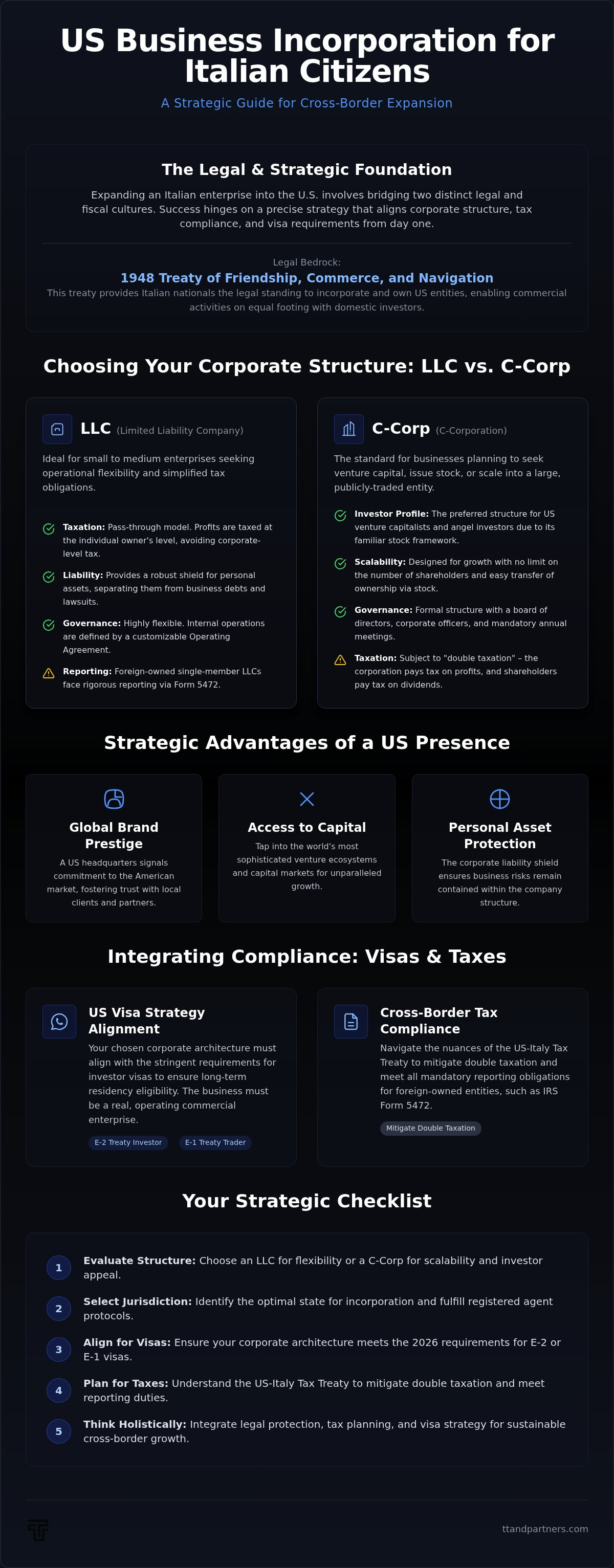
The foundation of US business incorporation for Italian citizens rests upon the 1948 Treaty of Friendship, Commerce, and Navigation. This historic agreement provides the legal bridge that allows Italian nationals to engage in commercial activities on equal footing with domestic investors. While automated filing services offer a veneer of speed, they often fail to account for the intellectual complexity of this treaty. High-stakes ventures require a bespoke legal architecture that aligns corporate bylaws with long-term immigration and tax strategies. A generic setup might save time today, but it can create structural fractures when you later apply for investor status or seek to mitigate double taxation.
The Strategic Advantage of a US Presence
Establishing a US entity provides immediate access to the world's most sophisticated venture ecosystems and capital markets. It allows Italian entrepreneurs to shield their personal assets through corporate liability protection, ensuring that the risks of international expansion remain contained within the business structure. Beyond the legal safeguards, a US-based headquarters enhances global brand prestige. It signals to American clients and partners that you're committed to the local market, fostering a level of trust that cross-border transactions alone cannot achieve.
Legal Capacity for Italian Citizens
Italian citizens enjoy the right to own and manage 100% of a US business as non-resident aliens. It's vital to distinguish between corporate ownership and the right to work; owning a company doesn't automatically grant the legal authority to perform daily operational duties on US soil. Italian treaty nationals possess the robust legal standing to incorporate and own US entities as non-resident aliens, enjoying the full protections afforded by bilateral commercial agreements. For those seeking a comprehensive strategy that integrates setup with future growth, consulting a specialized firm at ttandpartners.com/contact ensures your corporate foundation is built with the necessary precision to support both your business and your visa objectives.
LLC vs. C-Corp: Selecting the Optimal Structure for Italian Investors
Choosing a corporate vehicle is a foundational decision that shapes the fiscal and operational future of an Italian enterprise in America. This choice isn't merely administrative; it's a strategic maneuver that balances tax efficiency with the need for future capital. For most Italian entrepreneurs, the decision centers on whether to prioritize the flexibility of a Limited Liability Company (LLC) or the institutional rigidity and scaling potential of a C-Corporation. Each path carries distinct implications for how profit is treated under the US-Italy tax treaty and how the entity interfaces with US immigration authorities. Mastering US business incorporation for Italian citizens requires selecting a structure that harmonizes with both domestic growth and international compliance.
The LLC Framework for Italian Entrepreneurs
The LLC remains the preferred structure for small to medium-sized enterprises seeking a pass-through tax treatment. In this model, the entity's profits are generally taxed at the individual level rather than the corporate level. For Italian-based founders, this provides a robust shield for personal assets while maintaining a lean administrative profile. In 2026, the IRS maintains a high level of transparency for foreign-owned, single-member LLCs, requiring rigorous reporting through Form 5472. Despite these disclosures, the LLC offers unmatched governance flexibility. Owners can define their internal relationships through a bespoke Operating Agreement rather than following the strict statutory requirements of corporate bylaws. This structural agility is often a key factor when aligning the business with the Official E-2 Treaty Investor Visa Guidelines, as it allows for a clear demonstration of the investor's control over the enterprise.
The C-Corporation and Global Scaling
Investors aiming for rapid expansion or seeking venture capital often find the C-Corporation to be the superior choice. This structure standardizes equity, making it easier to issue shares to US-based employees or international investors. Under current 2026 regulations, C-Corporations are subject to a 21% federal corporate tax rate. While this introduces the potential for double taxation, once at the corporate level and once on dividends, the US-Italy treaty provides significant relief. Specifically, the withholding tax on dividends is limited to 15%, or as low as 5% for qualified corporate parents who own at least 25% of the voting stock. Italian founders must also remain vigilant regarding the Permanent Establishment rules; if the US entity is managed too closely from Italy, it may inadvertently trigger tax liabilities in both jurisdictions. Ensuring your corporate architecture is sound from the start prevents these cross-border frictions. For a precise evaluation of which structure serves your long-term vision, consulting with a specialist can provide the necessary clarity for your expansion.
The Step-by-Step Roadmap to Incorporating Your US Entity
Executing the US business incorporation for Italian citizens involves a transition from abstract strategy to procedural precision. The process begins with the formal selection of a jurisdiction, a choice that dictates the legal environment where your enterprise will reside. Once the state is selected, you must appoint a Registered Agent. This individual or entity serves as the official point of contact for service of process and state communications, ensuring that your business remains in good standing with local authorities. The core of the filing consists of submitting Articles of Organization or Incorporation to the Secretary of State, a document that formally births the entity into the American legal landscape.
Choosing the Right Jurisdiction
Selecting a jurisdiction requires a sophisticated analysis of corporate laws and their long-term impact on your operations. Many Italian investors prioritize jurisdictions with a robust Chancery Court system, which offers specialized judicial expertise in resolving complex business disputes without the unpredictability of a jury. This legal stability is essential for high-stakes ventures where intellectual property or intricate equity structures are involved. For a deeper exploration of how these choices influence your corporate form, refer to our LLC Incorporation: A Strategic Guide to US Business Architecture in 2026. The goal is to find a balance between administrative simplicity and a protective legal framework that respects the nuances of the U.S.-Italy Income Tax Treaty.
The EIN and Banking Hurdle for Italians
The post-incorporation phase often presents the most significant logistical challenges for non-resident founders. Obtaining an Employer Identification Number (EIN) from the IRS is a prerequisite for any commercial activity, yet doing so without a Social Security Number (SSN) or Individual Taxpayer Identification Number (ITIN) requires a specific application process. Italian citizens must also account for the international authentication of documents; often, US-issued corporate papers require an Apostille to be recognized by Italian authorities or banks. Navigating 'Know Your Customer' (KYC) protocols at US financial institutions involves demonstrating a legitimate physical nexus. This goes beyond a mere mailing address. Banks in 2026 demand evidence of a functional business presence to ensure account security and compliance.
Secure a professional Registered Agent to manage legal notices and maintain compliance.
File organizing documents that reflect your long-term governance and equity needs.
Apply for an EIN through specialized channels designed for foreign owners without an SSN.
Establish a physical US nexus to facilitate banking and merchant services.
Cross-Border Tax Compliance and the US-Italy Tax Treaty
The fiscal architecture of US business incorporation for Italian citizens is governed by the 1984 Double Taxation Treaty and its 1999 protocol. This framework's designed to prevent the same income from being taxed in both jurisdictions, yet its application requires surgical precision. For the Italian investor, the primary challenge lies in balancing US domestic tax obligations with Italian residency rules. Failure to maintain a clear separation between the two can lead to corporate tax inversion, where Italian authorities claim taxing rights over the US entity because its effective management's perceived to remain in Italy. Establishing a legitimate permanent establishment in the US isn't just a commercial goal; it's a defensive tax necessity that protects your global revenue.
IRS Reporting for Italian Owners
Foreign-owned US entities face rigorous information reporting requirements that differ significantly from those of domestic firms. Form 5472 is the most critical document for an Italian-owned LLC, used to disclose reportable transactions between the US company and its foreign owners. This form must be filed alongside the annual informational Form 1120. In 2026, the IRS has intensified its scrutiny of these disclosures to ensure global tax transparency. The 2026 penalty threshold for failing to file required information returns remains a significant financial burden that can escalate for continued non-compliance. Maintaining meticulous records of every cross-border transfer's the only way to safeguard the entity against these aggressive enforcement measures.
Mitigating Double Taxation
The treaty provides specific relief through reduced withholding rates on various types of passive income. Under the current agreement, the standard withholding tax on dividends is 15%, which is reduced to 5% if the beneficial owner's a company that has held at least 25% of the voting stock for a minimum of 12 months. Interest payments are generally limited to a 10% withholding rate. For royalties, the treaty distinguishes between types: software and scientific equipment royalties are taxed at 5%, while other intellectual property carries an 8% rate. Coordinating these benefits requires a synchronized effort between your US legal counsel and your Italian tax advisor. By strategically applying foreign tax credits, you can optimize your global liability and ensure that your expansion remains fiscally sustainable. To ensure your tax strategy's as robust as your business plan, contact our specialized cross-border team for a comprehensive review of your corporate structure.
Integrating Incorporation with US Visa Strategy (E-2 and E-1)
The final step in US business incorporation for Italian citizens involves aligning the corporate structure with long-term residency goals. For many Italian nationals, the entity serves as the primary vehicle for an E-2 Treaty Investor or E-1 Treaty Trader visa. This isn't a secondary consideration; it's a structural requirement. The way you draft your operating agreement or bylaws can directly influence a consular officer’s assessment of your "control" over the investment. In 2026, USCIS has increased its scrutiny, issuing 22% more Requests for Evidence (RFEs) compared to previous years. A fragmented approach, where corporate setup and immigration strategy are handled by separate entities, often leads to inconsistencies that trigger these delays.
The E-2 Visa Foundation
To qualify for an E-2 visa, your capital must be considered "at risk." This means the funds must be irrevocably committed to the business before the application is submitted. Simply holding money in a corporate bank account doesn't suffice; you must demonstrate that the investment is active and the enterprise is operational. You must also pass the "marginality" test. Your business plan must prove that the entity has the capacity to generate more than enough income to provide a minimal living for you and your family. For a detailed breakdown of these requirements, see our E-2 Visa Guide 2026: The Strategic Framework for Treaty Investors. While there's no legal minimum, a practical investment for a service business in 2026 often ranges between $120,000 and $150,000.
Strategic Counsel for Cross-Border Expansion
The E-1 Treaty Trader visa offers an alternative for those whose primary focus is the continuous exchange of goods or services. Successful E-1 applications often involve trade volumes exceeding $250,000 annually, with at least 50% of that trade occurring between the US and Italy. Whether pursuing an E-1 or E-2, the benefit of unified legal representation cannot be overstated. By coordinating your corporate architecture with your immigration petition, you ensure that every document, from the initial filing to the final business plan, tells a consistent story. This holistic approach minimizes the risk of structural mistakes that often lead to denials. To secure a foundation that supports both your commercial and personal aspirations in America, Contact Tosolini, Toniutti & Partners for expert guidance.
Architecting Your American Expansion
Building a sustainable enterprise in the United States requires a sophisticated synthesis of corporate governance, fiscal discipline, and immigration strategy. The process of US business incorporation for Italian citizens isn't a mere administrative filing; it's a strategic foundation that must account for the nuances of the US-Italy tax treaty and the rigorous "at risk" requirements of treaty investor status. Whether you select the flexibility of an LLC or the scalability of a C-Corp, your success depends on a structure that harmonizes with both domestic growth and international compliance.
Tosolini, Toniutti & Partners provides the specialized bridge between these two legal systems. With decades of experience in cross-border law and expertise in E-1 and E-2 visas, we offer comprehensive support ranging from entity formation to real estate closings. Secure your US business future; consult with our cross-border legal experts today. Your vision for the American market deserves a framework as ambitious as the goals you set for your enterprise.
Frequently Asked Questions
Can an Italian citizen own 100% of a US LLC?
Yes, Italian citizens can hold full ownership of a US Limited Liability Company. US corporate law doesn't impose citizenship or residency requirements on shareholders or members of an LLC. This allows Italian entrepreneurs to maintain complete control over their American ventures while benefiting from a structure that shields personal assets. However, it is vital to remember that 100% ownership doesn't grant the legal right to work physically within the United States without a valid visa.
Do I need to live in the United States to run my US company?
No, you can manage your US entity remotely from Italy or any other global location. By appointing a professional Registered Agent, you ensure that your business maintains a consistent legal point of contact for state and federal authorities. While day to day management can occur abroad, a physical US nexus is often required to maintain banking relationships. If you wish to perform operational work on US soil, you'll need to secure an E-1 or E-2 visa.
How does the US-Italy tax treaty prevent double taxation for entrepreneurs?
The treaty provides a legal framework that determines which country has the primary right to tax specific income streams. It utilizes mechanisms such as foreign tax credits and reduced withholding rates on dividends and royalties to ensure you aren't taxed twice on the same profit. By correctly applying these treaty benefits, Italian investors can significantly reduce their global tax burden. This coordination requires precise alignment between your US legal counsel and your Italian tax professionals to ensure full compliance.
Is an Italian Apostille required for US business documents?
Yes, any US corporate document intended for use in Italy must be authenticated with an Apostille. This certification is issued by the Secretary of State in the jurisdiction where your company is incorporated. It confirms the document's validity under the Hague Convention, making it legally recognizable by Italian banks and government agencies. This step is essential for Italian citizens who need to register their US expansion or open secondary accounts within the Italian legal system.
Can I get a US bank account for my company without a Social Security Number?
Yes, you can open a corporate account using an Employer Identification Number (EIN) issued by the IRS. While the process for non-residents is more rigorous, you don't need a Social Security Number to establish a business banking relationship. Most 2026 financial protocols require extensive "Know Your Customer" documentation. You must provide proof of your US business incorporation for Italian citizens and demonstrate a functional physical presence to satisfy the bank’s security and anti money laundering requirements.
Will incorporating a US business automatically grant me a visa?
No, incorporation is a corporate filing and doesn't grant any immigration benefits or the right to reside in the US. While forming an entity is a necessary first step for an E-2 Treaty Investor application, you must still prove that your investment is substantial and the business is not marginal. A successful petition requires a comprehensive five year business plan and evidence that the investment is "at risk." Strategic planning must integrate your corporate setup with specific visa eligibility criteria.
What are the annual maintenance requirements for a US company in 2026?
Maintaining a US entity requires fulfilling several recurring legal and fiscal obligations. You must file an annual report with the Secretary of State and pay the associated franchise tax. For example, a Delaware LLC tax for the 2026 tax year is $400, due by June 1, 2027. Furthermore, foreign owned entities must comply with federal IRS disclosures, such as Form 5472. These filings are critical for maintaining the company’s good standing and avoiding significant non compliance penalties.
What is the difference between a Registered Agent and a Business Manager?
A Registered Agent is a statutory requirement whose role is limited to receiving official legal documents and government notices on behalf of the entity. They don't participate in the company's commercial activities. Conversely, a Business Manager is responsible for the daily operations, strategic direction, and financial decisions of the firm. While the agent provides the necessary legal presence in the state of incorporation, the manager is the individual who drives the enterprise's growth and market expansion.



Comments