

Italy Elective Residency Visa Requirements: The 2026 Strategic Guide
- Gianni Mendes Toniutti, Esq.

- May 12
- 12 min read
What if the greatest barrier to your Italian legacy isn't the physical distance, but the hidden architecture of a single application? Many aspiring residents view the process as a simple administrative hurdle, yet the reality is a complex structural challenge that requires both mathematical precision and cultural foresight when evaluating the Italy elective residency visa requirements. You've likely felt the weight of ambiguous income guidelines or the nagging fear that a minor formatting error could derail your entire timeline. We understand that your transition from a US resident to an Italian one deserves the same intellectual rigor as a master-planned estate.
This strategic guide provides the clarity you need to master the 2026 application process, ensuring your passive income of at least 31,000 Euro meets the heightened scrutiny of modern consulates. We'll outline the exact path from your initial filing to securing your residence permit while avoiding common pitfalls that trigger rejection. You'll gain a comprehensive roadmap that minimizes administrative delays and secures your place within the Italian social fabric with absolute confidence.
Key Takeaways
Distinguish the Elective Residency Visa from active work-based permits to ensure your passive income sources align with Italy's non-work residency framework.
Master the specific Italy elective residency visa requirements for 2026, including the strategic necessity of exceeding the legal minimum passive income thresholds to satisfy consular scrutiny.
Identify the structural differences between short-term rentals and the long-term housing contracts required to provide a valid foundation for your residency application.
Navigate the two-stage administrative journey from your regional consulate to the local Questura to ensure a seamless transition from entry visa to residence permit.
Learn how a visionary Letter of Intent transforms a standard document set into a compelling narrative of your cultural and financial commitment to Italy.
Table of Contents
The Framework of the Italy Elective Residency Visa (ERV) in 2026
The Architecture of Financial Requirements: Proving Passive Independence
Housing and Motivation: The Strategic Pillars of Your Application
The Application Process: From US Consulate to the Residence Permit
Navigating US-Italy Cross-Border Residency with TT & Partners
The Framework of the Italy Elective Residency Visa (ERV) in 2026
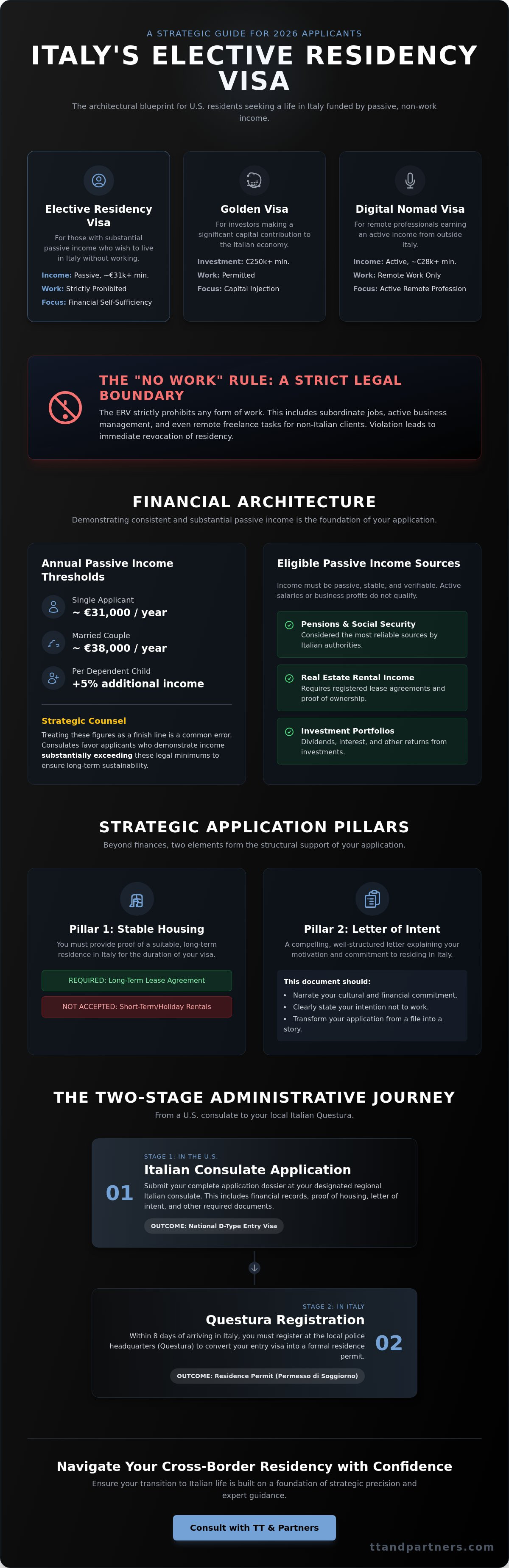
The Elective Residency Visa (ERV) serves as a refined architectural blueprint for those who wish to inhabit Italy without engaging in the local labor market. It isn't merely a travel document. It's a formal recognition of your financial independence. While the Golden Visa demands a capital injection of at least 250,000 Euro into Italian enterprises, and the Digital Nomad Visa targets active remote professionals with income around 28,000 Euro, the ERV occupies a different space. It's designed for those whose wealth is already established, passive, and entirely self-sustaining. In the shifting landscape of 2026, Italy remains a premier destination for US-based wealth. It offers a timeless quality of life that transcends global market volatility. The core of the Italy elective residency visa requirements is the burden of proof. You must demonstrate that your presence adds to the social fabric without ever placing a financial strain on the Italian state. This framework is anchored in the broader Schengen Area visa policy, which dictates the rigorous standards for long-term residency within the European Union.
Who is the Elective Residency Visa For?
This pathway is curated for a specific demographic of global citizens who value time over active accumulation. Traditional retirees often choose this route to secure a permanent Mediterranean lifestyle for their legacy. High-net-worth individuals with diversified global portfolios use the ERV to establish a strategic European base that offers high aesthetic and cultural returns. It also suits independently wealthy individuals who don't need a local salary to maintain a premium standard of living. If you seek to integrate into the urban texture of Rome or the serene landscapes of Umbria, this visa provides the necessary legal foundation. It allows you to focus on the human-centered experience of Italian life rather than the mechanics of a career.
The "No Work" Rule: A Strict Legal Boundary
The most rigid pillar of the Italy elective residency visa requirements is the absolute prohibition on work. Italian authorities interpret "professional activity" with uncompromising precision. You cannot hold a subordinate job, manage an active business from an Italian address, or even perform freelance tasks for US-based clients. This isn't a flexible guideline. It's a legal boundary that defines the entire visa category. In our digital world, the lines often blur, but the Italian Questura remains vigilant. Any evidence of active income generation within Italy can lead to the immediate revocation of your residence permit. This rule ensures that ERV holders remain consumers and patrons of the Italian economy rather than competitors in the local job market. For those ready to transition from builders to observers, this restriction is simply the price of a more harmonious pace of life.
The Architecture of Financial Requirements: Proving Passive Independence
Securing residency through the ERV requires more than a healthy bank balance. It demands a structural demonstration of passive permanence. For a single applicant in 2026, the baseline of the Italy elective residency visa requirements is approximately 31,000 to 32,000 Euro per year. Married couples should prepare for a threshold of 38,000 to 40,000 Euro, with an additional 5% required for each dependent child. However, focusing solely on these minimums is a strategic error. In practice, consulates often look for "substantial" income that far exceeds the legal floor to ensure your lifestyle is sustainable without local employment. This discretionary approval process involves a two-year retrospective look at your financial health. You aren't just showing a snapshot of today. You're proving a consistent history of self-sufficiency. Consular officers evaluate the harmony between your reported income and the cost of living in your chosen Italian region, meaning a villa in Tuscany requires a different financial narrative than a small apartment in a southern village.
Eligible Sources of Passive Income
Pensions and Social Security offer the most stable documentation for the Italian authorities. If you rely on real estate rental income, you must provide registered lease agreements alongside proof of property ownership. Portfolio income, including dividends and interest, is equally valid but requires more meticulous presentation to account for market fluctuations. The Italian Consulate General in Los Angeles emphasizes that these funds must be continuous and stable to satisfy the requirements. Every document must serve as a brick in the wall of your financial independence. We've seen that including a detailed investment summary can help bridge the gap between abstract numbers and the practical reality of your wealth.
Advanced Financial Documentation for Entrepreneurs
Younger high-net-worth individuals or business owners often face challenges because their wealth is tied to entities like LLCs. To qualify, you must demonstrate that your income is a passive distribution rather than a salary for active management. K-1 forms and LLC distribution histories are essential here. A CPA-certified letter becomes a vital structural component of your application. It should explicitly state that your presence in Italy won't interfere with the company's operations and that your income is strictly non-active. Trust funds and annuities can also serve as powerful pillars in your financial narrative, providing the predictable cash flow that Italian officials prioritize. These sources are often more persuasive than simple cash savings, as they represent an enduring stream of support. If your wealth structure is complex, connecting with a strategic advisor can help translate your US financial architecture into a format that resonates with Italian legal standards.
Housing and Motivation: The Strategic Pillars of Your Application
While financial independence provides the structural integrity of your case, your residential choice serves as the physical anchor for your presence. Consular officers do not approve applications based on the mere promise of securing a home later; you must demonstrate a suitable residence through either a deed of ownership or a long-term lease. This requirement ensures that you are establishing a permanent base rather than engaging in transient tourism. The Official Elective Residency Visa Requirements specify that your living arrangement must be finalized before your interview. Your choice of region should reflect a logical connection to your lifestyle, as the authorities look for a genuine commitment to the local community as part of the Italy elective residency visa requirements. This physical presence is the foundation upon which your legal status is built.
Real Estate Requirements and Documentation
Your residential proof must meet rigorous legal standards to be accepted by the consulate. For those who choose to rent, the lease agreement must be officially registered with the Italian Revenue Agency; an informal document or a simple letter from a landlord will not suffice. If you own property, you must provide the deed and evidence that the space is fit for permanent habitation and meets local occupancy standards. Temporary solutions such as vacation rentals or short-term online platforms are universally rejected. These options suggest a lack of permanence that contradicts the purpose of the residency. The state requires a stable, year-round address where you can be reached for administrative matters, serving as a pillar of your long-term residency framework.
Drafting a Persuasive Letter of Intent
The Letter of Intent is the visionary narrative that connects your financial profile to your physical home. It shouldn't be a generic list of cultural interests, but a professional document explaining your desire for residency with intellectual depth. You might highlight long-standing cultural ties, previous engagement with a specific region, or a detailed plan for your life in the country. This letter provides the context that financial data alone cannot convey, proving you understand the responsibilities of your new status. Your motivation must reflect a conscious choice to reside in the country for its intrinsic cultural and social value, rather than a necessity for work, to truly align with the elective nature of the visa. This narrative ensures your application is viewed as a coherent life project rather than a collection of forms.
The Application Process: From US Consulate to the Residence Permit
The journey toward Italian residency is a two-stage structural sequence that begins long before you cross the border. It's helpful to view the process as an architectural project where the visa is the permit to build and the residence permit is the final certificate of occupancy. You must initiate this journey at the Italian consulate that holds jurisdiction over your permanent US residence. Attempting to apply elsewhere will lead to immediate rejection, as strict adherence to the Italy elective residency visa requirements begins with respecting geographical boundaries. Managing the timeline is essential. In 2026, the administrative backlog in major hubs like New York or Los Angeles requires you to secure appointments several months in advance. The clock starts immediately upon arrival. You have exactly eight working days to declare your presence and begin the conversion from a visa holder to a legal resident.
Stage One: The Consular Interview and Visa Issuance
Securing an appointment is the first major milestone in meeting the Italy elective residency visa requirements. During the interview, officers don't just look at your bank statements. They evaluate your financial autonomy and your ability to sustain a life in Italy without ever seeking local employment. Be prepared for deep inquiries into the stability of your passive income streams. Common triggers for a request for evidence include health insurance policies that lack mandatory coverage, missing international certifications on vital records, or lease agreements that haven't been officially registered with the national revenue agency. Precision in your paperwork at this stage prevents the structural collapse of your application before it even reaches Italy.
Stage Two: The Residence Permit and Police Headquarters Visit
Upon arrival, your first destination isn't your new home, but a local post office to file the yellow application kit. This standardized packet is the formal request for your residence permit. It requires specific revenue stamps and a processing fee for the long-stay visa. After submission, you'll receive a receipt and an appointment date for the police headquarters. At this second appointment, authorities will collect your fingerprints and verify your original documents. Maintaining this status requires you to spend at least 183 days per year in the country, which also triggers tax residency status. If you find the administrative sequence overwhelming, request a consultation with our immigration strategists to ensure every document is placed with engineer-like accuracy. This final step transforms your visionary plan into a permanent reality, allowing you to fully integrate into the Italian urban fabric.
Navigating US-Italy Cross-Border Residency with TT & Partners
The architectural integrity of your residency plan depends on how well you bridge the divide between two distinct legal systems. While the technical Italy elective residency visa requirements provide a baseline, a successful relocation requires a master-planned strategy that accounts for US wealth structures and Italian administrative expectations. Specialized legal counsel acts as the strategic partner in this transition. We ensure that your financial portfolio is translated into a language the Italian authorities respect, turning complex asset distributions into a clear narrative of independence. This partnership transforms a bureaucratic process into a visionary life project, allowing you to focus on the human experience of your new Mediterranean context.
Securing an ERV is often the first step toward a much larger legacy. For many of our clients, integrating residency with broader goals like Italian Citizenship is the ultimate objective. We design your initial application with these long-term milestones in mind, ensuring that your five-year path to permanent residency or ten-year path to citizenship remains structurally sound. Should you encounter administrative hurdles or consular overreach, the role of International Litigation becomes a vital tool. We provide the legal weight necessary to resolve cross-border disputes, ensuring that your right to reside is protected against inconsistent interpretations of the law.
Strategic Legal Oversight for HNWIs
For high-net-worth individuals, the transition involves more than just physical presence. We coordinate closely with your US tax advisors to ensure your ERV compliance doesn't create unintended fiscal friction. Our team provides a professional buffer between you and the Italian bureaucracy, managing the intricate details of the application so you don't have to. We pay particular attention to the "No Work" restriction. Our goal is to ensure that your residency status never compromises your existing US business interests or global investment strategies. We build a framework that protects your wealth while you enjoy the cultural returns of Italian life.
Your Bridge to Italy
Every client brings a unique portfolio architecture that requires a customized application strategy. We don't believe in one-size-fits-all solutions. Our assistance extends to the physical foundations of your move, including expert guidance on Real Estate Closings to satisfy housing requirements with absolute certainty. We ensure that every lease or deed meets the exact standards of the Italy elective residency visa requirements. By aligning your financial reality with Italian legal expectations, we create a seamless bridge to your new home.
Ready to design your Italian future?Contact Tosolini, Toniutti & Partners to begin your residency strategy and secure your place in the Italian urban fabric with professional precision.
Architecting Your Italian Legacy
Securing residency is a process of intellectual and legal construction where every document serves as a vital structural element. You've seen that mastering the Italy elective residency visa requirements requires a precise alignment of passive income, registered housing, and a visionary narrative of your future. This journey transforms from a bureaucratic challenge into a strategic relocation when you prioritize stability and long-term intent over temporary solutions. By establishing a permanent physical anchor and proving financial autonomy, you create a foundation that supports your presence for years to come.
At TT and Partners, we bring decades of experience in US-Italy cross-border law to your specific needs. Our specialized focus on high-net-worth immigration and real estate closings ensures your transition is handled with the same precision as a master-planned estate. We bridge the gap between Consular expectations and the final Questura procedures with absolute confidence. Consult with our US-Italy immigration experts today to begin drafting your residency strategy. Your new life in the Italian urban fabric is a project worth building with the highest standards of excellence.
Frequently Asked Questions
Can I work remotely for a US company on an Italian Elective Residency Visa?
No, you cannot perform any work activities while living in Italy under this specific visa. This prohibition includes remote employment for foreign companies or managing your own US-based business. If your goal is to remain professionally active, you should explore alternative pathways like the digital nomad visa rather than attempting to bypass the strict non-work nature of the elective residency framework.
What is the minimum passive income required for a couple in 2026?
For a married couple, the baseline passive income requirement is approximately 38,000 to 40,000 Euro per year. This figure accounts for the standard individual requirement plus a 20 percent increase for the spouse. Meeting the Italy elective residency visa requirements with a significant buffer is often necessary to demonstrate true financial independence to consular officers who exercise broad discretion during the approval process.
Do I need to buy property in Italy to get the Elective Residency Visa?
Purchasing real estate is not a mandatory requirement for residency. While owning a home demonstrates a deep commitment to the country, a long-term lease agreement registered with the national revenue agency is a perfectly valid alternative. You must avoid temporary vacation rentals or unlicensed apartments, as these do not provide the structural permanence required for a successful application.
How long is the Elective Residency Visa valid, and can it be renewed?
The initial visa and the subsequent residence permit are valid for one year. You can renew your permit annually at the local police headquarters provided you still meet the original financial and residency criteria. After five years of continuous residence, you may apply for a long-term permit, which offers greater stability and reduces the need for annual administrative filings.
Is health insurance mandatory for the Italian ERV application?
Yes, you must maintain comprehensive health insurance with at least 30,000 Euro in coverage. The policy must cover all medical expenses, emergency hospitalizations, and repatriation costs throughout the entire European travel zone. This insurance serves as a guarantee that you won't rely on the public social safety net, which is a central pillar of the elective residency status.
Can I include my children or spouse in my ERV application?
You can include immediate family members by proving you have the financial architecture to support them. The base income requirement increases by 20 percent for a spouse and 5 percent for each dependent child. Each family member must be included in the initial consular application, as it's generally not possible to add dependents from within the country after you've arrived.
What happens if my Elective Residency Visa application is rejected?
If your application is denied, you have the right to file an administrative appeal or submit a new application with corrected documentation. Most rejections occur because the passive nature of the income wasn't clearly established or the housing contract didn't meet legal standards. Analyzing the specific reasons for the refusal allows you to refine your strategy and address the consulate's concerns with greater precision.
Does the Elective Residency Visa lead to Italian citizenship?
The elective residency pathway provides a clear route to becoming a citizen through naturalization. After ten years of legal, continuous residence in Italy, you can apply for full citizenship. This long-term goal requires careful maintenance of your residence permits and consistent tax compliance, eventually allowing you to fully integrate into the nation's social and legal fabric.


Comments