

Italy Investor Visa: 2026 Guide for US Citizens
- Gianni Mendes Toniutti, Esq.

- Aug 4
- 12 min read
With approved applications surging by 63.3% in the last year alone, Italy’s Investor Visa has solidified its position as the premier strategic gateway for Americans seeking a sophisticated European foothold. You likely realize that while the lifestyle benefits are undeniable, the administrative reality is often shrouded in a layer of opaque bureaucracy. It’s natural to feel hesitant when faced with rigorous source-of-wealth audits or the intricate details of the US-Italy tax treaty. Mastering the specific Italy investor visa requirements for US citizens is the first step toward transforming an ambitious vision into a compliant, high-performing reality.
This guide serves as your definitive 2026 roadmap to navigating these complexities with professional precision. You’ll gain expert insights into the updated €300,000 flat tax regime and the specific investment tiers, ranging from innovative startups to government bonds. We’ll explore the legal framework necessary for a successful Nulla Osta acquisition and a clear path to permanent residency. We will outline a holistic strategy to optimize your tax positioning while securing seamless, visa-free mobility across the Schengen Area.
Table of Contents
Understanding the Italian Investor Visa (Golden Visa) for US Investors
Investment Tiers and Eligibility Criteria: Navigating 2026 Requirements
The Application Roadmap: From Digital Nulla Osta to Italian Residency
Beyond Residency: Tax Optimization, Family Inclusion, and Heritage
The Necessity of Dual-Jurisdiction Legal Counsel for US Citizens
Understanding the Italian Investor Visa (Golden Visa) for US Investors
The Italian Investor Visa represents a sophisticated residency-by-investment pathway designed for high-net-worth individuals seeking a strategic foothold in Europe. Unlike programs that focus solely on passive assets, Italy’s model prioritizes active economic contribution to its national ecosystem. Within the broader Immigrant Investor Programs Overview, the Italian "Golden Visa" is distinguished by its intellectual rigor and its alignment with the country's industrial and cultural heritage. By 2026, the program has matured into a digitally streamlined experience, reflecting a visionary approach to global mobility and cross-border investment.
The 2026 landscape is defined by a significant digital transformation. The full integration of the EU’s Entry/Exit System (EES) and a modernized application portal have effectively removed the traditional bottlenecks of Italian bureaucracy. This digital shift ensures that the initial phase is handled with engineering precision, allowing for a more predictable timeline. However, meeting the Italy investor visa requirements for US citizens still demands a high level of technical accuracy. Interfacing with the Ministry of Enterprises and Made in Italy (MIMIT) requires specialized legal counsel to manage the complex due diligence and source-of-wealth documentation that Italian authorities scrutinize with increasing depth.
The Strategic Advantage of Italian Residency
Acquiring residency through investment is not merely a legal transaction; it's an entry into a lifestyle defined by harmony and quality. For US investors, this means immediate access to world-class Italian healthcare and education systems for their entire family. One of the most significant technical benefits is the ability to live and work in Italy outside the restrictive annual quota system known as the Decreto Flussi. This provides a clear, unencumbered path for business expansion into the European Union, positioning your corporate interests within a stable yet evolving market. It’s an opportunity to blend professional ambition with the enduring values of the Italian way of life.
Regulatory Framework: MIMIT and the Investor Visa Committee
The Ministry of Enterprises and Made in Italy (MIMIT) serves as the primary gatekeeper for the program. Their role involves a meticulous vetting process to ensure that every investment aligns with national interests and regulatory standards. The Investor Visa Committee for Italy (IVCI) evaluates US applications with a focus on transparency and the long-term viability of the committed funds. Success in this arena depends on presenting a case that reflects both financial strength and a commitment to the Italian socio-economic fabric. The Nulla Osta is the mandatory certificate of no impediment issued by the IVCI. To ensure your application meets these high standards, engaging with experts at Tosolini, Toniutti & Partners can provide the necessary bridge between US financial structures and Italian legal expectations.
Investment Tiers and Eligibility Criteria: Navigating 2026 Requirements
The architectural integrity of your application rests on selecting an investment pathway that aligns with both your financial strategy and the specific Italy investor visa requirements for US citizens. Unlike many other European residency programs, Italy does not offer a path through the simple acquisition of residential real estate. The government prioritizes "active" economic injections that foster innovation, support public debt, or provide philanthropic value. This distinction is vital; while a villa in Tuscany is an admirable lifestyle choice, it remains separate from the Investor Visa framework. Every capital commitment requires a minimum holding period of two years to maintain the validity of your residency status.
The Four Investment Pathways for US Citizens
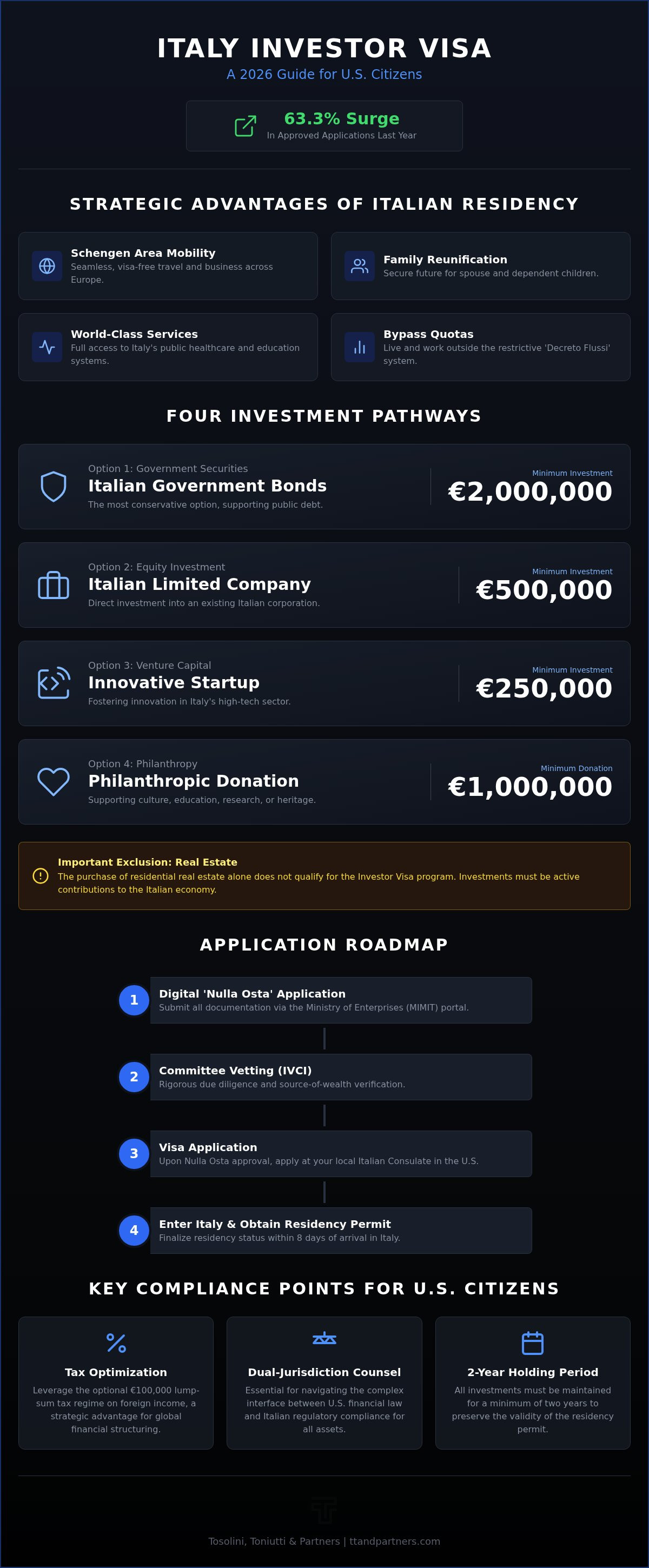
According to the Official Investor Visa for Italy Program, investors can choose from four distinct categories. Each tier is designed to address different risk profiles and economic objectives:
€2 million in Italian Government Bonds (BTP): This remains the most conservative option, requiring a two-year lock-up period in securities such as BTP, BTP Italia, or CCT.
€1 million Philanthropic Donation: A non-refundable contribution to projects of public interest in fields like culture, education, or scientific research.
€500,000 in Established Companies: Investment in the shares of an Italian limited company (S.p.A. or S.r.l.) that is operational and in good standing.
€250,000 in Innovative Startups: The most accessible entry point, targeting companies enrolled in the official Register of Innovative Startups.
A unique advantage of the Italian system is that the actual transfer of funds occurs only after your visa is approved and you have entered Italy. You have a three-month window from the date of entry to complete the investment, significantly reducing initial financial exposure.
Proof of Funds and Lawful Origin
The vetting process for US citizens involves a rigorous analysis of the source of wealth to satisfy international anti-money laundering standards. Italian authorities require a cohesive narrative of how your capital was accumulated. This documentation typically includes three years of US tax returns, audited financial reports for corporate entities, and detailed bank statements. When funds originate from complex structures like trusts or specific corporate dividends, the legal burden of proof increases. Precision in these disclosures prevents the delays that often plague unassisted applications. To ensure your documentation meets these exacting standards, you may wish to consult with our cross-border legal team for a preliminary review of your asset structure.
Beyond the capital requirement, eligibility is contingent upon a clean criminal record and proof of comprehensive health insurance. These elements ensure that investors are seamlessly integrated into the Italian social fabric without placing an undue burden on public resources. The harmony between your financial goals and these regulatory expectations is the key to a successful 2026 application.
The Application Roadmap: From Digital Nulla Osta to Italian Residency
The journey from a US-based investor to an Italian resident is a sequence of four distinct phases. Each stage requires a blend of engineering precision and strategic foresight to ensure compliance with the Italy investor visa requirements for US citizens. This roadmap reflects the 2026 digital evolution, where the interface between the investor and the Italian state has become more transparent and data-driven. The process is logical, yet it demands a high degree of intellectual rigor during the documentation phase.
Digital Filing and the 30-Day Decision Window
The first phase takes place entirely online through the dedicated MIMIT portal. The Investor Visa Committee typically issues a decision on the Nulla Osta within 30 working days. This certificate of no impediment is the foundational document for your application. During this window, authorities may issue a Request for Information (RFI) to clarify details regarding your source of wealth or the specifics of your chosen asset. A precise Declaration of Commitment is necessary here; it acts as your formal pledge to execute the investment exactly as described. Success at this stage depends on the clarity of your narrative and the transparency of your financial history.
Once the Nulla Osta is secured, you must file for the investor visa at your local Italian Consulate in the United States. This step transitions your application from a digital file to a physical travel document. Consular officials verify your approval and issue the visa, which is usually valid for two years. This period mirrors the initial duration of your residency permit, creating a cohesive timeline for your relocation strategy.
Securing the Permesso di Soggiorno per Investitori
Upon entering Italy, the focus shifts to the Permesso di Soggiorno. You must visit the Questura, or Police Headquarters, within eight days of arrival to submit your biometric data. This step is critical for the issuance of your two-year residence card. While the visa facilitates your entry, the permit defines your legal status within the country. The 2026 implementation of the Entry/Exit System (EES) has refined how the Italian government tracks the three-month investment window. This automated infrastructure records your exact arrival date, ensuring that the timeline for capital injection is monitored with absolute clarity.
The final phase is the execution of the investment. You have a strict three-month window from the date of your entry into Italy to transfer the funds. Failure to meet this deadline or deviating from the original Declaration of Commitment will result in the immediate revocation of your permit. Renewal for a subsequent three-year period is contingent upon proving the investment remains active. Managing the Italy investor visa requirements for US citizens during this transition requires a deep understanding of both Italian administrative law and US financial reporting. It’s a process where every detail must align with your long-term residency goals.
Beyond Residency: Tax Optimization, Family Inclusion, and Heritage
The strategic value of the Italian Investor Visa extends far beyond the initial acquisition of a residence permit. For the discerning investor, this pathway serves as a foundation for long-term wealth preservation and the establishment of a multi-generational European legacy. While mastering the Italy investor visa requirements for US citizens is the necessary first step, the true success of a cross-border relocation depends on how well you navigate the subsequent fiscal and personal landscape. This phase of the journey requires an intellectual shift from mere compliance to the holistic optimization of your global interests.
Italy Special Tax Regime for New Residents
A cornerstone of Italy’s appeal to high-net-worth individuals is the Neo-Resident tax status, a visionary incentive designed to attract global capital. Under the 2026 Budget Law, this regime allows new residents to pay a flat €300,000 annual tax on all foreign-sourced income, a significant increase from previous years that reflects the program's premium nature. This lump-sum payment covers offshore dividends, interest, and capital gains, providing a predictable and often highly favorable fiscal environment. The Flat Tax regime is valid for 15 years and requires a specific election within your first Italian tax return. It’s a powerful tool for those with complex portfolios, though it demands a sophisticated understanding of the US-Italy tax treaty to manage ongoing IRS obligations effectively.
Family Dynamics and Heritage Ties
Italy’s approach to residency is fundamentally human-centered, recognizing that a successful transition involves the entire family unit. The program grants an automatic right to work and study for spouses and dependent children without requiring any additional capital injection. This ensures that your relocation supports the educational and professional aspirations of your family within the European Union. For many Americans, this process is also an emotional return to their ancestral roots. If you discover that your lineage offers a more direct path to legal status, you may also explore Italian Citizenship through heritage as a complementary or alternative strategy.
Avoiding common pitfalls during this transition is essential. Italian tax authorities often look at the "Center of Vital Interests" to determine residency, focusing on where your personal and economic ties are most concentrated. Mismanaging this can lead to unintended tax liabilities in both jurisdictions. To ensure your residency and tax planning are perfectly synchronized with the 2026 regulations, you should contact our legal team for a strategic cross-border consultation. Proactive planning is the only way to secure your assets while embracing the harmony of an Italian lifestyle.
The Necessity of Dual-Jurisdiction Legal Counsel for US Citizens
The successful navigation of Italy investor visa requirements for US citizens is rarely a matter of simple form-filling. It requires a sophisticated legal architecture that bridges two distinct jurisdictions. For the American investor, the challenge lies in the interface between US financial structures and Italian regulatory expectations. A standard agency might manage the upload of documents. They often lack the intellectual depth to handle the complexities of US corporate dividends, trust distributions, or the specific due diligence required for Italian innovative startups. Ensuring that your capital commitment meets the exacting standards of the Ministry of Enterprises and Made in Italy (MIMIT) while remaining compliant with US reporting obligations is the hallmark of a professional approach. This dual-sided compliance is the only way to mitigate the risk of a visa denial at the consular level after the Nulla Osta has already been issued.
The TT&P Advantage: Strategic Precision
At Tosolini, Toniutti & Partners, our methodology is rooted in professional precision and a visionary understanding of cross-border law. We don't just process applications. We curate a comprehensive residency strategy. This includes managing intricate source-of-funds narratives that require a nuanced explanation of US tax law and corporate structures. Our deep expertise in International Litigation allows us to anticipate and resolve potential disputes before they arise. We provide a level of security that traditional immigration services cannot offer. We treat each residency permit as a component of a larger lifestyle and business framework, often integrating visa acquisition with LLC Incorporation or real estate closings to ensure your transition to Italy is seamless and structurally sound. This holistic approach ensures that your Italian residency is not an isolated legal event, but a well-integrated part of your global portfolio.
Next Steps: Securing Your Italian Future
Securing your Italian future begins with a clear evaluation of your investment goals and long-term residency objectives. For some, the path may involve a synergy between Italian residency and US-based business interests, perhaps even considering E-2 Visa strategies for reciprocal transatlantic operations. The 2026 regulatory environment rewards those who approach the process with engineering accuracy and strategic foresight. To begin this journey with the confidence of expert counsel, we invite you to contact our cross-border legal team for an initial consultation. We believe in building a dialogue that respects the values of the past while embracing the technological solutions of the future. Precision is the only safeguard for your international legacy.
Securing Your Legacy in the Heart of Europe
Italy’s 2026 investor landscape offers a refined equilibrium between digital efficiency and enduring cultural value. Success in this arena is defined by more than just capital; it requires a meticulous alignment with the latest Italy investor visa requirements for US citizens and a proactive approach to cross-border fiscal strategy. By integrating the €300,000 flat tax regime with a precisely chosen investment tier, you aren't just acquiring a permit; you're designing a future rooted in one of the world’s most inspiring environments. This journey is an invitation to harmonize your professional ambitions with a lifestyle defined by aesthetic and intellectual richness.
Managing the nuances of the Nulla Osta and subsequent residency permits demands a partner who understands the intellectual complexity of your global portfolio. At Tosolini, Toniutti & Partners, we provide specialized US-Italy cross-border legal expertise to ensure your corporate and personal assets remain perfectly synchronized. We offer comprehensive support from the initial digital filing to the final issuance of your residency permit, emphasizing the strategic tax and corporate alignment essential for HNWIs. It’s time to transform your vision into a compliant, lasting reality. Schedule a Strategic Consultation for Your Italian Investor Visa and take the first step toward your new life in Italy.
Frequently Asked Questions
How long does it take for a US citizen to get an Italian Investor Visa?
The entire process typically spans three to six months from the initial digital filing to the final issuance of the residence permit. The Investor Visa Committee for Italy (IVCI) generally issues the Nulla Osta within 30 working days of receiving a complete application. Consular processing in the United States and the subsequent appointment at the Questura in Italy account for the remaining timeline.
Do I need to live in Italy to maintain my Investor Visa status?
Maintaining your investor status does not require a minimum physical presence in Italy. This is a significant advantage for those who manage global assets and cannot commit to a 183 day annual stay. However, if your long term goal includes permanent residency or citizenship, you'll need to establish and maintain a continuous legal and physical residence within the country.
Can I buy residential real estate to qualify for the Italian Golden Visa?
No, residential real estate acquisition is not an eligible category under the current Italy investor visa requirements for US citizens. The program focuses on active economic contributions, such as government bonds, corporate shares, or philanthropic donations. For those interested in property, real estate should be viewed as a complementary lifestyle investment rather than a qualifying capital injection for this specific visa.
What is the difference between the Investor Visa and the Elective Residency Visa?
The primary difference lies in the right to work and physical presence requirements. The Investor Visa allows for professional activity and has no minimum stay requirement to maintain the permit. In contrast, the Elective Residency Visa is designed for those with passive income; it strictly prohibits employment in Italy and requires significant physical presence to remain valid over time.
Can I bring my family with me on an Italian Investor Visa?
Yes, you can include your spouse and dependent children in your residency application without making an additional investment. Family members receive the same duration of residency as the primary investor and enjoy full access to the Italian education and healthcare systems. The inclusion of family supports a holistic transition to an Italian lifestyle and ensures multi generational mobility.
What happens if my investment loses value after I receive the visa?
Market fluctuations in the value of your shares or bonds generally don't impact the validity of your permit. The critical requirement is that the investment remains active and is not divested or withdrawn during the mandatory holding period. You must provide evidence that the original capital commitment is still in place when applying for your subsequent permit renewal.
Is there a minimum stay requirement for the Italian Golden Visa?
There is no minimum stay requirement for the maintenance and renewal of the Investor Visa itself. This flexibility allows US citizens to enjoy the benefits of European residency while maintaining their primary interests and professional obligations abroad. It's a strategic tool for mobility that respects the complex schedules and international reach of modern business leaders.
Can the Investor Visa lead to permanent residency or Italian citizenship?
Yes, the Investor Visa provides a clear legal pathway to both permanent residency and eventually citizenship. You may apply for permanent residency after five years of continuous legal residence; citizenship is typically accessible after ten years. Both milestones require physical presence in the country and a demonstrated integration into the Italian social and economic fabric through residence.


Comments