

Italy Investor Visa Lawyer: A Strategic Framework for Residency in 2026
- Gianni Mendes Toniutti, Esq.

- May 7
- 12 min read
Securing residency in Italy isn't a mere administrative checkbox; it's a high-stakes architectural project where a single structural flaw in your source-of-funds documentation can collapse the entire vision. You've likely felt the weight of Italy’s opaque bureaucracy or struggled with conflicting advice from agents who don't grasp the complexity of international wealth. This is why partnering with a specialized Italy investor visa lawyer is essential to ensure your investment remains a foundation for growth rather than a liability.
We’ll provide a precision-engineered legal strategy that protects your capital while securing long-term residency for your entire family. This guide explores the 2026 requirements for the €250,000 startup path and the €500,000 corporate investment, offering a clear blueprint for a successful Nulla Osta issuance. You'll learn how to integrate your global assets into the Italian landscape with the same rigor and foresight you apply to your most significant business ventures.
Key Takeaways
Identify the optimal investment threshold, ranging from €250,000 for innovative startups to €2 million in government bonds, to align with your long-term capital preservation goals.
Consult with a specialized Italy investor visa lawyer to navigate the structural differences between US business entities and Italian civil law requirements.
Master the two-phase application sequence, ensuring your digital Nulla Osta is secured before any capital is deployed within Italy.
Discover how to integrate your residency with strategic LLC incorporation and real estate closings to build a cohesive lifestyle and business presence.
Leverage Italy’s unique flat-tax regime to optimize your global fiscal footprint while securing permanent residency for your entire family.
Table of Contents The Italian Investor Visa Landscape: A Strategic Gateway for 2026 The Four Investment Pathways: Technical Requirements and Thresholds Why Cross-Border Legal Expertise is Essential for US-Italy Investors The Two-Phase Roadmap: From Digital Nulla Osta to Residency Integrating Your Visa into a Broader Corporate and Real Estate Strategy
The Italian Investor Visa Landscape: A Strategic Gateway for 2026
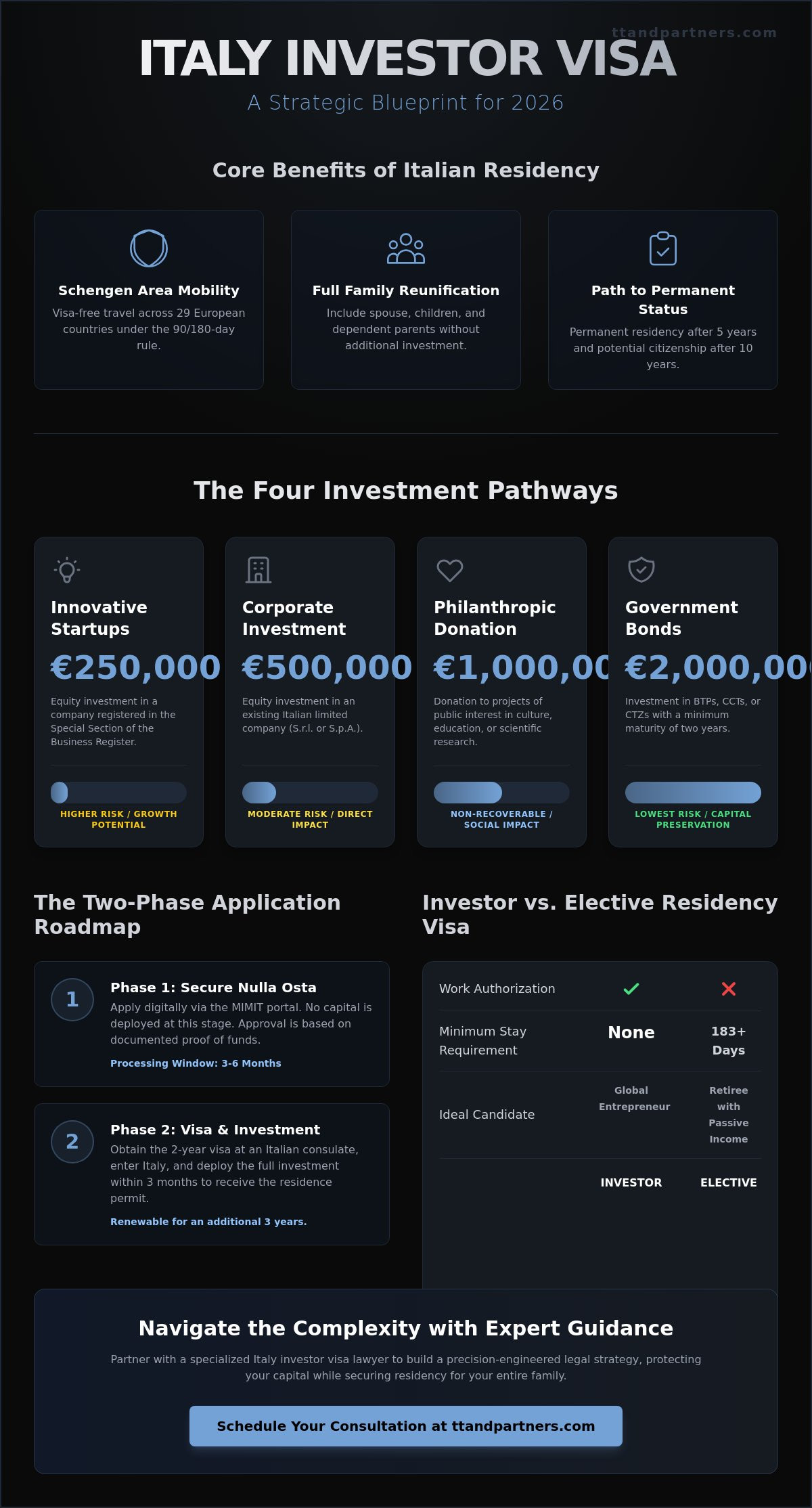
The Italian Investor Visa represents a specialized legal track for non-EU citizens who wish to contribute to the nation's economic fabric. Unlike traditional immigration routes, this program is designed for high-net-worth individuals who view residency as a strategic asset rather than a mere permit. In 2026, the approval process is centralized through the Ministry of Enterprises and Made in Italy (MIMIT), which oversees the Investor Visa Committee. This committee ensures that every "Nulla Osta" (Certificate of No Impediment) meets rigorous standards of financial transparency and economic impact. Enlisting a specialized Italy investor visa lawyer ensures that your application aligns with these evolving regulatory expectations, preventing delays in the typical 3 to 6 month processing window.
The program, which is a prominent fixture among European immigrant investor programs, functions on a 2-year initial residency permit cycle. Upon successful entry and investment, the permit is renewable for an additional 3 years, provided the capital remains deployed. This 5-year framework provides the stability required for long-term wealth planning and lifestyle integration within the Italian territory.
Investor Visa vs. Elective Residency: Choosing the Right Path
Choosing between the Investor Visa and the Elective Residency Visa (ERV) requires a clear understanding of your professional goals. The ERV is tailored for retirees with high passive income, but it strictly prohibits any form of work in Italy. In contrast, the Investor Visa grants full work authorization, allowing you to manage Italian-based operations or serve as a director in a local firm. While the ERV often requires 183 days of physical presence to maintain tax residency, the Investor Visa offers unparalleled flexibility. Investors don't face a minimum stay requirement to renew their initial permit, making it the superior choice for global entrepreneurs who maintain active business interests across multiple continents.
The Benefits of Residency in the Italian Context
Residency provides more than just a place to live; it integrates you into the European landscape. By May 2026, holders enjoy full Schengen Area mobility, allowing for visa-free travel across 29 European countries under the 90/180 day rule. Family reunification is a core pillar of this strategy. You can include a spouse, children, and dependent parents in the application without additional investment. This creates a multi-generational legacy, leading to permanent residency after 5 years and the potential for Italian citizenship after 10 years of legal residence. For those seeking a tailored approach to these complex timelines, our team is available for consultation via our contact page to provide the clarity needed for a seamless transition.
The Four Investment Pathways: Technical Requirements and Thresholds
The Italian legal framework offers four distinct entry points, each requiring a specific capital commitment and risk profile. As of May 2026, these thresholds are strictly defined to ensure meaningful economic participation. Investors must select a pathway that aligns with their broader financial architecture, choosing between:
Italian Government Bonds: A €2,000,000 threshold, specifically targeting BTPs, CCTs, and CTZs with a minimum maturity of two years.
Corporate Investment: A €500,000 threshold for equity investments in existing Italian limited companies, typically structured as an S.r.l. or S.p.A.
Innovative Startups: A €250,000 threshold, provided the entity is officially registered in the Special Section of the Business Register.
Philanthropic Initiatives: A €1,000,000 donation to projects of public interest in fields such as culture, education, or scientific research.
Strategic Selection of Investment Assets
Selecting the right asset is a balance between capital preservation and risk tolerance. While government bonds offer a traditional safety net, innovative startups provide a lower entry point for those comfortable with venture-level volatility. However, the technical criteria for these startups are rigid; they must maintain their "innovative" status on the Business Register throughout your residency. A critical detail often overlooked by local agents is the "maintenance of investment" requirement. If the underlying asset is liquidated or falls below the threshold before the permit's renewal, the residency is subject to immediate revocation. An experienced Italy investor visa lawyer provides the technical oversight needed to verify that your chosen asset remains compliant with these ongoing maintenance mandates.
Source of Funds: The Precision of Documentation
Proving the lawful origin of capital is the most demanding phase of the application. The official Investor Visa for Italy portal requires a comprehensive dossier illustrating the complete traceability of funds. This includes multi-year bank statements, certified tax returns, and documentation of asset sales. The Italian Investor Visa Committee scrutinizes the flow of funds to prevent money laundering and ensure the investor is the primary beneficial owner. Common pitfalls include using third-party accounts or opaque currency transfers that lack a clear legal nexus. Precision in this documentation prevents the rejection of the Nulla Osta. If you're navigating complex international wealth structures, it's wise to discuss your strategy with an Italy investor visa lawyer who understands the Committee's specific evidentiary standards.
Why Cross-Border Legal Expertise is Essential for US-Italy Investors
For American investors, the transition to Italy involves more than moving capital across the Atlantic. It requires reconciling two disparate legal philosophies. US legal structures, particularly the Limited Liability Company (LLC), often lack a direct mirror in Italian civil law. This creates a technical friction point during the initial application phase. An Italy investor visa lawyer acts as a bridge, translating your domestic corporate architecture into a format that the Italian Ministry of Enterprises and Made in Italy (MIMIT) can validate. Without this precise cross-border alignment, your source-of-funds documentation may be flagged as inconsistent, delaying your residency by several months.
Ensuring all documentation meets the 2026 Apostille and certified translation standards is equally vital. The Italian administration is famously exacting about the form and substance of foreign documents. A single missing stamp or an improperly translated bank statement can halt a million-euro investment strategy. By managing these technicalities with professional rigor, we ensure your path to the Permesso di Soggiorno remains unobstructed by bureaucratic nuance.
Bridging the Gap Between US and Italian Jurisdictions
Tosolini, Toniutti & Partners specializes in this specific cross-border immigration architecture. Our approach integrates deep knowledge of the US tax nexus with the technicalities of Italian residency permits. This dual-perspective is vital because an investment that makes sense for your US portfolio might trigger unforeseen tax liabilities or legal hurdles in Italy. By leveraging our expertise in International Litigation, we protect your assets from the outset. We don't just file papers; we coordinate with your US-based financial advisors to ensure capital deployment is seamless. This includes managing the specific requirements of Italian consulates in major hubs like New York, Los Angeles, and Miami.
Managing the "Nulla Osta" Committee Relationship
The Nulla Osta is the critical preliminary security clearance that serves as the foundation for your visa. Your Italy investor visa lawyer serves as the primary interlocutor with the Italian Ministry, managing the delicate dialogue between your financial reality and the state's regulatory expectations. When the Investor Visa Committee issues a Request for Information (RFI), the response must be delivered with engineering-level precision. Vague answers or incomplete financial trails lead to immediate rejection. We treat these interactions as a high-stakes negotiation where clarity is the most valuable currency. If you're ready to build your Italian future on a secure legal foundation, we invite you to reach out for a strategic consultation.
The Two-Phase Roadmap: From Digital Nulla Osta to Residency
The journey toward Italian residency is structured as a chronological sequence of four distinct legal milestones. It's a process where timing is as critical as the substance of the application itself. Engaging an Italy investor visa lawyer ensures each phase is executed with the required technical accuracy, preventing the administrative friction that often stalls DIY applications. The process begins long before you set foot in Italy, starting with a digital clearance that serves as the blueprint for your entire relocation strategy.
Phase 1: The digital application for the Nulla Osta (Certificate of No Impediment) via the Ministry's dedicated portal.
Phase 2: The formal visa application at the Italian Consulate in your home jurisdiction, such as New York, Miami, or San Francisco.
Phase 3: Entry into Italy followed by the mandatory "Permesso di Soggiorno" application at the local Questura within 8 days.
Phase 4: The final execution of the investment, which must be completed within 3 months of your entry date.
Navigating the Digital IVIS Portal
Phase one takes place entirely within the Digital IVIS Portal, a secure environment where you must upload your declaration of commitment and exhaustive financial proof. This is where the technical precision of your documentation is first tested. The Investor Visa Committee operates under a 30-day statutory limit to issue a decision once your file is submitted. During this window, they may issue a Request for Information (RFI) that requires an immediate, data-driven response. You'll need a valid digital signature and a secure communication channel to manage these interactions. If the Committee isn't satisfied with the traceability of the capital at this stage, the project stops before it truly begins.
Consular Procedures and the Questura Appointment
Once the Nulla Osta is secured, you have six months to apply for the visa at your local Italian Consulate. This phase involves a physical interview where you present the original, Apostilled versions of the documents previously uploaded. After the visa is stamped in your passport, the clock begins to tick. Upon arriving in Italy, you have exactly 8 days to visit the Post Office and subsequently the Questura (Police Headquarters) for "fotosegnalamento," or physical fingerprinting. This transition from a temporary receipt to the physical residency card is a delicate period. You're legally a resident, but you must still finalize the capital transfer within the 90-day window to maintain your status. To ensure your timeline remains on track, contact our firm to coordinate your residency roadmap.
Integrating Your Visa into a Broader Corporate and Real Estate Strategy
The Italian investor visa serves as the foundational element of a much larger architectural project. It is not merely a travel document; it is a gateway to a multi-layered presence in the European market. For many US-based investors, this journey includes LLC Incorporation to manage Italian operations with the same structural integrity they apply to their domestic ventures. By May 2026, the synergy between Italian residency and the E-2 Visa has become a preferred framework for treaty investors who require fluid mobility between New York and Milan. This dual-jurisdiction approach ensures that your business growth is never limited by borders.
The fiscal landscape also offers unique advantages that must be integrated into your personal wealth strategy. Italy’s substitute tax regime for new residents allows for a fixed annual payment of €100,000 on foreign-sourced income, regardless of the total amount earned outside the country. This flat-tax structure provides the financial predictability required for high-stakes long-term planning. To navigate these tax implications while maintaining residency compliance, an Italy investor visa lawyer coordinates the timing of your entry and fiscal domicile to maximize these benefits from the first day of your arrival.
Real Estate and Strategic Asset Acquisition
Securing a primary residence is a technical necessity for registering with the local Anagrafe, or town hall. Unlike the US market, Italian real estate transactions involve a distinct set of legal safeguards, from the preliminary contract to the final deed. A rigorous legal review of these contracts is mandatory to ensure the property meets all habitability standards and is free of historical encumbrances. Your Italy investor visa lawyer will also facilitate the issuance of your Codice Fiscale, which is the essential tax identifier for every transaction and utility connection in the country. This ensures your physical presence in Italy is as secure as your legal status.
Building Your Italian Business Architecture
Building a sustainable future in Italy requires a holistic vision that combines individual lifestyle needs with global economic trends. The investor visa grants you the authority to take on active leadership roles within the Italian corporate fabric, allowing for a seamless transition from investor to operator. This alignment between immigration law and corporate governance ensures that your business interests are protected under both jurisdictions. To design a bespoke framework that reflects your unique professional and personal goals, we invite you to Contact Tosolini, Toniutti & Partners for an initial consultation.
Architecting Your Italian Legacy through Strategic Residency
Establishing residency through the Italian Golden Visa is an exercise in structural integrity where every financial document serves as a load-bearing element. By May 2026, the complexity of the digital Nulla Osta process and the strict three-month investment window require more than just an application; they demand a comprehensive cross-border strategy. Whether you're committing €500,000 to an Italian corporation or pursuing the €2,000,000 government bond path, the technical precision of your legal counsel determines the longevity of your vision.
Partnering with a specialized Italy investor visa lawyer provides the dual-jurisdiction expertise necessary to navigate the unique friction between US corporate structures and Italian civil law. With decades of experience focused on HNWIs and corporate investors in both New York and Italy, our firm ensures your transition is seamless. Italy offers more than a permit; it offers a timeless context for your family's future and your business's expansion.
Schedule a Strategic Consultation with our US-Italy Legal Experts to begin architecting your residency framework. We look forward to building your Italian future with you.
Frequently Asked Questions
How much do I need to invest for the Italy Investor Visa in 2026?
You must choose from four distinct capital thresholds as of May 2026. The lowest entry point is a €250,000 investment in an innovative startup registered in the official Special Section. Alternatively, you can invest €500,000 in an Italian limited company, donate €1,000,000 to a public interest project, or purchase €2,000,000 in government bonds. These funds must be deployed within three months of your entry into Italy to maintain your residency status.
Does the Italian Investor Visa lead to citizenship?
Yes, the Investor Visa provides a clear path to Italian citizenship after 10 years of legal residency. Before reaching that milestone, you're eligible to apply for permanent residency after 5 years of continuous legal residence. Both paths require you to satisfy the physical presence requirements of at least 183 days per year in Italy if you intend to pursue these long-term naturalization goals.
Can I include my family in the Italian Golden Visa application?
You have the right to include your spouse, children, and dependent parents in your residency plan. The Italian Golden Visa program facilitates family reunification without requiring additional capital beyond the initial investment. This allows your entire family to benefit from Schengen Area mobility and access to Italian education and healthcare systems, provided you submit the necessary documentation during the initial application phase.
Do I need to live in Italy for a minimum number of days to keep the visa?
No, there's no minimum stay requirement to renew your initial two-year residence permit. This flexibility is a significant advantage for global entrepreneurs who manage international assets and travel frequently. However, if your long-term goal is permanent residency or citizenship, you'll need to spend at least 183 days per year in Italy to satisfy the physical presence requirements established by Italian immigration law.
What is the "Nulla Osta" and how long does it take to get?
The Nulla Osta is a certificate of no impediment issued by the Investor Visa Committee that verifies your background and source of funds. The Committee is legally bound to issue a decision within a 30-day statutory limit from the moment your digital application is complete. Total processing times for the entire visa typically range from 3 to 6 months, depending on the complexity of your financial documentation.
Can I invest in Italian real estate to qualify for the Investor Visa?
No, direct investment in Italian real estate doesn't qualify you for the Investor Visa in 2026. The program requires capital to be directed into startups, limited companies, government bonds, or philanthropic projects. While a real estate closing is often a secondary step to establish a primary residence for local registration, it can't serve as the primary investment asset for the residency permit itself.
What happens if I sell my investment after getting the residency permit?
Selling or liquidating your investment will lead to the immediate revocation of your residency permit. The Italian Ministry requires you to maintain the full amount of the investment for the entire duration of your stay. If the asset value fluctuates or the company loses its status, you must consult an Italy investor visa lawyer to ensure your portfolio remains compliant with the Ministry's ongoing maintenance standards.
Is a lawyer mandatory for the Italy Investor Visa application?
While not legally mandatory, engaging an Italy investor visa lawyer is essential for navigating the precision required in source-of-funds documentation. Most rejections occur because of opaque financial trails or inconsistencies between US and Italian legal structures. Professional counsel ensures that your declaration of commitment and cross-border asset transfers meet the exacting standards of the Investor Visa Committee, protecting your capital and residency timeline.


Comments