

Italy Long Stay Visa: 2026 Legal Guide for US Citizens

What if the most significant barrier to your Italian residency isn't the distance, but the invisible complexity of its administrative framework? For American professionals and investors, the transition to a life in the Mediterranean is a strategic undertaking that demands more than just aspiration; it requires the architectural precision of a well-crafted legal plan. Securing a long stay visa Italy for US citizens represents the critical first step in a journey that bridges two distinct legal systems and sets the stage for a permanent presence abroad.
We recognize that the intersection of foreign bureaucracy and international tax law can be opaque. This article provides the clarity necessary to navigate the 2026 landscape, offering a roadmap tailored for those seeking to establish residency through investment, remote work, or retirement. You'll learn how to secure your official residence permit, manage the intricacies of cross-border property acquisition, and protect your assets under the current treaty frameworks. By the end of this guide, you'll have a clear path to a seamless and legally compliant transition.
Table of Contents
Understanding the National Visa Framework
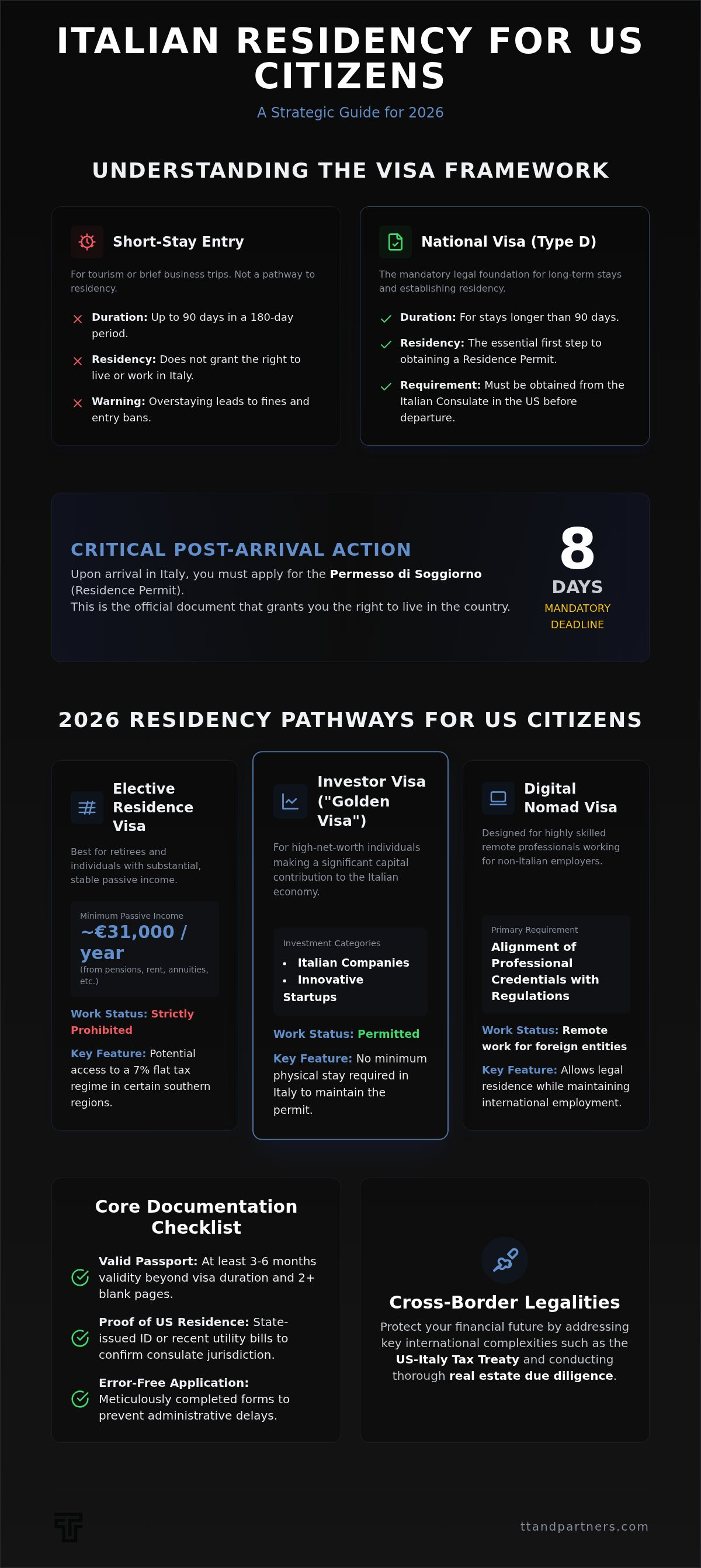
Establishing residency requires a shift from a tourist mindset to a strategic legal perspective. The foundation of this transition is the National Visa, categorized as a Type D entry document. This document is fundamentally different from the short-stay visa, which most Americans use for brief travel. While the short-stay option allows for visits up to 90 days within a 180-day period, the National Visa is the only valid path for those intending to remain for more than three months. It serves as the essential legal bridge to the Residence Permit, which is the document that actually grants you the right to live on the ground.
Success begins with choosing a visa category that matches your long-term intentions. Whether you're an investor, a remote professional, or a retiree, your visa type must align with your residency goals. You can't easily change your status once you're in the country. Applications are processed through the Consulate that holds jurisdiction over your permanent residence in the United States. You don't have the luxury of choosing a consulate based on appointment availability; your legal domicile dictates the venue. This jurisdictional rule ensures that your application is handled by the office responsible for your specific geographic region.
The 90-Day Rule vs. Long-Term Residency
Under current agreements, US citizens enjoy a visa-exempt period for short visits. However, as of April 10, 2026, the new Entry and Exit System will record biometric data, including facial images and fingerprints, making it impossible to reset a 90-day stay by briefly crossing a border. To live abroad, you must secure a long stay visa Italy for US citizens before departing the United States. Overstaying a tourist entry carries severe legal risks, including heavy fines and multi-year bans from the region. Establishing a legal domicile through the correct visa is the first disciplined step in your residency journey.
Core Documentation Standards for 2026
Precision in documentation is the hallmark of a successful application. For 2026, consulates maintain strict standards regarding passport integrity. Your travel document must remain valid for at least three to six months beyond the intended duration of your visa and contain at least two blank pages. You'll also need to provide definitive proof of residence within your consulate's jurisdiction, typically through a state-issued ID or recent utility bills. Clerical errors in standardized application forms are the primary cause of administrative delays. Ensuring every field aligns perfectly with your supporting evidence is a technical necessity that prevents unnecessary rejections. For tailored assistance with these complex requirements, you can contact our legal team for a professional review.
Strategic Residency Pathways for US Investors and Retirees
Selecting the appropriate long stay visa Italy for US citizens requires a precise calculation of both financial liquidity and lifestyle goals. For those with established wealth, two primary legal structures exist: the Elective Residence Visa (ERV) and the Italian Investor Visa. While they both facilitate residency, their underlying legal requirements serve different strategic purposes. One prioritizes the quiet enjoyment of passive wealth, while the other serves as a dynamic tool for capital deployment within the Italian economy.
The Elective Residence Visa (ERV) for Retirees
The ERV remains the preferred choice for individuals who have concluded their professional careers. Under the 2026 regulations, the minimum passive income threshold for a single applicant is approximately €31,000 per year. This income must derive from stable, non-work sources such as pensions, annuities, or diversified real estate portfolios. It's critical to understand that this visa category strictly prohibits any form of active employment or remote work. For those looking to optimize their fiscal footprint, moving to specific southern regions may qualify you for a 7% flat tax regime, a detail often discussed in coordination with the U.S. Embassy in Italy regarding bilateral tax obligations and social security agreements.
The Italian Investor Visa: The 2026 "Golden Visa" Roadmap
High-net-worth individuals seeking greater flexibility often opt for the Investor Visa. Unlike the ERV, this path permits the holder to engage in work activities and doesn't require a minimum stay in Italy to maintain the permit. Investment categories for 2026 include capital injections into Italian limited companies or innovative startups. This framework differs significantly from the E-2 Visa, which is a treaty-based solution for those moving to the United States. The Italian Golden Visa provides an initial two-year residency permit, renewable for three additional years, provided the investment remains intact and the capital stays within the country.
Choosing between these paths involves more than just meeting a financial threshold. It's about aligning your international wealth structure with Italian civil law. While the ERV is accessible for many retirees, the Investor Visa offers a faster, more flexible route for those still active in the global market. Both pathways eventually lead to permanent residency after five years of legal stay. To ensure your chosen path integrates seamlessly with your long-term residency goals, you may wish to consult with our cross-border legal specialists for a comprehensive portfolio analysis and strategic planning.
The Digital Nomad and Professional Pathways in 2026
The professional landscape for Americans has evolved into a sophisticated ecosystem designed to attract global talent through active contribution. For those seeking a long stay visa Italy for US citizens through professional merit rather than passive wealth, the 2026 framework offers two distinct architectures: the refined Remote Worker Visa and the traditional Autonomous Work Visa. Each requires a different level of interaction with the administrative state and a specific alignment of your US-based professional history with European standards. While subordinate work visas are reserved for those with a firm job offer from a local employer, the autonomous and nomad paths provide the flexibility that modern professionals demand.
The Remote Worker Visa: Income and Skill Requirements
The Remote Worker Visa is specifically tailored for "highly qualified" workers, a designation that in 2026 typically requires a university degree or at least five years of documented professional experience in your field. This pathway bypasses the traditional annual quota system but maintains rigorous financial and technical standards. To qualify, you must demonstrate:
A minimum annual income of €28,000 derived exclusively from remote work for entities outside the country.
Proof of remote employment or a valid service contract for at least six months.
Health insurance with a minimum coverage of €30,000, ensuring no burden is placed on the national healthcare system.
The visa application fee is €116, but the true cost of entry is the meticulous preparation of your professional portfolio to meet strict scrutiny.
Autonomous Work Visas for Entrepreneurs
For those looking to establish a more permanent business presence or practice a regulated profession, the Autonomous Work Visa remains the primary vehicle. This pathway is subject to the annual labor quota system, which for 2026 has allocated 164,850 permits across various sectors. Unlike the nomad path, this requires an official security clearance from the local authorities. This clearance verifies that your proposed business activity doesn't conflict with local market regulations and that you possess the necessary professional certifications recognized by the state.
Strategic entrepreneurs often utilize LLC incorporation to bridge their US operations with the local market, allowing for a more seamless transition of corporate assets and professional standing. You'll need to demonstrate that your business has the financial capacity to support your residency, which often requires coordination with regulatory bodies to validate your credentials. If your professional journey requires a bespoke legal strategy for a long stay visa Italy for US citizens, you can contact our advisors to align your business architecture with residency mandates.
Beyond the Visa: Securing the Permesso di Soggiorno
Landing in Italy with a long stay visa Italy for US citizens is a significant milestone, yet it's only the first chapter of your residency. The visa is an entry permit; the Permesso di Soggiorno is the document that validates your legal presence. You have exactly eight working days from your arrival to initiate the application. Missing this window can jeopardize your status and complicate future renewals. This mandatory step transforms your temporary entry into a recognized legal residency, allowing you to access national services and establish a permanent home.
The Residence Permit Application Process
The journey begins at a local post office displaying the "Sportello Amico" logo. Here, you'll submit the "Kit Giallo," a technical application package that requires absolute accuracy. You must include copies of your passport, visa, and proof of health insurance with at least €30,000 in coverage. The financial requirements for 2026 include a €16 revenue stamp and a base fee of €76.46 for the electronic card and postal services. You'll also pay a processing fee of €40 for permits up to one year or €50 for two-year permits.
Once submitted, the post office issues the "Ricevuta." Treat this receipt with the highest care. It's your primary legal document while you wait for your appointment at the Questura. It proves you've fulfilled your obligation and allows you to remain in the country legally. Your subsequent appointment at the Questura involves fingerprinting and a final verification of your original documents. It's a formal process where your biometric data is officially recorded into the national system.
Integration and Permanent Residency
For those staying longer than 12 months, the Italian state requires the signing of an Integration Agreement. This contract is a commitment to acquire basic Italian language skills and understand civic culture within two years. It's a foundational step for those looking toward long-term EU residency or even Italian citizenship. Maintaining your permit requires meeting annual income thresholds, which for 2026 is set at €7,101.12 for an individual applicant.
Success in this phase requires more than just following instructions; it requires professional oversight to avoid administrative pitfalls. If you're ready to secure your legal standing and ensure your documents meet every 2026 standard, our team provides expert guidance on Permesso di Soggiorno acquisition to make your transition seamless and fully compliant.
Navigating US-Italy Cross-Border Legalities
The acquisition of a long stay visa Italy for US citizens represents more than a change in geography; it's a fundamental shift in your legal and fiscal architecture. Moving across borders requires a harmonized strategy that respects both the common law traditions of the United States and the civil law foundations of Italy. Without a cohesive legal framework, expats often find themselves caught between conflicting reporting requirements and property laws. Success in this final stage of relocation depends on your ability to align your American assets with Italian residency mandates while protecting your global interests.
Real Estate and Legal Due Diligence
For many, securing a residence is the physical manifestation of their Italian dream and often serves as the primary basis for an Elective Residence Visa. However, the Italian real estate market operates on principles that differ significantly from American standards. In Italy, the Notary (Notaio) acts as a neutral public official responsible for the legality of the transaction, but they don't represent your specific interests as a buyer. This creates a critical gap in advocacy. Professional real estate closing support ensures that your investment is protected through exhaustive title searches and the verification of building permits (concessioni edilizie). Establishing a firm legal title is essential not only for your peace of mind but also for the long-term stability of your Permesso di Soggiorno.
Cross-Border Tax and Asset Protection
Residing in Italy doesn't absolve US citizens of their domestic tax obligations. The United States maintains a citizenship-based taxation system, requiring you to report worldwide income regardless of where you live. For the 2026 tax year, the Foreign Earned Income Exclusion is projected at $132,900, but navigating the US-Italy Tax Treaty is necessary to avoid double taxation. Beyond income, you must remain compliant with FBAR and FATCA reporting for any foreign bank accounts or assets. Professionals moving to Italy can often leverage "impatriate" tax incentives, which can provide significant exemptions on Italian-sourced income for those who establish tax residency.
Strategic asset protection is equally vital for the prevention of international litigation. When disputes arise across borders, they require a sophisticated understanding of both jurisdictional nuances and treaty-based resolution mechanisms. Having dual US-Italian legal representation provides a strategic advantage, allowing you to resolve conflicts before they escalate into complex court proceedings. By integrating your long stay visa Italy for US citizens with a robust cross-border legal strategy, you ensure that your transition is both culturally enriching and legally secure.
Securing Your Future in the Italian Landscape
Mastering the transition to an Italian life requires more than an appreciation for heritage; it demands a rigorous alignment of your legal and financial architecture with 2026 regulations. Whether you're navigating the €31,000 threshold for elective residency or the technical nuances of the Digital Nomad Visa, success lies in the precision of your initial strategy. You've learned that securing a long stay visa Italy for US citizens is only the first step, followed by the critical eight-day window to formalize your Permesso di Soggiorno and the ongoing management of cross-border tax obligations.
Tosolini, Toniutti & Partners serves as the essential bridge for American professionals and retirees, offering decades of experience in US-Italy immigration law. Our bilingual legal team operates across the United States and Italy, providing comprehensive support for real estate closings and corporate expansion. We ensure that every document and investment serves your long-term residency goals with absolute clarity. Consult with our US-Italy cross-border legal experts today to begin your journey with professional confidence. Your vision of an Italian future is within reach when built on a foundation of legal excellence.
Frequently Asked Questions
Do US citizens need a visa to live in Italy for more than 90 days?
Yes. While the 90-day tourist exemption exists, any stay exceeding this limit requires a Visto Nazionale. Without this entry document, you cannot obtain legal residency. The new EU Entry and Exit System launching in April 2026 will monitor biometrics closely, making it harder to bypass regulations. Securing a long stay visa Italy for US citizens is the only way to reside legally beyond the short-term tourist window.
Can I work in Italy with an Elective Residence Visa?
No, the Elective Residence Visa strictly prohibits any form of active employment, including remote work for US companies. This category is designed for retirees or those with substantial passive income from pensions or real estate. If you intend to work while residing in Italy, you must explore the Digital Nomad Visa or an Autonomous Work Visa category instead. Violating these terms can lead to the revocation of your residency permit.
How much income do I need for the Italian Digital Nomad Visa?
For 2026, the minimum annual income requirement for a single applicant is €28,000. This income must be derived from remote work activities for companies or clients located outside of Italy. You must also provide proof of "highly qualified" status, such as a university degree or significant professional experience. Additionally, you must maintain health insurance with a minimum coverage of €30,000 to remain compliant with the visa's health safety mandates.
What is the difference between a visa and a Permesso di Soggiorno?
A visa is an entry document issued by an Italian Consulate in the United States, granting you permission to cross the border for a specific purpose. The Permesso di Soggiorno is the actual residence permit issued by the local police after you arrive. You have eight working days post-arrival to apply for the permit. While the visa gets you through the door, the permit is what allows you to live in Italy legally.
How long does it take to get an Italian long-stay visa in 2026?
Processing times vary significantly depending on the specific consulate's workload and the visa category. Generally, you should allow three to six months for the entire process, including securing an appointment and the administrative review. Because appointments are often limited, it's vital to begin your application well before your intended departure. Precise documentation is the best way to avoid delays, as clerical errors often trigger additional requests for information or administrative holds.
Can I buy property in Italy to qualify for a residency visa?
Real estate ownership alone does not automatically grant residency, but it serves as a strong foundation for the Elective Residence Visa. To qualify, you must still meet the passive income threshold of approximately €31,000 per year. Owning property demonstrates your intent to establish a permanent home and satisfies the accommodation requirement. However, the property must be suitable for residential use and large enough for all family members included in the application.
What happens if my Italian visa application is rejected?
If your application for a long stay visa Italy for US citizens is rejected, the consulate will provide a formal notice outlining the legal grounds for the decision. You have the right to appeal this decision through the Italian administrative courts within 60 days. Common reasons for rejection include insufficient financial proof or inconsistent documentation. Professional legal counsel is often necessary to evaluate the merits of an appeal or to correct the file for a reapplication.
Is it possible to switch from one visa type to another while in Italy?
Generally, you cannot switch visa types after you have entered Italy on a long-stay visa. Your residency permit is tied to the specific visa category you used for entry. If your circumstances change significantly, such as moving from remote work to local employment, you may need to apply for a conversion of your permit. This is a complex administrative process that depends on current quotas and specific legal requirements under the Decreto Flussi.


Comments