

Italy's Digital Nomad Visa Requirements: The 2026 Strategic Guide
- Gianni Mendes Toniutti, Esq.

- Jun 7
- 12 min read
The Italian Digital Nomad Visa is an elite pathway designed for professionals who bring intellectual value to the peninsula's evolving economy, rather than a simple permit for remote work. Navigating Italy's digital nomad visa requirements demands a level of professional precision that goes beyond basic documentation. It requires a strategic alignment with the "highly specialized" standards of Article 27-quater. You've likely encountered the frustration of opaque bureaucratic definitions or the fear of tax double-exposure, wondering if your career truly fits the mold required by Italian consulates.
This guide provides the clarity you need to master these legal hurdles, offering a visionary yet technical roadmap for your 2026 residency goals. We'll examine the specific €28,000 income threshold, the necessary tertiary qualifications, and the precise trajectory from your visa appointment to obtaining your Permesso di Soggiorno. You'll gain the confidence to present a professional profile that resonates with Italian authorities, transforming a complex legal process into a structured and successful transition.
Key Takeaways
Understand the nuanced legal distinction between independent digital nomads and remote employees to ensure your application aligns with the specific 2026 Type D visa framework.
Identify how your professional background maps to Art. 27-quater standards using the three-tier qualification system for highly specialized workers.
Master Italy's digital nomad visa requirements by documenting not only the €28,000 income threshold but also the broader proof of financial self-sufficiency required for US applicants.
Navigate the step-by-step transition from gathering apostilled documents in the United States to successfully completing your consular interview.
Learn how to coordinate your Italian residency with existing US business architectures, such as LLCs, to prevent tax double-exposure and ensure long-term stability.
Table of Contents
What is Italy's Digital Nomad Visa? The 2026 Framework
Italy's Digital Nomad Visa represents a sophisticated legal bridge for non-EU professionals seeking to harmonize their global careers with an Italian lifestyle. It's a long-stay Type D visa that allows individuals to reside in Italy while performing work for entities or clients located outside the country. By 2026, the application landscape has matured significantly. The initial ambiguity surrounding consulate protocols that followed the 2024 launch has been replaced by a predictable, structured process. This maturity offers a distinct strategic advantage over the Elective Residency Visa. While the latter is designed for retirees or those with passive wealth, the Digital Nomad Visa celebrates active professional contribution. It recognizes that modern, high-value work is no longer tethered to a specific geography.
Understanding What is a Digital Nomad? is essential for setting the right legal foundation for your application. In the Italian context, this definition is strictly bound by professional qualifications and the nature of your employment. It's not merely about working from a laptop; it's about proving a high level of expertise that justifies a long-term stay. Successfully meeting Italy's digital nomad visa requirements involves demonstrating that your presence in Italy is backed by a stable, specialized career path.
Digital Nomad vs. Remote Worker: Choosing Your Category
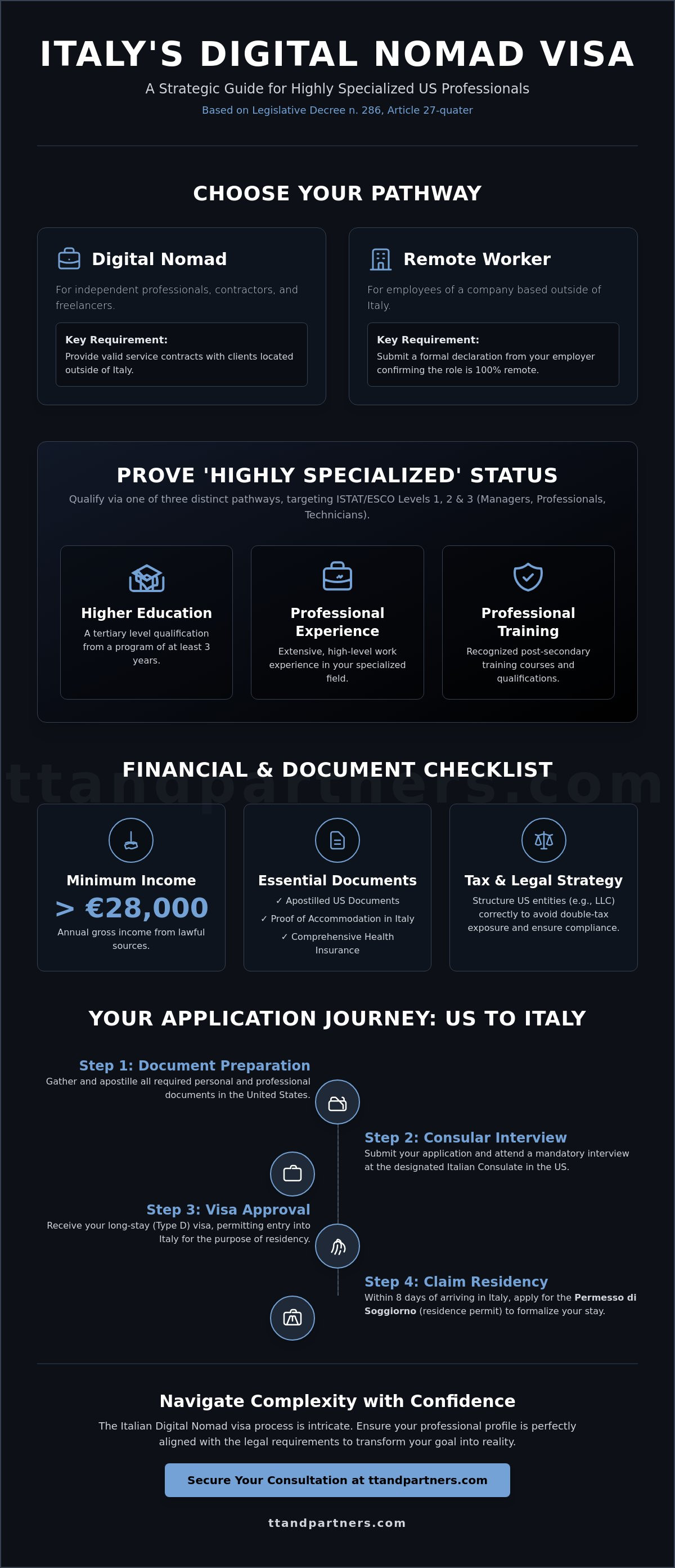
The Italian framework divides applicants into two primary categories based on their employment structure. Independent contractors and freelancers fall under the "Digital Nomad" umbrella. They must provide evidence of their professional history and valid service contracts with clients outside Italy. Conversely, "Remote Workers" are employees of foreign companies. For these individuals, the burden of proof extends to the employer. You'll need a formal declaration from your company confirming your role can be performed entirely remotely. This contract language must be explicit. Any ambiguity regarding hybrid expectations or physical office requirements can lead to a visa denial during the consular review process.
The Role of Article 27-quater in Your Application
The legal architecture of this visa is rooted in Legislative Decree n. 286, specifically under the provisions of Article 27-quater. This isn't a general-purpose remote work permit. It's a targeted initiative for highly specialized talent. The Italian government uses this decree to ensure that residents contribute to the nation's intellectual and economic vitality. This focus on high-level expertise is what differentiates Italy's program from more permissive, entry-level nomad visas found in other Mediterranean jurisdictions. Article 27-quater serves as the definitive gatekeeper for non-EU professionals seeking to transform their remote career into Italian residency. Mastery of Italy's digital nomad visa requirements begins with acknowledging that your professional background must meet these rigorous, specialized criteria to secure approval.
Proving 'Highly Specialized' Status: The Art. 27-quater Criteria
The cornerstone of Italy's digital nomad visa requirements is the classification of the applicant as a "highly qualified worker." This isn't a subjective assessment. It's a rigorous legal determination based on the ISTAT/ESCO classifications, specifically targeting professions within Levels 1, 2, and 3. These levels generally encompass managers, professionals, and technicians with high-level cognitive or technical skills. When presenting your US professional portfolio to a consular officer, the goal is to map your career trajectory directly onto these European standards. Precision in how you define your role is vital to proving you belong in this elite category of residents.
According to the Official Italy Digital Nomad Visa Requirements, you must prove this status through one of three distinct pathways: formal higher education, recognized professional training, or extensive work experience. Each path requires a specific set of verified documents that leave no room for administrative doubt.
Education and Training Requirements
For most applicants, a university degree is the most straightforward evidence. You'll need a tertiary level qualification of at least three years. It's not enough to simply possess the diploma; you must obtain a "Declaration of Value" (Dichiarazione di Valore) from the Italian consulate with jurisdiction over the school that issued the degree. This document translates your US academic achievements into the Italian educational context. If your expertise lies in tech or finance, specialized certifications can bolster your case, but they rarely replace the need for a foundational degree unless they're recognized as post-secondary professional qualifications of at least three years.
Proving Experience for Senior Professionals
If you don't hold a matching university degree, the "5-year rule" becomes your primary strategy. You must demonstrate at least five years of professional experience in a field comparable to a tertiary-level degree. For managers and specialists in the information and communication technology sector, this requirement is reduced to three years of relevant experience within the seven years preceding your application. Documenting this requires more than a standard resume. You'll need to provide tax returns, signed contracts, and detailed client references that verify your senior status. A common pitfall is using generic job titles like "Consultant" or "Manager" without explaining the high-level responsibilities involved. If you're unsure how to categorize your specific career path within the ESCO framework, seeking specialized legal guidance can prevent a costly rejection at the interview stage. Every document you submit should reinforce the narrative that your skills are indispensable and highly specialized.
Financial Requirements and Documentation for US Applicants
Securing residency in Italy requires more than a visionary professional profile. It demands a robust financial foundation that satisfies the state's self-sufficiency criteria. For 2026, Italy's digital nomad visa requirements mandate a minimum annual income of €28,000. This specific threshold is calculated as three times the minimum level required for exemption from national healthcare participation. While a steady salary is the most common proof, consular officers also evaluate passive income, dividends, and significant liquid investments. You must demonstrate that these funds are recurring and accessible, ensuring you won't become a burden on the Italian social welfare system. Beyond income, you need comprehensive health insurance providing at least €30,000 in coverage for hospitalization, medical emergencies, and repatriation for your initial twelve months.
Your physical presence in Italy must be anchored by a legitimate housing solution. A simple hotel reservation or short-term rental agreement won't suffice. You're required to present a signed 12-month lease or a property deed during your consular interview. This document proves you have a stable residence and allows the local Questura to process your subsequent stay permit once you arrive on Italian soil.
Income Verification and Tax Compliance
US applicants must use their Internal Revenue Service documentation as primary evidence. Your Form 1040 from the previous two years, paired with recent pay stubs or client contracts, provides the necessary transparency. Maintaining a clean legal record is equally critical. You'll need to submit an FBI background check and potentially state-level clearances, all of which must bear an apostille. To protect your global earnings, it's vital to review the US-Italy Tax Treaty. This legal framework is essential for avoiding double taxation and ensuring your financial transition remains efficient and compliant with both jurisdictions.
Passport and Jurisdictional Rules
One of the most frequent administrative failures involves passport validity. Your US passport must remain valid for at least 15 months beyond your planned date of entry into Italy. If your document is nearing its expiration, renew it before initiating the visa process to avoid a summary rejection. You must also prove you live within the specific Consulate's jurisdiction. A state-issued driver's license is the standard proof, though utility bills are sometimes accepted as secondary evidence. If you're a non-US citizen applying from within the United States, you must provide your Green Card or a valid long-term visa to establish your right to use a US-based Italian consulate for your application.
The Step-by-Step Application Process: US to Italy
Transitioning your professional life to Italy is a logistical symphony that requires precise synchronization between two distinct legal jurisdictions. The journey begins long before you reach the Mediterranean. It starts with the meticulous assembly of your US-based dossier. Every foundational document, from your FBI background check to your university transcripts, must undergo the apostille process at the state or federal level. This international certification ensures your documents carry legal weight within the Italian administrative system. Failing to secure these stamps correctly is a frequent cause of delays, as Italian consulates will not accept unverified foreign paperwork. Once your dossier is complete, you'll move into the dual-phase process of securing your visa and, subsequently, your legal residency.
The Consulate Phase: Securing the Type D Visa
The first major hurdle is securing an appointment through the Prenot@mi portal. In 2026, demand remains high at major hubs like the New York, Los Angeles, and Chicago consulates. Persistence is necessary; slots are often released at midnight Central European Time. During the consular interview, your demeanor should reflect the "highly specialized" nature of your work. Officers look for professional consistency and a clear understanding of Italy's digital nomad visa requirements. You'll pay an application fee of approximately €116, usually in the local US dollar equivalent. Processing times typically range from 30 to 120 days. Use this period to finalize your 12-month housing contract, as you'll need the physical address for the next phase of the journey.
The Italian Phase: Permesso di Soggiorno and Residency
Your arrival in Italy triggers a critical legal countdown. You must visit a qualified Poste Italiane office within eight days of entry to submit the "Kit Giallo" for your residency permit. This application starts the process for your Permesso di Soggiorno, which transforms you from a temporary visitor into a legal resident. A unique advantage of this specific visa is that it doesn't require a "nulla osta" (security clearance) prior to your US interview, simplifying the initial steps significantly. However, the security check occurs during the Italian phase.
After submitting your kit, you'll receive a receipt and an appointment for fingerprinting at the local Questura (Police Headquarters). This meeting is the final technical verification of your presence. Once your permit is issued, you can complete your registration at the local Anagrafe (Registry Office) to secure your residency in your chosen commune. Throughout this process, having your Codice Fiscale (tax code) is essential for everything from utility contracts to healthcare registration. If you find the interplay between US documentation and Italian police protocols overwhelming, contacting our immigration specialists can ensure your transition remains seamless and compliant with Italy's digital nomad visa requirements at every turn.
Strategic Legal Support for Cross-Border Professionals
DIY applications for the Italian Digital Nomad Visa often falter because they treat the process as a static checklist rather than a dynamic legal argument. The most common point of failure remains the "highly specialized" definition. Consular officers don't just look for a remote job; they look for proof that your role aligns with high-level cognitive levels defined by specific European standards. A specialized legal strategy ensures your professional portfolio is translated into the language of Italian bureaucracy, effectively bridging the gap between your US career and European regulations. Without this strategic framing, even the most impressive resumes can be dismissed due to administrative technicalities that a professional eye would have caught early in the process.
The complexity of Italy's digital nomad visa requirements is amplified when you consider the life you're building beyond the paperwork. This isn't just about a stamp in a passport; it's about the architectural integrity of your international lifestyle. Professionals who succeed are those who view their relocation through a holistic lens, ensuring their business interests, real estate goals, and family residency are all moving in the same direction. By treating the visa as one component of a broader strategic plan, you avoid the common pitfalls of fragmented planning and uncoordinated documentation.
Integrating Business and Immigration Goals
For many US professionals, their livelihood is tied to specific US business structures like LLCs. How you structure your company directly affects how you meet Italy's digital nomad visa requirements, particularly regarding income stability and cross-border social security contributions. If you're planning to acquire real estate alongside your move, coordinating your residency application with your property closing is vital for a smooth transition. High-net-worth individuals also need legal safeguards to protect global assets while moving into the EU tax landscape. We help align these commercial realities with your immigration timeline to ensure no part of your professional or personal life is left exposed.
Why Tosolini, Toniutti & Partners?
Navigating the nuances of Italian Immigration requires a partner who understands the friction between US and Italian legal systems. We provide bilingual expertise that covers every phase of your relocation. Our approach isn't just about the initial visa; it's about your long-term vision. Whether your goal is a multi-year residency or eventually pursuing Italian Citizenship, we build the foundation for that journey today. We manage the complexity of your dossier, from the initial consular interview in the US to the final residency registration at the local Anagrafe, ensuring your Italian dream is built on a secure and sophisticated legal structure.
Architecting Your Italian Professional Legacy
Transforming your remote career into a legal Italian residency is a deliberate act of professional architecture. By mastering the "highly specialized" criteria of Article 27-quater and meticulously documenting the €28,000 income threshold, you move beyond the status of a temporary visitor. You've seen that success lies in the details, from the 15-month passport validity rule to the precise coordination of your US business structure. Italy's digital nomad visa requirements are rigorous, but they offer a stable and visionary pathway for those who approach the process with technical precision and strategic foresight.
Our cross-border US-Italy legal team specializes in bridging these two complex jurisdictions. We provide expert guidance on Article 27-quater specialized visas and offer comprehensive Permesso di Soggiorno support to ensure your transition is seamless. Don't leave your residency to chance or administrative ambiguity. Schedule a consultation with our US-Italy immigration experts to begin your journey with confidence. Italy is waiting to welcome your talent and vision into its unique professional landscape.
Frequently Asked Questions
What is the minimum income required for the Italy Digital Nomad Visa in 2026?
The minimum annual income requirement is €28,000 for the primary applicant. This figure is calculated as three times the minimum level required for exemption from national healthcare participation in Italy. You must demonstrate that this income is recurring and derived from remote work activities through tax returns, bank statements, or signed contracts to satisfy Italy's digital nomad visa requirements.
Do I need a university degree to qualify as a 'highly specialized worker'?
You don't strictly need a university degree if you can prove at least five years of comparable professional experience in your field. For specialists and managers in the information and communication technology sector, this requirement is reduced to three years of experience within the seven years preceding your application. If you rely on education, you'll need a three-year tertiary-level qualification and a Declaration of Value.
Can I bring my family members to Italy with a Digital Nomad Visa?
Yes, you can bring family members, provided you meet the increased financial thresholds for dependents. You'll need an additional €9,900 per year for your spouse and €4,950 for each child. These family permits are tied to your primary residency status, allowing your loved ones to live in Italy while you maintain your remote professional activities under the 2026 framework.
How long does the entire application process take from the US?
The processing time for the visa at Italian consulates in the US typically ranges from 30 to 120 days. This timeline begins after your successful interview and the submission of your completed dossier. It's important to account for additional time before your appointment to gather documents, secure apostilles, and obtain the necessary Declaration of Value for your academic credentials.
Is there a limit on how many Digital Nomad Visas Italy issues per year?
There is currently no annual quota or cap on the number of Digital Nomad Visas issued by the Italian government. Unlike the standard work permits governed by the annual "decreto flussi," this specialized pathway remains open throughout the year. Any applicant who meets the rigorous professional and financial standards defined by Article 27-quater can apply for residency without waiting for a quota window.
Do I have to pay taxes in Italy if I have a Digital Nomad Visa?
You'll likely become an Italian tax resident if you spend more than 183 days in the country during a calendar year. While Italy's digital nomad visa requirements focus on entry, your physical presence triggers local tax obligations. You may be eligible for specific incentives, such as the "regime forfettario" for freelancers or the "regime impatriati," which can offer a 50% income tax exemption for five years.
Can I renew the Digital Nomad Visa, and does it lead to permanent residency?
The initial visa is valid for one year and is renewable as long as you continue to meet the income and employment criteria. After five years of continuous legal residency, you're eligible to apply for permanent residency in Italy. Following ten years of legal residency, you can initiate the process for Italian citizenship through naturalization, provided you meet the language and integration requirements.
What happens if my application for the 'highly specialized' status is rejected?
If your status is rejected, you have the right to file a legal appeal or submit a new application with a more precisely mapped professional portfolio. Rejections often occur when job titles don't clearly align with the ISTAT/ESCO Level 1, 2, or 3 classifications. Refining your documentation to better reflect the cognitive and technical complexity of your role can often resolve these administrative discrepancies.


Comments