

Jure Sanguinis Lawyer: Navigating Italian Citizenship by Descent in 2026
- Gianni Mendes Toniutti, Esq.

- May 8
- 12 min read
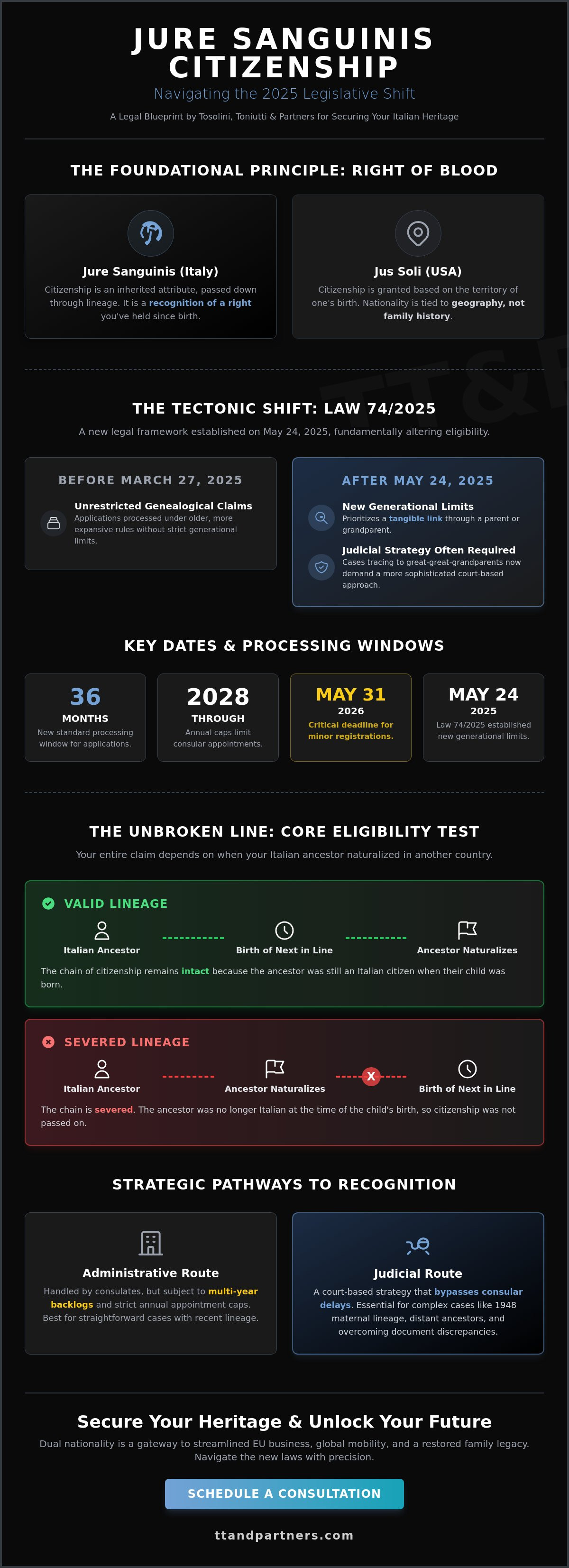
The era of unrestricted genealogical citizenship ended on May 24, 2025, when Law 74/2025 established new generational limits that prioritize a tangible link to the republic. If you're searching for a jure sanguinis lawyer to reclaim your heritage, you've likely realized that this journey requires the same structural integrity and foresight as a complex architectural project. You're right to feel concerned about the new thirty-six month processing window and the annual caps currently limiting consular appointments through 2028. Tosolini, Toniutti & Partners will provide a definitive legal blueprint for successfully securing your Italian passport while navigating the latest legislative shifts. This guide details the critical May 31, 2026, deadline for minor registrations, the judicial path for maternal lineage cases, and the cross-border strategies designed to harmonize your dual legal status within the evolving European context.
Key Takeaways
Master the distinction between the recognition of inherent citizenship and the application for new status under the refined 2025 legislative framework.
Identify how to document the critical timeline of your ancestor's naturalization to ensure your lineage remains intact under the latest generational limits.
Consult with a jure sanguinis lawyer New York to execute a precise judicial strategy for 1948 maternal lineage cases that bypass consular backlogs.
Map the essential steps for procuring certified vital records, creating a robust evidentiary foundation that withstands rigorous legal scrutiny.
Explore how dual nationality serves as a catalyst for cross-border innovation, providing a gateway to streamlined EU business operations and global mobility.
Table of Contents
Understanding Jure Sanguinis: The Legal Architecture of "Right of Blood"
Eligibility Requirements and the Impact of the 2025 Legislative Shifts
Resolving Complex Lineage Obstacles: 1948 Cases and Maternal Rights
The Strategic Process: From Document Procurement to Judicial Recognition
Beyond the Passport: Integrating Citizenship into a Cross-Border Strategy
Understanding Jure Sanguinis: The Legal Architecture of "Right of Blood"
The legal architecture of Italian citizenship is built upon the foundational principle of the right of blood. Unlike the American system of birthright citizenship, which grants nationality based on the soil of one's birth, Italian nationality law operates on the premise that citizenship is an inherited attribute. When you engage a jure sanguinis lawyer New York, you're seeking a formal recognition of a right you've held since birth rather than an application for a new status. The structural integrity of your file depends entirely on the unbroken line of descent. If an ancestor naturalized as a United States citizen before the birth of the next person in your lineage, the legal connection to Italy was severed. This framework was significantly expanded by legislation in February 1992, which allowed individuals to reclaim their heritage without forfeiting their existing status.
The Philosophical and Legal Basis of Dual Nationality
Reclaiming Italian citizenship is an act of restoring a heritage that was never legally surrendered, only dormant. While American citizenship is tied to geography, Italian ancestral rights are tied to family history. Citizenship by descent is a statutory recognition of an inherent right from birth. This duality allows for a seamless integration of identities, where the participant maintains full rights in both nations. Since the 1992 legislative shift, the Italian state has viewed its diaspora as vital components of a global community, provided the lineage remains documented and uninterrupted.
Why Legal Counsel is Essential for Citizenship by Descent
The path to recognition is divided into administrative and judicial routes. While government offices handle standard cases, the court-based path is often the only way to bypass multi-year backlogs. A jure sanguinis lawyer New York provides the technical precision required to certify complex document chains, especially when faced with high-scrutiny cases involving name discrepancies. Common pitfalls, such as name variations where an ancestor’s name was changed upon arrival but remained original on a birth certificate, can derail a file for years. Expertly navigating these inconsistencies requires court-ordered amendments or legal affidavits before they reach a judge's desk. To begin auditing your family's legal eligibility, you may reach out to our team at Tosolini, Toniutti & Partners for a consultation.
Eligibility Requirements and the Impact of the 2025 Legislative Shifts
The legal landscape for citizenship by descent underwent a tectonic shift on May 24, 2025, with the conversion of Decree-Law No. 36/2025 into Law 74/2025. This legislation introduced generational limits that prioritize immediate lineage over distant ancestry. For many seeking a jure sanguinis lawyer New York, the primary challenge is now demonstrating a tangible link to the republic through a parent or grandparent. Applications submitted before the March 27, 2025, cutoff are processed under the older, more expansive rules, but new applicants in 2026 must navigate a much narrower corridor. The unbroken line remains the most vital concept. You must prove your ancestor didn't naturalize as a United States citizen before the birth of the next person in your direct line. If they did, the chain was severed. A secondary complication is the controversy involving ancestors who naturalized while their children were still minors, potentially stripping the next generation of their inherent status. Resolving these nuances requires a strategic audit of your family's vital records before approaching the Italian Consulate in New York.
Analyzing the 2025 Eligibility Thresholds
The 2025 reform shifted the administrative focus toward grandparent-level proximity. This change was designed to move beyond purely genealogical claims and require a more effective connection to the nation. If your line traces back to a great-great-grandparent, your file now requires a sophisticated judicial strategy rather than a standard consular appointment. Those who had already begun their document procurement before the law change may find protection under specific clauses, provided their initial intent was documented. If the path forward seems obscured by these new limits, you can schedule a strategic lineage review with Tosolini, Toniutti & Partners to identify alternative evidentiary routes.
The Naturalization Timeline: The Make-or-Break Factor
Timing is everything in citizenship law. The June 1912 legislation established that nationality was lost upon the voluntary acquisition of a foreign one. Proving an ancestor never naturalized is often done through the gold standard of evidence: a certified negative search from federal immigration authorities combined with census records showing alien status. If you receive a no records found letter, it's not a dead end. It's an invitation to dig deeper into national archives or local county court records.
Checklist for the Unbroken Line:
Certified Birth Certificate in a multilingual format from the ancestral municipality.
Final Naturalization Certificate or a certified no-record letter from federal authorities.
All birth, marriage, and death records for every generational link in the chain.
International legal certifications and professional translations for every non-Italian document.
Resolving Complex Lineage Obstacles: 1948 Cases and Maternal Rights
Historical gender discrimination created a structural flaw in Italian citizenship transmission that persisted for decades. Under the 1912 Citizenship Law, Italian women were unable to pass their nationality to children born before January 1, 1948. This "1948 Rule" reflects an era where a woman's legal status was often subsumed by her husband's. While the Italian Constitution of 1948 established gender equality, it didn't retroactively apply to births occurring before its enactment. If your lineage passes through a woman whose child was born prior to this date, your file contains a "1948 Case" that cannot be resolved through an administrative appointment at a consulate. Instead, this requires a specialized judicial reclamation. 1948 cases are now a standardized judicial remedy for gender discrimination in citizenship law. Working with a jure sanguinis lawyer New York allows you to prepare the necessary documentation locally before initiating a lawsuit against the Italian Ministry of Interior in the appropriate regional court.
Maternal Lineage and Gender Equality in Italian Law
The path to equality was paved by a landmark 2009 Supreme Court ruling which declared the pre-1948 gender restriction unconstitutional. This decision didn't change the administrative rules used by consulates, but it empowered Italian judges to recognize the inherent citizenship of descendants in the maternal line. On April 30, 2026, the Constitutional Court further reinforced these protections, ensuring that the 2025 legislative shifts don't unjustly penalize those pursuing judicial recognition. These cases are no longer speculative; they are established legal precedents that restore the integrity of the family's "right of blood" regardless of the ancestor's gender.
Navigating the Regional Court System
In June 2022, Italy decentralized citizenship litigation from Rome to regional courts, or Tribunali, based on the ancestor's place of birth. This shift has transformed the timeline for many applicants. While wait times for an appointment at the Italian Consulate in New York can stretch between two to eight years, a judicial filing often reaches a resolution in 18 to 24 months. This route utilizes international litigation to bypass the administrative bottlenecks that plague the consular system. A jure sanguinis lawyer New York acts as the bridge between U.S. record procurement and the Italian courtroom, ensuring every vital record is formatted to meet the specific evidentiary standards of the regional judge overseeing your file.
The Strategic Process: From Document Procurement to Judicial Recognition
Reclaiming citizenship is a multi-phase engineering project for your family's legal identity. It begins with the precise mapping of your lineage to identify the "last Italian born" ancestor who held the right of blood. You must secure certified vital records from both the Italian comune of origin and various U.S. authorities, ensuring every birth, marriage, and death in the chain is documented. Once these records are gathered, they must undergo the Apostille process to ensure international legal validity under the Hague Convention. A jure sanguinis lawyer New York provides the necessary oversight during the translation phase, as every non-Italian document requires a certified translation by a recognized expert to survive the scrutiny of Italian officials. The process concludes with your recognition and subsequent registration in the Registry of Italians Residing Abroad (AIRE), which is the final prerequisite for your Italian passport.
The Art of Document "Correction" and Amendments
Precision in vital records is non-negotiable for a successful file. Records from the early 20th century often contain phonetic misspellings or inconsistent dates that can threaten the "unbroken line" of your descent. When discrepancies are significant, a "One and the Same" court order from a U.S. judge is often required to legally link the various iterations of an ancestor's name. These amendments must be handled with care to ensure the corrected record remains consistent with the rest of the evidentiary chain. Expertly certified translations are the final layer of this architectural foundation, ensuring that the Italian authorities receive a clear, legally sound narrative of your family history.
Consular Appointments vs. Judicial "Atto di Citazione"
The reality of the "Consular Queue" in 2026 remains a significant hurdle, with wait times at the Italian Consulate in New York often stretching between two and eight years. This extensive backlog has created a legal opening for the "denial of justice" argument. When a consulate cannot provide an appointment within a reasonable timeframe, you may have the right to file an Atto di Citazione in the Italian regional courts. This judicial path bypasses the consular waiting list entirely, moving your case directly before a judge in Italy. Managing expectations is critical; while the judicial route is often faster, the timeline from the first document procured to the final Italian passport typically spans 18 to 36 months. If you're ready to move beyond the consular waitlist and secure your heritage through the courts, contact our legal team to begin your judicial filing.
Beyond the Passport: Integrating Citizenship into a Cross-Border Strategy
Recognizing your Italian heritage is more than a sentimental journey; it's a strategic expansion of your global legal architecture. An Italian passport isn't merely a travel document. It's a key that unlocks the European Union's single market, providing a frictionless environment for business and investment. For the modern entrepreneur, dual nationality facilitates seamless LLC incorporation and the establishment of cross-border ventures that bridge the Atlantic. By working with a jure sanguinis lawyer New York, you ensure your citizenship reclamation is integrated into a broader plan for international tax optimization and asset protection. Italian citizens benefit from significantly lower registration taxes when purchasing real estate, often paying as little as 2% compared to the 9% rate applied to non-resident foreign nationals. This status also creates powerful synergies with treaty-based mobility, acting as a foundation for a sophisticated E-2 Visa or E-1 Visa strategy for those managing trade between the United States and Italy.
Mobility and Investment in the European Union
As the European Travel Information and Authorization System (ETIAS) becomes fully operational in 2026, holding an EU passport allows you to bypass the digital pre-screening required of U.S. citizens. You gain permanent access to Italy’s public healthcare system and the right to enroll in European educational institutions at domestic tuition rates. Partnering with a jure sanguinis lawyer New York ensures that these benefits are secured through a legally sound application that withstands the scrutiny of Italian authorities. While some consider a Permesso di Soggiorno for residency, citizenship offers an immutable status that doesn't require renewals or specific investment thresholds. This permanence is the ultimate safeguard for your family’s future mobility and financial security within the Eurozone.
The Tosolini, Toniutti & Partners Vision for Global Citizens
Our firm views every citizenship file with the precision of an architect designing a lasting structure. We don't simply process documents; we build the legal framework that allows your heritage to serve your future business and lifestyle goals. We focus on the delicate intersection where immigration law, international litigation, and corporate strategy meet. This holistic approach ensures that your recognition as an Italian national is just the first step in a larger narrative of global citizenship. If you're ready to design your cross-border future, schedule a strategic citizenship consultation with the team at Tosolini, Toniutti & Partners today.
Architecting Your Global Future Through Italian Heritage
The legislative landscape of 2026 demands a higher level of precision than ever before. With Law 74/2025 establishing new generational boundaries and the May 31, 2026, deadline for minor declarations approaching, the window for administrative simplicity is narrowing. You've seen how the judicial path can bypass the eight year consular backlogs while providing a definitive resolution for 1948 maternal lineage cases. Partnering with a jure sanguinis lawyer New York ensures your application is treated with the architectural detail necessary to survive modern scrutiny. At Tosolini, Toniutti & Partners, we bring decades of US-Italy cross-border legal expertise to every file, managing everything from the initial document procurement to the final passport issuance. Our team specializes in complex international litigation, transforming a genealogical search into a strategic asset for your global business and personal mobility. Your heritage is a foundation for future innovation. Secure your Italian heritage with a strategic legal consultation and begin the journey toward your dual nationality today.
Frequently Asked Questions
How long does the Jure Sanguinis process take in 2026?
The recognition process typically spans 18 to 36 months, depending on the chosen legal path. While administrative processing at consulates is legally capped at 36 months as of 2026, the wait for an initial appointment can add several years to the timeline. Judicial filings in regional courts often provide a more predictable and efficient alternative for those seeking a faster resolution through the Italian legal system.
Do I need to speak Italian to qualify for citizenship by descent?
No, there is no language requirement for citizenship by descent. Unlike citizenship through marriage or naturalization, which requires a B1 level certification under current law, jure sanguinis is the recognition of an existing right from birth. You aren't required to demonstrate Italian language proficiency or pass a citizenship test to reclaim your heritage through your direct ancestral lineage.
Can I apply for Italian citizenship if my ancestor naturalized as a US citizen?
You qualify if your ancestor naturalized after the birth of the next person in your direct line. If naturalization occurred after the next generation was born, the Italian citizenship was successfully transmitted. Proving this specific sequence with a jure sanguinis lawyer New York is the most critical step in establishing a valid claim and ensuring the unbroken line of descent is legally documented.
What is the "1948 Rule" and does it apply to my maternal line?
The 1948 Rule applies if your Italian female ancestor gave birth to her child before January 1, 1948. Historical laws prevented these women from passing citizenship to their descendants. However, modern Italian courts routinely grant citizenship in these cases through a judicial appeal. These cases must be filed in the Italian regional courts rather than at a consulate to correct this historical gender discrimination.
What happens if I cannot find my ancestor’s birth certificate in Italy?
If a civil birth certificate is missing, we utilize baptismal records from the local parish or military records as secondary evidence. These documents must be authenticated by the local Diocese or the relevant Italian State Archive to hold legal weight. In rare instances where no records exist, a judicial "Atto di Notorietà" can be used to legally reconstruct the ancestor's identity through sworn testimonies.
Is it better to apply through the Italian Consulate or the Italian Courts?
Choosing between the consulate and the courts depends on your specific lineage and the current administrative backlog. The judicial route is mandatory for 1948 cases and is increasingly used to bypass the multi-year wait times at the Italian Consulate in New York. A court-based application often provides a more structured timeline and avoids the unpredictability of consular scheduling while providing a binding judicial decree.
Can my spouse and children get Italian citizenship if I qualify through Jure Sanguinis?
Minor children under 18 automatically acquire citizenship once your status is recognized. For children born before May 24, 2025, a declaration must be filed by the May 31, 2026, deadline. Spouses may apply for citizenship through marriage after three years, provided they pass a B1 level Italian language exam. This period is reduced by 50 percent if the couple has minor children together.
Does the 2025 law change mean I can no longer apply through my great-grandfather?
Law 74/2025 generally limits new administrative applications to those with an Italian-born parent or grandparent. If your line goes back to a great-grandfather, a jure sanguinis lawyer New York can help determine if you qualify for a judicial exemption or if your file was grandfathered. Applications filed before the March 27, 2025, cutoff remain subject to the older rules without these specific generational limits.


Comments