

Legal Requirements for Buying US Property from Italy: The 2026 Investor's Guide
- Gianni Mendes Toniutti, Esq.

- Apr 20
- 13 min read
The distance between a Milanese apartment and a Manhattan penthouse is measured less in miles and more in the precision of your legal framework. You likely recognize that the American real estate market offers a scale of innovation and liquidity that's hard to find elsewhere; yet, the fear of double taxation under the 1984 US-Italy Tax Treaty often halts even the most visionary investors. Understanding the specific legal requirements for buying US property from Italy is the first step in transforming a cross-border ambition into a tangible legacy. It's natural to feel overwhelmed by the stark differences between a New York co-op and a Florida condo, especially when non-resident financing feels like a closed door.
This 2026 guide provides the clarity you need to move forward with confidence. We'll outline a roadmap for asset protection through strategic entity structuring, such as the use of domestic LLCs to mitigate liability. You'll gain a clear understanding of how to navigate FIRPTA withholding and the specific paths that lead from property ownership to potential residency. By the end of this article, the complexities of US-Italy transactions will resolve into a functional, sustainable strategy for your international portfolio.
Key Takeaways
Understand how the US-Italy Treaty of Friendship establishes the legal foundation for Italian investors to acquire American real estate with the same protections as domestic buyers.
Discover why [LLC incorporation](https://ttandpartners.com/post/llc-incorporation-a-strategic-guide-to-us-business-architecture-in-2026) is a vital architectural tool for your investment, providing essential asset protection and liability shielding.
Navigate the specific legal requirements for buying US property from Italy by mastering FIRPTA withholding rules and treaty benefits to safeguard your capital.
Learn to coordinate the US closing process from abroad, identifying the critical legal clauses and professional roles necessary for a secure international transaction.
Explore how to leverage strategic real estate investments as a basis for the [E-2 Investor Visa](https://ttandpartners.com/post/visto-o-1-the-complete-2026-guide-to-extraordinary-ability-visas-for-the-us-1), moving beyond common myths regarding property and residency.
Table of Contents The Legal Foundation: Reciprocity and Rights for Italian Buyers Structuring the Investment: Individual Ownership vs. LLC Incorporation The US Real Estate Closing Process from Italy Cross-Border Tax Obligations: FIRPTA and the US-Italy Treaty Property as a Gateway: Visas and Residency Opportunities
The Legal Foundation: Reciprocity and Rights for Italian Buyers
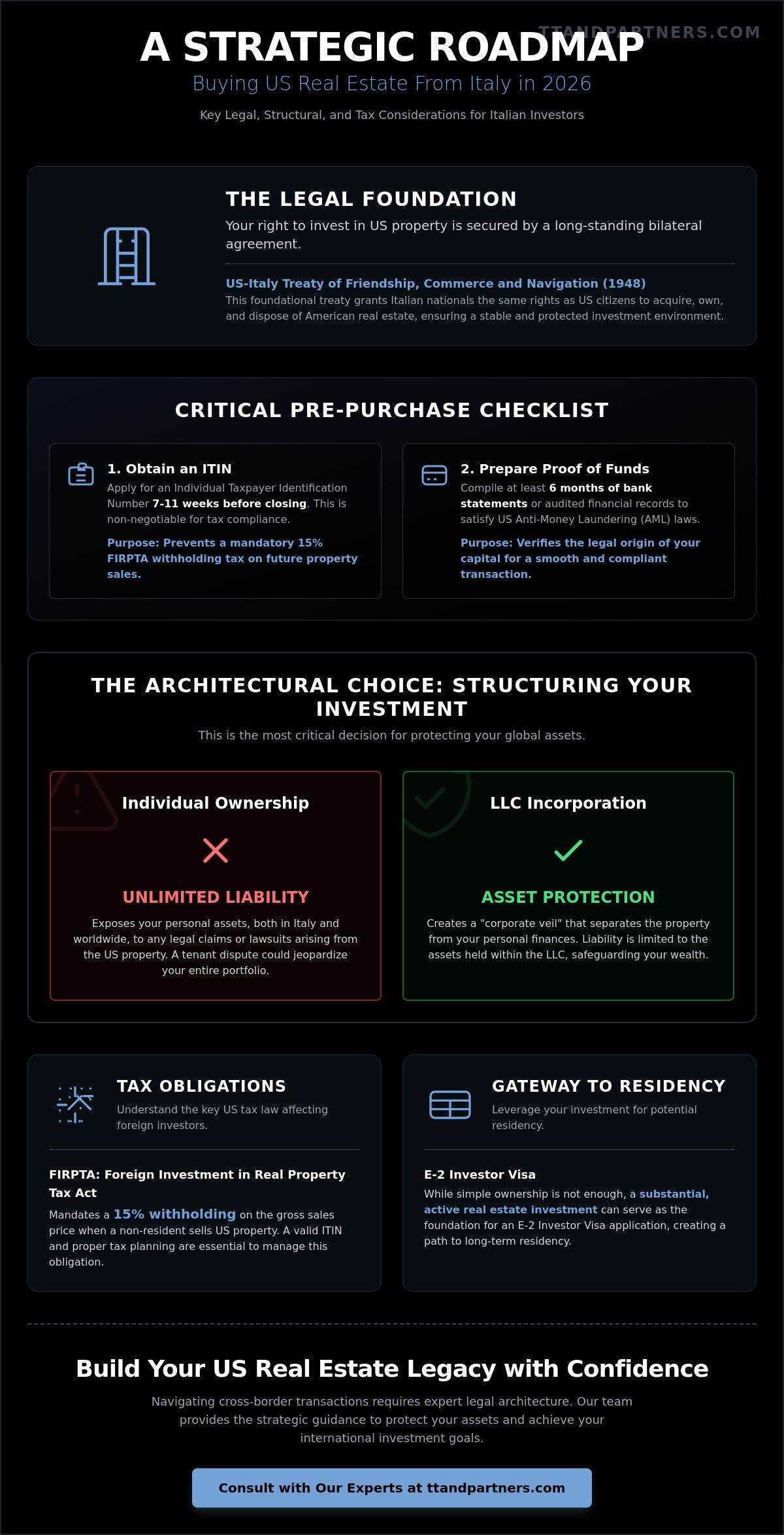
The acquisition of American real estate by Italian investors represents more than a financial transaction; it's a structural integration into a distinct urban fabric. Understanding the legal requirements for buying US property from Italy begins with a bilateral framework established decades ago. The US-Italy Treaty of Friendship, Commerce and Navigation, signed on February 2, 1948, serves as the primary pillar of this relationship. This document ensures that Italian nationals receive treatment equal to US citizens regarding the right to acquire, own, and dispose of immovable property. This legal symmetry allows for a seamless transition of capital into the American landscape, reflecting a shared respect for private ownership and investment stability.
While federal law provides the broad strokes of permission, the practical reality of land ownership is governed by the states. Italian citizens possess the legal capacity to own land in all 50 states. However, certain jurisdictions maintain specific reporting requirements for non-resident aliens, particularly concerning agricultural land under the Agricultural Foreign Investment Disclosure Act (AFIDA) of 1978. These regulations don't prohibit ownership but require transparency through detailed filings with the Department of Agriculture. Success in these transactions relies on a meticulous approach to these administrative layers.
Understanding the US-Italy Reciprocity Agreement
The principle of reciprocity, or condizione di reciprocità, is a fundamental concept in Italian law. It dictates that foreign nationals can only purchase property in Italy if their home country allows Italians to do the same. Since the US maintains an open-door policy, this legal harmony remains fully intact. Foreign investment in U.S. real estate is protected under the US Constitution, specifically through the 14th Amendment's Due Process Clause. This protection ensures that your assets aren't subject to arbitrary seizure or discriminatory legislation, providing a secure environment for long-term capital appreciation.
Essential Documentation for Italian Nationals
The administrative architecture of a cross-border deal requires engineering precision. Italian buyers don't need a specific residency visa to own property, but the Internal Revenue Service demands an Individual Taxpayer Identification Number (ITIN). You'll need to apply for this at least 7 to 11 weeks before your scheduled closing date. Without an ITIN, the Foreign Investment in Real Property Tax Act (FIRPTA) can trigger a mandatory 15% withholding on the gross sales price during future liquidations. This tax identification is the key to managing your fiscal obligations and ensuring your investment remains compliant with federal standards.
Compliance also involves rigorous Anti-Money Laundering (AML) protocols. US financial institutions require documented proof of funds to satisfy the standards set by the 2001 Patriot Act. You must be prepared to provide at least six months of bank statements or audited financial records to verify the origin of your capital. If you're coordinating with legal counsel or architectural consultants for a specific development project, early communication is vital to align these documents with the transaction timeline. You can reach out to our team at TT and Partners to discuss the strategic alignment of your international property goals.
Structuring the Investment: Individual Ownership vs. LLC Incorporation
Choosing a legal structure is as critical as the architectural foundation of the property itself. For Italian investors, holding US real estate in their personal name exposes them to unlimited liability. If a legal claim arises from a tenant or a contractor, every asset the investor owns, whether in Milan or Rome, could be targeted. Navigating the legal requirements for buying US property from Italy requires a shift from personal ownership to a more structured corporate approach. Utilizing LLC incorporation creates a distinct legal entity that holds the deed. This separation ensures that the property's liabilities remain contained within the US entity. It's a standard practice for managing the legal requirements for buying US property from Italy while maintaining a clean global balance sheet.
Privacy is another pillar of the corporate strategy. States like Wyoming or Delaware don't require the public disclosure of members. This shields the identity of the Italian beneficial owner from public records, adding a layer of security. Regarding estate taxes, foreign individuals face a steep 40% tax on US assets exceeding $60,000. Corporate structures, when designed correctly, provide a shield against this significant levy. It's about building a framework that lasts across generations.
Asset Protection and Liability Shielding
A US LLC acts as a firewall. It isolates property-level risks from your personal wealth. US courts generally respect this "corporate veil" unless there's evidence of fraud or commingling of funds. Single-member LLCs are particularly popular for private Italian investors. They offer this protection without the complexity of a multi-partner board. This structure ensures that a slip-and-fall lawsuit at a Miami condo won't jeopardize a family estate in Tuscany. It's a clean, functional solution for risk management.
Tax Transparency and Flow-Through Entities
The IRS treats single-member LLCs as "disregarded entities" for tax purposes. Profits flow directly to the owner. The US-Italy Tax Treaty, ratified in 1999, helps prevent double taxation on these profits. However, the IRS mandates strict reporting for foreign-owned LLCs. You must file Form 5472 annually. Failure to do so results in a minimum $25,000 penalty. When selling, you must also navigate FIRPTA withholding rules, which typically require a 15% holdback of the gross sales price. If you're planning a complex acquisition, our team can help align your vision with the right strategic framework.
The US Real Estate Closing Process from Italy
The transition from an Italian real estate context to the American system requires a shift in perspective. In the US, the division of labor is distinct. Real estate agents focus on market positioning and negotiation, while attorneys or title companies handle the legal architecture of the deal. Understanding the legal requirements for buying US property from Italy means recognizing that the purchase agreement is a binding blueprint. It must include specific contingencies for international wire transfers and tax compliance. Buyers should pay close attention to the IRS FIRPTA Withholding Rules, which dictate how funds are managed if the seller is a non-resident. This prevents the Italian investor from inheriting the seller's tax debts. For those seeking a strategic partner to navigate these complexities, consulting with professionals at TT and Partners ensures that the investment aligns with both legal and aesthetic standards.
The Title Company acts as a neutral clearinghouse. They hold the deposit in an escrow account, ensuring no funds move until every contractual obligation is met. This precision mirrors the structural integrity required in high-end architecture. Italian buyers often find this system more transparent than the traditional European model. The escrow process protects the buyer's capital until the title is confirmed as "clear," meaning no hidden claims exist against the property.
Due Diligence and Title Insurance
Title insurance isn't optional for the prudent investor. It serves as a guarantee that the property's history is clear of encumbrances. A title search typically examines 60 years of public records to identify liens or easements. In 2026, environmental audits have become more rigorous. These inspections ensure the property meets modern sustainability standards and zoning laws, protecting the long-term value of the urban fabric. Investors must also verify that the property's current use complies with local ordinances to avoid future litigation.
The Mechanics of the Remote Closing
Closing a deal from Milan or Rome relies on robust digital infrastructure. A specific Power of Attorney (POA) allows a US representative to sign on your behalf, though Remote Online Notarization (RON) is now accepted in 47 states as of early 2026. The legal requirements for buying US property from Italy also mandate that all remote signatures meet the Hague Convention standards for an Apostille if a physical notary is used at an embassy. For the final walk-through, investors utilize 3D spatial scans or high-definition drone footage to verify the property's condition before the title company releases the final funds from escrow.
Cross-Border Tax Obligations: FIRPTA and the US-Italy Treaty
Investing in American real estate requires a meticulous understanding of the fiscal architecture connecting Washington and Rome. One of the most critical legal requirements for buying US property from Italy involves navigating the Foreign Investment in Real Property Tax Act (FIRPTA). This 1980 legislation mandates that a buyer withholds 15% of the gross sales price when an Italian resident sells US property. It isn't a final tax but a security deposit for the IRS. Without a strategic approach, this withholding can severely disrupt your liquidity during a divestment phase.
FIRPTA Compliance and Exemptions
To mitigate the 15% impact, investors often apply for a Withholding Certificate via IRS Form 8288-B. This document proves the actual tax liability is lower than the standard withholding, allowing the escrow agent to release funds sooner. The "Principal Residence" exemption offers relief if the sale price is under $300,000 and the buyer intends to reside there for 50% of the time over a two year period. However, most Italian seasonal residents don't qualify for this. Utilizing a qualified substitute, typically a title company or attorney, ensures that sensitive tax identification numbers remain confidential while maintaining strict compliance with federal mandates.
Avoiding Double Taxation for Italian Residents
The 1999 US-Italy Tax Treaty serves as the primary defense against being taxed twice on the same dollar. Italian investors must report US rental income on their Modello Redditi, but they can claim a foreign tax credit for taxes paid to the US. This prevents the erosion of returns. Simultaneously, owners must account for IVIE (Imposta sul Valore degli Immobili all'Estero), which is currently set at 1.06% for most properties. Because the legal landscape is fluid, professional international litigation support becomes vital if the IRS or the Agenzia delle Entrate disputes your filings.
State-level taxes introduce another layer of complexity. While federal rules are uniform, your tax burden shifts based on geography. Florida remains attractive with 0% state income tax, whereas California or New York can impose rates exceeding 8% or 13% respectively. Balancing these variables is essential for maintaining the long-term viability of your portfolio. Understanding these legal requirements for buying US property from Italy ensures that your investment remains a source of growth rather than a source of unforeseen liability.
If you need precise guidance on structuring your cross-border investment, contact our legal team for a consultation.
Property as a Gateway: Visas and Residency Opportunities
Owning a piece of the American skyline represents a significant achievement, yet many Italian investors mistakenly believe that a title deed doubles as a permanent residency permit. It doesn't. Purchasing a residential property, regardless of the price tag, provides no direct path to a Green Card. The US Citizenship and Immigration Services (USCIS) separates real estate ownership from immigration status. To bridge this gap, investors must look toward specific visa categories that transform passive holdings into active business ventures. Understanding the legal requirements for buying US property from Italy involves recognizing that the property itself is merely a vessel. To secure a long-term future, one must layer architectural vision with strategic legal structures.
The E-2 Visa Real Estate Strategy
The E-2 Investor Visa offers a viable pathway for Italian citizens, thanks to the bilateral treaty between Italy and the US. In 2026, the key lies in shifting from a passive landlord to an active entrepreneur. A single vacation home won't qualify. However, a property management company that acquires, renovates, and leases multiple units can meet the USCIS "active" criteria. The investment must be substantial, often starting at $100,000. It needs to contribute to the local urban fabric by creating jobs or providing essential housing services. This transformation requires a meticulous business plan where the architectural assets serve as the core capital.
Estate Planning for Cross-Border Families
Acquiring US assets necessitates a parallel focus on legacy and succession. Italian succession laws, which often mandate "forced heirship," frequently clash with the flexible probate systems found in US states like Florida or New York. Without a specific US Will, your American property could fall into a complex probate process that lasts 12 to 18 months. Structuring ownership through a domestic LLC or a trust can mitigate these risks. This approach ensures that the transfer to heirs remains seamless and reflects the investor's original intent. For those looking to eventually become a US Resident, aligning these estate plans with long-term immigration goals is essential for maintaining family wealth across borders.
Mastering the legal requirements for buying US property from Italy requires a dual focus on tax and immigration law. Successful investors typically follow these steps to ensure their property supports their residency goals:
Identify properties with high renovation potential to increase "active" investment value.
Establish a US business entity, such as an LLC, before the 2026 tax year begins.
Consult with cross-border legal experts to draft a US Will that complements Italian succession plans.
Maintain meticulous records of all capital improvements to satisfy E-2 "substantial investment" audits.
If you require a tailored analysis of how your architectural investments can support your transatlantic transition, please reach out to our team at TT and Partners for a professional consultation.
Architecting Your Transatlantic Investment Legacy
Securing North American real estate involves more than a simple transaction; it's about the structural precision of the underlying legal foundation. By leveraging the 1948 Treaty of Friendship, Commerce and Navigation, Italian investors access a framework that ensures reciprocal property rights. Navigating the legal requirements for buying US property from Italy requires a strategic decision between individual ownership and LLC incorporation to optimize efficiency within the 2026 regulatory landscape. Our bilingual legal team, operating directly from offices in New York and Italy, manages the entire lifecycle of your acquisition. We provide comprehensive support that spans from the initial entity formation to the complexities of the US real estate closing process. We apply the same meticulous rigor to cross-border law that defines the world's most enduring architectural projects. TT and Partners acts as your strategic collaborator, bridging the gap between two distinct legal cultures with professional confidence. Don't let administrative hurdles obscure your long-term vision for growth. Secure your US property investment with a legal consultation to ensure your portfolio stands on solid ground. The journey toward a sophisticated international presence is built on clarity and expert foresight.
Frequently Asked Questions
Can an Italian citizen buy property in the US without a visa?
Yes, Italian citizens don't need a specific visa to purchase or own real estate in the United States. The legal requirements for buying US property from Italy focus on financial transparency and tax compliance rather than immigration status. Most investors use the ESTA program for short visits to inspect assets or attend closings. It's important to remember that property ownership doesn't grant residency rights or provide a direct path to a Green Card.
Do I need a US bank account to purchase real estate in America?
You don't legally need a US bank account to complete a purchase, but it's essential for the long-term management of the asset. Domestic accounts facilitate the seamless payment of property taxes, insurance, and monthly utilities. Most title companies prefer funds via domestic wire transfers to comply with anti-money laundering regulations. Setting up an account usually requires a valid passport and an ITIN, depending on the specific bank's 2026 compliance protocols.
What is the difference between a Condo and a Co-op for a foreign buyer?
Condominiums provide fee simple ownership of a specific unit, while Cooperatives involve purchasing shares in a corporation that owns the building. Foreign investors almost exclusively choose Condos because they offer greater flexibility for leasing and future resale. Co-op boards often require exhaustive financial disclosures and personal interviews. Industry data shows that roughly 90% of international buyers in major hubs like New York choose Condos to avoid restrictive approval processes.
How much are the typical closing costs for a foreign investor in the US?
Closing costs for foreign investors generally range from 2% to 5% of the total purchase price. These expenses cover title insurance, government recording fees, and legal representation. If you're financing the acquisition, costs will increase due to mortgage origination fees and appraisal charges. It's vital to budget for these figures early. This ensures the financial architecture of your investment remains stable throughout the entire transaction process.
Does owning US property make me a US tax resident?
No, simply owning real estate doesn't trigger US tax residency for an individual. Residency is typically determined by the Substantial Presence Test, which measures if you've been in the country for 183 days over a three year period. You'll still owe taxes on any rental income generated by the property. Understanding the legal requirements for buying US property from Italy helps you navigate these fiscal boundaries without triggering unintended global tax obligations.
Can I get a mortgage in the US as an Italian resident?
Italian residents can access US financing through specialized Foreign National mortgage programs. Lenders typically require a down payment ranging from 30% to 40% of the property's appraised value. You'll need to provide international credit reports or proof of significant liquid assets to qualify. While interest rates for non-residents are often 1% to 2% higher than domestic rates, these loans provide a strategic way to leverage your capital in the American market.
What is an ITIN and why is it mandatory for property owners?
An ITIN is a tax processing number issued by the IRS for individuals who aren't eligible for a Social Security Number. It's mandatory for reporting rental income and complying with the Foreign Investment in Real Property Tax Act, known as FIRPTA. Without an ITIN, the IRS may withhold 15% of the gross sales price when you eventually sell the property. It serves as your primary fiscal identity within the American legal system.
How does the US-Italy tax treaty protect me from double taxation?
The US-Italy Income Tax Convention, effective since 2000, prevents you from paying taxes on the same income in both jurisdictions. It allows you to claim a tax credit in Italy for certain taxes paid to the US government on your property earnings. This bilateral agreement ensures your investment returns aren't eroded by dual taxation. It's a foundational element for any Italian citizen looking to build a sustainable and transparent international real estate portfolio.


Comments