

Legal Requirements for Moving to Italy from the US: The 2026 Strategic Guide
- Gianni Mendes Toniutti, Esq.

- Jul 9
- 13 min read
Updated: Jul 16
Moving your life to the Mediterranean is not merely a change of scenery; it's a complex architectural undertaking that requires the precise synchronization of two distinct legal systems. Many US citizens view the transition as a simple matter of paperwork, yet the reality involves navigating a sophisticated web of regulations that govern both your residency and your assets. Understanding the legal requirements for moving to Italy from US is the foundation upon which your future in the EU is built. You likely feel the weight of the 'nulla osta' process or the pressure of the eight-day window to secure your first permit. It's natural to feel overwhelmed by the transition from a consulate-issued visa to a local residency permit.
This guide provides the intellectual framework and technical precision you need to navigate the 2026 landscape with absolute confidence. We'll outline the specific financial thresholds for Digital Nomad and Elective Residence visas, including the latest 2026 fee structures and biometric requirements. You'll gain a clear roadmap for the Permesso di Soggiorno and a strategy for maintaining cross-border legal compliance. From initial visa selection to the five-year path toward permanent residency, we'll ensure your move is as seamless as a well-designed structure.
Table of Contents
Understanding the Legal Framework: Schengen vs. National Visas
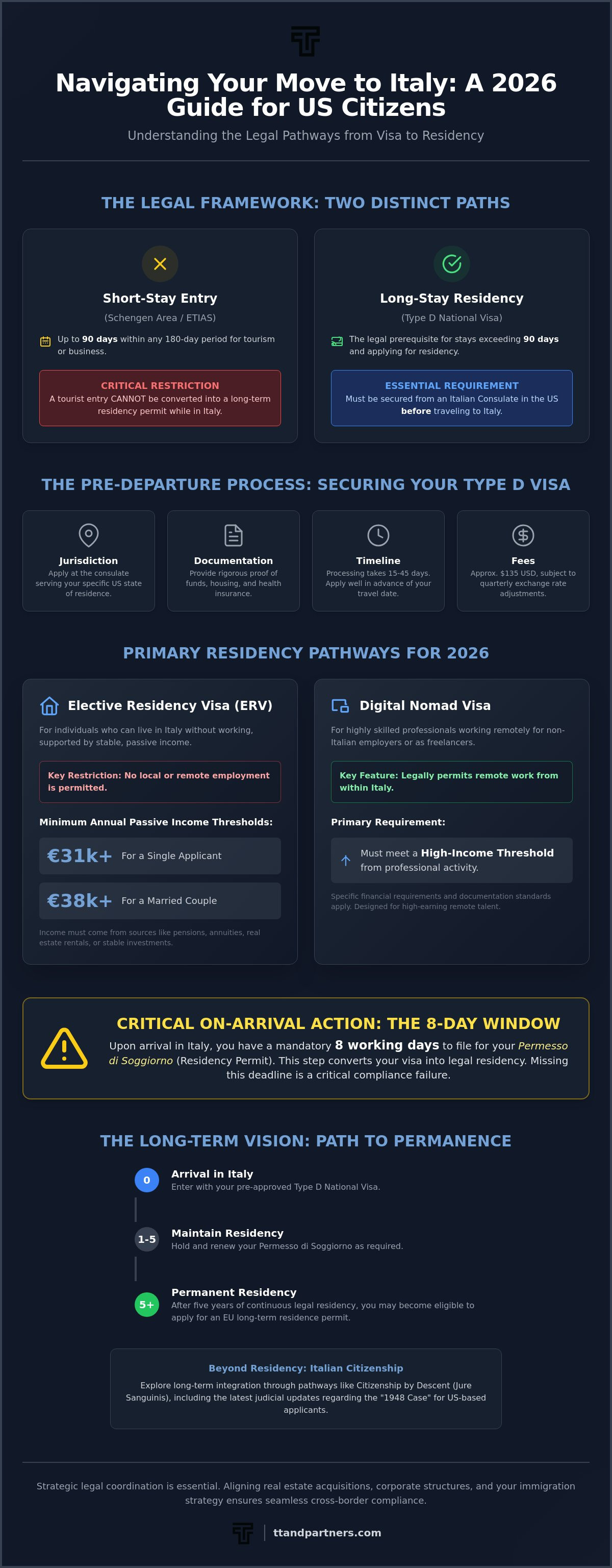
The foundation of any successful relocation lies in the precise distinction between temporary visitation and legal residency. For US citizens, the initial entry into Europe is governed by the Schengen Area visa policy, which permits stays of up to 90 days within any 180-day period for tourism or business. However, this framework is fundamentally restricted. You cannot legally convert a visa-exempt tourist entry into a long-term residency permit once you're on Italian soil. Attempting to do so is a common strategic error that often results in mandatory departure and significant delays. This rigid separation exists to maintain the integrity of Italy's immigration control; the Ministry of Foreign Affairs mandates that the intent for long-term residency be declared and vetted through a consulate abroad before your journey begins. To establish a permanent presence, you must secure a Type D National Visa. This document is the structural prerequisite for all subsequent legal requirements for moving to Italy from US, acting as the essential bridge between your current life and your future residency.
Short-Stay vs. Long-Stay Legal Status
In late 2026, the implementation of the ETIAS system adds a layer of digital authorization for short stays, but it doesn't change the underlying 90-day limitation. Overstaying this limit carries severe legal consequences, including biometric flags in the Entry/Exit System (EES) and potential bans from the entire Schengen zone. If your relocation goal extends beyond a three-month summer, you must trigger the National Visa process while still in your home jurisdiction. The Type D visa is specifically designed for stays exceeding 90 days, providing the legal authority to apply for a Permesso di Soggiorno upon arrival. It's the only way to ensure your transition remains compliant with both EU and Italian statutes, protecting your ability to live and work in the country long-term.
The Role of the Italian Consulate in the US
The Italian consular network in the US operates under strict jurisdictional boundaries. You must apply at the consulate serving your specific state of residence, whether that's the Embassy in DC or one of the regional offices in cities like New York, Chicago, or San Francisco. Documentation standards for 2026 are rigorous, requiring authenticated proof of financial means, health insurance, and suitable housing. While processing times typically range from 15 to 30 days, peak seasons can extend this to 45 days. Securing an appointment early is essential for maintaining your timeline. Expect to pay a fee of approximately $135.20 for a standard National D Visa, a cost that is subject to quarterly exchange rate adjustments. Precision in your initial application prevents the structural failures that derail many relocation efforts before they truly begin. If you're unsure which jurisdiction applies to your move, you can always contact our team for a precise assessment of your consular requirements.
Primary Residency Pathways for US Citizens in 2026
Selecting the correct residency pathway is a strategic decision that shapes the legal architecture of your life in Italy. Unlike the general entry rules discussed previously, these specific categories define your rights to work, invest, or retire. US citizens have several distinct avenues, each with unique legal requirements for moving to Italy from US that must be met with meticulous documentation. Whether you're seeking a quiet retirement or a high-tech remote office, the choice depends on your financial profile and professional goals. Precision in this initial selection ensures that your immigration status remains in harmony with your long-term lifestyle objectives.
The Elective Residency Visa (ERV) Requirements
The Elective Residency Visa is designed for those who intend to live in Italy without engaging in any form of local or remote employment. The legal standard for "passive income" is strict; it must derive from pensions, annuities, real estate rentals, or stable investment portfolios. For 2026, the minimum income threshold typically sits between €31,000 and €32,000 for a single applicant, rising to approximately €38,000 to €40,000 for a couple. However, individual consulates often exercise discretion, sometimes requiring higher amounts to ensure long-term stability. You must also demonstrate ownership or a long-term lease of Italian residential property. It's vital to remember that the ERV strictly prohibits active work, making it unsuitable for those still active in their careers.
The Investor Visa and Digital Nomad Options
For professionals and high-net-worth individuals, more dynamic pathways exist. The Digital Nomad Visa, fully operational in 2026, caters to "highly qualified" remote workers earning at least €28,000 annually. This pathway allows you to maintain your US-based career while residing in Italy, provided you meet the technical standards for digital employment. Alternatively, the Investor Visa, or "Golden Visa," offers a fast-track residency through significant capital infusion into the Italian economy. Benefits include a streamlined "nulla osta" priority process and more flexible physical presence requirements. If your situation involves complex corporate assets or high-value investments, you may wish to consult with a specialist to align your financial structure with these immigration goals.
Traditional work visas remain subject to the "Decreto Flussi," a government decree that sets annual quotas for non-EU workers. These quotas are often limited and highly competitive. Study visas offer a more accessible entry point for those pursuing education, with a reduced application fee of $58.30 for 2026. Official guidance on these quotas and specific application forms can be found through the Italian Embassy in the U.S., ensuring you have the most current regulatory data for your planning. Understanding these distinctions is the first step toward a successful cross-border transition.
Navigating the Permesso di Soggiorno: From Visa to Residency
Your arrival in Italy marks the transition from consular theory to local administrative reality. While the National D Visa grants entry, it doesn't finalize your residency status. One of the most critical legal requirements for moving to Italy from US is the mandatory eight-day window. Within eight days of crossing the border, you must initiate the application for your Permesso di Soggiorno. This isn't a suggestion; it's a strict legal obligation that transforms your temporary entry into a recognized long-term stay. Missing this deadline can jeopardize your legal standing before your new life even begins. This two-step architecture ensures that while the consulate vets your intent, the local authorities manage your physical presence.
The Step-by-Step Application Process
The process begins at a local post office featuring a "Sportello Amico" counter. Here, you'll request the "Kit Giallo" (Yellow Kit), a series of forms and instructions specifically designed for residency permits. For 2026, the total application cost is €116.46. This includes €70.46 for the electronic permit card, a €16.00 "marca da bollo" (tax stamp), and a €30.00 mailing fee. Once submitted, the clerk provides a "ricevuta" (receipt). This small piece of paper is a powerful legal document. It serves as proof of your legal status while your application is pending, allowing you to reside in Italy and, depending on your visa type, access healthcare. Following this, you'll receive a scheduled appointment at the Questura (Police Headquarters) for biometric data collection and fingerprinting. In major jurisdictions like Rome or Milan, wait times for the final card can vary significantly, often taking several months.
Maintaining Legal Residency Status
Maintaining your status requires foresight and meticulous record-keeping. Most initial permits are valid for one or two years and must be renewed at least 60 days before expiration. Extended absences can invalidate your permit; generally, being away for more than six consecutive months may trigger a revocation. After five years of continuous legal residence, US citizens can apply for permanent residency, known as the EU Long-Term Residence Permit. This milestone requires a stable income of at least €6,500 per year, adequate housing, and an A2 level of Italian language proficiency. This permanent status offers greater security and eliminates the need for frequent renewals. If you're navigating the complexities of the "Kit Giallo" or need assistance with Questura appointments, you can reach out to our legal team for precise guidance through the Italian administrative landscape.
Italian Citizenship: Long-Term Legal Integration for US Nationals
Citizenship represents the ultimate synthesis of heritage and legal permanence. While residency permits provide a stable foundation for your daily life, attaining an Italian passport is the final evolution of the legal requirements for moving to Italy from US. This transition from resident to citizen isn't merely administrative; it's a profound commitment that grants you the same rights as any native born Italian, including the right to vote and unrestricted freedom of movement within the European Union. Whether you're reclaiming your lineage or integrating through years of residency, the path to citizenship requires a strategic alignment of historical records and modern legal standards.
Jure Sanguinis: The Legal Requirements
Italian citizenship by descent, or Jure Sanguinis, is based on the principle of "right of blood." If you can prove an uninterrupted line of citizenship from an Italian ancestor, you may already be a citizen by birth. The primary challenge is the "Great Naturalization" hurdle. If your ancestor became a US citizen before the birth of the next person in your lineage, the legal chain was technically severed. Overcoming this requires a meticulous document portfolio, including certified vital records, Apostilles from US Secretaries of State, and professional translations. For many US applicants, the "1948 Case" provides a judicial pathway. Before 1948, Italian women could not pass citizenship to their children. Modern courts now recognize this as discriminatory, allowing descendants to claim their rights through a court case in Italy rather than a standard consular application.
Naturalization and Dual Passport Benefits
If you lack Italian ancestry, citizenship by residency or marriage offers a pathway to total integration. For US nationals, citizenship by residency generally requires 10 years of continuous, legal presence in Italy. If you're married to an Italian citizen, this timeline is significantly shortened to two years if residing in Italy, or three years if living abroad; these periods are halved if you have children together. A critical requirement for both marriage and residency paths is the B1 level language proficiency certificate. This ensures you can engage meaningfully with the social and professional fabric of the country. Beyond the cultural connection, an Italian passport offers strategic tax and social security advantages when managed alongside your US obligations. If you're ready to explore your eligibility for a dual passport, you can schedule a citizenship assessment with our legal team to review your specific lineage or residency status.
The legal impact of dual citizenship is significant. Italy fully recognizes dual status, allowing you to maintain your US passport while enjoying the benefits of an EU citizen. This dual identity provides a safety net for your family and assets, ensuring that your move to Italy is not just a temporary change, but a multi-generational legacy. Each pathway has its own technical nuances, from judicial updates in regional Italian courts to evolving document standards in the US, making professional oversight essential for a successful outcome.
Strategic Legal Coordination for Your Italian Relocation
A successful transition across the Atlantic requires more than a valid visa; it demands the architectural integration of your personal and professional assets. Moving your life to Italy involves a complex interplay between US tax obligations and Italian civil law. It's a technical intersection where the legal requirements for moving to Italy from US meet your broader financial health. For many expats, this involves coordinating with the Law Offices of Robert P. Bergman to ensure that US-based estate plans and trusts are properly aligned with their new international status. Managing a property purchase or a corporate expansion in a foreign jurisdiction necessitates a synchronized strategy that protects your interests on both sides of the border. Without this coordination, even the most carefully planned move can face structural legal vulnerabilities.
Real Estate and Business Incorporation
Securing a residence is often the first tangible step in your relocation, yet the process differs fundamentally from US standards. Professional oversight for real estate closings in Italy is essential to ensure that the property meets the specific "adequate housing" standards required for your residency permit. These property standards are a core component of the legal requirements for moving to Italy from US. Beyond personal housing, many expats choose to maintain their professional activities by balancing US and Italian corporate entities. You must carefully evaluate the benefits of LLC incorporation versus establishing an Italian branch. This decision impacts your liability, your tax exposure, and even your eligibility for certain visa categories. Performing due diligence early prevents future disputes and ensures your business architecture remains compliant with both jurisdictions.
Cross-Border Compliance and Litigation
Operating in two legal systems inevitably introduces the risk of conflict, whether in contract disputes or asset management. Effective resolution requires a deep understanding of international litigation to handle Italian assets within a global context. High-net-worth expats must also navigate the US-Italy tax treaty to avoid double taxation on passive income or corporate earnings. This level of cross-border compliance is not a task for generalists; it requires a specialized vision that bridges the gaps between different legal philosophies. To ensure your relocation is built on a secure foundation, you may contact Tosolini, Toniutti & Partners for a strategic consultation. Our team provides the precision and foresight necessary to transform your vision of an Italian life into a legally sound reality.
Building Your Mediterranean Legacy
Designing a life in Italy is an exercise in both legal precision and visionary planning. You've seen how the transition from a National D Visa to a residency permit requires strict adherence to administrative windows and biometric standards. Aligning your professional goals with the correct residency pathway ensures that your status remains in harmony with your financial architecture. Mastering the legal requirements for moving to Italy from US is the first step toward a seamless integration that spans from your initial arrival to the eventual attainment of a dual passport.
Our firm brings deep expertise in US-Italy cross-border immigration law to every relocation strategy. Whether you require specialized support for E-1, E-2, and O-1 visa holders or comprehensive real estate and corporate legal services, we bridge the gap between two distinct jurisdictions. You can secure your Italian residency with expert legal guidance from Tosolini, Toniutti & Partners to ensure your assets and residency are protected. Your journey toward a permanent Italian home is a significant undertaking, and with the right strategic coordination, it's one you can navigate with absolute confidence.
Frequently Asked Questions
Do US citizens need a visa to move to Italy in 2026?
US citizens must obtain a National D Visa to move to Italy for any period exceeding 90 days. While short-term tourism is managed through the ETIAS authorization system starting in late 2026, relocation requires a formal application at an Italian consulate in the US. This document serves as the legal foundation for your entry and subsequent residency permit, ensuring you remain compliant with Italian immigration statutes from the moment you cross the border.
What is the minimum income required for the Italian Elective Residency Visa?
The minimum passive income for a single applicant is approximately €31,000 to €32,000 per year, though specific consulates may require higher thresholds. For couples, this amount typically increases to a range between €38,000 and €40,000. It's essential that this income originates from passive sources like pensions or investments. The Elective Residency Visa strictly prohibits any form of active employment, whether performed within Italy or remotely for a foreign employer.
How long does it take to get an Italian residency permit (Permesso di Soggiorno)?
Obtaining the physical card can take several months, though your legal status is secured the moment you receive your application receipt. You're legally required to submit your application within eight days of arriving in Italy. After your initial filing at a post office, you'll attend a biometric appointment at the Questura. The processing time for the final electronic card varies by jurisdiction, with major administrative centers often experiencing longer wait times.
Can I work in Italy with a Digital Nomad Visa as a US citizen?
You can legally perform remote work for companies located outside of Italy while holding a Digital Nomad Visa. This pathway is designed for highly qualified professionals earning at least €28,000 annually. It offers a modern solution for those who wish to integrate into the Italian lifestyle without abandoning their US careers. Meeting the legal requirements for moving to Italy from US under this category requires proof of remote employment and specialized health insurance coverage.
What is the difference between a visa and a residency permit in Italy?
A visa is an entry document issued by an Italian consulate abroad, while a residency permit is a local document that legalizes your stay once you're in the country. You can think of the visa as the key to the border and the permit as the structural foundation of your residency. You must have a valid National D Visa to apply for your first residency permit, completing the two-step transition required for all US nationals.
Can I apply for Italian citizenship if my great-grandparents were Italian?
You may qualify for citizenship through Jure Sanguinis if you can prove an unbroken line of descent from your Italian ancestors. This involves identifying whether your ancestor naturalized as a US citizen before the birth of the next person in your lineage. If the chain remained intact, you can reclaim your heritage through a consulate or a judicial case, providing a permanent solution to the legal requirements for moving to Italy from US.
Is it necessary to hire an Italian immigration lawyer for the relocation process?
While not a statutory requirement, engaging a legal professional provides the structural precision needed to navigate the technical nuances of cross-border compliance. This need for specialization is universal; for instance, those requiring high-complexity criminal defense in Chile often turn to Meriño y Abogados Asociados for expert representation. Similarly, Italian immigration involves sophisticated interactions between consular policies and local administrative procedures that are often difficult to manage without specialized vision. An attorney ensures your documentation meets the rigorous standards of the Questura, offering the intellectual oversight required to prevent administrative delays or application denials during your transition.
What happens if my Italian visa application is denied at the consulate?
If your application is denied, the consulate will issue a formal letter outlining the specific legal grounds for the rejection. You generally have the right to appeal this decision through the Italian administrative court system or to submit a new application that addresses the identified deficiencies. Understanding the exact reason for denial is crucial for a successful reapplication, as it allows you to refine your documentation and ensure your future submission aligns with regulatory expectations.


Comments