

Legal Requirements for Selling US Property as an Italian Citizen: The 2026 Guide
- Gianni Mendes Toniutti, Esq.

- Jun 25
- 12 min read
What if the primary risk to your U.S. real estate investment isn't market volatility, but the 15% of your gross proceeds that the IRS holds captive at closing? For many investors, this standard withholding feels like a sudden penalty rather than a manageable tax protocol. Mastering the legal requirements for selling US property as an Italian citizen is the only way to transform a complex regulatory event into a seamless financial exit. You've built significant value in your American assets; it's natural to feel a sense of unease regarding the friction of cross-border taxation and the overlapping demands of the IRS and the Agenzia delle Entrate.
We'll show you how to manage these complexities with professional precision and intellectual rigor. This 2026 guide provides a definitive roadmap for the closing process, detailing how to successfully apply for a FIRPTA withholding certificate to mitigate or eliminate the standard 15% deduction. You'll receive a clear preview of your obligations under the US-Italy tax treaty, ensuring you can handle every detail from abroad with absolute confidence. By aligning technical compliance with strategic foresight, you'll ensure your transaction is both profitable and perfectly harmonized with international legal standards.
Table of Contents
Navigating the Legal Framework for Italian Citizens Selling US Real Estate
The sale of American real estate by an Italian national begins with establishing legal capacity within a system that differs fundamentally from the civil law tradition. While Italian sellers might expect the heavy involvement of a Notaio to authenticate every stage of the transaction, the American process centers on the Closing Agent and the title company. Reciprocity agreements between the two nations, rooted in long standing treaties of friendship and commerce, ensure that Italian citizens enjoy the same property rights as U.S. nationals. This allows for a direct transfer of title without the discriminatory barriers often faced by foreign investors in other jurisdictions. However, fulfilling the legal requirements for selling US property as an Italian citizen requires more than just a valid deed; it demands an early engagement of a cross-border legal team to review the contract of sale.
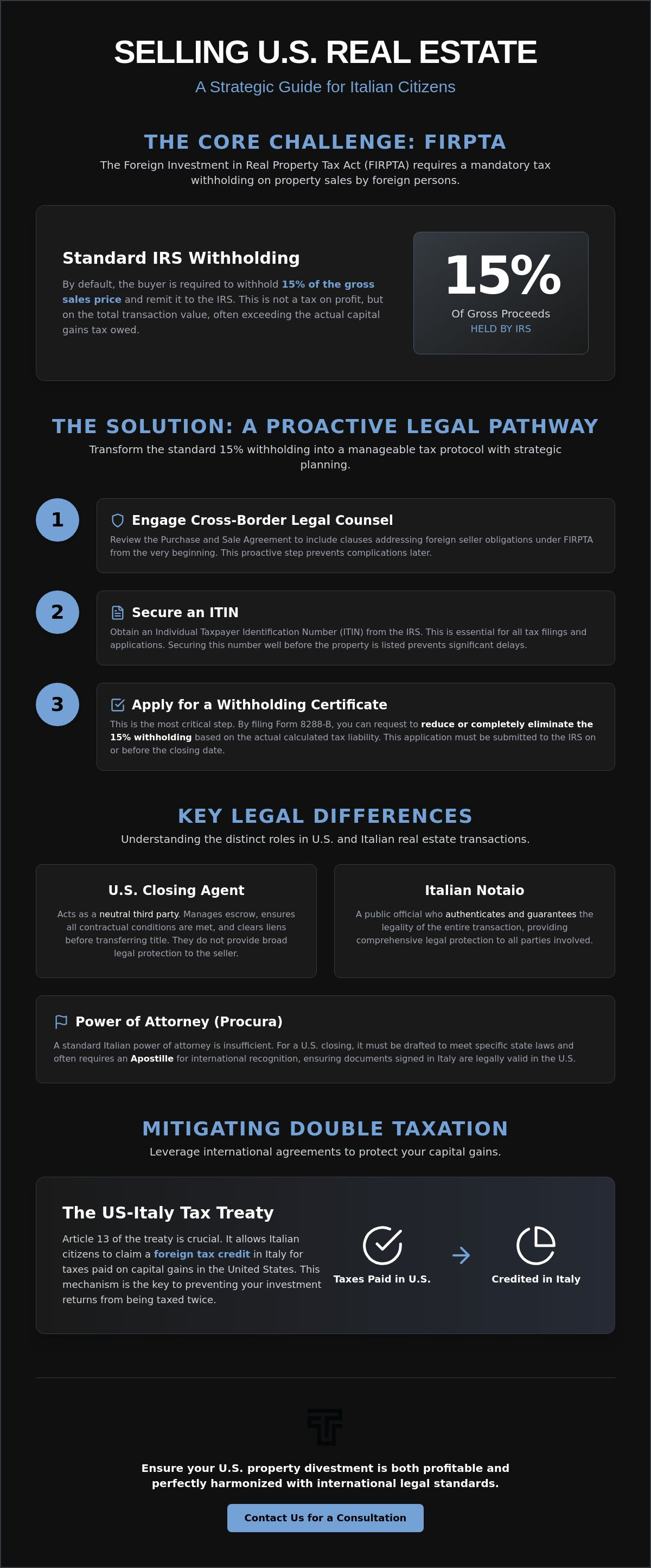
A primary distinction lies in the role of the U.S. Closing Agent, who acts as a neutral third party to manage escrow and ensure all liens are cleared before the transfer. This professional doesn't provide the same broad legal protections as an Italian notary, which is why having your own counsel is vital. Your legal team must ensure that specific clauses address foreign seller obligations under the Foreign Investment in Real Property Tax Act (FIRPTA) right from the initial offer. This proactive approach prevents the common pitfall of agreeing to terms that make the 15% withholding more difficult to manage later.
The Legal Standing of Non-Resident Aliens (NRAs)
Your status as a Non-Resident Alien (NRA) is defined by the U.S. Internal Revenue Code based on your physical presence and tax residency at the moment of divestment. This classification triggers specific reporting mandates that don't apply to domestic sellers. You'll need an Individual Taxpayer Identification Number (ITIN) to facilitate the sale. Without this number, the IRS cannot track the transaction, which often leads to significant delays in releasing funds from escrow or processing refund claims. It's best to secure this number well before the property hits the market.
US-Italy Cross-Border Legal Synergy
Managing a transaction from Milan or Rome requires a sophisticated approach to the Procura, or Power of Attorney. A standard Italian power of attorney isn't sufficient for a U.S. closing; it must be drafted to meet specific state laws and typically requires an apostille for international recognition. This legal bridge ensures that documents signed in Italy carry weight in U.S. courts. If structural issues or contractual breaches occur, these preparations integrate naturally with international litigation strategies to protect your equity. Such high-level planning is also essential for those coordinating their real estate exit with broader Italian citizenship objectives. For personalized guidance on these protocols, you can reach out through our contact page.
Understanding FIRPTA: The 15% Withholding Rule and Exemptions
The Foreign Investment in Real Property Tax Act, commonly known as FIRPTA, represents the most significant fiscal hurdle for international sellers. It's a mechanism designed to ensure the IRS collects capital gains tax from foreign entities who might otherwise exit the U.S. jurisdiction without settling their tax liabilities. Under the official guidelines for Understanding FIRPTA: The 15% Withholding Rule, the buyer is legally mandated to act as the withholding agent. This means the buyer, not the seller, is personally liable for remitting 15% of the gross sales price to the IRS if the transaction doesn't meet specific exemption criteria. For an Italian seller, this 15% is taken from the top of the sales price, not the profit, which can often exceed the actual tax owed.
In 2026, the standard rate remains 15%, but nuanced thresholds offer relief for certain transactions. If the sales price falls between $300,001 and $1,000,000 and the buyer intends to use the property as their primary residence, the withholding is reduced to 10%. For properties sold at $300,000 or less where the buyer maintains that same residential intent, the withholding is waived entirely. Successfully managing the legal requirements for selling US property as an Italian citizen requires verifying the buyer's intentions early in the negotiation phase to ensure these lower rates are applied correctly at closing.
Securing a Withholding Certificate
Applying for an IRS Withholding Certificate via Form 8288-B is the most effective way to protect your liquidity. This application notifies the IRS that your actual tax liability is significantly lower than the 15% gross withholding. Timing is everything. You've got to file this application on or before the day of the sale. If filed correctly, the closing agent can hold the funds in escrow rather than remitting them to the IRS immediately. This prevents your capital from being locked away for months while you wait for a standard tax return refund. If you've already closed and the funds were sent, you can still file an "Early Refund" request, though this is a more arduous administrative path.
Common Exemptions for Italian Sellers
Beyond the residence exemption, sellers can avoid withholding if they can prove the sale results in a loss or zero gain. This requires a meticulous calculation of the adjusted basis, including original purchase costs and documented capital improvements. Some investors utilize LLC incorporation to manage their real estate holdings. While an LLC offers structural benefits, it doesn't automatically bypass FIRPTA unless the entity is structured specifically to be treated as a domestic corporation. For a tailored evaluation of your divestment strategy, you might consider consulting with our cross-border legal team to ensure your equity is protected.
Essential Documentation and the US Real Estate Closing Process
The closing phase is where the theoretical legal requirements for selling US property as an Italian citizen transform into tangible financial outcomes. It begins with the Purchase and Sale Agreement. This document must include specific contingencies that require the buyer to cooperate with your FIRPTA withholding certificate application. Without these clauses, you're at the mercy of a buyer's timeline. The U.S. system relies heavily on title search and title insurance to guarantee the transfer's validity. While the buyer typically pays for the policy, you're responsible for clearing any encumbrances or "clouds" identified during the search to ensure a clean title transfer.
The Closing Disclosure provides a final, line-by-line breakdown of the transaction. You'll see the gross sales price, agent commissions, and, most importantly, the FIRPTA withholding amount. If your legal team successfully secured a withholding certificate, this line should reflect the reduced amount or a zero balance, with the funds held in escrow. Disbursing these funds to an Italian bank account requires precise wire instructions. U.S. financial institutions often require verbal verification for international transfers, so you'll need to stay accessible on closing day to confirm the transaction.
The Role of the ITIN in the Sale
You can't legally finalize a U.S. property sale or receive a tax refund without an Individual Taxpayer Identification Number (ITIN). This nine-digit number, issued via Form W-7, serves as your identifier within the Internal Revenue Service's systems. Since the US-Italy Tax Treaty governs how your income is reported, the ITIN is the key to ensuring your payments are credited to the right account. Working with a Certified Acceptance Agent (CAA) is the fastest way to verify your passport and submit the application without mailing original documents to the U.S.
Closing from Abroad: Remote Signatures and Notarization
Selling from Italy doesn't always require a flight to the U.S. Many states now recognize Remote Online Notarization (RON), allowing you to sign documents via a secure video link. If the title company requires physical signatures, you'll need to visit a U.S. Embassy or use an Italian notary followed by a Hague Apostille. This certification confirms the notary's authority to U.S. officials. Finally, you'll receive a 1099-S form, which reports the proceeds to the IRS. For assistance with coordinating these international logistics, you can reach out for a professional consultation to ensure every document meets the required standard.
Mitigating Double Taxation: The US-Italy Tax Treaty in 2026
The successful transfer of title is only half the journey; the final phase involves reconciling your gains with two distinct tax authorities. Article 13 of the US-Italy Tax Treaty establishes the primary right of the United States to tax income derived from the alienation of real property situated within its borders. This means that even as a non-resident, your capital gains are subject to U.S. federal tax rates. However, the treaty is specifically designed to prevent the same income from being taxed twice. By leveraging the Foreign Tax Credit, you can apply the taxes paid to the IRS as a deduction against your Italian tax liability. Fulfilling the legal requirements for selling US property as an Italian citizen involves a dual-reporting obligation that requires high-level coordination between your U.S. and Italian tax advisors.
In Italy, the sale must be disclosed to the Agenzia delle Entrate. This is typically handled through Quadro RW of your annual tax return for the disclosure of foreign assets, while any taxable gain is reported in Quadro RM. If you've held the property for more than five years, Italian law may offer specific exemptions that differ from U.S. long-term capital gains rules. For those dealing with inherited property, the Successione process in Italy must be harmonized with U.S. "step-up in basis" rules to ensure you aren't overpaying on a gain that doesn't exist. If you need a detailed analysis of your specific tax position, contact our cross-border specialists for a strategic review.
Calculating Capital Gains in Two Jurisdictions
One of the most overlooked aspects of cross-border divestment is the impact of currency exchange fluctuations. The IRS calculates your gain based on U.S. dollars at the time of purchase and sale. Conversely, the Agenzia delle Entrate requires the calculation in Euros. It's entirely possible to have a capital gain in one currency and a loss in the other simply due to the strengthening or weakening of the Euro against the Dollar over the holding period. You can lower your taxable basis in both countries by meticulously documenting closing costs, legal fees, and capital improvements made during your ownership.
1031 Exchanges for Italian Investors
While a Section 1031 "Like-Kind" Exchange allows you to defer U.S. capital gains tax by reinvesting proceeds into a new property, it presents a unique challenge for Italian residents. The U.S. tax code recognizes the deferral, but Italy generally does not. This means you might owe Italian tax on the "deferred" gain immediately, even if no cash was pocketed. This strategy is most effective for those considering a E-2 Visa or other long-term U.S. investment frameworks where the goal is to keep capital within the American market. Careful planning ensures your reinvestment strategy remains compliant with both jurisdictions without creating an unexpected cash flow crisis.
Strategic Legal Support for Cross-Border Property Divestment
A standard U.S. real estate agent is trained to navigate local market dynamics and state-level disclosures. They rarely possess the specialized knowledge to manage the legal requirements for selling US property as an Italian citizen, particularly when those requirements intersect with international tax law and immigration status. Relying solely on a domestic agent often leads to procedural oversights that can delay the release of funds or trigger unintended tax consequences in Italy. Strategic divestment requires a legal partner who views the transaction through a global lens. Every contractual clause must align with your long-term residency and financial objectives to prevent friction at the intersection of two different legal systems.
Tosolini, Toniutti & Partners serves as this essential bridge. We harmonize the technical precision of a U.S. real estate closing with the sophisticated needs of Italian nationals. This holistic approach is vital for individuals who aren't just selling a property, but are also navigating the path toward Italian citizenship or a full relocation back to the European Union. By integrating real estate counsel with immigration strategy, we ensure that the liquidation of your American assets supports your next chapter rather than complicating it. Our work is defined by an intellectual depth that treats each transaction as a cornerstone of your broader international legacy.
Integrated Immigration and Real Estate Counsel
The timing of your sale can have profound implications for your Green Card or visa status. For long-term residents, selling a primary home might trigger "Exit Tax" considerations or be viewed by the USCIS as an intent to abandon U.S. residency. Conversely, if you're looking to reinvest, a properly structured sale provides the clean capital necessary to support future investment-based visas. We help you navigate these transitions, ensuring that your asset divestment is a strategic move that preserves your global mobility and complies with all legal requirements for selling US property as an Italian citizen.
Next Steps: Securing Your Proceeds
Waiting until a property is under contract is often too late to implement the most effective tax-saving strategies. A pre-sale consultation allows for a comprehensive review of your title, basis, and withholding eligibility before the listing even goes live. We coordinate directly with your Italian tax advisors to create a unified strategy that accounts for both IRS and Agenzia delle Entrate regulations. This ensures a seamless transition of wealth across borders. To ensure your equity is protected through every stage of the transaction, you can reach out to our team for a tailored cross-border closing strategy.
Securing Your Cross-Border Legacy through Strategic Divestment
Mastering the legal requirements for selling US property as an Italian citizen requires a delicate balance of technical compliance and strategic timing. You've explored the critical importance of FIRPTA withholding management and the structural benefits offered by the US-Italy Tax Treaty. These protocols aren't merely administrative hurdles. They're essential tools to protect your liquidity and ensure that your asset transition remains perfectly aligned with both IRS and Agenzia delle Entrate regulations. Proper documentation and early legal review are the only ways to prevent your equity from being caught in a jurisdictional vacuum.
Our bilingual legal team, based in the US, offers decades of experience in cross-border law and specialized expertise in FIRPTA applications. We provide the professional precision needed to bridge the gap between American closing agents and Italian legal expectations. Don't allow your proceeds to be held by standard withholding rules when a strategic legal review can secure your capital. Consult with our US-Italy Real Estate Experts today to finalize your transaction with absolute confidence and clarity. Your international financial legacy is a structure worth protecting, and we're here to ensure it remains secure.
Frequently Asked Questions
Does an Italian citizen need a US Social Security Number to sell property?
You don't need a Social Security Number to sell property in the United States, but you must obtain an Individual Taxpayer Identification Number (ITIN). This number serves as your primary identifier for tax reporting purposes. It's a critical component of the legal requirements for selling US property as an Italian citizen, as the IRS uses it to track the transaction and any associated withholdings.
How long does it take to get a FIRPTA withholding certificate in 2026?
The IRS typically takes between 90 and 120 days to process a FIRPTA withholding certificate application. You must submit Form 8288-B on or before the closing date to ensure the funds remain in escrow during the review period. If the application is filed late, the buyer is legally required to remit the full 15% to the IRS immediately.
Can I avoid the 15% withholding if I am selling my property at a loss?
You can avoid the 15% withholding by applying for a withholding certificate that proves your tax liability is zero. The IRS will review your purchase price, capital improvements, and selling costs to verify the loss. Once they issue the certificate, the closing agent is authorized to release the full proceeds to you without any federal tax deduction.
Do I have to pay taxes in Italy on the sale of my US home?
Italian residents are required to report their worldwide income, which includes capital gains from U.S. real estate sales. You'll report the transaction on your Italian tax return using Quadro RW and Quadro RM. However, the bilateral tax treaty allows you to claim a credit for taxes paid in the U.S. to offset your Italian tax bill.
What is an ITIN and why is it required for the property sale?
An ITIN is a tax processing number issued by the IRS for non-residents who aren't eligible for a Social Security Number. It's required to facilitate the FIRPTA withholding process and to file for any tax refunds. Without an ITIN, the closing agent cannot properly document the seller's identity, which often leads to significant delays in the distribution of sale proceeds.
Can I sign the US closing documents while I am in Italy?
You can sign all necessary closing documents without traveling to the United States. Many jurisdictions now accept Remote Online Notarization (RON), which uses a secure video link to verify your identity. If RON isn't an option, you can sign documents at a U.S. Consulate or use an Italian notary followed by a Hague Apostille to ensure legal recognition.
What happens if the IRS withholding is more than the actual tax I owe?
If the amount withheld at closing exceeds your actual tax liability, you must file a U.S. non-resident tax return (Form 1040-NR) to claim a refund. This return is typically filed in the year following the sale. The IRS will then calculate the exact tax on your profit and return the excess funds to your designated bank account.
How does the US-Italy Tax Treaty protect me from double taxation?
The US-Italy Tax Treaty protects you by establishing clear rules on which country has the primary right to tax the sale. Under Article 13, the U.S. taxes the gain first because the property is located there. Italy then provides a foreign tax credit for those U.S. payments, ensuring you aren't taxed twice on the same capital gain.


Comments