

LLC Incorporation for Italian Investors: 2026 Guide
- Gianni Mendes Toniutti, Esq.

- Aug 2
- 12 min read
What if the most critical element of your US expansion isn't the capital you invest, but the structural harmony between your Italian assets and a 2026-compliant American entity? For many visionaries, the dream of scaling across the Atlantic often feels shadowed by the complexity of conflicting tax systems and the rigorous new transparency laws. You're likely concerned about maintaining compliance while ensuring your personal assets remain protected. Navigating LLC incorporation for Italian investors in USA requires more than just filling out forms; it demands a sophisticated alignment of corporate structure and immigration strategy.
We understand that your goal is a seamless transition that honors both your Italian roots and your American ambitions. This guide provides the blueprint to master the legal architecture of US market entry by integrating LLC incorporation with strategic visa planning for Italian entrepreneurs. You'll discover how to navigate the 2026 corporate transparency landscape, optimize your tax position under the current federal rates, and establish a clear, compliant pathway toward an E-2 or E-1 visa. We'll examine the essential steps to protect your Italian-based assets while building a robust foundation for your future in the United States.
Table of Contents
Strategic LLC Incorporation for Italian Investors in 2026
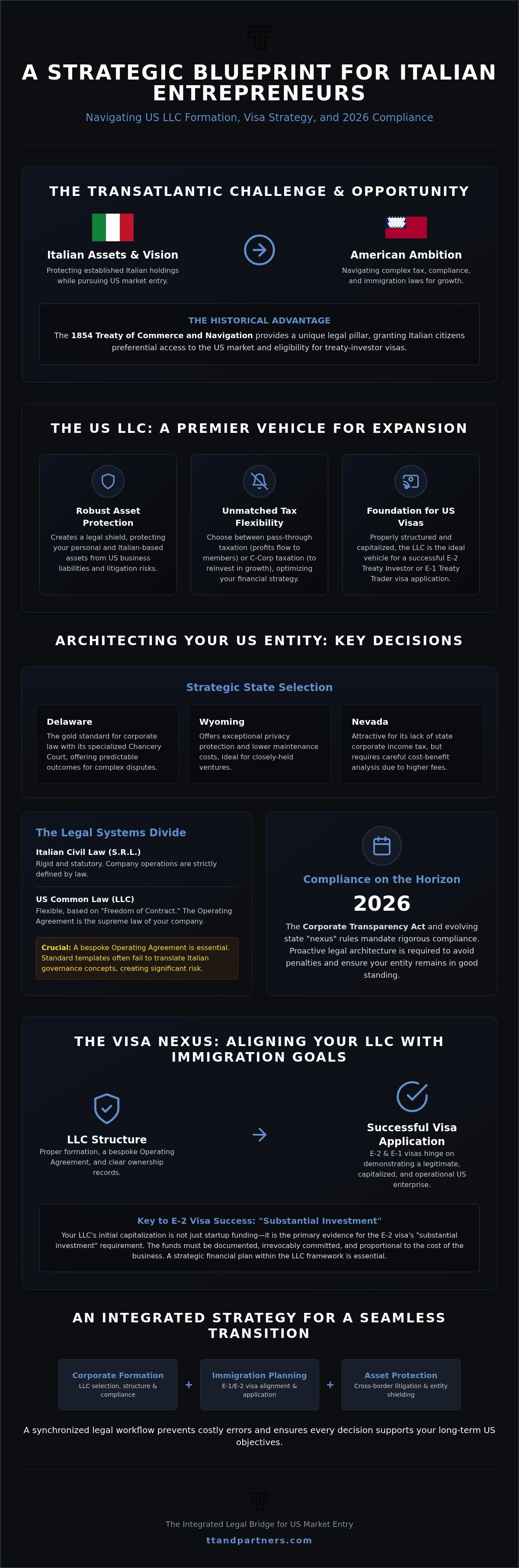
The 2026 investment landscape between Italy and the United States remains defined by a unique historical foundation that most automated filing services simply ignore. While digital platforms offer rapid registration, they often overlook the 1854 Treaty of Commerce and Navigation. This historic agreement is the primary legal pillar granting Italian citizens preferential access to the American market. For those seeking LLC incorporation for Italian investors in USA, this treaty provides the essential framework for both commercial operations and subsequent treaty-investor visa eligibility. It's the difference between a static entity and a dynamic vehicle for growth.
A strategic entry requires a deep understanding of What is a Limited Liability Company (LLC)? and how its inherent flexibility serves the cross-border entrepreneur. In 2026, the US-Italy trade relationship has matured into a sophisticated exchange of high-end technology, design, and specialized services. The LLC has emerged as the ideal structure for these ventures because it combines the protection of a corporation with the tax efficiency of a partnership. A cross-border lawyer doesn't just file paperwork; they act as an intellectual architect, translating your specific Italian business goals into a robust US legal structure that stands up to scrutiny.
The Civil Law vs. Common Law Divide
Italian investors are often accustomed to the rigid, statutory nature of the Società a Responsabilità Limitata (S.R.L.). The US Common Law system operates on a fundamentally different principle: the freedom of contract. In the US, your Operating Agreement is the supreme law of your company. Relying on a standard online template is a significant risk for an international investor. These generic documents often contain "legal translation" errors that fail to account for how Italian governance structures interact with American courts. A bespoke agreement ensures that your intent is preserved and that your US entity functions in harmony with your global operations.
The Benefits of a US LLC for Italian Nationals
The primary advantage of LLC incorporation for Italian investors in USA is the robust shield it places around your assets held in Italy. By creating a distinct legal personality in the US, you ensure that domestic liabilities don't reach your Mediterranean holdings. Beyond protection, the LLC offers unparalleled tax flexibility. You can choose pass-through taxation, where profits flow directly to members, or elect to be taxed as a corporation if you plan to reinvest heavily in US growth. This adaptability allows you to establish a professional, local presence that builds immediate credibility with American partners while maintaining a lean, efficient tax profile.
If you are ready to begin architecting your US presence with precision, you can reach out to our team to discuss your specific objectives through our contact page.
Architecting the Entity: State Selection and 2026 Compliance
Selecting the right jurisdiction is the first architectural decision in your American journey. While many investors default to New York due to its cultural ties, a strategic approach looks at the specific legal benefits of Delaware, Wyoming, and Nevada. Delaware remains the gold standard for corporate law due to its specialized Chancery Court, which provides predictable outcomes for complex commercial disputes. In contrast, Wyoming offers exceptional privacy and lower maintenance costs, making it a favorite for smaller, closely-held ventures. Nevada remains attractive for its lack of state corporate income tax, though its filing fees have increased in 2026, requiring a careful cost-benefit analysis. Understanding these nuances is a key part of the Official Steps to Start a U.S. Business.
However, the "Nexus" concept is where many Italian entrepreneurs stumble. If your LLC operates, hires, or holds property in a specific state, it's "doing business" there regardless of where it was formed. This requires "foreign qualification" in that state, leading to double filing fees and administrative duplication. For LLC incorporation for Italian investors in USA, we often recommend aligning the state of formation with the primary place of business to simplify compliance. Every entity must also maintain a Registered Agent to receive legal service of process. This agent provides a physical address within the state to ensure you never miss a critical filing deadline or legal notice, which is vital for maintaining good standing.
Compliance for Non-Resident Owners
Establishing a US presence as a non-resident requires specific administrative precision. You don't need a Social Security Number to obtain an EIN (Employer Identification Number); instead, we use Form SS-4 to secure this identifier for banking and tax purposes. In 2026, the most critical hurdle is the Corporate Transparency Act (CTA). You must report Beneficial Ownership Information (BOI) to FinCEN, disclosing every individual who owns or controls at least 25% of the entity. Failing to comply with these 2026 reporting requirements can result in civil penalties of up to $500 for each day the violation continues, alongside potential criminal fines.
Integrating Real Estate into Your LLC
Many of our clients use an LLC as a sophisticated vessel for US real estate. Whether you're acquiring a commercial space for operations or a residential portfolio for investment, holding property through an LLC provides a layer of asset protection that personal ownership lacks. We manage the complexities of real estate closings for non-resident Italian buyers, ensuring the title is held correctly to shield your broader estate. For a deeper analysis of these frameworks, explore our LLC incorporation strategic guide. If you're navigating these 2026 regulations, our team at Tosolini, Toniutti & Partners can help you align your entity structure with your long-term vision.
The Visa Nexus: Aligning LLC Structure with E-2 and E-1 Goals
Most practitioners view corporate law and immigration as isolated silos. This perspective is a strategic oversight. For an Italian national, the process of LLC incorporation for Italian investors in USA serves as the legal foundation for a future visa petition. Your entity's capitalization is not merely an accounting entry; it is the primary evidence of your commitment to the American economy. In 2026, the alignment between your corporate documents and your immigration goals must be absolute to withstand the rigorous scrutiny of the U.S. Embassy in Rome.
The "Substantial Investment" test remains a cornerstone of the E-2 Visa application. While the law avoids a specific dollar threshold, consulates in 2026 look for an investment that is sufficient to ensure the business's successful operation. Crucially, you must prove that this capital is "at risk." This means the funds must be irrevocably committed to the business. We document this through the LLC’s expenditures, such as executed commercial leases, equipment procurement, and initial operating costs. Your LLC must also avoid "marginality." It must demonstrate the capacity to generate significant economic impact beyond simply supporting you and your family, typically through the creation of jobs for US workers.
E-1 Treaty Trader vs. E-2 Treaty Investor
If your business model focuses on the exchange of goods or services rather than capital investment, the E-1 visa may be the superior path. The LLC must document a "substantial" volume of trade, where over 50% of the total international trade volume occurs between the United States and Italy. To satisfy the nationality requirement for these treaty visas, Italian citizens must own at least 50% of the US entity. Maintaining precise records is vital, as you must also adhere to specific IRS requirements for foreign-owned LLCs to remain in good standing with federal authorities.
The O-1 Alternative for Innovative Founders
For founders possessing extraordinary ability in science, business, or design, the O-1 visa for entrepreneurs offers a merit-based route that bypasses treaty limitations. In this scenario, the LLC acts as the petitioner, sponsoring the founder based on their professional accolades and the innovative mission of the company. This structure is particularly effective for high-growth startups in 2026 that may not yet meet the "at risk" capital requirements of an E-2 but possess significant intellectual property or industry recognition.
Risk Mitigation: Litigation and Cross-Border Asset Protection
Operating within the American legal system requires a paradigm shift for those accustomed to the slower, more predictable pace of Italian civil proceedings. The US is a highly litigious environment where legal fees can quickly erode corporate capital if a structure isn't properly fortified from the outset. Successful LLC incorporation for Italian investors in USA must include a proactive defense strategy that begins at the contract drafting stage. Every agreement your LLC enters should feature meticulously crafted jurisdiction and choice-of-law clauses. Without these, you risk being pulled into unfavorable courts in distant states, far from your primary base of operations. A boutique firm that understands both systems acts as an essential bridge, ensuring your US contracts don't inadvertently expose your Italian parent company to liability.
Protecting your intellectual heritage is equally vital to your American expansion. Many Italian brands assume their domestic trademarks provide global coverage, but the US follows a distinct "first-to-use" system rather than the "first-to-file" approach common in Europe. This means an American competitor could potentially claim your brand name if they use it in commerce before you register it with the USPTO. We work to ensure your Italian intellectual property and trademarks are correctly licensed to or owned by your US LLC, creating a clear legal perimeter. Managing international litigation in 2026 often means preventing it before it starts through precise corporate governance and aggressive trademark filings.
Enforcing Foreign Judgments
Enforcing an Italian court judgment against US assets is an uphill battle that many investors underestimate. There's no federal treaty between the US and Italy for the automatic recognition of foreign judgments, meaning you might have to re-litigate the entire case in an American court. This is why we often recommend arbitration clauses in US-Italy commercial contracts. Arbitration offers a private, more efficient forum where decisions are more easily enforceable across borders under the New York Convention. Early-stage mediation is another essential tool we use to resolve disputes before they escalate into ruinous litigation, preserving your capital for growth rather than legal fees.
FIRPTA and Tax Withholding
When your LLC holds and eventually sells US real estate, you must navigate the Foreign Investment in Real Property Tax Act. FIRPTA is a 15% tax withholding on the sale of property by foreign persons. While the LLC is a US entity, the IRS often looks through to the foreign owners to determine withholding requirements at the time of a closing. Strategic LLC accounting and filing for specific withholding certificates can mitigate this immediate cash-flow burden. If you're concerned about cross-border compliance or asset shielding, you can consult our litigation experts to review your current corporate framework and real estate holdings.
Tosolini, Toniutti & Partners: The Integrated Legal Bridge
Tosolini, Toniutti & Partners operates as more than a legal service; we are the architectural bridge spanning the Atlantic. While larger, impersonal firms often treat immigration and corporate law as disconnected departments, our boutique structure ensures that your LLC incorporation for Italian investors in USA is perfectly synchronized with your visa strategy from day one. We understand that for an Italian entrepreneur, the US market isn't just a destination. It's an extension of a vision that requires both technical precision and cultural sensitivity. By managing your corporate setup, E-visa application, and real estate closings in a single, unified workflow, we eliminate the friction that typically stalls international expansion.
Our reach extends across the entire United States, providing comprehensive national coverage regardless of whether you choose to incorporate in Delaware, Florida, or Nevada. We pride ourselves on our ability to translate not just language, but the fundamental differences between the Italian Civil Law and US Common Law systems. This dual-perspective allows us to anticipate challenges before they arise, ensuring your business architecture is resilient and compliant with the latest 2026 regulations. We don't just file documents; we build the legal infrastructure that supports your long-term legacy in the American market.
Beyond Business: Italian Citizenship and Residency
The modern global family often requires solutions that transcend corporate boundaries. We assist our US-based clients in reclaiming their heritage through Italian citizenship by descent (Jure Sanguinis), navigating the intricate historical and genealogical requirements with professional rigor. Similarly, we manage the Permesso di Soggiorno for family members of investors, ensuring that your transition to the US doesn't come at the cost of your family's mobility or residency status in Italy. We provide a full-spectrum legal sanctuary for families whose lives and assets are distributed across both nations, fostering a sense of continuity and security.
Start Your Expansion with a Strategic Consultation
The most common errors occur in the earliest stages of expansion. Signing a commercial lease or a partnership agreement before securing proper legal counsel can create irreversible complications for your future visa eligibility. We streamline the LLC and visa process to ensure your 2026 market entry is both swift and legally sound. To begin architecting your American future with a team that speaks your language and understands your heritage, Contact Tosolini, Toniutti & Partners for expert US-Italy legal guidance. Our strategic consultations provide the clarity you need to move forward with confidence and precision.
Architecting Your American Legacy in 2026
Success in the American market is rarely the result of chance; it's the product of a meticulously designed legal structure. We've explored how a synchronized approach to LLC incorporation for Italian investors in USA serves as the indispensable foundation for both commercial growth and treaty-based visa eligibility. By navigating the 2026 Corporate Transparency Act with precision and aligning your entity's capitalization with E-2 requirements, you secure more than just a business. You secure a clear pathway for your family and your future. Our specialized US-Italy legal bridge ensures that your Italian assets remain protected while your US operations thrive under expert cross-border litigation support.
The transition from the Civil Law traditions of Italy to the Common Law landscape of the US requires a partner who understands the nuances of both. Whether you're focusing on international trade through an E-1 visa or scaling an innovative startup, your legal architecture must be resilient. Now is the time to finalize your blueprint for market entry. Schedule a consultation to architect your US-Italy business strategy with Tosolini, Toniutti & Partners today. Your vision deserves a structure that matches its ambition, and we're here to build it with you.
Frequently Asked Questions
What are the primary benefits of an LLC for an Italian investor in the US?
The primary benefits include limited liability protection for your Italian assets and the flexibility of pass-through taxation. This structure allows profits to flow directly to owners, avoiding the double taxation often associated with traditional corporations. For those pursuing LLC incorporation for Italian investors in USA, it also provides a professional local presence that is essential for building trust with American vendors and customers.
Can I qualify for an E-2 visa just by incorporating a US LLC?
No, mere incorporation does not grant visa eligibility. While an LLC is the necessary vehicle for the application, you must also satisfy the substantial investment and at risk capital requirements. The business must be active and capable of generating more than a marginal living for the investor. Incorporation is simply the architectural foundation upon which the broader immigration strategy is built.
How much does it cost to incorporate an LLC for an Italian national in 2026?
One-time state filing fees for 2026 generally range from $50 to $150, though they can be as low as $35 in Montana or as high as $500 in Massachusetts. You should also account for recurring costs like California's $800 annual franchise tax or the $400 annual tax in Delaware. These figures represent government filing costs and do not include professional legal fees for structural design and compliance.
Do I need a US Social Security Number to open an LLC or a business bank account?
You do not need a Social Security Number to form an LLC or open a business bank account. We assist clients in obtaining an Employer Identification Number (EIN) from the IRS without a prerequisite SSN. While many banks have strict internal policies, presenting a properly structured LLC with an EIN and a physical US address typically satisfies their compliance requirements for non-resident entrepreneurs.
What is the "Substantial Investment" required for an E-2 visa for Italians?
There is no fixed statutory minimum for a substantial investment, but successful applications in 2026 typically range between $80,000 and $300,000. The amount is evaluated relative to the total cost of establishing the specific type of business. A service-based consultancy might require less capital than a manufacturing plant to be considered substantial by the U.S. Embassy in Rome.
How does the US-Italy tax treaty affect my LLC’s profits?
The US-Italy tax treaty is designed to prevent the same income from being taxed in both jurisdictions. Because an LLC is often treated as a pass-through entity, profits are taxed at the individual level rather than the corporate level. This alignment helps Italian investors optimize their global tax position while ensuring full compliance with the 2026 Corporate Transparency Act reporting standards.
Can my Italian S.R.L. be the owner of my US LLC?
Yes, an Italian S.R.L. can serve as the sole or partial owner of a US LLC. This parent-subsidiary structure is common for established Italian firms looking to expand their footprint while maintaining centralized control. It allows for a clear separation of liabilities between the Mediterranean parent company and its American subsidiary, providing an additional layer of protection for global assets.
How long does the LLC incorporation and visa process take in 2026?
LLC formation typically takes a few business days once the state filings are submitted. However, the E-2 visa process is more extensive; the U.S. Embassy in Rome generally completes its initial prescreening within three weeks as of August 2026. Total timelines vary based on the complexity of your business plan and the current USCIS backlog, which reached nearly 12 million applications in July 2026.


Comments