

Maintaining E-2 Visa Status While Traveling: The 2026 Compliance Guide
- Gianni Mendes Toniutti, Esq.

- Jun 28
- 12 min read
Your passport stamp is not your permission to stay. For the modern treaty investor, maintaining E-2 visa status while traveling requires a sophisticated understanding of the boundary between an entry document and an authorized period of stay. Many professionals assume a valid visa expiration date guarantees their right to remain in the U.S., but the reality is dictated by the digital I-94 record issued at the border. Misinterpreting this distinction can lead to accidental overstays that jeopardize years of strategic business development.
We recognize that the pressure of managing a cross-border enterprise is often compounded by the anxiety of CBP officer discretion. You've built a vision that requires your presence on multiple continents, and administrative complexity shouldn't stifle your global growth. This 2026 compliance guide promises to clarify the nuances of re-entry, from the latest fee structures to the specific evidence needed to prove your business remains an active, vibrant entity. We'll provide a clear checklist for re-entry and explain how to renew your I-94 without a full visa renewal; this ensures you have the confidence to lead your operations without legal friction.
Table of Contents
The Dual-Track Framework: Visa Validity vs. Period of Stay
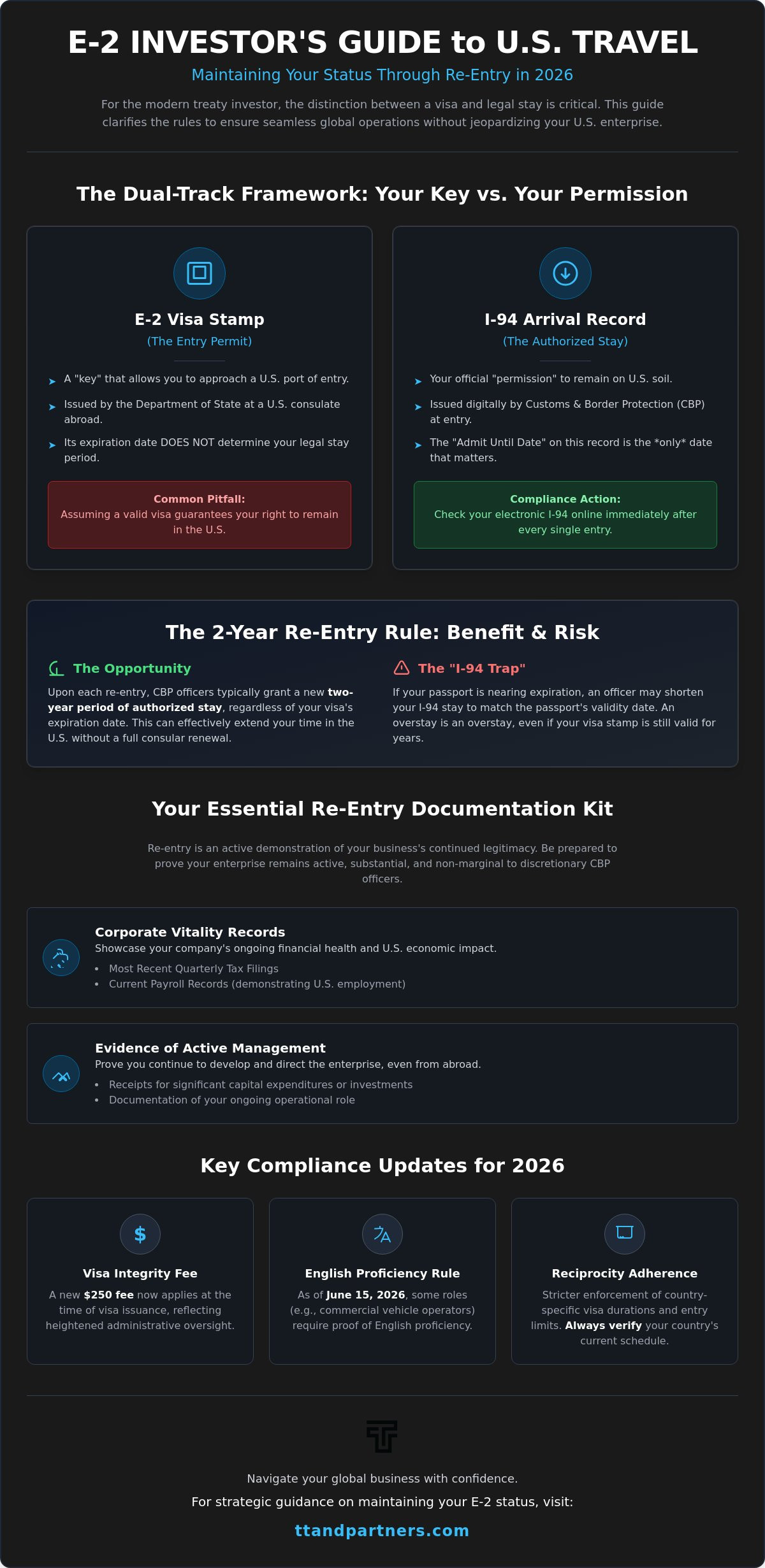
Success in maintaining E-2 visa status while traveling hinges on a structural understanding of two distinct legal documents. The visa stamp in your passport, issued by the Department of State, functions solely as an entry permit. Think of it as a "key" that allows you to approach the U.S. border. Once you pass through the gate, your legal presence is governed by the I-94 record. This digital document, managed by Customs and Border Protection (CBP), serves as your actual "permission" to remain on American soil. Confusing these two roles is the most common cause of status violations for even the most diligent investors.
The E-2 Investor Visa landscape became more complex in late 2025 and early 2026. A new Visa Integrity Fee of $250 now applies at the time of issuance, reflecting a broader trend toward heightened administrative oversight. Additionally, as of June 15, 2026, a new hurdle has emerged for specific E-2 roles. Applicants operating commercial motor vehicles must now provide evidence of English language proficiency. While a visa issued after this date serves as proof, travelers should be prepared for nuanced questioning regarding their operational role during re-entry interviews.
Understanding the Reciprocity Schedule
The duration and flexibility of your visa stamp aren't universal; they're dictated by the reciprocity schedule between the U.S. and your home country. For example, Italian treaty investors often navigate validity periods that reflect the specific diplomatic standing of their nation. These agreements determine if you receive a single-entry or multiple-entry visa. While a multiple-entry visa offers the freedom of frequent travel, a single-entry visa requires a new consular application for every return trip. Policy shifts in 2026 have emphasized stricter adherence to these country-specific treaty nuances. It's vital to verify your specific country's current standing before booking international flights.
The 2-Year Admission Rule
Upon every re-entry, CBP officers generally grant a new two-year period of authorized stay. This happens regardless of the expiration date printed on your visa stamp. It's a powerful tool for extending your stay without a full renewal, but it carries a hidden risk. You must check your electronic I-94 record immediately after every arrival. If your passport is nearing its expiration date, the officer might shorten your I-94 stay to match the passport's validity. Staying past that digital date constitutes an overstay, even if your visa stamp remains valid for another three years. If you need assistance reconciling a discrepancy in your admission records, you can reach out to our team at TT&Partners for strategic guidance.
Essential Documentation for Seamless US Re-entry
Re-entering the United States is more than a simple presentation of a passport; it's an active demonstration of your business's continued legitimacy. CBP officers possess significant discretion and often look beyond the visa stamp to ensure the underlying investment remains active, substantial, and non-marginal. To ensure you're effectively maintaining E-2 visa status while traveling, we recommend assembling a curated "E-2 Travel Kit." This folder acts as a defensive shield, providing immediate, documented answers to questions about your operations and your specific role within the enterprise.
The border environment in 2026 reflects a heightened focus on operational transparency. Officers aren't just checking if you have a visa; they're verifying that the business you've built continues to meet the rigorous standards set by the USCIS E-2 Investor Rules. If your role involves the operation of commercial motor vehicles, be prepared for the new English proficiency standards effective as of June 15, 2026. While your visa may serve as proof, having additional evidence of your language skills can prevent unnecessary secondary inspections.
Corporate Vitality Records
The border is the primary site where the "marginality test" is informally applied. You must prove your enterprise does more than just provide a minimal living for you and your family. Carrying the most recent quarterly tax filings provides an objective, undeniable snapshot of your company's financial health. Payroll records are equally vital, as they demonstrate a tangible U.S. economic impact through the employment of local workers. If you've made significant capital expenditures while abroad, such as purchasing new technology or expanding your facilities, bring those receipts to show the business remains "real and operating."
Individual Compliance Documents
Personal documentation must be as precise as your corporate records. Your passport should ideally have at least six months of validity remaining beyond your intended stay. This prevents an officer from shortening your I-94 duration to match a nearing passport expiry. If you originally obtained your status through a Change of Status within the U.S., the original I-797 Approval Notice is indispensable for re-entry. We also suggest including a concise letter from your legal counsel that summarizes your E-2 eligibility. This letter bridges the gap between complex immigration law and the officer's immediate need for clarity. If you're unsure whether your current documentation meets these evolving 2026 standards, it's wise to consult with a strategic advisor before your next departure.
Navigating the I-94 Trap: Proactive Status Management
A valid visa stamp is merely the prologue to legal residence; the actual authority over your daily life in the United States resides in the digital I-94 record. This distinction creates what many practitioners call the "I-94 Trap." While your visa might remain valid for several years, your authorized stay is a finite window that requires constant vigilance. The most common pitfall involves passport expiration. If your passport is set to expire before the standard two-year admission period ends, the CBP officer will likely truncate your I-94 stay to match your passport's end date. This happens silently. There's no alert or notification, yet staying even one day past that shortened date constitutes a status violation that can jeopardize maintaining E-2 visa status while traveling in the future.
Strategic investors must also exercise caution when planning short excursions to contiguous territories. While "automatic revalidation" allows for trips of less than 30 days to Mexico or Canada on an expired visa, these journeys often do not trigger a "reset" of your I-94 clock. If you're nearing the end of your two-year stay, a weekend in Vancouver might not grant you a fresh two-year admission. For a comprehensive understanding of how these entry requirements interact with your specific nationality, the Department of State E-2 Visa Info provides a necessary foundation for treaty-specific nuances.
The Automatic 2-Year Extension
Every successful re-entry into the U.S. on an E-2 visa should technically trigger a fresh two-year period of authorized stay. This creates a powerful, cost-effective alternative to filing Form I-129 extensions with USCIS. In 2026, where filing fees for standard employers have reached $1,015, the ability to "reset" the clock through international travel offers significant financial and administrative relief. It bypasses the need for premium processing fees, which increased to $2,965 in March 2026, and avoids the lengthy wait times associated with domestic petitions. However, this strategy requires a pristine travel history and a business that remains demonstrably active.
Correcting Admission Errors
Human error at the border is a persistent risk. A CBP officer might inadvertently admit an E-2 holder under a B-2 tourist classification, an error that effectively strips the investor of their right to work. Check your electronic I-94 record via the official portal within 72 hours of arrival. If you detect a classification error or an incorrect expiration date, you must resolve it immediately through a CBP Deferred Inspection site. Waiting too long can complicate the correction process. If an error persists or if your stay was truncated unexpectedly, it's essential to seek immediate contact with legal counsel to rectify the record before a technical overstay occurs.
Proving Active Management During International Absences
Physical presence is not the sole metric of leadership. However, for the treaty investor, extended periods spent outside the United States can trigger intense administrative scrutiny. Maintaining E-2 visa status while traveling requires a proactive approach to documenting your remote leadership. You must prove the enterprise remains "real and operating" even when you aren't physically on-site. If the U.S. entity appears dormant or if revenue-generating activities cease during your absence, you risk failing the marginality test during your next visa renewal. This test is designed to ensure the business provides a significant economic contribution beyond simply supporting the investor's family.
Executive leadership must be visible in the digital record. Board minutes, executive email chains, and time-stamped digital signatures on contracts serve as essential evidence of your continued direction. Without this paper trail, a CBP officer or consular official might conclude that your presence is no longer essential to the U.S. operation. This is particularly dangerous if your travel exceeds six months in a single year, as it suggests the business can function indefinitely without your direct management. Every absence should be backed by a clear business justification, such as managing international supply chains or negotiating with overseas partners.
The Executive and Managerial Threshold
Investors and essential employees must show that their duties are being performed, not abandoned. You should clearly document how you delegate day-to-day tasks to your U.S.-based workforce. This delegation shouldn't suggest your role is redundant; instead, it should highlight your focus on high-level strategic growth. The U.S. facility must remain fully operational. Continued payments for rent, utilities, and local payroll prove that the business architecture remains intact. This continuity is a primary indicator of a healthy, non-marginal enterprise that requires your ongoing oversight.
Strategic Absences for Business Growth
It's often effective to frame international travel as a tool for American business expansion. If you're traveling to source specialized materials or to manage an international supply chain, your absence directly supports the E-2 treaty's intent of fostering cross-border economic activity. This strategic approach turns a potential red flag into a narrative of growth and commitment. For those establishing new ventures, our LLC Incorporation guide offers insights into building a structure that supports this level of international mobility. If you need a tailored strategy to justify your travel patterns, contact our legal team for a consultation.
Strategic Planning: When Travel Becomes a Legal Risk
International mobility is a hallmark of the treaty investor lifestyle, yet travel is not always a neutral act. There are specific windows within the immigration lifecycle where departing the United States transitions from a routine business trip to a significant legal liability. Maintaining E-2 visa status while traveling becomes exceptionally precarious when there are active petitions pending with USCIS. A pending Request for Evidence (RFE) represents a critical "red flag" scenario. If an investor is abroad when an RFE is issued, the strict response deadlines can be difficult to meet; any delay or failure to provide a comprehensive response can lead to the immediate denial of the underlying status.
Strategic planning also requires choosing the correct processing path. For frequent travelers, consular processing is often superior to a domestic Change of Status. While a Change of Status provides legal standing within the U.S., it does not provide a travel document. To re-enter after a trip abroad, the investor would still need to attend a consular interview to obtain the actual visa stamp. Auditing your travel history with professional counsel before these interviews is essential to ensure that your past entries and exits align perfectly with the requirements of your visa classification.
Travel During Pending Petitions
Leaving the U.S. while a Form I-129 Change of Status is processing typically results in the automatic abandonment of the petition. This trap catches many investors who assume their physical presence is secondary to the administrative filing. If urgent travel is non-negotiable, the "Consular Notification" workaround allows the petition to proceed, though the investor must then secure a visa stamp at a U.S. Consulate abroad before returning. Managing family travel schedules is equally vital. E-2D dependents must ensure their travel does not result in misaligned I-94 expiration dates, which can lead to accidental overstays for spouses or children who did not travel alongside the principal investor.
The Path to Permanent Residency
For those looking toward a long-term future in the United States, travel patterns carry consequences for immigrant intent. Frequent or extended absences can complicate the strategic transition from an E-2 to a Green Card. While the E-2 is a flexible category, excessive travel can impact the "continuous residence" requirements necessary for future naturalization. A fragmented presence may suggest that your primary residence remains outside the U.S., triggering scrutiny during the permanent residency process. To protect your long-term objectives, we recommend you schedule a consultation for a comprehensive travel audit before your next departure.
Strategizing for Global Business Continuity
The complexity of 2026 immigration standards requires a shift from reactive travel to proactive compliance. Success lies in mastering the technical boundary between your passport's entry stamp and the digital I-94 record. By maintaining a meticulous travel kit and documenting active management from abroad, you ensure your enterprise remains beyond the reach of marginality scrutiny. Your international presence should serve as a catalyst for growth, not a liability for your legal standing.
Maintaining E-2 visa status while traveling is an art of precision that requires a holistic view of your international business architecture. At Tosolini, Toniutti & Partners, we bring specialized expertise to US-Italy cross-border immigration, focusing on the sophisticated needs of E-2 Treaty Investors. We provide the strategic clarity needed to navigate pending petitions and complex re-entry scenarios with confidence. Our approach combines engineering precision with a visionary understanding of global mobility.
Your vision for a cross-border enterprise deserves a legal foundation that is as ambitious and resilient as your business itself. With the right preparation, the world remains your marketplace.
Compliance and Mobility: Frequently Asked Questions
Can I re-enter the US if my E-2 visa stamp has expired but my I-94 is still valid?
No, you cannot re-enter the United States with an expired visa stamp regardless of your I-94 status. The visa stamp acts as your entry permit; without a valid one, you'll be denied boarding or entry at the port. You must visit a U.S. Consulate abroad to secure a new visa stamp before attempting to return to your business operations.
What happens if a CBP officer admits me for less than two years on my E-2 visa?
This usually occurs if your passport expires in less than two years, as CBP won't grant a stay beyond your passport's validity. You should renew your passport immediately to resolve this. Once you have the new document, you can either travel internationally to reset the two-year clock or visit a CBP Deferred Inspection site if the shorter stay was a clerical error.
Do my spouse and children need to travel with me to maintain their E-2 dependent status?
Your dependents don't need to accompany you on every trip, but their stay authorization isn't automatically updated when you travel alone. This is a critical distinction for families. While your re-entry resets your two-year period, your spouse and children must track their own I-94 expiration dates and file Form I-539 extensions if they don't travel to reset their status at the border.
How many days can I stay outside the US without jeopardizing my E-2 investor status?
There isn't a fixed statutory limit on days spent abroad, but absences exceeding six months often trigger scrutiny regarding your "active direction" of the business. Maintaining E-2 visa status while traveling requires you to prove that your leadership remains essential and continuous. You should carry evidence of remote executive actions to satisfy officers that the U.S. enterprise hasn't been abandoned during your absence.
Is it better to renew my E-2 status through travel or by filing a petition with USCIS?
Travel is often the more efficient path because it avoids the $1,015 USCIS filing fee and the $2,965 premium processing cost. However, a domestic petition provides a formal approval notice that offers certainty without the need for a border interview. Your choice should reflect your specific risk tolerance and whether your business requires frequent international movement.
What is the English proficiency requirement mentioned for E-2 travelers in 2026?
Effective June 15, 2026, E-2 visa holders who operate commercial motor vehicles must provide evidence of English language proficiency. This regulation ensures that those in commercial transport roles can interpret safety signs and interact with regulatory authorities. While a visa issued after this date serves as proof, officers may still conduct brief assessments during the re-entry process at the border.
Can I travel to Italy while my E-2 visa renewal is pending at the US Consulate?
You can remain in Italy while your application is under review, but you're restricted from returning to the U.S. until the new visa is stamped in your passport. Consular processing requires you to be physically present at the consulate for your interview and visa issuance. It's vital to plan for potential administrative processing delays that could extend your stay in Italy beyond your initial expectations.
What documents should I show if I am asked about the 'marginality' of my business at the border?
Present your most recent U.S. tax returns and comprehensive payroll reports to prove your business isn't marginal. These documents provide objective evidence that your enterprise supports U.S. workers and generates significant economic impact. Successfully maintaining E-2 visa status while traveling involves demonstrating that your investment provides much more than just a minimal living for you and your family.


Comments