

Navigating Challenges in Jure Sanguinis Applications: The 2026 Legal Landscape
- Gianni Mendes Toniutti, Esq.

- Jun 14
- 12 min read
In 2026, the pursuit of Italian citizenship has transformed from a nostalgic administrative task into a high-stakes judicial procedure where precision is the only currency that matters. The landscape of challenges in jure sanguinis applications shifted permanently following the 2025 reforms and the subsequent 2026 court rulings that redefined the boundaries of heritage. You're likely feeling the weight of Law 74/2025 and the uncertainty of the new generational limits, or perhaps you're exhausted by the multi-year silence from Italian consulates in the United States. It's understandable to fear that an ancestor's early naturalization or a lack of a "genuine connection" might've severed your connection to Italy forever.
This guide provides the intellectual rigor and strategic clarity needed to master these complexities, ensuring your path to an Italian passport remains open despite the tightening legal framework. We'll explore the strategic shift toward judicial appeals following Order n. 13818/2026, the critical nuances of the reacquisition window for the "minor issue," and the exact eligibility requirements under current 2026 standards. By aligning your application with this modern legal architecture, you can bypass consular backlogs and secure your place within the Italian community with confidence and professional grace.
Key Takeaways
Navigate the transition from historical lineage standards to the structured generational limits established by the 2025 reforms and 2026 court rulings.
Address the technical challenges in jure sanguinis applications involving the "minor issue" and the legal intersection of US birth and parental naturalization.
Evaluate the strategic advantages of bypassing extensive consular backlogs through judicial appeals to accelerate your path to an Italian passport.
Clarify the requirements for 1948 maternal line cases and how to successfully litigate gender-based citizenship claims within the modern Italian court system.
Distinguish between basic administrative assistance and the specialized litigation strategy required for complex cross-border citizenship proceedings.
Table of Contents
The Evolution of Jure Sanguinis: The 2026 Legal Framework
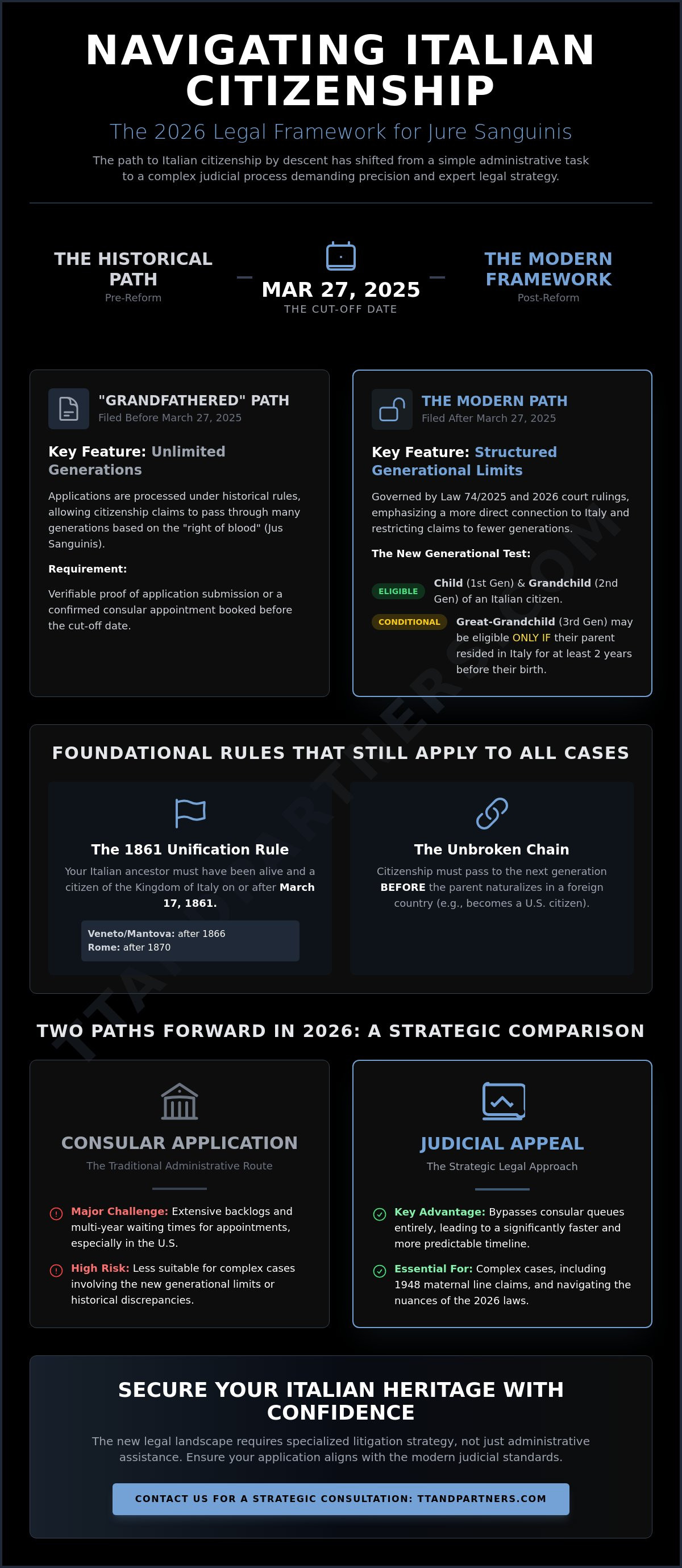
Historically, the transmission of Italian citizenship relied on a nearly boundless interpretation of the Jus sanguinis principle. This "right of blood" allowed descendants of Italian emigrants to reclaim their heritage regardless of how many generations had passed since the original ancestor departed the peninsula. However, the legal environment has shifted toward a more structured and restrictive model. The introduction of Law No. 74/2025, often referred to as the May 2025 Reform, represents the most significant turning point in modern citizenship law. It transitioned the process from an automatic administrative recognition into a regulated legal framework that demands more than just a biological link.
On March 12, 2026, the Italian Constitutional Court issued a landmark ruling that validated these new restrictions. The court confirmed that the state possesses broad discretion to define the parameters of citizenship, effectively ending the era of unlimited generational claims for those who hadn't already initiated their process. This ruling underscores why simply identifying an Italian ancestor is no longer sufficient for a successful outcome. Today, the most prominent challenges in jure sanguinis applications stem from this intersection of historical lineage and modern legislative boundaries.
The 1861 Unification Rule
The foundation of any claim remains the Unification of Italy on March 17, 1861. An ancestor must've been alive and held Italian citizenship on or after this date to transmit it to their descendants. This creates specific hurdles for families originating from regions like Veneto, Mantova, or Rome. Since Veneto and Mantova weren't annexed until 1866, and Rome followed in 1870, an ancestor who emigrated or passed away before these specific dates never technically became a citizen of the Kingdom of Italy. The transmission of citizenship requires an unbroken chain where the right is passed to each successive generation before the parent naturalizes in a foreign country.
The Impact of Decree-Law 36/2025
Decree-Law 36/2025 formally closed the window on the "unlimited" era of citizenship by descent. For many, the March 27, 2025, cut-off date is the most critical factor in their eligibility. Applications filed after this date are subject to the stricter 2026 standards, which emphasize a more immediate connection to Italian society. The Italian legislator now exercises significant discretion in these matters, prioritizing applicants who can demonstrate a tangible link to the modern state. For those facing these new complexities, seeking strategic legal counsel is often the only way to manage the evolving requirements.
Navigating the Generational Limit and Cut-off Dates
The introduction of Law 74/2025 created a binary reality for descendants of Italian emigrants. If you filed your case or secured a confirmed appointment before the March 27, 2025, deadline, your application is likely "grandfathered" under the historical rules that allowed for unlimited generational transmission. However, those initiating the process in 2026 face a significantly different terrain. One of the most pressing challenges in jure sanguinis applications today is determining which legal framework governs a specific lineage, particularly for those caught in the administrative "gray area" of pending or rescheduled appointments.
The 2026 legal landscape requires a precise understanding of the second-generation limit. While the previous system was remarkably open, the new regulations generally restrict citizenship to the children and grandchildren of Italian citizens. There's a notable exception for third-generation applicants. If a grandchild can prove that one of their parents resided in Italy for at least two years before their birth, the line may still be valid. This nuance highlights the shift from a purely biological right to a model that prizes a demonstrable connection to the Italian state.
Grandfathered Applications: Pre-March 2025 Status
To qualify for the previous standards, you must provide verifiable proof that your application was submitted or a consular appointment was booked before the 2025 cut-off. The Italian Court of Cassation has played a pivotal role in interpreting these transition periods, protecting the rights of those who acted before the legislative shift. If a consulate attempts to apply new restrictions to an older case, legal intervention is often required to ensure the law isn't applied retroactively. Reviewing the official application requirements can help you document your timeline and safeguard your eligibility status.
New Applications: The 2026 Reality
For cases initiated in 2026, the documentation burden has intensified. Proving the "non-renunciation" of citizenship throughout the entire chain is now scrutinized with greater intensity by Italian authorities. This shift makes professional genealogical research a mandatory first step. It's no longer sufficient to simply locate a birth certificate. You must now prove a continuous, legally valid connection across generations that satisfies the stricter 2026 evidentiary standards. If your lineage involves complex naturalization dates, consulting with strategic legal counsel can help identify the most viable path forward.
Determining your eligibility requires a structured approach. Use this strategic checklist to evaluate your position:
Confirm if your ancestor naturalized after the birth of the next person in your line of descent.
Verify if your initial filing or appointment booking occurred on or before March 27, 2025.
Assess if you are within two generations of the Italian-born ancestor.
Identify if a parent met the two-year residency requirement if you are a third-generation applicant.
The "Minor Issue" and Naturalization Obstacles
While generational limits and cut-off dates form the structural boundaries of a claim, the most intricate challenges in jure sanguinis applications often arise from the "Minor Issue." This legal hurdle centers on Article 12 of Law 555/1912, which historically suggested that if a parent naturalized in a foreign country, their minor children residing with them also lost their Italian citizenship. For decades, this was rarely an obstacle for those born in the United States, as birthright citizenship (Jure Soli) was viewed as a shield. The argument was simple: the child didn't "acquire" a foreign status through the parent's voluntary act because they already possessed it from birth. However, a significant shift in the 2025 and 2026 judicial climate has seen Italian courts increasingly reject cases where the ancestor naturalized while their child was still a minor.
The conflict between Jure Soli and the parent’s voluntary naturalization is now a primary focus of Italian litigation. Judges are scrutinizing whether the parent's decision to naturalize effectively severed the child's link to Italy, regardless of where they were born. This scrutiny is often compounded by the historical context of the Strasbourg Convention, which sought to reduce cases of dual nationality across Europe. Proving the exact date of naturalization is no longer a mere formality; it requires a deep dive into NARA records and authenticated "Red Ribbon" files from USCIS to establish a precise timeline of citizenship transmission.
Naturalization Timelines and Eligibility
Proving eligibility requires demonstrating that the Italian ancestor naturalized only after the next person in the line of descent was born and had reached the age of majority. If the naturalization occurred during the child's minority, the case moves into a complex territory where the "Involuntary Acquisition" argument must be meticulously crafted. Law 91/1992 formally acknowledged the validity of dual citizenship, ending the era where naturalization automatically triggered the loss of Italian status. For ancestors who naturalized before this date, the burden of proof rests entirely on the documented sequence of events and the specific statutes in place at the time of their oath.
Defending the Line of Descent in Court
There's a widening gap between administrative processing and judicial reality. While a consulate might issue an outright rejection based on a strict reading of the 1912 law, the Italian Civil Courts offer a venue for more nuanced legal arguments. Overcoming the "Minor Issue" in 2026 requires a strategy that looks beyond the surface of historical statutes to the constitutional principles of citizenship retention. Because of these evolving standards, securing strategic legal counsel is essential to interpret the intersection of US naturalization records and Italian high court precedents. Success in these cases isn't found in standard paperwork but in the ability to litigate the continuity of the lineage against a backdrop of shifting judicial interpretations.
Consular Backlogs vs. Judicial Appeals: A Strategic Comparison
The choice between a consular appointment and a judicial appeal is often the difference between a decade of administrative silence and a structured legal resolution. While Italian consulates in the United States are legally required to process applications within 24 months, the reality on the ground is far more stagnant. Many applicants face wait times ranging from 2 to 10 years just to secure an initial meeting. This systemic paralysis represents one of the most significant challenges in jure sanguinis applications today, pushing many to seek the precision of the Italian court system instead.
The judicial route offers a sophisticated alternative to the traditional administrative path. By filing a petition directly in the Italian courts, you bypass the consular waitlists entirely. These proceedings typically conclude within 12 to 24 months, providing a definitive timeline that the consular system lacks. Perhaps the most significant benefit is that the entire process occurs in Italy through legal representation; there's no requirement for the applicant to travel or establish residency. This transition from a passive wait to an active litigation strategy ensures your right to citizenship is handled with the intellectual rigor it deserves.
The 1948 Case: Gender Equality in Citizenship
Historical gender discrimination remains a hurdle for those descending from an Italian mother or grandmother who gave birth before January 1, 1948. Under the old statutes, Italian women couldn't transmit citizenship to their children. While consulates still lack the authority to correct this, the Italian courts have consistently ruled this practice unconstitutional. These "1948 cases" are founded on the principle of gender equality and enjoy a high rate of success in the 2026 legal climate. They remain a specialized judicial category that isn't affected by the recent administrative restrictions of Law 74/2025.
The "Against the Wait" Appeal
For those stuck in the "consular trap," the May 12, 2026, Court of Cassation ruling (Order n. 13818/2026) provides a powerful remedy. If you can prove that you're unable to book an appointment or that the delay exceeds the legal 730-day limit, you may file a "Denial of Justice" appeal. This case is filed in the regional court corresponding to your ancestor’s birthplace, such as Rome, Naples, or Venice. To optimize resources, families can bundle multiple members into a single judicial petition, sharing the costs of litigation while securing a collective path to their Italian passports.
If you're facing indefinite delays at your local consulate, it's time to evaluate a more direct legal path. To explore how a judicial appeal can accelerate your timeline, contact our legal team for a strategic consultation.
Strategic Legal Counsel for Cross-Border Success
Successfully overcoming the modern challenges in jure sanguinis applications requires more than a genealogical map; it demands a sophisticated litigation strategy. Tosolini, Toniutti & Partners serves as the essential bridge between American archival records and the Italian judicial system. While many individuals consider using non-lawyer "citizenship consultants," these entities lack the legal standing to represent you in court. In the 2026 legal landscape, where cases are increasingly decided by judicial decree rather than administrative discretion, professional legal counsel is the only viable path to security.
Italian citizenship is often the first step in a broader vision for global mobility and investment. For business owners, an Italian passport can be a powerful catalyst, facilitating E-2 visa strategies that allow for treaty investor status in the United States. Beyond immigration, our firm provides the intellectual rigor required for complex real estate closings and represents clients in international litigation. We ensure that your interests are protected on both sides of the Atlantic, treating your heritage as a foundational asset for your future.
The Value of a Dual US-Italy Perspective
Understanding both legal systems is vital for the precise authentication of documents. We manage the entire lifecycle of your evidence, from obtaining Apostilles to providing certified translations that meet the exacting standards of Italian judges. When historical records contain discrepancies, we handle "One and the Same" (OATS) court orders within the US legal system to ensure your line of descent remains unbroken. Our support continues through the final administrative steps, including AIRE registration and the formal issuance of your passport, ensuring a seamless transition into your new status.
Holistic Cross-Border Planning
We view citizenship as part of a larger architectural plan for your legacy and business goals. This perspective includes integrating your status into your LLC incorporation or broader investment strategies. Navigating the tax implications of dual citizenship is critical, as recognition often brings new fiscal responsibilities that require proactive management. To address the unique challenges in jure sanguinis applications and begin your journey, contact Tosolini, Toniutti & Partners for a preliminary eligibility assessment. We believe in a collaborative approach that respects the past while building a secure, international future.
Securing Your Italian Heritage in a Modern Legal Era
The landscape of Italian citizenship has evolved into a space where historical lineage must be defended with contemporary legal precision. Navigating the 2026 standards requires a deep understanding of how Law 74/2025 and the "Minor Issue" intersect with your specific family history. While the challenges in jure sanguinis applications have intensified, the shift toward judicial appeals offers a faster, more predictable path for those previously trapped in consular backlogs. This transition from a passive administrative process to an active litigation strategy ensures that your right to a passport is managed as a sophisticated legal asset.
With decades of experience in US-Italy cross-border litigation, Tosolini, Toniutti & Partners provides the expertise needed to manage both consular and judicial routes. We offer comprehensive support that extends beyond citizenship to include business and real estate integration; this ensures your new status serves your broader lifestyle goals. Schedule a consultation with our Italian citizenship attorneys to begin your journey. Your connection to Italy is a bridge to the future, and we're here to help you cross it with confidence.
Frequently Asked Questions
Is there a generational limit for Italian citizenship by descent in 2026?
Yes, Law 74/2025 generally restricts citizenship claims to the children and grandchildren of an Italian citizen. An exception exists for third-generation applicants if they can prove a parent resided in Italy for at least two years prior to their birth. This new restriction represents one of the most significant challenges in jure sanguinis applications for those with more distant ancestry.
What is the "1948 Case" and does it still work?
A 1948 case involves claiming citizenship through a female ancestor whose child was born before January 1, 1948. While consulates cannot legally process these applications due to historical gender discrimination in old statutes, Italian courts consistently grant citizenship based on constitutional equality principles. These judicial claims remain a highly successful and reliable path in the 2026 legal landscape.
How long does a Jure Sanguinis judicial appeal take compared to a consulate?
Judicial appeals typically conclude within 12 to 24 months, providing a significantly faster resolution than the 2 to 10 year wait times often found at US consulates. Following the Court of Cassation ruling in May 2026, applicants who can't secure a consular appointment within the legal 730-day limit have a confirmed right to file their case directly in the Italian courts.
Can I apply for Italian citizenship if my ancestor naturalized as a US citizen?
You can apply if your Italian ancestor naturalized only after the birth of the next person in your line of descent. If the naturalization happened before the child reached adulthood, the case may be subject to the "minor issue" scrutiny currently trending in Italian courts. Establishing the exact date of the naturalization oath through authenticated NARA or USCIS records is essential for success.
What happens if I already applied before the 2025 law change?
Applications submitted or appointments confirmed on or before March 27, 2025, are grandfathered under the previous rules and aren't subject to the new generational limits. These cases are assessed based on the historical "unlimited" descent standards. It's vital to maintain documented proof of your initial filing or booking date to protect your eligibility against the stricter 2026 legislative framework.
Do I need to speak Italian to apply for citizenship by descent?
No formal language exam is currently required for jure sanguinis applicants, unlike those applying through marriage or naturalization. However, the 2025 reform introduced a "genuine connection" requirement that grants authorities more discretion. While a B1 certificate isn't mandatory, demonstrating ties to Italian culture or language can be beneficial for applications filed after the March 2025 cut-off date.
Can I include my children in my Jure Sanguinis application?
Minor children are automatically included and recognized as Italian citizens once your application is successfully processed and registered. Adult children must typically file their own separate applications, though they can often leverage the same genealogical research and document portfolio. As of January 1, 2026, the administrative fee for citizenship declarations for minor children has been completely abolished.
What is the "Minor Issue" and why are courts rejecting these cases?
The "Minor Issue" involves an interpretation of the 1912 Citizenship Law where a child might've lost Italian status if their parent naturalized while they were a minor. Some Italian courts are now rejecting these cases, arguing that the parent's voluntary naturalization effectively severed the child's link to Italy. This has become one of the most technical challenges in jure sanguinis applications, requiring specialized litigation to resolve.


Comments