

O-1 Visa Criteria: The 2026 Strategic Checklist for Extraordinary Talent

What if the most celebrated project in your portfolio isn't the one that secures your professional future in the United States? For many elite architects and designers, the challenge isn't a lack of talent but the complex translation of international success into the specific o-1 visa criteria required by USCIS. You understand the precision needed to execute a complex building, yet the ambiguity surrounding what constitutes extraordinary ability often creates a sense of professional vertigo. It's frustrating to see a decade of innovation reduced to a series of checkboxes that don't seem to account for the nuance of your creative work.
We've designed this strategic checklist to provide the same clarity you'd expect from a detailed floor plan. We promise a comprehensive, expert led breakdown of the evidentiary requirements that will define extraordinary talent petitions through 2026. By focusing on the 3 out of 8 regulatory benchmarks that best align with your unique career trajectory, you'll gain the confidence to submit a petition that anticipates and answers every potential concern. We'll explore how to document your impact on the built environment and transform your professional history into a compelling legal narrative that avoids the common triggers for a Request for Evidence.
Key Takeaways
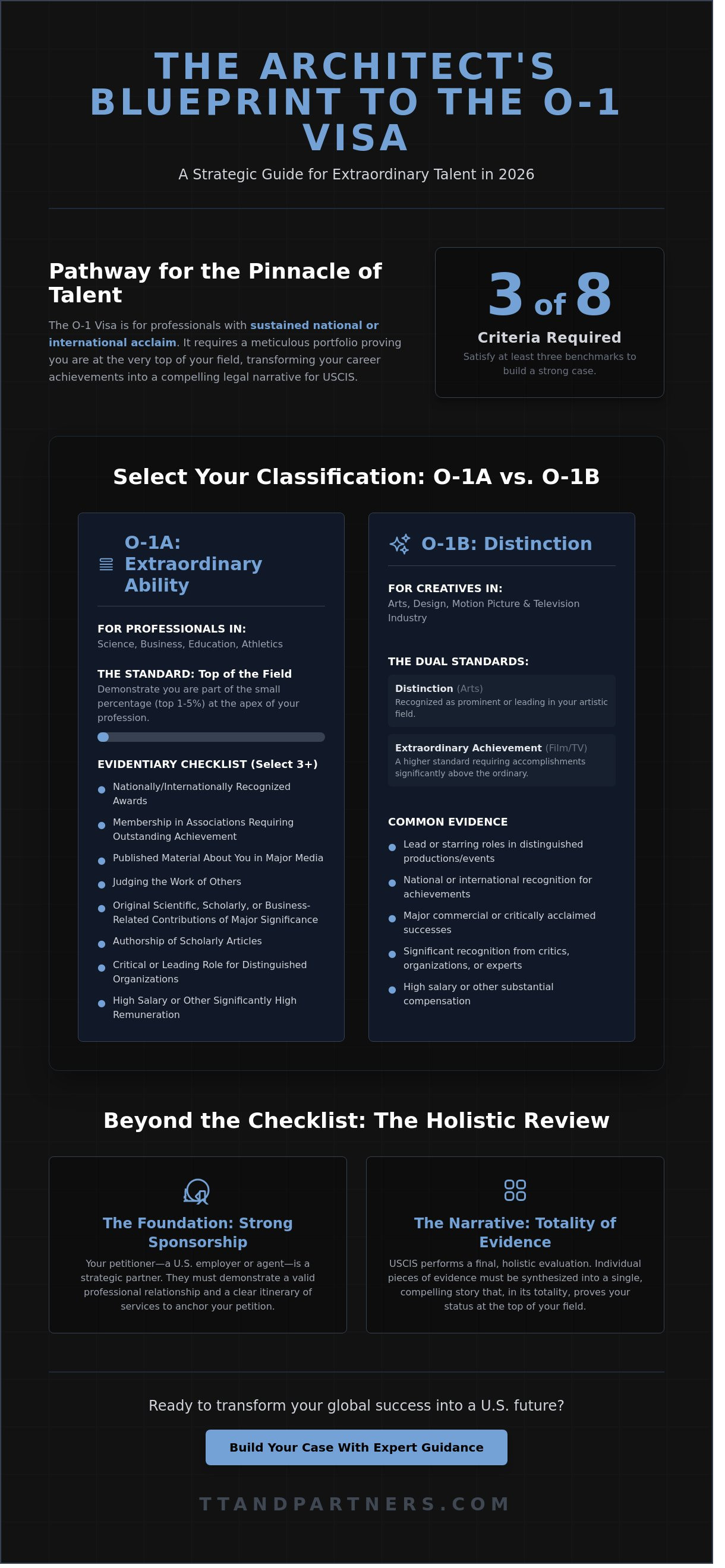
Decipher the structural differences between O-1A and O-1B classifications to ensure your professional trajectory aligns with the evolving "Sustained Acclaim" standards of the 2026 landscape.
Navigate the o-1 visa criteria with precision by mastering the "3 of 8" rule and documenting high-impact industry recognition within business and scientific sectors.
Explore the evidentiary framework for the arts, learning to articulate the significance of lead roles in distinguished productions through a lens of creative distinction.
Synthesize fragmented evidence into a compelling professional narrative that satisfies the "Totality of the Evidence" standard for a holistic USCIS evaluation.
Gain a strategic perspective on cross-border migration, leveraging the synergy between global innovation markets and rigorous legal requirements to ensure professional harmony.
Table of Contents Understanding the Architecture of Extraordinary Ability (O-1A vs. O-1B) The O-1A Checklist: Proving Excellence in Business and Science The O-1B Framework: Defining Distinction in the Arts Beyond the Checkbox: Building a Persuasive Evidence Portfolio Navigating US-Italy Professional Migration with Precision
Understanding the Architecture of Extraordinary Ability (O-1A vs. O-1B)
The O-1 Visa represents a sophisticated pathway for professionals who've reached the zenith of their respective fields. In the 2026 immigration environment, this classification functions as a vital instrument for global talent mobility. It allows the United States to integrate individuals with exceptional expertise into its economic and cultural fabric. Meeting the o-1 visa criteria requires more than a standard resume. It demands proof of sustained national or international acclaim. This standard implies that your recognition isn't a fleeting moment of success. It's a consistent record of high-level performance that continues into the present day.
Choosing a petitioner acts as the structural foundation for any successful application. Whether it's a U.S. employer or a specialized agent, the sponsor must demonstrate a valid professional relationship and a clear itinerary of services. A weak sponsorship structure can compromise even the most impressive portfolio of achievements. The petitioner isn't just a facilitator; they're a strategic partner in validating your professional standing before federal authorities. Clear communication between the talent and the sponsor ensures the petition aligns with the specific regulatory demands of the USCIS.
The O-1A Category: Business, Science, and Education
The O-1A category serves those in science, education, business, and athletics. To qualify, you must prove you're part of the small percentage at the very top of your field, often interpreted as the top 1% to 5% of practitioners. For entrepreneurs, this category offers a level of flexibility the H-1B often lacks. Following the 2024 USCIS policy clarifications, founders can more effectively use evidence like venture capital funding or incubator participation to satisfy the o-1 visa criteria. For a deeper look at these nuances, consult the O-1 Visa: The Complete 2026 Guide to Extraordinary Ability Visas for the US.
The O-1B Category: Arts and Motion Pictures
Creative professionals utilize the O-1B category, which relies on two distinct legal standards. Artists and designers must show "Distinction," meaning they're recognized as prominent or leading in their craft. In contrast, those in motion pictures or television face the "Extraordinary Achievement" threshold. This higher standard requires a history of accomplishments significantly above the norm. Success is often evidenced by critical reviews, high salary indicators, or commercial success in the globalized creative market. The O-1B serves as a bridge for international talent to access the American creative industry's infrastructure.
Success in these categories depends on the precise assembly of evidence. Every document must serve a purpose. If you're ready to begin building your case, you can reach out to us through our contact page to discuss your professional trajectory.
The O-1A Checklist: Proving Excellence in Business and Science
The O-1A classification requires a precise evidentiary strategy. Applicants must satisfy at least three out of eight specific Official USCIS O-1 Visa Criteria to qualify as an individual of extraordinary ability. In 2026, the focus shifts toward the qualitative impact of these proofs rather than mere volume. For a business executive or a research scientist, this means moving beyond simple participation. It requires demonstrating that your presence has fundamentally shifted the trajectory of your field. Documentation must be meticulous, reflecting the same level of detail found in a complex architectural blueprint.
Documenting prizes and awards is the first pillar of a successful petition. These honors shouldn't be local or internal; they must represent the pinnacle of professional achievement at a national or international level. A 2024 analysis of adjudication trends suggests that USCIS officers now scrutinize the "pool of competitors" for every award cited. If the prize is awarded to less than 1% of practitioners in your sector, it carries the necessary weight. Membership in elite associations provides a similar benchmark. These organizations shouldn't just require a membership fee. They must demand outstanding achievements, verified by recognized national or international experts, as a prerequisite for entry.
Published material about your work in professional or major trade publications serves as external validation of your status. High-impact media coverage in outlets like the Wall Street Journal or specialized journals with an impact factor above 5.0 provides the necessary context. Every article must mention your specific work and its influence on the industry's evolution. If you're mapping out a long-term career trajectory, consulting with strategic partners can clarify how your specific portfolio aligns with these benchmarks.
Judging and Original Contributions
Serving as a judge for the work of others validates your authority. It positions you as a gatekeeper of quality within your industry. Whether it's peer-reviewing for a scientific journal or sitting on a venture capital selection committee, the context of the judging experience is vital. Original contributions must be documented through patents, proprietary technologies, or market-disrupting strategies. A contribution of major significance is an innovation that alters industry standards. You must prove that your work has been widely implemented or cited by others in the field.
Authorship and Leading Roles
Scholarly writing and features in major media outlets serve as a ledger of your intellectual influence. Beyond authorship, you must prove you held a leading or critical role in an organization with a distinguished reputation. This is often quantified by the project's scale or the company's market valuation. High salary acts as a secondary indicator of extraordinary ability. If your compensation is in the top 10% for your role in a major global hub, it reinforces the claim that you meet the o-1 visa criteria. These elements, when combined, create a narrative of sustained excellence that is difficult to dispute.
The O-1B Framework: Defining Distinction in the Arts
The O-1B classification requires a demonstration of distinction. This means a high level of achievement in the field of arts. It's evidenced by a degree of skill and recognition substantially above that ordinarily encountered. To satisfy the official O-1 visa eligibility criteria, applicants must meet at least three out of six specific evidentiary categories. These include lead roles in distinguished productions and evidence of significant national or international recognition through critical reviews. Success isn't measured by intent, but by documented impact. For instance, a 2024 analysis of creative visas showed that 86 percent of successful O-1B petitions included third-party press coverage from major media outlets.
Significant Recognition from Experts
Expert testimonials serve as the intellectual foundation of a petition. These aren't mere letters of recommendation; they're technical analyses of an artist's contribution to their field. Peer group consultations differ from expert advisory opinions because the former often comes from a labor union, while the latter comes from an individual authority. Expert letters must provide specific, factual evidence rather than generic praise. A letter describing a designer's "unique vision" carries less weight than one detailing how their 2025 installation reduced urban heat island effects by 12 percent in a specific district. This level of detail transforms a subjective opinion into a verifiable fact.
Leading Roles for Distinguished Organizations
A "distinguished" organization possesses a reputation that precedes its projects. This status is verified through awards, consistent media coverage, or historical significance. When documenting your role, focus on how your specific involvement led to the venture's success. Did your lead role result in a 20 percent increase in ticket sales for a 2023 exhibition? It's vital to align this history with the right petitioner. Refer to the O-1 Visa Sponsor Guide: Choosing the Right Petitioner in 2026 to understand how your sponsor's standing influences the USCIS officer's perception of your creative environment.
Commercial success provides the empirical data needed to finalize the narrative of extraordinary talent. This includes box office receipts, record sales, or high gallery standing. If an artist's 2025 solo show sold 90 percent of its inventory within 48 hours, that data point is a powerful indicator of distinction. The o-1 visa criteria demand this level of specificity to separate true talent from temporary trends. Precise documentation ensures the narrative is as structurally sound as a well-designed building. To build a compelling case, you should focus on these key evidentiary pillars:
Critical Reviews: Documented analysis in major newspapers or trade journals dated within the last five years.
Commercial Impact: Specific financial data, such as a 2024 report showing top-tier sales rankings or box office performance.
Production Credits: Proof of a lead or starring role in projects with a distinguished reputation, such as those featured in international festivals.
The o-1 visa criteria aren't just a list of rules; they're a framework for proving that your work has shaped the cultural fabric of your industry. By treating the petition like a technical project, you ensure every claim is backed by the architectural precision required for a 2026 approval.
Beyond the Checkbox: Building a Persuasive Evidence Portfolio
An O-1 petition functions much like an architectural master plan. It requires more than a collection of disparate achievements; it demands a cohesive narrative of professional vision. USCIS officers don't simply tally your awards. They apply the "Totality of the Evidence" standard, a two-part evaluation established by the 2010 Kazarian v. USCIS decision. First, they verify if you technically meet the o-1 visa criteria. Second, they perform a final merits determination to see if the evidence, taken together, proves you've reached the pinnacle of your profession. A successful portfolio treats every document as a structural element that supports this central thesis.
Precision is vital when translating international credentials into US standards. A title like "Lead Designer" in a European firm might carry different weight than a "Principal" in a US context. You must bridge this gap with objective data. Cite specific project metrics, such as managing a $45 million urban redevelopment or achieving a 30% increase in energy efficiency through innovative materials. This clarity prevents the common Request for Evidence (RFE), which often targets claims that lack context or verifiable scale.
Strategic Evidence Selection
Curating your evidence requires a focus on quality over sheer volume. Three robust pillars that demonstrate sustained acclaim are far more persuasive than six weak points that barely meet the threshold. Your alignment with the o-1 visa criteria should be grounded in high-impact proof. A featured spread in a publication like Architectural Record or a primary role in a project that won an AIA National Award provides the "extraordinary" weight USCIS seeks. Modern petitions should also leverage digital footprints. Verified professional influence on platforms like LinkedIn or invitations to speak at international summits like the 2025 World Architecture Festival serve as potent evidentiary support.
Professional Planning for the Future
The petition's success hinges on your documented intent to continue work in your specialized field. It's not enough to prove past greatness; you must demonstrate a future trajectory that benefits the US industry. Your itinerary should outline a clear three-year path, linking specific upcoming projects to your unique expertise. This document transforms your application from a history of achievements into a strategic roadmap for future innovation. To ensure your career narrative meets these rigorous standards, contact our team to begin your portfolio evaluation.
Prioritize evidence from prestigious, nationally or internationally recognized sources.
Use objective data, including project budgets and performance metrics, to ground subjective claims.
Ensure all foreign certifications are clearly mapped to their US equivalents.
Maintain a consistent narrative across your CV, recommendation letters, and project summaries.
Navigating US-Italy Professional Migration with Precision
The migration of talent from Italy to the United States represents more than a simple change in geography; it's a strategic alignment of two distinct yet complementary ecosystems. Italian professionals bring a legacy of artisanal precision and aesthetic mastery that finds its perfect counterpart in the American culture of rapid scaling and technological disruption. Meeting the o-1 visa criteria requires a meticulous assembly of evidence that reflects this high-level synergy. It's about documenting how an individual's unique vision will integrate into the American professional landscape while maintaining the integrity of their Italian heritage. This cross-border legal perspective ensures that the transition doesn't disrupt long-term career goals or personal assets.
The O-1 status serves as a robust foundation for permanent residency. Many extraordinary individuals move toward the EB-1A category by 2027, leveraging the same evidence used for their initial petition. This progression allows for a seamless evolution from a temporary work authorization to a permanent stake in the US market. The O-1 acts as a catalyst, enabling businesses to establish a physical presence in innovation hubs like New York or San Francisco while maintaining operational roots in Milan or Rome. It transforms a professional move into a global business expansion strategy. We don't just view the visa as a permit, but as the structural framework for international growth.
The TT and Partners Approach
We approach legal petitions with the same rigor required to design a complex skyscraper. Every detail must serve a functional purpose within the larger structure. Our team specializes in tailoring petitions for high-net-worth individuals and visionary entrepreneurs who require a sophisticated touch. We understand that complex disputes may arise during international expansion. You can explore our International Litigation services to see how we manage legal friction across borders with technical precision and intellectual depth.
Starting Your Extraordinary Journey
Success begins with a cold, objective analysis of the facts. A preliminary eligibility assessment determines if your profile aligns with the current o-1 visa criteria before significant resources are committed. This phase considers both professional achievements and the practicalities of residency in a new jurisdiction. Planning for 2026 requires foresight regarding tax implications and business structure. If you're ready to define your place in the global market, schedule a consultation to map your US professional future with the guidance of strategic thinkers who value excellence as much as you do.
Architecting Your Professional Future in the United States
The landscape of international mobility in 2026 demands more than just meeting a checklist. It requires a holistic strategy where every piece of evidence functions as a structural pillar in your professional narrative. Success depends on a deep understanding of the o-1 visa criteria and the ability to curate a portfolio that reflects your unique intellectual value. Whether you're navigating the rigid metrics of the O-1A for science and business or the nuanced distinction of the O-1B for the arts, your evidence must be as precise as an architectural blueprint.
TT and Partners specializes in the US-Italy cross-border corridor, providing visionary legal strategies tailored for high-achieving professionals. Our team maintains a proven track record in securing O-1, E-1, and E-2 visas by treating every application as a unique design challenge. We focus on the harmony between your past achievements and your future impact on the American landscape. Your extraordinary talent deserves a platform that matches its scale, and we're here to ensure your transition is both seamless and significant.
Begin your extraordinary ability assessment with TT and Partners to transform your global ambitions into a tangible reality. With the right partnership, your professional legacy will find its perfect home.
Frequently Asked Questions
What is the "3 of 8" rule for the O-1A visa?
To satisfy the o-1 visa criteria for O-1A status, applicants must provide evidence for at least 3 of the 8 regulatory categories defined by USCIS. These categories range from receiving nationally recognized awards to publishing scholarly articles in professional journals. Officers use a two part evaluation process, first verifying the 3 criteria are met and then conducting a final merits determination to ensure the candidate stands among the small percentage at the top of their field.
Can an entrepreneur qualify for an O-1 visa without a traditional employer?
Entrepreneurs can qualify for an O-1 visa by establishing a US based company that serves as their petitioner. Since an individual can't petition for themselves, the business entity acts as the employer even if the applicant holds 100% ownership. This structure requires a formal employment agreement and a clear itinerary of services to prove the professional relationship between the visionary founder and the corporate entity. It's a strategic path for those shaping the future urban fabric.
Is there a minimum salary requirement for the O-1 visa criteria?
There's no fixed minimum salary requirement, but commanding a high remuneration relative to others in the field is one of the specific o-1 visa criteria. USCIS typically looks for compensation that falls within the top 10% of the prevailing wage for that specific occupation. Applicants often use data from the Bureau of Labor Statistics or private salary surveys from 2024 or 2025 to demonstrate their premium market value compared to peers.
How do I prove my contribution is of "major significance" in my field?
Proving a contribution is of major significance requires objective evidence that your work has fundamentally changed the professional landscape of your industry. You might document this through 50 or more independent citations of your research or proof that your proprietary technology is currently utilized by 15 major international firms. Letters from 5 independent experts who haven't collaborated with you can also validate the original nature and widespread impact of your innovations.
What is the difference between "extraordinary ability" and "distinction"?
Extraordinary ability applies to O-1A applicants in science, education, or business and represents a level of expertise found only at the very top of the field. Distinction is the lower standard used for O-1B applicants in the arts, requiring a high level of achievement evidenced by a degree of skill substantially above what's ordinarily encountered. While O-1A requires being part of a small percentage, O-1B focuses on being prominent or well known in a creative discipline.
Can I apply for an O-1 visa if I am currently outside the United States?
You can apply for an O-1 visa while residing outside the United States through a process called consular processing. Once USCIS approves the Form I-129 petition, you'll schedule an interview at a US embassy or consulate in your home country to obtain the visa stamp. This path is common for international talent who plan their relocation to align with specific project start dates or contract milestones. It ensures a seamless transition into the American market.
How long does it take for USCIS to evaluate the O-1 criteria?
USCIS typically evaluates O-1 petitions within 15 calendar days if you utilize the premium processing service for an additional fee. Without this expedited service, standard processing times can range from 2 months to 6 months depending on the specific service center's current workload. Planning your submission at least 180 days before your intended start date ensures a smooth transition into your US based professional activities. This precision allows for better long term career mapping.
Does a Nobel Prize automatically satisfy all O-1 visa criteria?
Receiving a major, internationally recognized award like a Nobel Prize automatically satisfies the o-1 visa criteria as a one time achievement. This single piece of evidence bypasses the need to meet 3 separate categories because the award itself signifies that the individual has reached the pinnacle of their profession. Other qualifying awards include an Academy Award or a Grammy, which serve as definitive proof of extraordinary status in the eyes of immigration officials.


Comments