

O-1 Visa Extraordinary Ability Evidence: A Strategic 2026 Guide

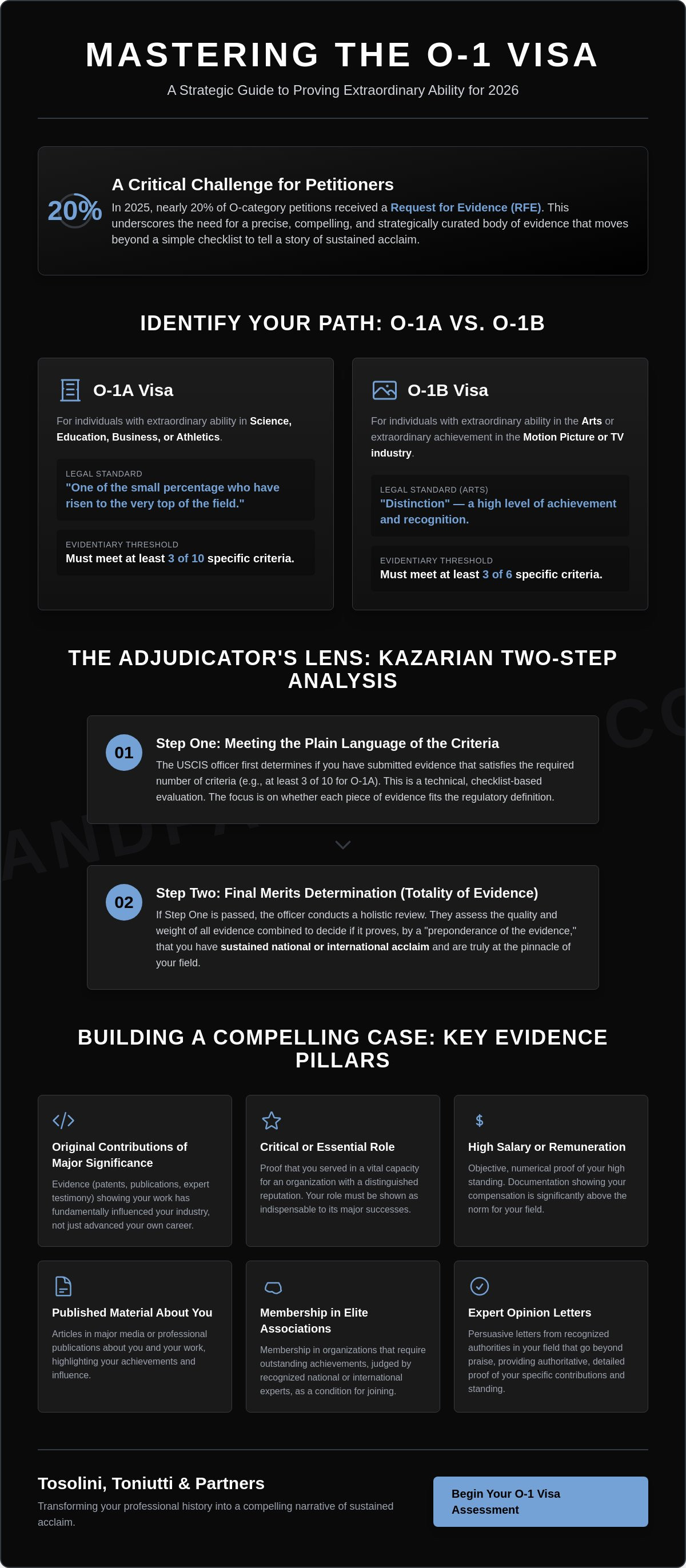
Nearly 20% of O-category petitions encountered a Request for Evidence in 2025, a statistic that underscores the delicate balance required when presenting O-1 visa extraordinary ability evidence. You likely recognize that your work possesses deep inherent value, yet the ambiguity of "extraordinary" often feels like an imprecise metric for a career defined by nuance. It's natural to feel a sense of hesitation when you're translating artistic vision or complex business leadership into a rigid regulatory framework. You aren't just looking for a list of documents; you're seeking a way to prove your impact with both precision and elegance.
This guide provides the strategic clarity you need to master these requirements, mapping your unique milestones to the specific expectations of USCIS in 2026. We'll move beyond simple checklists to explore the Kazarian two-step evaluation process, ensuring your petition narrative reflects both technical accuracy and intellectual depth. By the end of this article, you'll have the framework to transform your professional history into a compelling narrative of sustained international acclaim, giving you the confidence to move forward with your petition.
Key Takeaways
Identify the precise distinctions between O-1A and O-1B categories to align your career milestones with the correct legal framework.
Curate your O-1 visa extraordinary ability evidence to satisfy specific regulatory rules while building a cohesive narrative of your professional impact.
Master the Kazarian two-step analysis to ensure your documentation doesn't just meet a checklist but proves your sustained acclaim.
Craft persuasive Expert Opinion Letters that move beyond simple praise to provide authoritative proof of your standing in the field.
Utilize a strategic method for mapping international achievements to U.S. standards, ensuring your global career is translated with technical precision.
Table of Contents
Defining Extraordinary Ability: The High Bar for O-1 Visa Success
The O-1 visa isn't a reward for general competence or a long career. It's a recognition of rarity. To secure approval, your O-1 visa extraordinary ability evidence must demonstrate that you are among the few who have risen to the pinnacle of your field. While a Nobel Prize or an Academy Award serves as an immediate "golden ticket," most successful petitions rely on a meticulously curated portfolio of achievements that speak to sustained national or international acclaim. This acclaim isn't a static achievement from a decade ago; it must be current, vibrant, and recognized by the peers who define your industry's standards.
O-1A vs. O-1B: Which Standard Applies to You?
The legal hurdles differ significantly depending on your specific discipline. O-1A applicants in business, science, education, or athletics face the most rigorous scrutiny. They must prove they belong to that small percentage of individuals at the very top of their endeavor. Conversely, O-1B artists must demonstrate "distinction," which USCIS defines as a high level of achievement evidenced by a degree of skill and recognition substantially above that ordinarily encountered. For those in the motion picture or television industry, the standard shifts again toward "extraordinary achievement," a specific legal tier requiring proof of a preeminent status. This foundational O-1 visa overview illustrates how these categories define the legal boundaries of your petition.
The Burden of Proof in 2026
Adjudicators in 2026 operate under the "preponderance of the evidence" standard. This means you must show it's "more likely than not" that you meet the criteria. However, meeting the bare minimum is rarely enough to avoid a Request for Evidence (RFE). Successful applicants provide extensive documentation rather than just sufficient proof. Your reputation must be current. USCIS looks for O-1 visa extraordinary ability evidence that proves your acclaim is sustained, meaning your past successes aren't just historical footnotes but active components of your current professional identity. In a landscape of increased scrutiny, every document must serve a narrative purpose.
Your choice of petitioner carries significant weight in this process. Whether you utilize a direct employer or a specialized agent, the petitioner's own standing within the industry lends implicit credibility to your claims. They act as the bridge between your individual talent and the U.S. market, certifying that your presence provides a benefit to the American professional landscape. If you're unsure how your specific career path aligns with these standards, reaching out for a professional assessment at our contact page can provide the necessary clarity to begin your journey.
The Evidentiary Criteria: Mapping Your Career to USCIS Standards
Success in an O-1 petition depends on more than just professional talent. It requires a rigorous alignment between your life’s work and the specific regulatory markers defined by the government. For O-1A applicants in fields like business or science, you must satisfy at least three out of ten criteria. For O-1B artists, the requirement is three out of six. However, simply checking boxes isn't enough. The O-1 visa extraordinary ability evidence you submit must demonstrate a level of expertise that places you significantly above your peers.
Two of the most persuasive criteria to document are "Original Contributions of Major Significance" and "Critical or Essential Capacity." The former requires proof that your work has fundamentally influenced your industry. It isn't enough to be a high performer; you must be an innovator whose influence is documented by independent experts. The latter focuses on your role within distinguished organizations. You must prove that the entity itself has a preeminent reputation and that your specific contributions were vital to its success or continued standing. Objective metrics like a high salary or commercial success provide a numerical proof of this status that is difficult for adjudicators to ignore.
Quantifying Business and Scientific Success
In technical and corporate sectors, USCIS prioritizes objective, data-driven metrics. Patents are valuable, but evidence of their widespread industry adoption carries more weight. Venture capital funding, significant market share growth, and high remuneration serve as clear indicators of your value. Membership in associations that require "outstanding achievements" as a prerequisite for entry is another powerful marker. When compiling these documents, referring to the USCIS O-1 evidentiary criteria ensures your data points meet the exact technical definitions required for approval. Published material about your work in major trade journals or prestigious media outlets further solidifies your standing as a leader in your field.
Documenting Artistic Distinction
For artists and those in creative industries, the focus shifts to "distinction." You must document lead or starring roles in productions or events with distinguished reputations. This is often proven through critical reviews, high commercial ratings, or significant recognition from organizations and government agencies. A common oversight is neglecting the "Comparable Evidence" provision. If your professional role doesn't fit neatly into the standard criteria, perhaps because you're a specialized digital architect or a pioneer in a niche creative technology, you can submit alternative evidence that is functionally equivalent. This flexibility allows for a more nuanced representation of modern, non-traditional careers. If you find your professional achievements difficult to categorize, a strategic review of your portfolio can help identify the most effective way to present your unique narrative.
Strategic Evidence Selection: Beyond the Checklist
Adjudicating a petition is an intellectual exercise, not a clerical task. Officers don't simply count your documents; they evaluate them through a two-step framework known as the Kazarian analysis. Step one is a technical verification to see if you've met the threshold of at least three criteria within the USCIS O-1 Visa Evidentiary Criteria. Step two, however, is the Final Merits Determination. This is where the officer decides if the totality of your evidence proves you truly possess extraordinary ability. Providing "thin" evidence across many categories is a common mistake that often leads to scrutiny. It's far more effective to present robust, high-quality O-1 visa extraordinary ability evidence for three or four categories than to submit weak documentation for all ten.
In 2025, 19.7% of O-category petitions received a Request for Evidence (RFE). Many of these resulted from a failure to bridge the gap between technical eligibility and the final merits determination. You must demonstrate that your achievements aren't just isolated events but part of a sustained trajectory of excellence. Your narrative should feel like a well-constructed architectural plan, where every piece of evidence supports the overall structural integrity of your claim to preeminence.
The Final Merits Determination
Officers look for a "totality of the record" that confirms your status at the top of your field. You must avoid circular reasoning, which occurs when you claim a prize is major simply because you won it. Instead, use independent data to prove the award's prestige. Consistency is vital. Every letter, press clipping, and contract must harmonize to present a single, undisputed professional identity. If your evidence contradicts itself or feels disjointed, the officer will likely doubt the credibility of the entire petition.
Avoiding Common RFE Triggers
Generic letters of recommendation are a frequent point of failure. USCIS expects specific, detailed accounts of your "original contributions of major significance" rather than vague praise. When documenting work for distinguished organizations, don't rely on the company's own marketing. Use objective data like annual revenue, industry rankings, or major media coverage to prove the entity's standing. Additionally, ensure every foreign language document includes a certified translation. Small administrative oversights can stall a petition just as easily as a lack of O-1 visa extraordinary ability evidence. Precision in these details reflects the professional rigor that USCIS expects from an applicant of your caliber.
Expert Opinion Letters and Peer Documentation
Expert letters serve as the intellectual weight of your petition. They shouldn't be confused with standard character references; instead, they function as technical testimonies that validate the raw data of your O-1 visa extraordinary ability evidence. A successful letter doesn't just praise your talent. It provides a sophisticated analysis of your original contributions, explaining exactly how your work has shifted the industry's trajectory. When selecting experts, focus on authority over celebrity. A peer with deep, specialized knowledge of your niche often carries more weight with USCIS than a household name whose expertise is only tangentially related to your specific role.
For international professionals, particularly those from Europe, a significant challenge lies in translation. An accolade that carries immense prestige in Italy or France may not have an immediate equivalent in the U.S. legal framework. Your documentation must bridge this gap, contextualizing your achievements within the specific standards of the American immigration system. This requires a strategic approach to narrative building, where every European milestone is mapped to its U.S. counterpart with engineering precision. It's about proving that your reputation isn't just local but meets a global standard of excellence.
Structuring the Expert Letter
A persuasive letter begins by establishing the expert’s own preeminence. Without this foundation, their opinion holds little value for the adjudicator. Once their credentials are clear, the letter must move into specific, non-templated examples of your work. The expert needs to describe a project, a patent, or a performance in detail, specifically connecting it to the "Major Significance" criterion. This level of detail transforms a subjective opinion into an objective piece of O-1 visa extraordinary ability evidence that is difficult to dismiss. Avoid vague superlatives. Focus on the tangible impact your work had on the field.
The Role of Advisory Opinions
Most O-1 petitions require a mandatory advisory opinion from a peer group or labor organization. This "No-Objection" letter serves as a formal recognition from the industry that your presence in the U.S. won't negatively impact the domestic labor market. If your niche is so specialized that no appropriate labor organization exists, you must provide evidence of this absence while substituting other forms of peer recognition. You can learn more about our O-1 strategy to see how we manage these complex administrative requirements. If you're ready to discuss the specific nuances of your career, contact our team for a precise evaluation of your documentation.
Navigating the O-1 Process with Tosolini, Toniutti & Partners
The path to a successful O-1 petition requires more than just meeting criteria; it demands a strategic vision that aligns your professional past with your future in the United States. At Tosolini, Toniutti & Partners, we treat every case as a complex design project. Our cross-border expertise is specifically tailored for Italian and international professionals who need their global achievements translated into the precise language of American immigration law. We don't just gather documents. We construct a narrative that reflects the intellectual depth and aesthetic quality of your career, ensuring that your O-1 visa extraordinary ability evidence is presented with technical rigor.
Our proprietary method focuses on the architectural mapping of your milestones. We analyze your professional history to ensure it satisfies both the technical regulatory requirements and the subjective Final Merits Determination. This holistic approach is essential in a high-stakes adjudication environment where the quality of the narrative often determines the outcome. We understand that for many of our clients, the visa is only the first step. Our firm provides a broader ecosystem of support, including LLC incorporation and strategic business architecture, ensuring your professional transition is as seamless as the work that brought you here.
Comprehensive Support for High-Achievers
Success begins with a rigorous, strategic review of your existing portfolio. We identify the strongest markers of your acclaim and refine every detail of your expert letters to ensure they meet the specific standards of the Final Merits bar. This level of precision is particularly vital for founders and innovators. You can explore our specific insights on O-1 Visas for Entrepreneurs to understand how we navigate the nuances of beneficiary-owned companies and modern O-1 visa extraordinary ability evidence requirements.
Start Your US Journey
Preparing for an international relocation involves managing a multitude of variables. Our team handles the most complex aspects of this transition, from initial filing to managing Request for Evidence (RFE) responses with technical precision. We believe that a well-prepared petition is a testament to your professional standing. If you're ready to translate your global success into a permanent American presence, contact our specialized attorneys for a consultation to begin your strategic evaluation.
Designing Your Future in the United States
Your professional journey is defined by a series of intentional choices and remarkable milestones. Successfully navigating the 2026 landscape requires more than just high-level talent; it demands an architectural precision in how you present your career to USCIS. By focusing on the quality of your documentation and the strategic depth of your narrative, you move beyond a simple checklist to prove your status as a leader in your field. Whether you're an entrepreneur or a creative visionary, refining your O-1 visa extraordinary ability evidence is the final bridge between your international acclaim and your American aspirations.
At Tosolini, Toniutti & Partners, we provide the specialized US-Italy cross-border expertise necessary to manage these high-stakes petitions. Our proven track record with entrepreneurs and artists ensures that your transition is supported by intellectual rigor and comprehensive legal care. We offer end-to-end guidance, from the initial mapping of your achievements to business incorporation and long-term residency strategies. Don't leave your visionary career to chance. You can secure your O-1 visa with our expert cross-border legal team today. Your future in the U.S. is a structure waiting to be built, and we're ready to help you lay the foundation.
Frequently Asked Questions
What is the most important piece of evidence for an O-1 visa?
The "Original Contributions of Major Significance" criterion is arguably the most impactful piece of documentation in a petition. While no single document guarantees success, proving that your work has fundamentally changed your industry provides the strongest foundation for a positive Final Merits Determination. Adjudicators look for evidence that your innovations are widely used or cited by other experts, demonstrating that your influence extends beyond your immediate circle.
Can I use evidence of achievements that occurred outside the United States?
Yes, achievements earned anywhere in the world are fully valid for your petition. USCIS explicitly recognizes national or international acclaim regardless of the geographic location where it was received. International awards, press coverage in foreign languages with certified translations, and memberships in prestigious global associations are all essential components of a robust filing. The focus remains on your standing within the global professional community.
Do I need a Nobel Prize to qualify for an O-1 visa?
No, a Nobel Prize isn't a requirement for approval. While a major international award like a Nobel or an Oscar qualifies you immediately as a "one-time achievement," most applicants succeed by meeting at least three of the alternative criteria. You can prove your extraordinary ability through a combination of smaller awards, scholarly articles, high salary, and evidence of your critical role in distinguished organizations.
How many letters of recommendation should I include in my O-1 petition?
Quality is far more important than the total number of letters in your filing. Most successful cases include five to seven expert letters that provide deep, technical analysis of your specific achievements. These documents shouldn't be generic praise. They must explain the complexity of your work and its impact on the field, serving as authoritative testimonies that support the objective data in your portfolio.
What counts as a "distinguished" organization for the O-1 visa?
A distinguished organization is one that possesses a preeminent reputation within its specific sector. You can prove this through objective data such as major media coverage, high annual revenue, or prestigious industry rankings. It's not enough for the organization to be well-known locally. You must demonstrate that it's recognized as a leader by independent sources, ensuring your critical or essential capacity role carries the necessary weight.
Can I provide comparable evidence if I don’t meet the standard criteria?
Yes, the comparable evidence provision allows you to submit alternative documentation if the standard regulatory criteria don't readily apply to your specific occupation. This is particularly useful for pioneers in niche technologies or modern creative roles that didn't exist when the regulations were first drafted. You must explain why the standard criteria aren't applicable and how your alternative evidence proves your extraordinary status.
How recent must my O-1 visa extraordinary ability evidence be?
Your evidence should ideally reflect achievements from the recent past to prove your reputation is current. While foundational successes from earlier in your career provide necessary context, USCIS prioritizes recent O-1 visa extraordinary ability evidence to confirm that your acclaim is sustained rather than historical. If your most significant work happened a decade ago, you must supplement it with proof of your ongoing influence and active engagement.
What is the difference between O-1A and O-1B evidence requirements?
The primary difference lies in the legal standard of "extraordinary." O-1A applicants in business or science must prove they're among the small percentage at the very top of their field. O-1B artists need to demonstrate "distinction," which is a slightly lower hurdle. This means the O-1 visa extraordinary ability evidence for artists focuses on showing a degree of skill and recognition substantially above what's ordinarily encountered in the creative industries.


Comments