

O-1 Visa for Italian Artists: The 2026 Strategic Guide to Extraordinary Ability
- Gianni Mendes Toniutti, Esq.

- Apr 16
- 13 min read
Does a David di Donatello award or a prestigious Premiazione recognition truly hold the same weight when viewed through the clinical lens of a USCIS officer in 2026? You've spent years building a portfolio of architectural or visual excellence in Italy, yet the transition to the United States often feels like an exercise in translating artistic soul into rigid bureaucracy. It's natural to feel uncertain about whether your specific Italian accolades will resonate within the American immigration framework. This strategic guide reveals how to leverage your heritage and professional milestones to secure an O-1 visa for Italian artists, turning your Mediterranean success into a valid American petition.
We believe that your work isn't just a career; it's a contribution to the global cultural fabric. You'll discover a clear roadmap to approval that bypasses the need for a single, restrictive employer by utilizing a US based agent instead. We'll also clarify the often misunderstood Advisory Opinion requirement, ensuring your application reflects the true prestige of your background. By the end of this guide, you'll know exactly how to find legal partners who bridge the gap between US law and the nuanced aesthetic of Italian creative professionals.
Key Takeaways
Understand the distinct advantages of the O-1B visa over traditional routes, focusing on its lack of annual caps and its inherent flexibility for high-level creative talent.
Learn how to strategically align your Italian accolades and professional achievements with the specific evidentiary criteria required for a successful O-1 visa for Italian artists.
Evaluate the agent-sponsor framework to determine how this model provides Italian freelancers with the necessary autonomy to manage diverse projects across the United States.
Discover the essential steps for auditing your current portfolio and managing the precise translation of Italian documentation to meet rigorous USCIS standards.
Identify the value of specialized cross-border legal counsel in navigating the nuances between the Italian cultural landscape and the complexities of US immigration law.
Table of Contents Understanding the O-1B Visa: The Gateway for Italian Creative Talent Proving Extraordinary Ability: Translating Italian Accolades for USCIS The Sponsorship Framework: Employer vs. Agent for Italian Freelancers Strategic Preparation: Building Your O-1 Portfolio for 2026 Selecting Specialized Counsel: Why Italian Artists Require Cross-Border Expertise
Understanding the O-1B Visa: The Gateway for Italian Creative Talent
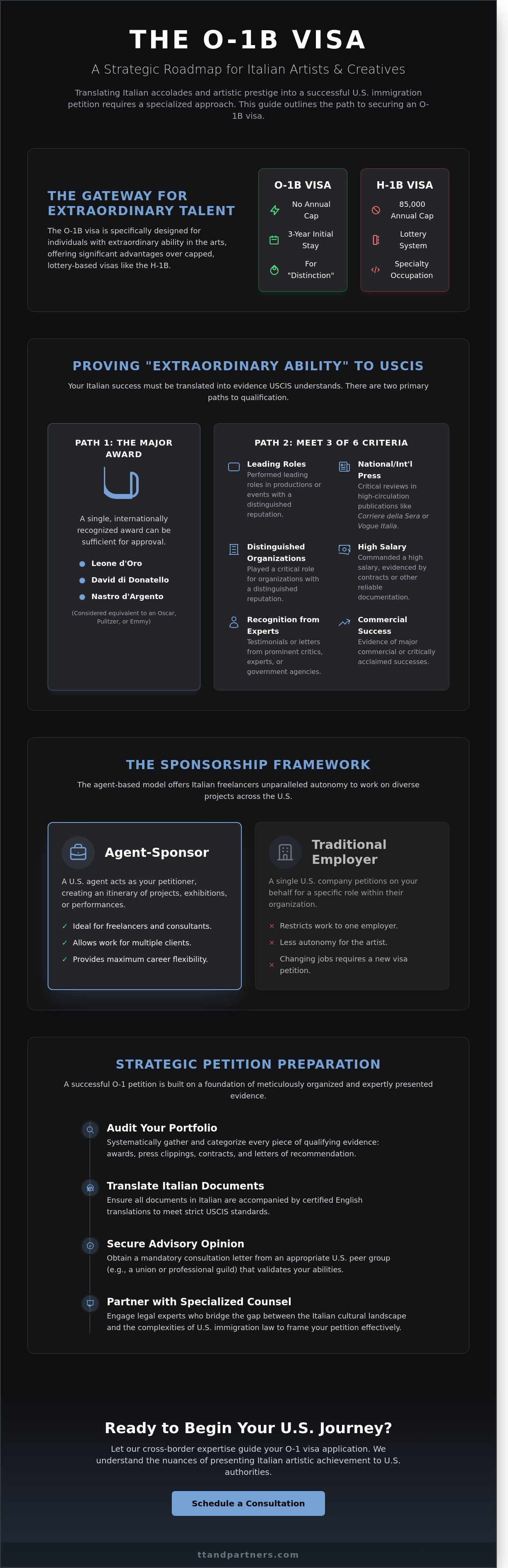
The O-1 visa represents a specialized non-immigrant status designed for individuals who possess extraordinary ability in the arts, science, education, business, or athletics. For the creative professional, specifically those seeking an O-1 visa for Italian artists, the O-1B classification serves as the primary vehicle for entry into the United States market. Unlike the H-1B visa, which is constrained by an annual cap of 85,000 and a random lottery system, the O-1 category remains open year-round with no numerical limits. This flexibility allows Italian creators to time their relocation based on project demands rather than administrative cycles. The initial period of stay spans three years, but the United States Citizenship and Immigration Services (USCIS) allows for unlimited one-year extensions. By 2026, these extension policies provide a stable framework for long-term career development in American creative hubs. Extraordinary ability in the arts is legally defined as achieving distinction through a record of high-level accomplishment that has earned the individual national or international acclaim.
O-1A vs. O-1B: Which Path Fits Your Craft?
Choosing between O-1A and O-1B requires a precise analysis of one's professional output. While O-1A targets sciences and business, the O-1B category focuses on the arts. Hybrid professionals, such as architects or digital designers, often find the O-1B more accessible. The legal standard for the arts is "distinction," which is statistically less rigorous than the "extraordinary ability" required for O-1A. Distinction implies that you're a leader in your field. It's not enough to be a working artist; you must prove you're among the small percentage at the top of your profession. Italian filmmakers and those in the audiovisual sector utilize the Motion Picture and Television (MPTV) sub-category, which demands a record of extraordinary achievement rather than just distinction.
The Italian Context: Why Now is the Time to Apply
In 2026, the demand for European design perspectives continues to rise, with a 12 percent increase in US-Italy creative partnerships reported in recent industry surveys. Data from the 2025 Creative Exchange Report indicates that US firms are actively seeking Italian talent to fill senior roles in urban planning and sustainable architecture. This trend makes the O-1 visa for Italian artists a vital tool for career expansion. The visa supports a holistic approach to professional growth, allowing artists to integrate into the American urban fabric while maintaining their unique cultural identity. This visa isn't just a temporary permit; it's a strategic foundation for those eyeing an EB-1 Green Card. Italian professionals often leverage their O-1 status to build the portfolio necessary for permanent residency. For those ready to initiate this transition, reaching out to experts at TT and Partners can provide the necessary structural guidance for a successful application.
Proving Extraordinary Ability: Translating Italian Accolades for USCIS
Securing an O-1 visa for Italian artists requires a precise translation of Mediterranean prestige into the specific legal framework of US immigration. The most direct path is the "Major Award" shortcut. If you've received a David di Donatello, a Nastro d'Argento, or a Leone d'Oro, you meet the extraordinary ability threshold immediately. These honors carry the same evidentiary weight as an Oscar or a Pulitzer in the eyes of the Department of Homeland Security.
Most applicants follow the secondary route by satisfying at least three of the six regulatory criteria. You'll need to align your Italian portfolio with the official USCIS O-1 criteria. This process involves proving national or international recognition through tangible documentation rather than vague assertions of talent.
Press coverage from high-circulation outlets like Corriere della Sera or Vogue Italia serves as vital proof. Don't just provide the article; include circulation data to establish the publication's reach. For instance, Corriere della Sera maintained a daily circulation of over 240,000 copies in 2023, which provides the "major media" context USCIS officers require. Commercial success is equally quantifiable. If your 2024 exhibition saw record attendance or your film topped the Italian box office, these figures are essential. High remuneration also qualifies. If your design contracts exceed the average 55,000 Euro salary of a senior creative in the national market by 150%, you possess a compelling case for "high remuneration."
Critical Roles and Distinguished Organizations
Documenting a lead role at distinguished national cultural institutions requires more than a simple program mention. You need "expert letters" from established figures. A testimonial from a lead curator at a distinguished national museum, signed within the last 12 months, provides the necessary validation. These letters must detail your specific contribution to the organization's distinguished reputation. If you're ready to map out your transition, you can reach out for a strategic consultation to align your professional milestones with US requirements.
The Role of Comparable Evidence
The USCIS allows "comparable evidence" for artists in digital spaces or niche crafts that don't fit standard categories. By 2026 standards, social media metrics must go beyond follower counts. You should document engagement rates, verified status, and collaborations with global brands. If you're an architect or designer, gallery representation at a major international design exhibition provides a framework for excellence. Use specific data points, such as the number of international attendees or featured mentions in architectural journals, to prove your distinction.
The Sponsorship Framework: Employer vs. Agent for Italian Freelancers
The structural foundation of the O-1 visa for Italian artists rests on the relationship between the applicant and the US petitioner. While a traditional employer-sponsored model offers a single, stable point of contact, it restricts the artist to a solitary firm. For the Italian professional whose practice spans diverse projects, this rigidity often conflicts with the fluid nature of creative work. An agent-sponsored model provides the necessary framework for a multi-faceted career, allowing the artist to engage with various clients under a single visa umbrella. This flexibility is essential for those who don't want to be tied to one specific studio or gallery for three years.
A successful application requires a comprehensive itinerary. This document functions as a blueprint for the artist's US tenure, detailing specific engagements, exhibition dates, or performance schedules. To satisfy the USCIS O-1 Visa Requirements, the itinerary must prove that a series of events exists. Contracts must be precise. They should define the scope of work, compensation structures, and the agent's role as a representative rather than a direct supervisor. This legal clarity ensures the artist maintains their professional autonomy while remaining compliant with federal regulations.
The Agent as a Petitioner
The agent acts as a legal bridge. They don't need to pay the artist's salary directly; instead, they represent the artist's interests to multiple US entities. The agent must be a US citizen or a registered US business entity with a verifiable tax ID. This structure is ideal for Italian freelancers who want to collaborate with several different galleries or production houses simultaneously. It ensures the visa remains valid even if one specific project concludes, provided the overall itinerary remains active.
Navigating the Advisory Opinion Requirement
Every O-1 petition requires a consultation letter from a peer group or labor organization. This document validates the artist's standing within their specific discipline. Italian creatives must identify the correct union, such as IATSE for technicians, SAG-AFTRA for performers, or the American Federation of Musicians (AFM). If a union doesn't respond within 15 days, the law allows the petition to proceed without the letter. Obtaining a "No Objection" letter is the standard goal, as it signals to immigration officers that the artist's presence won't negatively impact the US labor market. This step requires early coordination to avoid delays in the final filing process.
Strategic Preparation: Building Your O-1 Portfolio for 2026
Success in the O-1 visa for Italian artists category requires a meticulous assembly of evidence, similar to the blueprinting of a complex architectural structure. You'll need to audit your current portfolio against the six specific USCIS criteria to identify where your record of achievement needs reinforcement. This process begins with the "Translation" phase. Every Italian press clipping, contract, and award certificate must include a certified English translation that meets the strict standards of 8 CFR 103.2(b)(3). Accuracy here isn't just about language; it's about preserving the prestige of the original Italian context for a US official.
Securing high-level recommendation letters defines the "Advisory" phase. You should aim for 5 to 7 letters from recognized experts in both Italy and the United States. These aren't simple character references; they're technical testimonials that validate your extraordinary ability through specific examples of your work's impact on the industry. A letter from a curator at the MAXXI in Rome or a director at a major New York gallery carries significant weight when it details your specific contributions to high-profile projects.
The "Filing" phase involves strategic timing. In 2026, standard processing times at the Vermont or California Service Centers fluctuate between 2 and 6 months. To bypass these delays, many applicants utilize Premium Processing via Form I-907. This service guarantees a response within 15 calendar days for a fee that was updated to $2,805 in early 2024. Choosing this path provides clarity and allows you to finalize your US professional engagements with a concrete start date.
The Importance of the Petitioner's Cover Letter
A lawyer doesn't just list your accomplishments. They craft a narrative that synthesizes individual milestones into a cohesive story of sustained national or international acclaim. This legal argument translates your artistic vision into the specific terminology required by immigration statutes. The legal argument is just as important as the physical evidence because it provides the lens through which the officer views your career. For a broader perspective on how this fits into the visa O-1 framework, you'll see that the narrative often bridges the gap between raw data and the "extraordinary" legal standard.
Managing the Request for Evidence (RFE)
USCIS often issues RFEs when they require more detail on specific criteria, such as the "Distinction" requirement. Common triggers include missing proof of a project's commercial success or insufficient evidence of a leading role in a distinguished production. You can pre-empt these by including data-driven evidence, such as box office numbers or critical reviews from major publications like Corriere della Sera. When officers challenge your distinction, your response must provide comparative data showing you're among the small percentage at the top of your field. An RFE is a request for clarification that allows you to strengthen your case rather than a final decision or denial of your petition.
If you're ready to begin your journey, contact our team for a strategy session.
Selecting Specialized Counsel: Why Italian Artists Require Cross-Border Expertise
General immigration firms often lack the specific nuance required for high-level creative petitions. They treat the O-1 visa for Italian artists as a bureaucratic checklist rather than a narrative of professional excellence. This reductive approach fails to capture the cultural weight of Italian institutions. A lawyer must understand why a solo exhibition at the MAXXI in Rome or a design award from the Triennale di Milano carries significant weight. Without this cross-border literacy, your most prestigious achievements might be dismissed by a USCIS officer who lacks the proper context to evaluate international acclaim.
Expert counsel acts as a strategic architect for your career. They don't just file papers; they help structure your American presence from the ground up. This often involves a "Bridge" approach where immigration strategy meets business architecture. For many creative entrepreneurs, this includes planning for LLC incorporation to manage US contracts, royalties, and intellectual property effectively. By 2026, the seamless integration of legal status and business structure will be the standard for artists seeking long-term stability in the American market.
When evaluating a potential representative, look for a proven history of O-1B approvals specifically within the creative arts. Ask for examples of how they handled Requests for Evidence (RFEs) for European clients. A successful track record demonstrates an ability to pivot when federal guidelines shift. It's not just about the number of cases won; it's about the complexity of the profiles they have successfully represented and their ability to translate Italian success into American legal standards.
Checklist for Choosing Your O-1 Attorney
Does the firm have a documented history of managing Italian-to-US transitions for high-profile creatives?
Can they assist with the complexities of the E-1 visa if your artistic work involves significant trade or the sale of physical goods between Italy and the US?
Do they offer a holistic 2026-2027 roadmap that includes the path to a Green Card to ensure your initial visa is the beginning of a permanent career?
The TT & Partners Advantage
Our firm operates at the intersection of European heritage and American opportunity. We understand that an Italian portfolio isn't just a collection of jobs; it's a legacy of craftsmanship and innovation. We translate this legacy into the precise, technical language USCIS expects. We provide more than legal filing; we provide a strategic career bridge between two continents. Our goal is to ensure your transition is as aesthetically and professionally sound as the work you create. Contact our team for a tailored O-1 evaluation of your artistic portfolio to begin your journey.
Architecting Your Creative Legacy in the United States
Navigating the path to a U.S. career requires more than talent; it demands a structured, strategic approach to your professional narrative. Securing an O-1 visa for Italian artists involves a meticulous translation of your Mediterranean accolades into the specific evidentiary categories defined by USCIS. Success in 2026 hinges on the 3-year timeline of your portfolio development and the selection of a sponsorship framework that aligns with your freelance or contractual goals. At TT and Partners, we approach immigration with the same precision as an architectural project, ensuring every piece of documentation serves a functional purpose within your petition. Our practice draws on decades of experience managing O-1, E-2, and Green Card petitions from our strategic offices in both the United States and Italy. We don't just process paperwork; we design the strategic foundation for your international expansion. It's time to transform your vision into a sustainable professional reality across the Atlantic. Schedule a consultation with our US-Italy immigration experts to begin your journey. The horizon of the American creative market is waiting for your unique perspective.
Frequently Asked Questions
Can I apply for an O-1 visa if I am a freelance artist in Italy?
You can apply for an O-1 visa as a freelance artist by utilizing a US-based agent to petition on your behalf. This structure allows you to work on multiple projects for different clients under a single visa umbrella. The USCIS requires a comprehensive itinerary detailing all confirmed performances or exhibitions for the requested 1,095-day period. Italian creatives often use this route to maintain professional flexibility while building their international portfolio.
How long does it take to get an O-1 visa approved in 2026?
Standard processing for the O-1 visa for Italian artists typically ranges from 60 to 120 days based on 2025 USCIS performance metrics. If you require a faster decision, the Premium Processing Service guarantees a response within 15 business days for an additional government fee. Planning your application 180 days before your intended start date ensures a smooth transition into the American cultural landscape without the stress of administrative delays.
Do I need a university degree to qualify for the O-1B artist visa?
You don't need a university degree to qualify for the O-1B visa because the criteria focus on your extraordinary ability in the arts. Evidence of your success includes major international awards, high salary history, or critical reviews in publications like Domus or Corriere della Sera. USCIS evaluates your career through 3 out of 6 specific criteria. They prioritize professional impact and peer recognition over formal academic credentials or diplomas.
What happens to my O-1 status if my US project is canceled?
You have a 60-day grace period to find a new employer or file for a change of status if your project is canceled. This period, or until your I-94 expires if that's sooner, provides time to secure a new US agent or petitioner. If you fail to find a new project within these 60 days, your O-1 status technically terminates. You'll then need to depart the United States to avoid accrual of unlawful presence.
Can my spouse and children come to the US with me on an O-1 visa?
Your spouse and unmarried children under 21 can accompany you to the US using the O-3 non-immigrant visa category. While they can attend schools or universities during their stay, O-3 status doesn't grant them the right to seek employment in the US. Their stay is directly linked to your O-1 status; therefore, their visas remain valid for the exact duration of your approved artist petition, up to three years initially.
Is there a minimum salary requirement for an O-1 artist visa?
There isn't a fixed minimum salary requirement for the O-1 visa, but earning high remuneration compared to others in your field is a key criterion. You must demonstrate that your compensation reflects your status as an artist at the top of your profession. Providing contracts or tax returns that show earnings in the top 10 percent of Italian or US artists strengthens your case by proving your elite professional standing.
Can I change from an O-1 visa to a Green Card later?
You can transition from an O-1 visa for Italian artists to a Green Card, most commonly through the EB-1A Extraordinary Ability category. Since the O-1 and EB-1A criteria share similar benchmarks, successful O-1 holders often have a clear path to permanent residency. In 2023, over 3,500 artists utilized this dual-intent strategy to establish long-term professional roots in American creative hubs like New York, Los Angeles, or Miami.
What is the difference between an O-1 visa and a P-1 visa for performers?
The O-1 visa is designed for individuals with sustained national or international acclaim, whereas the P-1 visa is intended for members of an internationally recognized entertainment group. If you're a solo Italian painter or architect, the O-1 is your primary path. The P-1 requires you to perform as part of a team that's been together for at least 365 days. This requirement makes the P-1 unsuitable for most individual artistic practitioners.


Comments