

O-1 Visa Renewal Process for Italians: The 2026 Strategic Guide
- Gianni Mendes Toniutti, Esq.

- Jun 22
- 13 min read
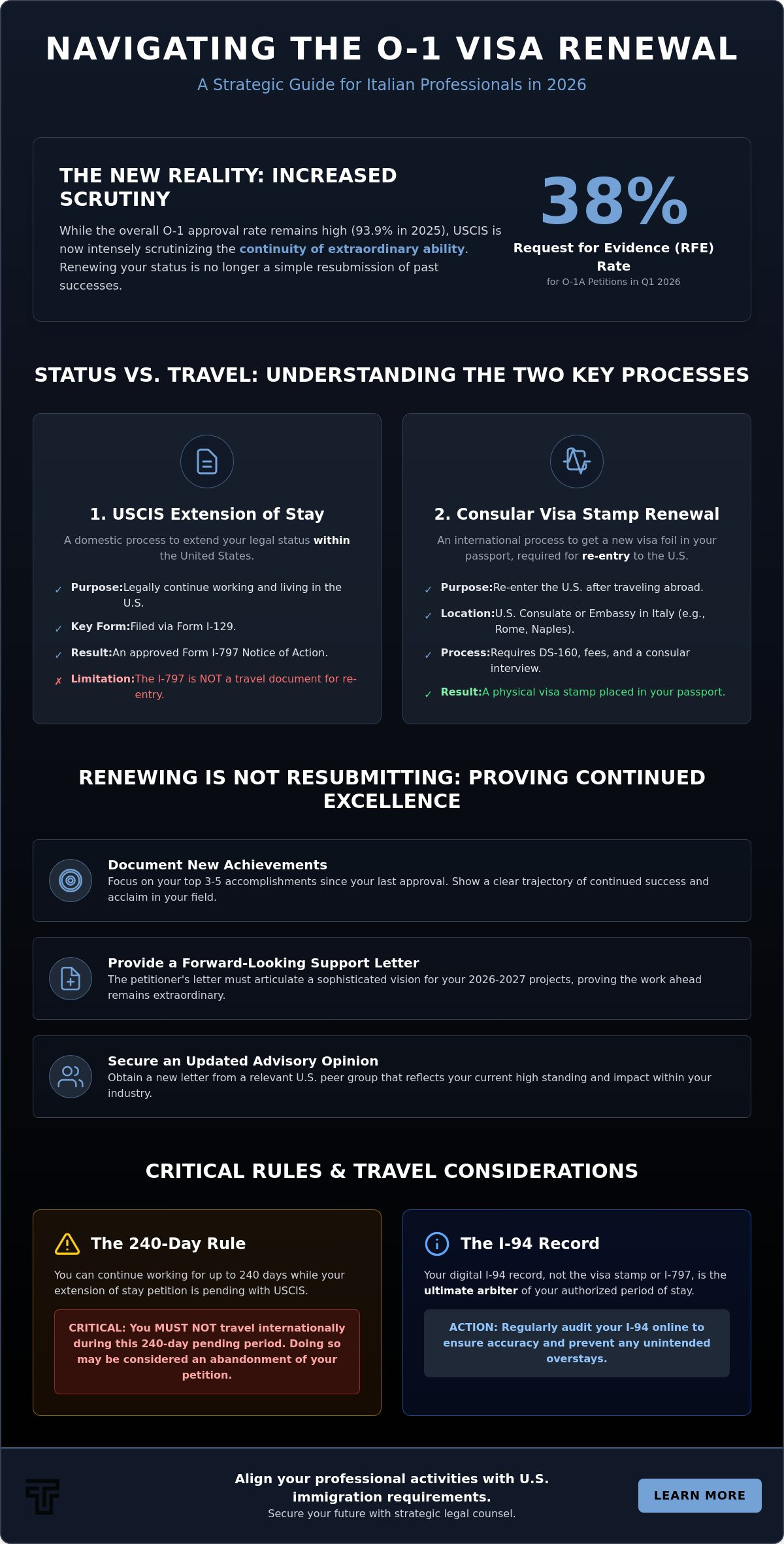
Did you know that despite a high overall approval rate of 93.9 percent in 2025, the Request for Evidence rate for O-1A petitions climbed to a striking 38 percent in the first quarter of 2026? This shift suggests that USCIS is scrutinizing the continuity of extraordinary ability with newfound intensity. You've already established your brilliance on the global stage, yet the prospect of re-validating that status can feel like an unnecessary weight. It's natural to feel anxious about the O-1 visa renewal process for Italians, especially when you're balancing high-stakes projects with the logistical puzzles of international travel and consular appointments.
This guide provides the strategic clarity you need to extend your stay with confidence and poise. You'll learn how to harmonize your 2026 professional milestones with the latest evidentiary standards, ensuring your petition reflects your current trajectory. We'll demystify the 240-day work authorization rule, clarify the distinction between USCIS extensions and Italian consular processing, and provide a roadmap for a seamless transition. By the end of this article, you'll have a precise framework to secure your future in the United States while maintaining your vital connection to Italy.
Table of Contents
Understanding the O-1 Visa Extension vs. Visa Stamp Renewal
Successfully managing the O-1 visa landscape requires a nuanced understanding of how U.S. authorities define your presence. Many Italian professionals mistakenly view the renewal as a single administrative act. In reality, it's a two-tiered architecture involving domestic status and international travel privileges. Distinguishing between these two concepts is the first step in ensuring your professional life in the United States remains uninterrupted. You aren't just renewing a document; you're re-validating your right to contribute to your field at the highest level.
It's common for Italian applicants to receive their Form I-797 approval notice and assume their travel documents are automatically updated. This is a critical error that can lead to significant logistical hurdles. The I-797 confirms your legal status within the U.S. borders, but it doesn't function as a travel document. For an Italian citizen planning a return to Milan or Rome, a physical visa stamp in the passport is essential for re-entry. Without this stamp, an approved extension of stay won't allow you to pass through U.S. Customs and Border Protection after an international trip.
The I-94 record serves as the ultimate arbiter of your authorized stay. While your I-797 might indicate a specific expiration, the date on your digital I-94 record dictates your legal window. Discrepancies here can lead to unintended overstays, making regular audits of your I-94 a mandatory part of your strategy. With RFE rates for O-1A petitions reaching 38 percent in early 2026, the O-1 visa renewal process for Italians demands more than a simple resubmission of past successes. USCIS now expects a forward-looking narrative that proves your extraordinary ability is a continuous professional evolution rather than a static achievement from years ago.
The USCIS Extension of Stay (Form I-129)
This domestic process allows you to extend your legal status without leaving the United States. Filed via Form I-129, these extensions are typically granted in one-year increments. The petition must include a new or extended contract with your U.S. employer or agent, clearly outlining the extraordinary projects you'll spearhead in the coming year. It's a technical exercise in proving that your presence remains vital to the U.S. professional landscape through 2026 and beyond.
The Consular Visa Stamp Renewal
When you need to travel back to Italy, you must secure a new visa stamp at a U.S. Consulate. This is a separate procedure from the USCIS extension. Current 2026 expectations for high-profile applicants include rigorous consular interviews. Officers in Rome or Naples will look for consistency between your approved USCIS petition and your current professional activities. The O-1 visa renewal process for Italians is only complete for travelers once this physical stamp is secured, enabling seamless movement between the two nations.
O-1 Visa Renewal Requirements: Proving Continued Extraordinary Ability
Relying on a previous approval is a strategic trap. The "Continued Evidence" rule requires you to demonstrate that your extraordinary status hasn't just been maintained but has flourished since your last filing. While your initial petition established your baseline, the 2026 renewal landscape demands fresh proof of acclaim. Understanding the evidentiary nuances of the O-1 visa renewal process for Italians is essential for maintaining your status without friction. USCIS officers don't simply rubber-stamp extensions; they look for a trajectory of excellence that justifies your continued presence in the U.S. professional ecosystem.
The Petitioner Support Letter must do more than list past duties. It needs to articulate a sophisticated vision for your 2026-2027 projects. This document serves as the architectural blueprint of your future contributions, proving that the work ahead remains extraordinary in nature. Similarly, an updated Advisory Opinion from a relevant U.S. peer group is mandatory. This letter must reflect your current standing within the industry, acknowledging the specific, high-level impact you've made since your initial entry. It's about showing that your peer group still recognizes you as being at the very top of your field.
Documenting New Achievements Since the Initial Petition
Focus on your top three to five achievements from the last three years. Extraordinary Ability is re-evaluated in the renewal phase as a measure of your sustained national or international acclaim within your specific field. If you've received prestigious Italian awards, secured European grants, or seen your work featured in major Italian press, these are vital components of your narrative. All Italian-language evidence requires certified English translations that maintain the professional gravitas of the original text. Accuracy here is paramount, as linguistic nuances often define the perceived weight of an achievement.
The Importance of the Italian Professional Network
Your influence in Italy remains a powerful asset for your U.S. status. Testimonials from Italian industry leaders don't just provide character references; they validate the international impact of your work. By bridging the gap between Italian professional standards and U.S. legal criteria, you create a holistic picture of a global leader. This cross-border synergy is often what separates a successful renewal from one that triggers an RFE. You can explore the foundational requirements in our O-1 Visa: The Complete 2026 Guide to Extraordinary Ability Visas for the US to ensure your base evidence remains rock-solid.
Understanding the nuances of maintaining work authorization is critical as you compile this evidence. With RFE rates for O-1A petitions climbing to 38 percent in early 2026, the O-1 visa renewal process for Italians requires a meticulous, data-driven approach. Aligning your Italian accolades with U.S. expectations ensures a seamless transition into your next professional chapter. For those managing complex cross-border operations, a bespoke legal strategy can provide the necessary precision to navigate these heightened evidentiary standards.
Consular Processing for Italians: Renewing Your Stamp in Italy
Securing the physical visa stamp is the final, essential piece of your international mobility. While the USCIS extension validates your stay within the United States, the O-1 visa renewal process for Italians remains incomplete for travelers until a U.S. Consulate in Italy issues a new passport entry. Most professionals choose between the U.S. Embassy in Rome or the consulates in Milan, Naples, and Florence. Each location operates with a distinct rhythm, but the core requirement remains the same: a sophisticated presentation of your continued extraordinary status. You'll need to navigate the digital application gateway and the specific payment portals used within the Italian consular district, ensuring the 205 dollar application fee and the 250 dollar visa integrity fee are processed correctly before your interview.
Preparing for the interview requires more than just a collection of documents. Even though the O-1 category is often treated with dual intent flexibility, Italian applicants should still be ready to discuss their ongoing professional connections to Italy. Consular officers in Rome and Milan are historically thorough. They look for a coherent narrative that bridges your U.S. activities with your Italian heritage. As of mid-2026, appointment wait times for O-category visas in Italy typically range from 14 to 30 days, though scheduling during peak summer months or the December holiday season often requires a longer lead time. Precision in your itinerary is non-negotiable; every project listed must align with the extraordinary scope defined in your approved petition.
Administrative Processing and the Italian Applicant
Section 221(g) represents a formal pause in the O-1 visa renewal process for Italians, often triggered by technical omissions. To avoid these delays, ensure your file includes updated Italian police certificates, specifically the Criminal Record Certificate and the Certificate of Pending Charges. Officers also scrutinize how you leverage the U.S.-Italy tax treaty. Demonstrating a clear, compliant financial structure reflects a stable and high-level professional standing, which can significantly reduce the likelihood of extended administrative reviews. A well-organized project itinerary, detailing your 2026-2027 engagements, serves as a shield against requests for further clarification.
The Third-Country National Option
While some professionals consider renewing their stamp in a third country like Canada or Mexico, Italian nationals generally find more success at home. Consular officers in Italy possess a deeper understanding of the Italian professional landscape, from the prestige of local awards to the specific weight of national press coverage. Renewing in Italy ensures that the nuance of your extraordinary ability isn't lost in translation. For those balancing renewal with business growth, our guide on the O-1 Visa for Entrepreneurs: A Strategic Guide to US Extraordinary Ability in 2026 offers deeper insights into managing cross-border operations during this transition.
Maintaining Work Authorization: The 240-Day Rule and Travel
The period between filing your extension and receiving a final decision is a delicate strategic window. For many, the most pressing concern is the ability to continue professional activities without interruption. The 240-day rule provides this essential continuity, allowing you to remain productive while USCIS reviews your case. However, this rule only applies if your extension is filed before your current I-94 record expires. Managing this timeline is a core component of the O-1 visa renewal process for Italians, especially as evidentiary standards for sustained extraordinary ability tighten in 2026. Monitoring your digital I-94 record is non-negotiable; an overlooked expiration date can lead to unlawful presence, which jeopardizes both your current renewal and any future U.S. entries.
A critical hazard during this phase is international travel. Leaving the United States while a Form I-129 extension of stay is pending generally results in the automatic abandonment of the extension request. You might find yourself stuck in Italy with an expired status, forced to navigate consular processing from scratch rather than benefiting from a domestic approval. To avoid these complications, many professionals opt for Premium Processing. For a fee of $2,965, USCIS guarantees a response within 15 business days. While the cost is significant, the certainty it provides for your 2026 project schedule and your ability to travel freely often outweighs the expense. It's a strategic investment in professional mobility and peace of mind.
The 240-Day Rule Mechanics
To trigger this protection, your petitioner must file a timely Form I-129 before your current authorized stay concludes. The 240-day rule allows non-immigrant workers with a timely filed extension petition to continue working for the same employer for up to 240 days beyond the expiration of their current status. When discussing this with your HR department or business partners, provide the USCIS receipt notice, also known as Form I-797C. This document serves as legal proof that your work authorization remains valid during the adjudication period, ensuring your projects stay on track.
Travel Logistics and Re-entry
Coordination is everything. You should ideally only plan your return to Italy once the USCIS approval notice is in hand, or if you intend to complete the entire O-1 visa renewal process for Italians via consular processing from the outset. Upon re-entry after your consular appointment, carry your new I-797 approval, your updated passport stamp, and a copy of the full petition to present to Customs and Border Protection. If your long-term vision includes transitioning to a more permanent status, understanding How Much Is a Green Card? The 2026 Cost and Strategy Guide can help you align your current renewal with future residency goals.
To ensure your travel and work authorization remain fully compliant throughout 2026, contact our legal team for a tailored renewal strategy.
Strategic Legal Counsel for US-Italy O-1 Renewals
The O-1 visa renewal process for Italians is a sophisticated exercise in translation. It requires more than just submitting a history of professional triumphs; it demands that your achievements in Italy be rendered into the precise dialect of U.S. immigration law. Tosolini, Toniutti & Partners operates at the intersection of these two distinct cultures. We understand that an Italian professional's trajectory often involves a complex mix of European grants, Mediterranean press coverage, and cross-border collaborations. Our role is to ensure these nuances aren't lost in the administrative machinery of USCIS. We provide a bridge between your creative or scientific vision and the engineering precision required for a successful legal petition.
For the Italian entrepreneur, the renewal strategy often involves intricate corporate layers. Integrating your immigration status with your LLC Incorporation ensures that your business architecture supports your extraordinary ability claim. We design customized renewal strategies that reflect your role as a strategic thinker managing both U.S. operations and Italian professional networks. This holistic approach doesn't just secure your stay; it reinforces the professional foundation upon which your American legacy is built. For those looking toward the horizon, we also provide a roadmap for transitioning from O-1 status to permanent residency, ensuring that your long-term residency goals align with your current professional milestones.
Minimizing RFE Risks in 2026
With the RFE rate for O-1A petitions climbing to 38 percent in early 2026, the margin for error has narrowed significantly. Common triggers often include a perceived lack of "sustained" acclaim or insufficient evidence of a high salary relative to the Italian market. Our expertise mitigates these risks by providing a data-driven narrative that contextualizes your Italian credentials within the U.S. framework. We ensure that every piece of evidence, from Italian industry awards to peer testimonials, is presented with the weight it deserves, leaving no room for ambiguity in the eyes of the adjudicating officer.
Your Next Steps for a Successful Renewal
Timing is the silent partner of a successful petition. We recommend initiating the O-1 visa renewal process for Italians at least six months before your current status expires. This window allows for the meticulous collection of fresh evidence and the coordination of updated advisory opinions from U.S. peer groups. A strategic consultation is the first step in evaluating your 2026 eligibility and identifying any gaps in your current portfolio. By acting early, you maintain control over your professional timeline and avoid the anxieties of a pending status. Contact Tosolini, Toniutti & Partners for your O-1 Visa Renewal Strategy to begin crafting your next chapter in the United States.
Mastering Your Global Professional Trajectory
Navigating the O-1 visa renewal process for Italians requires a blend of legal precision and strategic foresight. You've seen how the distinction between a domestic status extension and a consular visa stamp defines your international mobility. You also understand that current 2026 standards demand fresh evidence of your sustained acclaim, ensuring your petition reflects your most recent professional milestones rather than relying on past successes. By mastering the mechanics of the 240-day rule and the nuances of travel logistics, you protect your legal work authorization while maintaining your vital connection to Italy.
This transition is more than a mere administrative formality; it's an opportunity to re-affirm your position at the peak of your field within a sophisticated global framework. Our firm is specialized in US-Italy cross-border immigration, offering expertise in high-net-worth and extraordinary ability petitions. We provide comprehensive support for Italian entrepreneurs and artists, ensuring your achievements are presented with the intellectual depth they deserve. Secure your professional future in the US with expert O-1 renewal guidance. Your continued success in the American landscape is a testament to your brilliance, and we're here to ensure that your visionary journey remains uninterrupted.
Frequently Asked Questions
Can I renew my O-1 visa while I am still in the United States?
Yes, you can initiate an extension of stay while remaining in the United States by filing Form I-129 with USCIS. This domestic process allows you to maintain your legal status without the immediate need for international travel. It's a proactive way to manage the O-1 visa renewal process for Italians who wish to continue their professional engagements in the U.S. without interruption.
How many times can an Italian citizen extend their O-1 visa status?
There is no statutory limit on the number of times an Italian citizen can extend their O-1 status. As long as you continue to demonstrate extraordinary ability and have ongoing projects or employment in the U.S., you can apply for extensions indefinitely. Each extension is typically granted in one-year increments, requiring a fresh validation of your sustained professional acclaim and future contributions.
What happens if my O-1 visa expires while my renewal is still pending?
If your current status expires while your timely-filed renewal is pending, you are permitted to continue working for up to 240 days. This automatic authorization ensures your professional activities remain compliant while USCIS adjudicates your petition. You must remain in the U.S. during this period to benefit from the rule, as leaving the country can lead to the abandonment of your pending extension request.
Do I need a new Advisory Opinion for an O-1 extension if my field hasn’t changed?
Yes, a new Advisory Opinion or consultation letter is required for an O-1 extension even if your field remains the same. USCIS expects updated evidence that your peer group or a relevant labor organization still recognizes your extraordinary status. This letter must reflect your current standing in 2026, providing a contemporary endorsement of your expertise and the significance of your upcoming projects.
Can I travel back to Italy while my O-1 renewal application is being processed?
Traveling back to Italy while your domestic extension of stay is pending is generally discouraged because it often results in the abandonment of the petition. If you must travel, you should wait for the USCIS approval notice or plan to complete the O-1 visa renewal process for Italians entirely through consular processing. Leaving the U.S. during the adjudication window can complicate your re-entry and force a restart of the application.
Is it possible to change from an O-1 visa to a Green Card during the renewal process?
It is entirely possible to transition from an O-1 visa to a Green Card, such as the EB-1A or EB-2 NIW, while your renewal is underway. Since the O-1 category recognizes a high level of achievement, many professionals find the transition to permanent residency a natural progression. You can file for adjustment of status alongside or after your renewal, provided you meet the specific criteria for the immigrant visa category.
How much does the O-1 visa renewal process cost in 2026?
In 2026, the government filing fees for an O-1 renewal include the Form I-129 fee, which is $1,055 for standard employers or $530 for small employers. Additionally, most petitioners must pay an Asylum Program Fee of $300 or $600 and a $250 Visa Integrity Fee for consular cases. If you require an expedited decision, the optional Premium Processing fee is $2,965, guaranteeing a response within 15 business days.
Does a "gap" in employment affect my O-1 renewal eligibility?
A gap in employment can significantly affect your renewal eligibility because O-1 status is strictly tied to your approved petitioner and specific itinerary of events. If you stop working for your petitioner, you may lose your legal status. It's essential to ensure your renewal petition covers a continuous timeline of extraordinary projects to demonstrate that you've maintained your status and remain vital to the U.S. professional landscape.


Comments