

O-1 Visa Requirements for Italians: 2026 Guide

What if your professional legacy in Italy isn't just a collection of past triumphs, but the precise currency needed to unlock a future in the United States? For many high-achievers, the O-1 visa requirements for Italian citizens feel like an impenetrable barrier of legal jargon and rigid standards. You've likely felt the frustration of wondering if your Italian awards or press coverage carry weight in a foreign system, or struggled to distinguish between the O-1A and O-1B categories while searching for a reliable U.S. sponsor.
It's a common hurdle, yet the path to relocation is a strategic evidentiary build rather than a lottery for geniuses. This guide will help you master the ten USCIS criteria and provide a clear strategy for translating your professional success into the legal evidence required for a successful petition. We'll explore the 2026 regulatory landscape, from filing fees to premium processing, offering a roadmap that turns your visionary talent into a tangible American reality.
Table of Contents
Understanding the O-1 Visa Framework for Italian High-Achievers
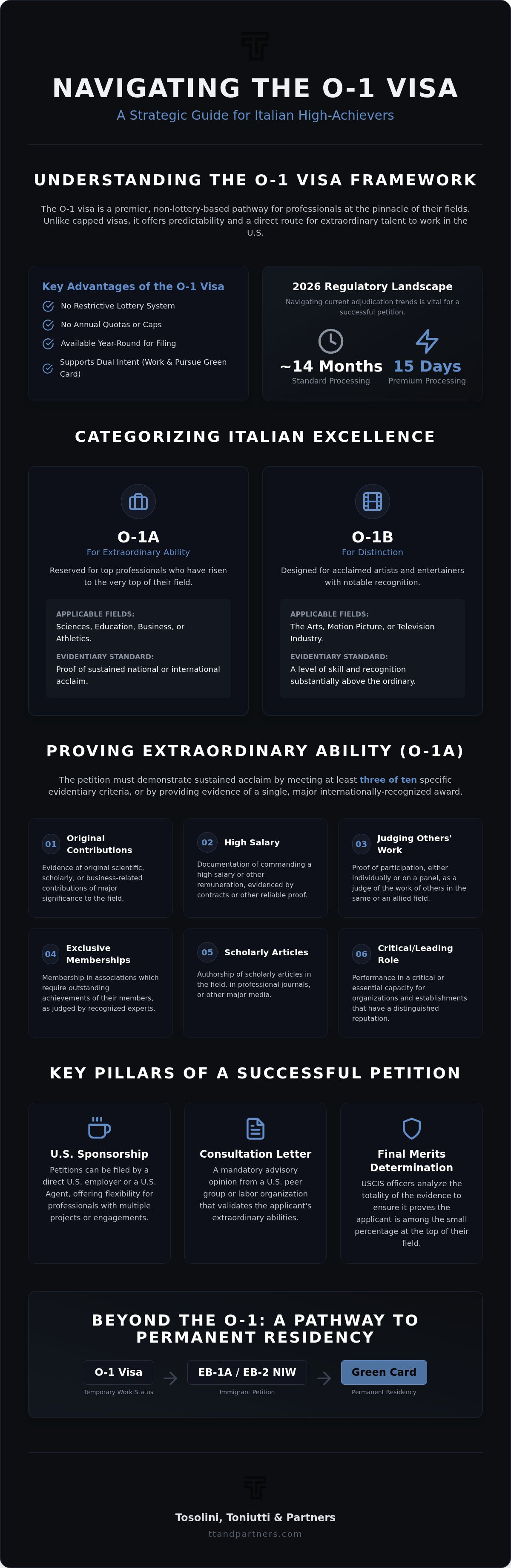
The O-1 visa serves as a premier gateway for Italians who have achieved the pinnacle of their professions. Unlike the H-1B, which relies on a restrictive lottery system and annual caps, the O-1 remains available year-round without numerical limits. This predictability makes it a strategic choice for Italian executives, scientists, and creatives who cannot afford to leave their career trajectory to chance. It operates within a specific O-1 Visa Framework designed to identify and welcome individuals with extraordinary talent. One of its most significant benefits is its dual intent nature. This means you can work in the U.S. while simultaneously pursuing permanent residency, providing a seamless transition to a Green Card without the need to maintain a foreign residence you intend to abandon.
O-1A vs. O-1B: Categorizing Italian Excellence
Italian excellence manifests in diverse forms, requiring a precise categorization under U.S. law to ensure a successful petition. The O-1A category is reserved for those in the sciences, education, business, or athletics. An Italian fintech founder, a high-level executive, or a biomedical researcher would typically apply here, meeting the rigorous "Extraordinary Ability" standard which requires proof of sustained national or international acclaim. Conversely, the O-1B category focuses on the arts and the motion picture or television industry. This is the natural home for Italy’s world-renowned fashion designers, architects, and cinematographers. For the Italian artist or designer, the O-1B standard requires proving "distinction," which is defined as a level of skill and recognition substantially above that ordinarily encountered.
The 2026 Regulatory Landscape for Italian Applicants
As of September 2026, the O-1 visa requirements for Italian citizens involve navigating a landscape of heightened evidentiary scrutiny. While the U.S. maintains a strong professional relationship with Italy, USCIS officers now place greater emphasis on the "final merits determination." This means simply meeting three of the baseline criteria isn't always enough; the totality of your record must prove you're truly among the small percentage at the top of your field. Standard processing times currently hover around 14 months, which makes early planning essential. However, the 15-day premium processing option remains the gold standard for those with urgent relocation timelines. Understanding these 2026 adjudication trends is vital for a successful filing, and you can contact our team to discuss how these shifts impact your specific case.
Deciphering the Extraordinary Ability Criteria
The O-1 petition is not a simple checklist; it's a persuasive narrative of professional dominance. While a singular "Major Award" like a Nobel Prize or an Academy Award serves as an automatic qualifier, the vast majority of Italian professionals navigate the multi-criteria path. This involves meeting at least three specific standards outlined in the Official O-1 Visa Eligibility Criteria. A critical, often overlooked component is the mandatory "Consultation Letter." This advisory opinion from a U.S. peer group or labor organization acts as a professional gatekeeper, confirming that your skills are indeed extraordinary. Even after meeting the technical count, petitions face the "Final Merits Determination." In this phase, USCIS officers analyze the totality of your evidence to ensure your presence in the U.S. will benefit the field at a high level.
The 10 Criteria for Science, Business, and Education (O-1A)
O-1A candidates must present evidence that reflects institutional leadership and intellectual influence. Criteria such as "Original Contributions of Major Significance" require more than just a patent or a published paper; they require proof of industry-wide adoption or scholarly impact. When documenting membership in exclusive associations, it's vital to show that entry is reserved for the elite, rather than being a standard professional registration. The "High Salary" criterion is particularly nuanced for those coming from Italy. We must bridge the gap between Italian compensation benchmarks and U.S. standards, using data to prove your earnings are significantly above the norm. Additionally, acting as a "Judge of the work of others," whether through peer reviews or executive hiring committees, serves as a powerful testament to your authority.
The 6 Criteria for the Arts and Film Industry (O-1B)
For the creative sectors, the O-1B requirements focus on "distinction" and cultural resonance. Italian artists and filmmakers must demonstrate they've held "Lead or Starring Roles" in productions that have achieved a distinguished reputation. This recognition is often validated through Italian national media, where features in major newspapers or trade journals serve as proof of your standing. Beyond critical acclaim, commercial success remains a cornerstone of the O-1B. We document this through gallery sales, fashion house collaborations, or box office performance. If you are navigating these complexities, reaching out for a professional evaluation of your portfolio can ensure you meet the O-1 visa requirements for Italian citizens with precision.
Navigating the Italian-US Sponsorship and Agency Model
Securing an O-1 visa requires more than just proving talent; it demands a solid petitioner. Italian citizens cannot sponsor themselves. This creates a structural necessity for a U.S. based entity to file the petition on your behalf. While many opt for a "Direct Employer" model, where a single company sponsors the individual for a specific role, this can be limiting for those with diverse professional portfolios. For the high-achiever, the choice of petitioner is a strategic decision that defines the scope of their American career. Understanding these O-1 Visa Requirements is the first step in building a compliant and flexible application. A valid contract is the cornerstone of the petition. If a written contract doesn't exist, USCIS accepts a summary of an oral agreement. This document must detail what the employer offered and what the employee accepted. It's a technical requirement that often trips up applicants who rely on informal handshakes common in certain Italian industries. Precision here is non-negotiable.
Working with a U.S. Agent: Flexibility for Italian Freelancers
For the Italian freelancer or consultant, the agent model provides unparalleled flexibility. You can choose between an agent performing the function of an employer or an agent representing multiple employers. The former assumes responsibility for the terms and conditions of employment, while the latter simply facilitates the relationship between the talent and various third-party clients. Navigating the specific O-1 visa requirements for Italian citizens often hinges on how these agency agreements are drafted to reflect true professional independence. Additionally, an "Itinerary" is required. This document must outline the specific events or engagements, including dates and locations, to ensure the visa covers the entire duration of the intended work. Legal safeguards are paramount; agency agreements must clearly define the relationship and the agent's authority to act on your behalf to prevent ambiguity during USCIS adjudication.
Dual-Nation Considerations: Managing Italian Commitments
Many high-achievers maintain active business interests in Italy while expanding to the U.S. Managing these dual commitments requires a sophisticated legal structure. If you're launching a U.S. subsidiary, LLC Incorporation can serve as a strategic foundation for your professional presence. This allows your U.S. entity to act as your petitioner while your Italian firm continues its operations. Balancing cross-border litigation risks and corporate governance ensures that your visa status remains secure. Proper planning bridges the gap between your established Italian legacy and your emerging American vision. If you have questions about structuring your cross-border operations, it's wise to contact a specialist who understands both legal systems.
Evidence Engineering: Translating Italian Success into U.S. Recognition
Professional success within the Italian market provides a sophisticated foundation for a petition, yet the primary challenge lies in the translation of these achievements for a foreign audience. U.S. immigration officers often lack the cultural context to recognize the weight of specific European milestones. For example, a feature in leading national newspapers or major economic journals must be presented alongside circulation data and editorial prestige to qualify as major media. It's about engineering a narrative that bridges the gap between Mediterranean excellence and American regulatory standards. When addressing the high salary criterion, a simple currency conversion rarely suffices. You must instead quantify your earnings by comparing them to national industry benchmarks, proving your compensation reflects a status far above the average professional in your specific field.
Beyond personal metrics, the distinction of the institutions where you've worked plays a vital role in the final merits determination. Whether you've led a historic fashion house or a cutting-edge research facility, you must document the organization's global influence through verifiable records. This involves highlighting international partnerships, prestigious patronage, or significant contributions to the industry at large. This meticulous approach ensures that the O-1 visa requirements for Italian citizens are not just met, but exceeded through authoritative proof. Expert opinion letters from high-ranking authorities in both your home country and the U.S. further validate this distinction, providing the necessary professional weight to your claims.
Documenting Italian Awards and Honors
For an award to be considered nationally or internationally recognized, it must transcend mere local popularity and represent a significant achievement in your field. Prestigious prizes or national government recognitions, such as being named to the national order of merit for labor, serve as powerful core evidence. To prove the significance of a specific Italian award, you must provide the selection criteria, the number of recipients annually, and the reputation of the awarding body within the global industry. This data-driven approach removes subjectivity from the adjudication process, grounding your extraordinary ability in verifiable facts rather than general praise.
Securing High-Impact Advisory Letters
Your recommendation letters should form a balanced chorus of Italian industry legends and U.S. based peers. While a letter from a titan of national industry carries weight, a U.S. based authority can provide the local validation that officials value during the review process. A successful letter avoids the template trap by being specific, technical, and fact-dense. It should detail your unique contributions and explain exactly why your specific skills are essential for the American market. Every sentence must reinforce your extraordinary ability through concrete examples of your work's impact. If you need assistance curating your professional portfolio to meet these standards, contact our specialists for a strategic evaluation.
Strategic Legal Planning for Your U.S. Relocation
The transition from an Italian professional environment to the U.S. market is a multifaceted evolution. It requires a vision that extends far beyond the initial approval. While mastering the O-1 visa requirements for Italian citizens is the first milestone, true success lies in how this status integrates into your long-term career architecture. A coordinated legal approach is essential. You must align your immigration strategy with corporate governance and residency planning to ensure a seamless relocation. This holistic view prevents the common pitfalls of fragmented advice, where a visa approval might conflict with your corporate structure or personal litigation history in Europe. Moving is about more than just a change of address; it's a strategic repositioning of your global brand.
From O-1 to Green Card: The Strategic Path
The O-1 serves as an ideal "bridge" to an EB-1 Extraordinary Ability Green Card. Since the evidentiary standards for both categories share significant DNA, the work performed to secure your O-1 acts as a rehearsal for permanent residency. It's a strategic advantage that allows you to build a U.S. based record of achievement while maintaining legal status. For a deeper dive into the technical nuances of this category, consult our O-1 Visa: The Complete 2026 Guide. This dual intent flexibility ensures you can pursue a Green Card without jeopardizing your ability to travel internationally or manage your existing Italian interests. You don't have to choose between your current success and your future potential.
The Tosolini, Toniutti & Partners Advantage
Tosolini, Toniutti & Partners bridges the legal gap between the U.S. and Italy with bilingual and bi-cultural expertise. We don't just process forms; we engineer cross-border solutions. Our team manages the entire legal lifecycle, from initial O-1 visa requirements for Italian citizens to complex International Litigation and business expansion. This integrated perspective is vital for high-achievers who require sophisticated representation in both jurisdictions. By harmonizing Italian professional history with U.S. legal demands, we provide a roadmap that respects your past while securing your future. We believe that a well-designed legal structure is the foundation of creative and professional freedom. If you're ready to translate your excellence into an American legacy, Contact Tosolini, Toniutti & Partners for a Strategic O-1 Assessment.
Architecting Your Professional Future in the United States
Securing an O-1 visa is not a matter of chance but a result of meticulous evidence engineering and strategic legal foresight. By translating your Italian achievements into the specific regulatory language of the U.S. system, you turn a lifetime of work into a compelling narrative of extraordinary ability. Whether you choose the flexibility of an agency model or the stability of direct sponsorship, the path forward requires a precise understanding of the current adjudication trends. Successfully meeting the O-1 visa requirements for Italian citizens provides more than just a temporary work permit; it creates a vital bridge toward permanent residency and long-term professional growth.
Tosolini, Toniutti & Partners specializes in US-Italy immigration, offering bilingual legal support to ensure your transition is handled with professional precision. As cross-border legal experts, we're dedicated to harmonizing your past success with your future ambitions. To begin your journey, Book a Strategic O-1 Visa Consultation today. Your visionary talent has already made an impact in Italy; now it's time to build your American legacy.
Frequently Asked Questions
Do I need a university degree to qualify for an O-1 visa?
You don't need a university degree to qualify for an O-1 visa. While advanced degrees can certainly support a petition, the O-1 category focuses on your sustained national or international acclaim and extraordinary ability in your field. USCIS evaluates your professional achievements, awards, and industry contributions rather than your formal education. This makes it a flexible option for self-taught experts or industry veterans who have reached the top of their profession through excellence.
Can my Italian company sponsor my O-1 visa in the United States?
Your Italian company cannot directly sponsor your O-1 visa because the petitioner must be a U.S. entity. This can be a U.S. employer, a U.S. agent, or a U.S. based subsidiary of your Italian firm. If you're expanding your operations, you might consider LLC incorporation for a new U.S. entity to serve as your sponsor. This structure allows your American business to legally petition for your talent while maintaining professional ties to Italy.
How long is the O-1 visa valid for Italian citizens?
The initial O-1 visa is valid for a period of up to three years. After this initial term, you can apply for extensions in increments of up to one year to continue the same activity or event. There's no statutory limit on the total number of extensions permitted, provided you continue to meet the O-1 visa requirements for Italian citizens and demonstrate a continued need for your presence in the United States for your professional engagements.
What is the difference between an O-1 and an E-2 investor visa?
The primary difference lies in the qualifying criteria: the O-1 is based on professional excellence, while the E-2 investor visa requires a substantial capital investment in a U.S. enterprise. While both are non-immigrant paths, the O-1 allows for dual intent, making it a more direct bridge to a Green Card. The E-2 is often preferred by those launching new businesses, whereas the O-1 suits individuals whose primary value is their specialized talent.
Can my spouse and children work in the U.S. on an O-3 visa?
Spouses and children under 21 who hold an O-3 visa are not authorized to work in the United States. They may attend school or university full-time or part-time, but they cannot accept any form of paid employment. If your spouse intends to work, they'd need to qualify for their own independent work visa, such as an H-1B, L-1, or an E-2 if they're also an investor. Planning these transitions requires a coordinated legal approach.
How much does it cost to process an O-1 visa for an Italian applicant?
As of September 2026, the standard Form I-129 filing fee is $1,055 for standard employers, while small employers with 25 or fewer employees pay a reduced fee of $530. Most petitioners must also pay a $600 Asylum Program Fee, though small employers pay $300. These government costs are separate from optional premium processing or professional legal fees. Understanding these O-1 visa requirements for Italian citizens ensures you can budget accurately for your relocation.
What happens if my O-1 visa petition is denied?
If your petition is denied, you have several legal avenues to explore. You can file a motion to reopen or reconsider the case if there were factual or legal errors in the adjudication. Alternatively, you may choose to refile a new petition with stronger, more comprehensive evidence that addresses the specific concerns raised by USCIS. A denial isn't a permanent bar, and many successful applicants refine their evidence for a subsequent, more robust filing.
Is premium processing available for O-1 visas in 2026?
Premium processing is fully available for O-1 visas in 2026. By filing Form I-907 and paying a fee of $2,965, you guarantee a response from USCIS within 15 business days. Given that standard processing times can currently reach approximately 14 months, this expedited service has become the standard choice for Italian professionals who need a predictable and timely decision to coordinate their international relocation and business commitments effectively without lengthy delays.


Comments