

O-1 vs E-2 Visa for Italians: 2026 Strategic Comparison

The most secure path to the United States for an Italian professional might not be the one that requires the largest bank account. While many assume a substantial capital injection is the only way to guarantee a long-term future in America, your intellectual capital often holds a more flexible power. Choosing between the O-1 vs E-2 visa for Italians involves a delicate balance of weighing professional accolades against business investments. It's a strategic decision that shapes the structural foundation of your American venture.
You likely feel the weight of uncertainty regarding what constitutes a substantial investment or how to translate Italian prestige into the language of American extraordinary ability. It's natural to feel anxious about the lack of a direct Green Card path for certain categories. This guide clarifies the costs, timelines, and strategic frameworks for both options in 2026. You'll discover whether your professional achievements or your investment capital provides the most secure path to living and working in the United States. We'll examine the 60 month reciprocity agreement for Italian E-2 applicants and the rigorous evidence standards for O-1 petitions to help you build a confident legal strategy.
Table of Contents
The US Visa Landscape for Italian Nationals in 2026
For Italian entrepreneurs and high-level professionals, the 2026 immigration environment demands a shift from simple administrative filing to sophisticated architectural planning. The O-1 vs E-2 visa for Italians represents a choice between two distinct philosophies of entry. One leverages financial substance; the other honors individual intellectual achievement. This decision rests on the 1851 Treaty of Commerce and Navigation, a historical foundation that remains the cornerstone of E-2 eligibility today. However, current adjudication standards have evolved significantly. As of August 5, 2026, USCIS officers have greater discretion to deny petitions outright if the initial filing does not establish eligibility or is missing required evidence. This heightened scrutiny makes a predefined Visa Strategy the most critical component of your relocation.
The E-2 Treaty Investor Path
The E-2 visa serves as a capital-driven gateway. It's designed for individuals who start or acquire a US business, offering remarkable flexibility for Italian small-to-medium enterprise owners. To qualify, you must possess Italian nationality and demonstrate a clear intent to develop and direct the enterprise. The capital must be "at risk," meaning it's committed to the business and subject to loss. It isn't just about the funds; it's about the active management of a functional entity that contributes to the American economy.
The O-1 Extraordinary Ability Path
The O-1 visa is a merit-based alternative for individuals who've reached the pinnacle of their profession. Whether in science, arts, business, or athletics, this path requires proof of sustained national or international acclaim. Unlike the E-2, it doesn't require personal investment but does necessitate a US petitioner, such as an employer or an agent. For a deeper look at the categories, this O-1 Visa Overview details the distinctions between O-1A and O-1B classifications, providing a baseline for those relying on their professional track record.
Why Italians Face Unique Strategic Choices
The deep economic synergy between Italy and the United States creates a landscape where both visas are highly viable. Italian professional credentials carry significant weight but require precise translation into the US legal framework to meet the "extraordinary" or "substantial" thresholds. A central factor in this decision is visa reciprocity, which is the agreement between two nations that determines the maximum validity period of a visa. For Italian nationals, the E-2 reciprocity period is currently 60 months, providing a five-year window of operational stability. Aligning your choice with your long-term corporate goals is essential, and you can contact our team to begin building that strategic framework.
The E-2 Treaty Investor Visa: Leveraging Italian Capital
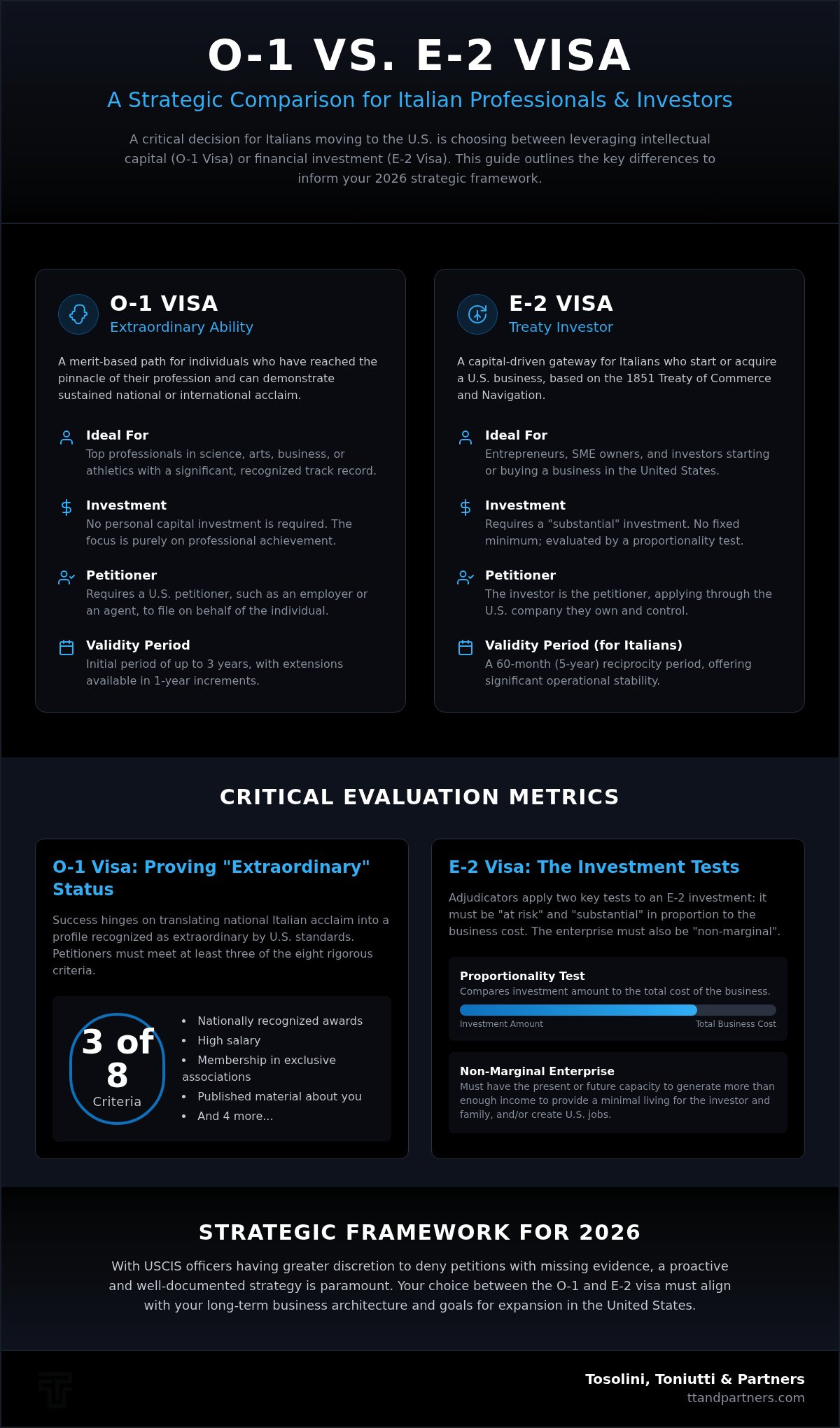
The 1851 Treaty of Commerce and Navigation provides the legal architecture for the E-2 path. While the O-1 vs E-2 visa for Italians debate often centers on talent versus money, the E-2 is specifically about the strategic deployment of capital. There's no fixed dollar minimum for this category. Instead, adjudicators at the U.S. Embassy in Rome apply a proportionality test. This calculation compares the investment against the total cost of establishing or purchasing the enterprise. For a service-based business, a smaller sum might be considered substantial, whereas a manufacturing plant or a high-end restaurant requires significantly more capital to meet the threshold.
The capital must be "at risk," meaning it's irrevocably committed to the business operations and subject to total loss. This requirement necessitates a robust 5-year business plan that proves the venture isn't marginal. A marginal business only generates enough income to support the investor and their family. To succeed in 2026, the enterprise must demonstrate the capacity to hire U.S. workers and contribute to the local economy. The investor's primary role is to "direct and develop" the entity, ensuring the original vision translates into measurable growth and operational stability.
Investment Structures for Italians
Choosing the right vehicle is a foundational step for any cross-border venture. Many Italians opt for an LLC incorporation to protect personal assets while maintaining operational flexibility. Others prefer purchasing an existing franchise, which offers a proven model and immediate cash flow. Regardless of the choice, documenting the source of funds is paramount. Italian bank transfers must be traced with surgical precision to prove the capital was legally obtained. While this section focuses on investment, those considering the merit-based alternative should review the Official O-1 Visa Criteria to understand the documentation burden involved in talent-based petitions.
E-2 Benefits for Italian Families
The E-2 path offers significant advantages for the domestic unit. Spouses of E-2 holders are eligible for work authorization, allowing them to pursue their own careers in the U.S. market. Dependent children under 21 can attend school without needing separate student visas. One of the most compelling features is the indefinite renewability of the status. As long as the business remains viable and continues to meet treaty requirements, the family can maintain their life in the United States. If you're ready to evaluate your capital's potential, you might consult with a specialist to begin your assessment.
The O-1 Visa: Recognizing Extraordinary Ability in Italians
The O-1 visa serves as a meritocratic alternative for those whose primary asset is their professional pedigree. While the E-2 path focuses on the deployment of capital, the O-1 honors individual intellectual history and sustained national or international acclaim. It's a common misconception that this category is reserved for Nobel laureates or world-renowned geniuses. In reality, it's designed for highly successful professionals who can demonstrate they are among the small percentage at the top of their field. To qualify, you must meet at least three out of eight specific criteria for the O-1A (science, business, or education) or O-1B (arts). A critical component of this petition is the consultation letter, a document from a US peer group or labor organization that validates your standing within the industry.
When evaluating the O-1 vs E-2 visa for Italians, the distinction lies in the nature of the commitment. If your strength is a proven track record rather than liquid capital, the O-1 provides a path without the specific financial thresholds found in the E-2 Treaty Investor Visa Requirements. However, 2026 adjudication standards have become increasingly rigorous. USCIS officers now exercise greater discretion, often denying petitions that lack clear, documented evidence of sustained acclaim without issuing a preliminary request for evidence. This heightened precision requires an evidentiary dossier that is both comprehensive and strategically structured.
Proving Acclaim: The Italian Context
Italian professionals possess a unique advantage due to the global prestige of Italian institutions and media. You can leverage press coverage from major publications like Corriere della Sera or Il Sole 24 Ore to establish your national standing. High salaries relative to peers in Italy and "critical or essential" roles in distinguished organizations also serve as powerful evidence. For a granular look at how to assemble these documents into a winning petition, our Pillar O-1 guide provides a comprehensive evidentiary roadmap tailored to the current legal landscape.
Sponsorship and Agency Models
The O-1 requires a US petitioner, which can be a direct employer or an agent. For Italian freelancers, consultants, or artists with multiple upcoming projects, the agent-based model is often the superior choice. It allows you to work for several different clients under a single petition, provided you submit a detailed itinerary of your planned activities. This structure offers the flexibility to build a diverse professional presence in the US market without the constraints of being tied to a single corporate entity.
Key Differences: A Comparative Framework for Italians
Understanding the O-1 vs E-2 visa for Italians requires a shift from viewing them as mere permits to seeing them as distinct business architectures. The E-2 demands a commitment of financial capital to run a commercial enterprise. In contrast, the O-1 relies on your professional track record to work within a specific field of expertise. A common misconception is that these visas provide a direct path to permanent residency. They don't. Both are non-immigrant categories, though they offer different bridging opportunities for those seeking a permanent future in the US. In 2026, the speed of your entry often depends on your budget for Premium Processing. For the O-1, an optional fee of $2,965 guarantees a decision in approximately 15 business days, whereas regular processing can extend up to 12.5 months.
Timeline and Duration Comparison
The Italian E-2 visa benefits from a 60 month reciprocity agreement, granting a five-year validity period that supports long-term business planning. The O-1 is typically granted for an initial three-year term. While E-2 holders must maintain an intent to depart the United States when their status ends, the O-1 is considered a quasi-dual intent visa because the government doesn't require you to maintain a residence abroad. Renewals for both categories are possible, but E-2 renewals in 2026 are treated as complete re-adjudications. This requires proof of realized financial growth and job creation rather than just original projections.
The Path to a Green Card
Transitioning to permanent residency involves different strategic hurdles depending on your initial entry. O-1 holders often look toward the EB-1A category, while E-2 investors might pivot to EB-5 or the EB-2 National Interest Waiver (NIW). Evaluating the cost and strategy of a Green Card is essential before committing to a specific non-immigrant path. Maintaining your current status while a residency petition is pending requires careful coordination to avoid violating the terms of your stay. Professional oversight ensures that your long-term residency goals don't conflict with your current non-immigrant obligations.
Flexibility and Mobility
Mobility is a key factor for Italian nationals who travel frequently between Rome and the US. Both visas require a stamp from the Consulate in Italy for international travel. However, the impact of professional setbacks varies significantly between the two. A business failure terminates E-2 status immediately because the underlying investment no longer supports the visa's purpose. Similarly, losing the sponsoring employer or agent ends O-1 eligibility. If you're unsure which architecture fits your 2026 goals, you should contact our legal team to discuss your specific professional assets.
Strategic Relocation: Choosing the Right Path for Your US Future
The final selection between the O-1 vs E-2 visa for Italians isn't a simple administrative choice. It's an act of architectural design for your future. You must look beyond the immediate entry and examine the structural integrity of your long-term goals. Are you leveraging a lifetime of intellectual achievements, or are you deploying capital to build a new commercial legacy? This distinction defines not just your legal status, but your daily operational reality in the United States. A successful relocation requires a multi-disciplinary approach that fuses immigration law with corporate strategy. You aren't just moving a person or a business; you're transplanting a professional ecosystem into a new market.
Decision Matrix for Italian Applicants
If you possess liquid capital exceeding €150,000 and desire total autonomy over your enterprise, the E-2 path remains the most logical focus. It provides the freedom to direct your own US business architecture from the ground up. Conversely, if your career is defined by major industry awards, significant press coverage, and a specific US job offer, the O-1 path honors that professional history without requiring a financial stake. Hybrid cases often emerge where an individual qualifies for both. In these instances, the choice depends on whether you'd rather be tied to a specific field of expertise or the financial performance of a corporate entity.
The Role of Tosolini, Toniutti & Partners
Our firm serves as a strategic architect for Italian professionals navigating these complex cross-border transitions. We don't just process applications. We build the legal and corporate framework necessary for sustained success. This involves understanding the nuances of Italian business culture and translating those values into the US legal system. Whether it's managing complex international litigation or handling your LLC incorporation, we provide the precision required for high-stakes moves. The 2026 landscape is too rigorous for a trial-and-error approach. You should contact our team for a strategic visa assessment to ensure your assets are positioned for the most secure outcome. Committing capital or resigning from a position in Italy before having a verified legal roadmap is a risk that modern professionals can't afford. Decisions made today determine the stability of your American venture for years to come.
Designing Your American Legacy in 2026
Your transition to the United States is more than a simple relocation; it's a deliberate act of professional and corporate architecture. Whether you leverage the 60 month reciprocity period of the treaty investor path or the merit-based prestige of the extraordinary ability category, your choice must align with your long-term vision. The decision between the O-1 vs E-2 visa for Italians hinges on whether your primary asset is liquid capital or a sustained history of industry acclaim. In the 2026 legal landscape, where adjudication standards demand surgical precision, a strategic framework is the only way to ensure operational stability.
Tosolini, Toniutti & Partners provides the essential bridge for Italian professionals. With specialized expertise in Italian-American treaty law and decades of experience in cross-border strategy, we offer full-service support ranging from LLC setup to complex visa processing. We invite you to Schedule a Strategic Visa Consultation with Our US-Italy Experts to begin refining your path. Your American venture deserves a foundation built on professional excellence and legal certainty. We look forward to helping you transform your vision into a thriving reality.
Frequently Asked Questions
Can an Italian citizen switch from an E-2 to an O-1 visa while in the US?
Yes, you can file a change of status petition with USCIS while remaining in the United States. This process requires you to meet all the extraordinary ability criteria and secure a US petitioner. If you depart the US after the change is approved, you'll need to obtain a new O-1 visa stamp at the US Embassy in Rome to re-enter. This transition is often used by professionals moving from business ownership to specialized roles.
Is there a minimum investment amount for Italians applying for an E-2 visa in 2026?
No official minimum investment amount exists for Italian nationals under the 1851 Treaty. However, the capital must be substantial relative to the cost of the enterprise. In 2026, a recommended benchmark for a successful E-2 application is approximately $75,000 USD. The US Embassy in Rome utilizes a proportionality test to ensure the investment is sufficient to ensure the successful operation and development of your specific US business model.
What happens to my E-2 visa if my US business fails?
If your US enterprise fails, your E-2 status terminates because the underlying investment no longer supports the visa's purpose. You would be required to depart the United States or transition to a different legal category. This highlights the importance of a robust 5-year business plan. Unlike merit-based paths, the E-2 is intrinsically tied to the continued viability and economic contribution of the commercial entity you established or purchased.
Does the O-1 visa allow my spouse to work in the United States?
No, the O-3 dependent visa for spouses does not provide work authorization. This is a critical distinction in the O-1 vs E-2 visa for Italians comparison. Spouses of E-2 holders are eligible for an Employment Authorization Document (EAD), allowing them to work for any US employer. If your family strategy relies on a dual-income household, the E-2 path provides a more flexible framework for a spouse's career development within the American market.
Can I use an E-2 visa to eventually apply for an EB-5 Green Card?
Yes, transitioning from an E-2 to an EB-5 Green Card is a viable long-term strategy. You must increase your investment to meet current EB-5 thresholds and demonstrate the creation of at least 10 full-time jobs for US workers. Many Italians utilize the E-2 visa to establish their initial operations before committing the more significant capital required for permanent residency, ensuring the business model is sustainable before filing an immigrant petition.
How long does it take for the US Consulate in Italy to process an E-2 visa?
Processing times at the US Embassy in Rome are subject to caseload fluctuations, but you should apply at least six months before your anticipated travel date. The application package must be submitted electronically to RomeEvisas@state.gov. Because E-visa adjudications involve a comprehensive review of financial records and business growth projections, the timeline is generally longer than other non-immigrant categories. In 2026, meticulous documentation is essential to avoid delays or outright denials.
Is an Italian university degree enough to qualify for an O-1 visa?
An Italian university degree is a valuable professional foundation but is not sufficient on its own to qualify for an O-1 visa. You must demonstrate sustained national or international acclaim in your field. This requires meeting at least three specific criteria, such as receiving major industry awards, having your work featured in major Italian publications like Corriere della Sera, or proving that you have performed a critical role for a distinguished organization.
Do I need to maintain a residence in Italy while on an O-1 or E-2 visa?
E-2 visa holders must demonstrate an intent to depart the US when their status terminates, which often involves maintaining professional or personal ties to Italy. The O-1 visa is considered a quasi-dual intent category, so you aren't strictly required to maintain a residence abroad. However, both remain non-immigrant visas. You must always maintain valid status and comply with the specific requirements of your category to preserve your future immigration options.


Comments