

O-1 Visa to EB-1A Green Card Pathway: A Strategic 2026 Transition Guide
- Gianni Mendes Toniutti, Esq.

- Jun 13
- 12 min read
An O-1 approval is not a final destination but a strategic laboratory where you refine the evidentiary record required for a successful self-petition. While your current status confirms your extraordinary ability, the O-1 visa to EB-1A green card pathway demands a more rigorous demonstration of sustained national or international acclaim. It's natural to feel a sense of anxiety as you face the increased scrutiny of a final merits review, especially with the 2026 shift in how USCIS views adjustment of status as discretionary relief. You've built a career on excellence, and your immigration strategy should reflect that same level of precision and foresight.
This guide provides the professional framework you need to master this high-stakes transition with confidence. You'll learn how to identify which O-1 evidence remains viable under the EB-1A standard and how to navigate the complexities of dual intent and travel restrictions. We'll outline a clear roadmap for self-petitioning that addresses the current $2,965 premium processing landscape and the strategic timing necessary to safeguard your professional future in the United States. By understanding the nuances of the 2026 regulatory environment, you can transform your temporary success into a permanent legacy.
Key Takeaways
Grasp the fundamental distinction between temporary non-immigrant status and the permanent residency offered through a strategic immigrant petition.
Identify the critical evidentiary gaps between the O-1 standard of distinction and the EB-1A requirement for sustained national or international acclaim.
Master the O-1 visa to EB-1A green card pathway by curating a recognition profile that moves beyond basic criteria into the realm of final merits excellence.
Navigate the heightened scrutiny of 2026 adjudications with a professional framework designed to prove you belong to the small percentage at the very top of your field.
See how a sophisticated gap analysis transforms your current O-1 approval into a narrative that's ready for high-scrutiny review.
Table of Contents
Understanding the Strategic Bridge: Why Transition from O-1 to EB-1A?
Evaluating the "Extraordinary Ability" Standard: O-1 vs. EB-1A Criteria
Critical Differences in Scrutiny and the Self-Petition Advantage
Bridging the Gap: 5 Strategic Steps to Strengthen Your EB-1A Filing
Navigating the Path to Permanent Residency with Tosolini, Toniutti & Partners
Understanding the Strategic Bridge: Why Transition from O-1 to EB-1A?
Securing an O-1 visa confirms that you've achieved a level of distinction that separates you from your peers. However, it remains a temporary, non-immigrant status. Transitioning to the EB-1A green card is the logical progression for those who seek to transform their temporary presence into permanent residency. The O-1 visa to EB-1A green card pathway is often considered the premier route for high-level talent because it leverages the evidentiary groundwork already established during the initial visa application. For a comprehensive overview of the initial requirements, you can review O-1 Visa Details to see how they align with your professional background.
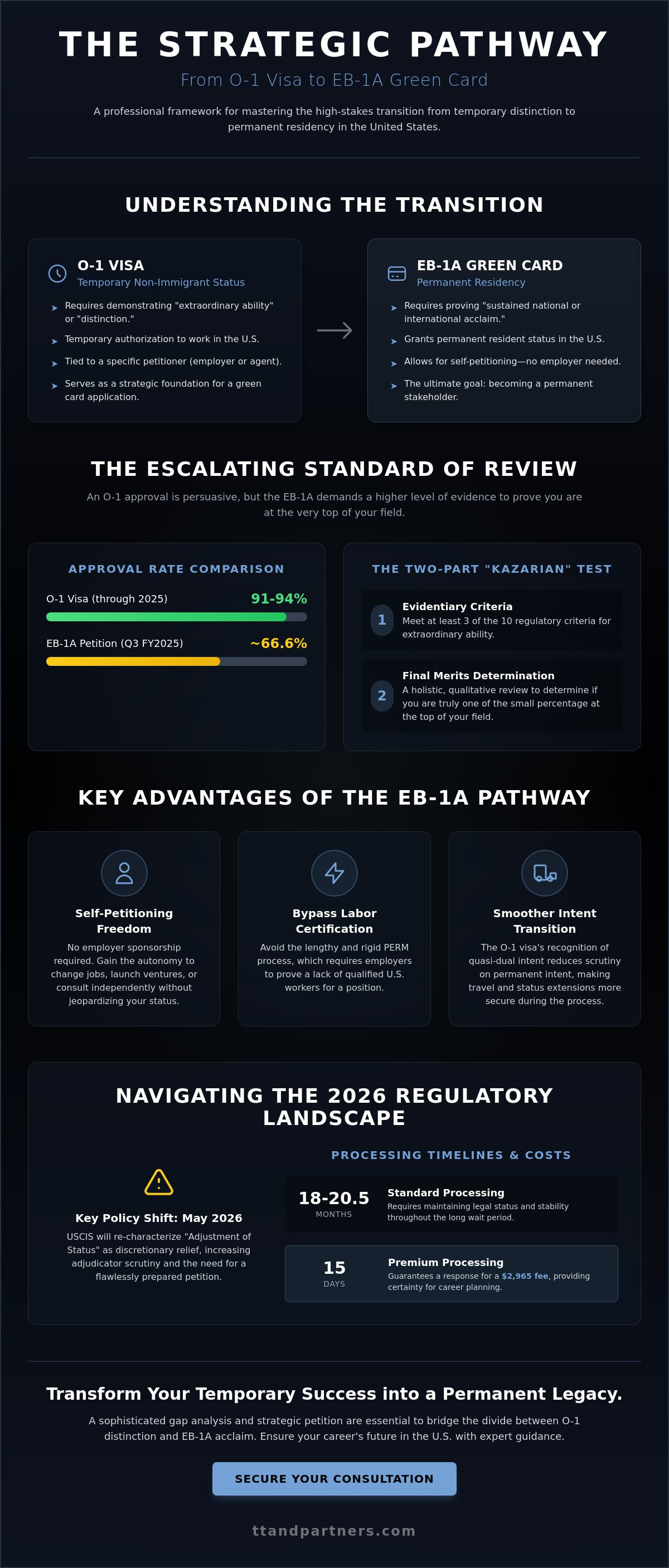
The 2026 regulatory environment has introduced new complexities, particularly with the May 2026 policy update that re-characterizes Adjustment of Status as discretionary relief. This shift makes the choice of an immigrant category vital. Unlike the O-1, which requires an employer or an agent, the EB-1A is an immigrant category that allows for self-petitioning. It removes the uncertainty of being tied to a specific petitioner and grants you the mobility to pursue your vision across the American landscape. You're no longer a guest; you're a permanent stakeholder in the nation's intellectual and economic growth.
The Freedom of the Self-Petition
One of the most significant advantages of the EB-1A is the absence of the Labor Certification (PERM) process. Traditional green card routes often require a Job Office to prove that no qualified U.S. workers are available, a process that is both time-consuming and rigid. The EB-1A bypasses this entirely. As a self-petitioner, you possess the autonomy to change employers, launch your own ventures, or operate as an independent consultant immediately after your status is granted. This flexibility is indispensable for entrepreneurs and visionary leaders who don't want their career trajectory dictated by a single corporate entity.
Immigrant Intent and the O-1 Advantage
Transitioning from an O-1 status is strategically smoother than moving from F-1 or TN visas because the O-1 recognizes a form of quasi-dual intent. While you must still maintain a residence abroad for certain O-1 categories, the scrutiny regarding your intent to stay permanently is generally less restrictive than it is for students or professionals under other categories. This makes filing an I-140 petition less likely to jeopardize your ability to travel or extend your current status. In 2026, with standard processing times for EB-1A petitions averaging 18 to 20.5 months, maintaining this legal stability is crucial. For those requiring faster results, the $2,965 premium processing fee guarantees a response within 15 days, providing the predictability necessary for long-term planning.
Evaluating the "Extraordinary Ability" Standard: O-1 vs. EB-1A Criteria
The O-1 visa to EB-1A green card pathway is not a simple administrative update. It's a fundamental shift in legal scrutiny. While your O-1 status confirms you possess extraordinary ability, the EB-1A requires you to prove "sustained national or international acclaim." This distinction is why an O-1 approval, though persuasive, is never binding for a 2026 adjudicator. The standards for permanent residency are inherently more rigorous than those for temporary work authorization, requiring a deeper narrative of your professional impact.
Adjudicators apply a two-part review known as the Kazarian standard. First, they verify if you meet at least three of the ten EB-1A Extraordinary Ability Criteria. Second, they perform a "Final Merits Determination." This is a qualitative assessment of your entire career. They ask: does this person truly sit at the very top of their field? This second step is where many petitions falter. Statistics show a clear divide; while O-1 approval rates hovered between 91% and 94% through 2025, EB-1A approvals fell to roughly 66.6% in the third quarter of fiscal year 2025.
The 10 EB-1A Criteria vs. O-1A Requirements
The criteria for the O-1A and EB-1A are similar, but the evidentiary threshold for the latter is significantly higher. For a green card, a "lesser" award that was sufficient for your O-1 might be dismissed as localized or insignificant. You must curate evidence that demonstrates global influence. High-impact evidence includes:
Judging the work of others in your field.
Original contributions of major significance.
Authorship of scholarly articles in major publications.
If your O-1 relied on "critical employment," you'll need to provide concrete data showing how your work specifically impacted the broader industry. This shift from personal distinction to industry-wide influence is essential for a successful filing.
The "Sustained" Element: Proving You Are Still at the Top
The word "sustained" is a critical gatekeeper. USCIS requires proof that your acclaim hasn't diminished since your O-1 was issued. Your petition must be anchored by recent evidence, ideally from the last 12 to 24 months. New press coverage, current original contributions, or ongoing leadership positions are vital. If you're relying solely on achievements from several years ago, you risk a denial for failing to show current excellence. If you're unsure how your current portfolio translates to these stricter standards, you can consult with our team to perform a detailed gap analysis.
Critical Differences in Scrutiny and the Self-Petition Advantage
Success in the O-1 visa to EB-1A green card pathway requires more than just recycling your previous petition. While both categories share a similar vocabulary, the "Preponderance of Evidence" standard is applied with far greater skepticism during an EB-1A review. Adjudicators aren't just looking for professional distinction; they're looking for evidence that you belong to the small percentage at the very top of your endeavor. This shift from a non-immigrant to an immigrant petition fundamentally changes the burden of proof, moving the goalposts from "extraordinary" to "globally sustained."
The self-petition advantage allows you to reclaim your narrative. You no longer depend on an employer's willingness to sponsor a PERM process or maintain a specific role. This autonomy is particularly vital when looking at the 2026 Visa Bulletin. While categories like EB-2 and EB-3 face significant delays, the EB-1A remains the relative "fast track" for global talent. Even with backlogs for India and China, which saw priority dates around August 2023 in early 2026, the EB-1A category offers a significantly more efficient route to permanent residency for those who can withstand the scrutiny.
The Final Merits Determination: The Adjudicator’s "Vibe Check"
Beyond the technical checkboxes, USCIS officers perform a qualitative "Final Merits Determination." This is essentially a holistic evaluation of your total acclaim. They look for corroborative evidence such as a high salary relative to your peers or leading roles in organizations with a distinguished reputation. It's about crafting a narrative that positions you as a national asset. Understanding the broader Green Card Application Process helps in visualizing how these individual merits contribute to the final discretionary decision.
Travel and Status Risks During the Transition
One of the most overlooked aspects of this transition is the risk to your travel flexibility. Unlike the H-1B, the O-1 is not a pure dual-intent visa. Filing an I-140 immigrant petition clearly signals your intent to remain in the United States, which can create complications at the border if you don't have a valid travel document or if an officer questions your non-immigrant status. To mitigate this uncertainty, many professionals utilize the 2026 premium processing option. For a fee of $2,965, you receive a decision within 15 calendar days, significantly reducing the window of legal ambiguity. Strategic timing ensures that your professional mobility isn't sacrificed for your permanent residency goals. If you're planning a transition and need to secure your status, you can discuss your timeline with our legal team to avoid unnecessary travel risks.
Bridging the Gap: 5 Strategic Steps to Strengthen Your EB-1A Filing
The O-1 visa to EB-1A green card pathway requires a proactive shift from passive documentation to active evidence building. You can't simply rely on the portfolio that secured your O-1 status. Instead, you must treat your current residency as a period of strategic accumulation. The goal is to move from a record of professional distinction to one of sustained international acclaim, ensuring your petition withstands the heightened scrutiny of 2026 adjudications.
Your first step is a rigorous gap analysis of your O-1 approval notice. Identify which criteria were accepted and which were met with skepticism. If your initial visa relied on "lesser" awards, your priority must be upgrading your recognition profile. Focus on securing national or international honors that carry significant weight beyond a specific niche. This transition from local excellence to global influence is the hallmark of a successful immigrant petition.
Curating Expert Letters for EB-1A
Independent letters are ten times more valuable than dependent letters from former colleagues or supervisors. An adjudicator wants to see that your work has reached individuals you've never met personally. Identify top-tier experts who have cited your research, implemented your technology, or critiqued your work in professional journals. When approaching these experts, focus on how your contributions have influenced the field at large. These letters shouldn't just praise your talent; they must provide objective testimony that addresses the Kazarian merits determination by highlighting your unique position at the top of the industry.
Demonstrating Original Contributions of Major Significance
There's a fundamental difference between performing a high-level role and changing the industry's trajectory. You must quantify your impact through concrete data, such as citation counts, revenue growth, or widespread user adoption. For those following the O-1 Visa for Entrepreneurs: A Strategic Guide to US Extraordinary Ability in 2026, this involves documenting how your business model or innovation has been implemented by others. Evidence of implementation, such as licensing agreements, patents, or significant media coverage, proves your work has moved beyond your immediate employer.
The final step is defining your proposed endeavor. You must present a clear, visionary plan that proves you'll continue to work in your area of extraordinary ability and that your work will substantially benefit the United States. This future-facing narrative transforms your petition from a historical record into a promise of national utility. If you're ready to map out your transition strategy, contact our legal team for a professional case evaluation.
Navigating the Path to Permanent Residency with Tosolini, Toniutti & Partners
Success in the O-1 visa to EB-1A green card pathway is rarely the result of a single filing. It's the culmination of a multi-year strategic plan that transforms professional distinction into a compelling narrative of sustained acclaim. At Tosolini, Toniutti & Partners, we specialize in this evolution, particularly for individuals navigating the unique cross-border complexities between Italy and the United States. Our approach is rooted in precision and a commitment to legal storytelling that matches the high-caliber work of our clients. We don't just file applications; we architect careers.
We recognize that an EB-1A petition is a high-stakes endeavor. With standard processing times currently averaging 18 to 20.5 months as of February 2026, the cost of a mistake is measured in years of lost professional growth. Our firm prioritizes meticulous RFE prevention by conducting an exhaustive review of your portfolio long before any documents reach USCIS. We structure your case to withstand the skepticism of the final merits review, ensuring every piece of evidence serves a specific purpose. This is especially vital given the May 2026 policy update that re-characterizes adjustment of status as discretionary relief, making the strength of your initial petition more critical than ever.
Strategic Legal Counsel for Extraordinary Talent
Our team provides high-level case architecture for researchers, entrepreneurs, and artists who require a sophisticated translation of their achievements. We understand the nuances of the Italian professional landscape and how to present those achievements to a U.S. adjudicator. Whether you're a founder scaling a venture in New York or a researcher with groundbreaking original contributions, we ensure your petition reflects your status as a national asset. For those still at the initial stages of their journey, our O-1 Visa: The Complete 2026 Guide to Extraordinary Ability Visas for the US provides the essential foundation for your future green card filing.
Begin Your Transition Today
Timing is your most valuable asset. We recommend beginning an early profile evaluation at least 12 to 18 months before your O-1 status expires. This window allows us to identify and bridge any evidentiary gaps, such as the need for more independent expert testimonials or higher-impact media coverage. A proactive feasibility assessment ensures that when you file, you do so from a position of strength. Every word has weight. Every document has a place. Don't leave your permanent residency to chance. Schedule a consultation with our immigration experts to define your roadmap to the United States.
Securing Your Permanent Legacy in the United States
The transition from temporary status to permanent residency is a defining moment in an elite professional's career. By moving beyond the baseline criteria of the O-1 and building a narrative of sustained global impact, you position yourself as a vital asset to the American landscape. Mastering the O-1 visa to EB-1A green card pathway requires a blend of legal precision and visionary strategy, especially as adjudicators apply more rigorous standards in 2026. It's not just about meeting checkboxes; it's about proving your place at the very top of your field.
Tosolini, Toniutti & Partners brings decades of experience to US-Italy cross-border immigration law, offering specialized expertise in extraordinary ability petitions for entrepreneurs and elite professionals. We focus on high-level case architecture that transforms your achievements into a bulletproof self-petition, minimizing risks in an increasingly discretionary regulatory environment. Your professional journey deserves a strategy that reflects the same excellence you bring to your work.
Schedule a strategic O-1 to EB-1A transition assessment to begin curating your permanent residency today. Your future as a permanent stakeholder in the United States is a goal we can achieve together through meticulous planning and expert representation.
Frequently Asked Questions
Is an O-1 approval a guarantee that my EB-1A will be approved?
No, an O-1 approval doesn't guarantee a successful green card petition. While the criteria overlap, the O-1 visa to EB-1A green card pathway requires a higher evidentiary threshold, shifting from professional distinction to sustained national or international acclaim. Adjudicators also apply the Kazarian two-part review, which wasn't a factor in your initial O-1 processing. You must prove you're among the small percentage at the very top of your field.
Can I self-petition for an EB-1A while still working for my O-1 sponsor?
Yes, you can file a self-petition for an EB-1A while maintaining your employment with your current O-1 sponsor. The EB-1A category doesn't require a job offer or employer sponsorship, granting you the autonomy to manage your own case. This independence allows you to continue your professional work while building a permanent residency strategy that isn't tied to a specific company or petitioner.
What is the "Final Merits Determination" and how does it affect my green card case?
The Final Merits Determination is a qualitative assessment where USCIS evaluates the totality of your evidence to see if you've achieved the required level of expertise. Meeting three of the ten criteria is just the first step; the adjudicator must also be convinced that your achievements are sustained and extraordinary. This subjective "vibe check" is the primary reason for denials, even when the technical criteria are met.
How many citations do I need for a successful EB-1A in 2026?
There's no fixed numerical threshold for citations in 2026. USCIS focuses on the impact and significance of your work rather than a raw count. A few high-impact citations in prestigious journals often carry more weight than hundreds of self-citations or mentions in obscure publications. You should focus on demonstrating how your original contributions have influenced the broader industry or shifted professional standards.
Can I travel outside the US while my O-1 to EB-1A transition is pending?
Traveling while your O-1 visa to EB-1A green card pathway is active involves significant risk. Since the O-1 isn't a pure dual-intent visa, re-entering the country after filing an I-140 can lead to questioning regarding your non-immigrant intent. If you must travel, you should ensure your O-1 visa stamp is valid or consider waiting until you've secured Advance Parole to avoid complications at the border.
What happens to my O-1 status if my EB-1A petition is denied?
Your O-1 status remains valid even if your EB-1A petition is denied, provided you haven't violated the terms of your non-immigrant stay. A denial of an I-140 doesn't automatically cancel your current work authorization. However, it's vital to have a backup strategy, as a denial can make it harder to renew your O-1 status in the future due to the clear signal of immigrant intent.
Does the O-1B (Arts) transition differently to EB-1A than the O-1A (Sciences)?
Yes, artists on an O-1B face a more significant evidentiary leap than those on an O-1A. The O-1B standard is "distinction," which is lower than the "extraordinary ability" required for the EB-1A. Artists must bolster their portfolios with evidence of major awards or significant commercial success to meet the stricter green card standards, whereas O-1A holders are already working under a more similar standard.
How much does the O-1 to EB-1A pathway cost in total legal and filing fees?
The cost consists of several mandatory government fees effective as of June 2026. The I-140 filing fee is $715, plus an asylum program surcharge of $300 or $600 depending on employer size. If you choose premium processing, the fee is $2,965. For the final stage, the I-485 adjustment of status fee is $1,440 for paper filing. Legal fees for professional representation are separate and vary by case complexity.


Comments