

O-1B Visa Extraordinary Achievement Criteria: 2026 Guide

Qualifying for an O-1B visa isn't about celebrity status; it's about strategic documentary architecture. Many accomplished creatives assume that critical acclaim naturally speaks for itself, only to discover that satisfying the extraordinary achievement criteria for O-1B visa petitions requires a precise, rigorous translation of their career into federal standards.
If you feel frustrated by the divide between creative recognition and rigid immigration thresholds, your hesitation is entirely justified. Disentangling mere distinction in the arts from the higher extraordinary achievement benchmark applied to motion picture and television productions creates persistent confusion, particularly when confronting the subjective scrutiny of USCIS officers during evidentiary reviews.
This guide demystifies that process. You'll learn exactly which three evidentiary criteria best match your professional record, how to structure documentation to withstand the two-part Kazarian adjudicative review, and how to secure strategic legal footing. Ahead, we examine each regulatory requirement in detail, giving you the practical framework needed to build an ironclad petition.
Table of Contents
Understanding the O-1B Visa Standards: Distinction vs. Extraordinary Achievement
The 6 Evidentiary Criteria for O-1B Extraordinary Achievement
How USCIS Evaluates O-1B Petitions: The Two-Step Adjudicative Framework
Mandatory Petition Elements: Advisory Opinions, Itineraries, and Sponsorship
Building Your O-1B Case Strategy: Next Steps with Legal Counsel
Understanding the O-1B Visa Standards: Distinction vs. Extraordinary Achievement
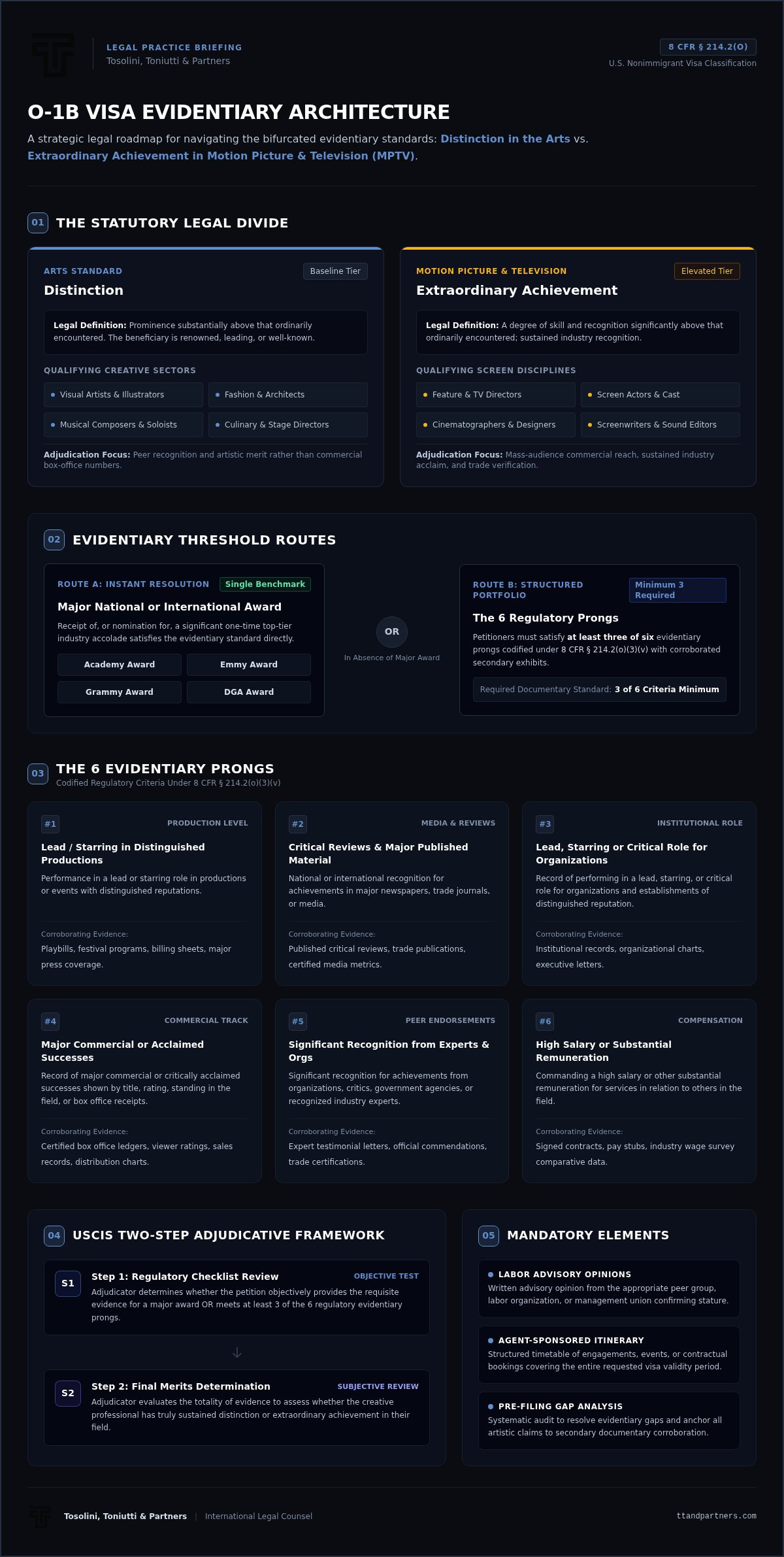
Federal immigration law treats the creative sector not as a single monolith, but as a bifurcated legal landscape. Codified under 8 CFR 214.2(o), the O-1 visa program enables foreign nationals with specialized talent to work temporarily within the United States. Many practitioners conflate the legal thresholds governing this classification, leading to flawed petition filings. The statute establishes two distinct evidentiary tests: "distinction" for arts practitioners, and "extraordinary achievement" for the motion picture and television (MPTV) sectors.
Adjudicators do not require household name recognition or international celebrity to grant an approval. Instead, the focus rests on verifiable professional prominence. USCIS determines which legal benchmark applies by reviewing the nature of the proposed services rather than the petitioner's professional title alone. Understanding this structural separation is vital when evaluating the extraordinary achievement criteria for O-1B visa filings, as mischaracterizing your operational category invites unnecessary regulatory pushback.
The Distinction Standard in the Arts Category
In the arts classification, immigration regulations define distinction as prominence substantially above that ordinarily encountered. The petitioner must prove that the beneficiary is renowned, leading, or well-known within their field. This benchmark covers a diverse array of creative disciplines:
Visual artists, fine craftspeople, and illustrators
Fashion designers, architects, and industrial stylists
Musical composers, soloists, and ensemble performers
Culinary professionals, choreographers, and stage directors
This standard focuses on artistic recognition rather than commercial box-office metrics. For broader regulatory context across visa types, explore our O-1 Visa legal counsel.
The Extraordinary Achievement Standard for Motion Picture and Television (MPTV)
In contrast, the MPTV standard imposes a heightened statutory bar. Regulations define this tier as a record of extraordinary creative attainment evidenced by a degree of skill and recognition significantly above that ordinarily encountered. It applies to all personnel working on productions intended for commercial screen distribution, including:
Feature film and episodic television directors
Screen actors, cinematographers, and production designers
Screenwriters, sound editors, and post-production specialists
USCIS maintains this heightened threshold because screen productions inherently reach mass audiences and generate significant commercial revenue. Evidentiary records for MPTV petitions must demonstrate sustained industry recognition, making precise adherence to the extraordinary achievement criteria for O-1B visa documentation essential for satisfying federal reviewers.
The 6 Evidentiary Criteria for O-1B Extraordinary Achievement
A single benchmark can resolve an entire petition instantly: receipt of, or nomination for, a significant national or international award such as an Academy Award, an Emmy, a Grammy, or a Director's Guild award. Absent such top-tier accolades, an applicant must satisfy at least three of the six regulatory prongs codified under 8 CFR 214.2(o)(3)(v). Navigating the official extraordinary achievement criteria demands clear corroborating exhibits rather than mere assertions of artistic merit.
Creative professionals often struggle to map their diverse career milestones to these six legal prongs. The key lies in anchoring every claim with independent secondary documentation, from trade publications to certified box-office ledgers. This structured evidentiary rigor forms the core of an ironclad petition.
Lead or Starring Roles in Distinguished Productions and Organizations
The first three prongs evaluate an artist's positioning within significant productions and institutions:
Criterion 1 (Lead or Starring in Distinguished Productions): Evidence that the beneficiary has performed, or will perform, as a lead or starring participant in productions or events with distinguished reputations. Proof requires billing sheets, playbills, festival programs, and third-party media showing critical prominence.
Criterion 2 (National or International Recognition): Critical reviews, major newspaper profiles, or published materials in trade journals documenting that the candidate has achieved national or sustained international acclaim.
Criterion 3 (Lead, Starring, or Critical Role for Organizations): Documentation showing a foundational role for organizations and establishments that hold a distinguished reputation, substantiated by organizational charts, press coverage of the entity, and executive testimony.
Commercial Acclaim, High Remuneration, and Peer Recognition
The remaining three prongs examine quantifiable market impact and peer assessment:
Criterion 4 (Commercial or Critical Success): A proven record of major commercial or critically acclaimed successes, established through box-office figures, broadcast ratings, album charts, distribution agreements, or international sales volume.
Criterion 5 (Significant Peer Recognition): Testimonials and official recognition from recognized industry experts, governmental cultural bodies, or respected professional organizations detailing specific artistic impacts.
Criterion 6 (High Remuneration): Proof that the applicant commands a high salary or substantially high remuneration relative to peers in the field, evidenced by executed contracts, payroll summaries, or tax documentation.
Creative directors and founders seeking to position their portfolio within the extraordinary achievement criteria for O-1B visa filings can benefit from structured portfolio mapping. If you are preparing your creative portfolio for federal scrutiny, you can consult with Tosolini, Toniutti & Partners to evaluate your evidence against these regulatory prongs.
How USCIS Evaluates O-1B Petitions: The Two-Step Adjudicative Framework
Securing an approval involves far more than checking regulatory boxes. When adjudicating petitions under the extraordinary achievement criteria for O-1B visa filings, USCIS employs a structured two-step framework derived from federal case law. In step one, the officer assesses whether the submission objectively satisfies at least three evidentiary prongs. In step two, the adjudicator shifts from quantitative accounting to a qualitative evaluation, conducting a final merits determination based on the totality of the record.
Adjudicators evaluate these materials under the preponderance of the evidence standard, meaning the petitioner must demonstrate that the claims are more likely true than not. While The 6 Evidentiary Criteria for O-1B petitions establish the statutory baseline, fulfilling three prongs alone won't guarantee an approval if the broader evidentiary portfolio lacks cohesive proof of industry standing.
Navigating the Final Merits Determination
The final merits determination is where an officer assesses whether your cumulative record genuinely reflects extraordinary creative attainment. Submitting a trade article is insufficient if you don't document the publication's national distribution and readership metrics. Similarly, an executive testimonial carries little weight without proof of that executive's standing within the field. A winning petition constructs an integrated narrative where every press clipping, contract, and testimonial reinforces a single standard of sustained excellence.
Preempting Requests for Evidence (RFEs)
In Fiscal Year 2025, 19.7% of completed O-category petitions received a Request for Evidence (RFE) from USCIS. Common triggers include:
Vague recommendation letters relying on generic praise rather than specific artistic milestones
Articles from local or unverified media outlets lacking national circulation data
Inadequate documentation establishing the distinguished reputation of an employing organization
Meeting the extraordinary achievement criteria for O-1B visa status demands proactive evidentiary architecture that addresses potential examiner doubts upfront. Thorough legal counsel ensures each exhibit directly corroborates the candidate's professional impact, preventing avoidable delays before the petition reaches an adjudicator's desk.
Mandatory Petition Elements: Advisory Opinions, Itineraries, and Sponsorship
Evidentiary criteria provide the substance, but administrative architecture provides the legal vehicle. A petition demonstrating complete alignment with the extraordinary achievement criteria for O-1B visa status won't succeed if procedural prerequisites are overlooked. Federal regulations require three structural pillars: a formal consultation from a labor union or peer organization, an authorized U.S. petitioner, and a comprehensive schedule of upcoming engagements.
Securing Required Peer Group and Labor Union Consultation Letters
For petitions evaluated under the motion picture and television standard, union consultations are mandatory. USCIS requires written advisory opinions from appropriate collective bargaining units such as SAG-AFTRA, the Directors Guild of America (DGA), or the International Alliance of Theatrical Stage Employees (IATSE). These organizations review your career portfolio to assess your industry standing and issue a favorable, neutral, or dissenting opinion.
If a specialized creative discipline lacks an established labor organization, regulations permit an advisory opinion from a recognized peer group of industry authorities. In rare circumstances where no peer organization exists, this mandate can be formally waived, provided the petitioner proves the complete absence of a governing collective body.
Structuring Agent Sponsorship and Compliant Itineraries
Creative professionals rarely work for a single employer. While traditional production companies can file petitions directly, multifaceted freelance careers often rely on agent-based sponsorship. Under 8 CFR 214.2(o)(2)(iv)(E), a U.S. agent can act as the petitioner representing multiple employers, allowing foreign talent to undertake projects across diverse productions without separate filings.
To secure the maximum three-year initial grant of stay, the filing must contain an unbroken itinerary substantiated by executed contracts, deal memos, or confirmed letters of intent. USCIS demands proof of bona fide artistic engagements rather than speculative future work. Independent expert letters accompany these contracts, certifying that each scheduled commitment demands an artist of distinguished caliber.
Structuring an itinerary that preserves creative agility while satisfying strict federal guidelines requires deliberate legal architecture. Contact Tosolini, Toniutti & Partners to design a resilient sponsorship framework tailored to your upcoming U.S. engagements.
Building Your O-1B Case Strategy: Next Steps with Legal Counsel
Bridging the gap between creative excellence and federal admissibility requires disciplined preparation. A disorganized compilation of accolades risks immediate pushback. Translating your artistic career to satisfy the extraordinary achievement criteria for O-1B visa classification starts with an objective evaluation of your record, pinpointing which regulatory prongs offer the most compelling documentary narrative.
Conducting a Comprehensive Portfolio and Gap Analysis
Before preparing formal agency petitions, prospective beneficiaries should execute a methodical gap analysis across their entire creative archive:
Audit published articles, critical reviews, and verified awards to confirm they reflect national or international standing rather than localized interest.
Obtain detailed recommendation letters from recognized authorities that articulate the concrete significance of your artistic milestones.
Corroborate compensation history with executed contracts, payroll records, or fee structures relative to others in your specific artistic discipline.
Timing plays an equally pivotal role. Standard processing for Form I-129 petitions currently averages 14 months, while optional premium processing guarantees an adjudicative response within 15 business days. Structuring your submission schedule around firm production dates protects your professional momentum.
Partnering with Experienced Immigration Counsel
Immigration officers evaluate creative careers through statutory filters, not artistic taste. Seasoned counsel acts as a legal architect, translating subtle achievements into the precise documentary standards demanded by federal regulations. Dedicated legal representation proves critical when coordinating consultations with labor organizations, structuring multifaceted agency contracts, and addressing complex adjudicative inquiries.
A properly constructed petition demonstrates compliance on day one. If you want to evaluate your creative milestones against the extraordinary achievement criteria for O-1B visa status, contact our legal team to develop a tailored immigration roadmap.
Architecting Your Path to U.S. Artistic Representation
Translating artistic prestige into federal immigration approval demands methodical preparation. Navigating the extraordinary achievement criteria for O-1B visa classification isn't simply an exercise in compiling creative accolades; it requires constructing a cohesive documentary record that withstands both initial regulatory scrutiny and the adjudicator's final merits assessment. Clear evidence, authentic union consultations, and well-structured itineraries transform an unpredictable filing into an undeniable legal narrative.
Every creative career path presents unique opportunities for evidentiary alignment. Our firm provides comprehensive counsel to help foreign talent structure robust filings that satisfy complex evidentiary thresholds. Contact our immigration team to evaluate your creative portfolio, assess your documentary standing, and build an O-1 visa petition tailored to your upcoming U.S. artistic milestones. Your creative vision deserves an equally sophisticated legal foundation.
Frequently Asked Questions
What is the difference between O-1A and O-1B visa categories?
The primary difference lies in the eligible fields of endeavor and the legal standard of proof. O-1A visas apply to individuals with extraordinary ability in sciences, education, business, or athletics, requiring evidence that the applicant has risen to the very top of the field. The O-1B classification specifically serves creative professionals in the arts, motion pictures, and television industries, evaluated under the distinct thresholds of prominence or extraordinary achievement.
Can I qualify for an O-1B visa without winning a major award like an Oscar or Grammy?
Yes, winning a major award isn't mandatory to qualify. When an applicant lacks a one-time major accolade like an Oscar, Emmy, or Grammy, USCIS regulations allow them to satisfy the extraordinary achievement criteria for O-1B visa status by documenting at least three of the six alternative evidentiary prongs. This alternative route relies on verifiable evidence such as critical reviews, starring roles, commercial successes, and peer recognition rather than major industry trophies alone.
How many criteria must I meet to satisfy O-1B evidentiary requirements?
You must satisfy a minimum of three out of the six regulatory evidentiary criteria established under federal immigration rules. Meeting three prongs serves as the threshold for step one of the USCIS review. To ensure petition approval, the totality of your evidence must also persuade the adjudicating officer during the final merits determination that your professional achievements place you significantly above the average practitioner in your artistic discipline.
What qualifies as an appropriate labor union advisory opinion for an O-1B petition?
An appropriate advisory opinion must be a formal written evaluation issued by an authorized U.S. labor organization or recognized peer group representing your specific discipline. For motion picture and television professionals, letters typically come from unions like SAG-AFTRA, the DGA, or IATSE. The document assesses your artistic accomplishments and confirms whether the proposed work matches your recognized caliber. Petitions filed without a valid consultation letter are routinely rejected.
Can an O-1B visa holder work for multiple US employers or clients simultaneously?
Yes, an O-1B visa holder can work for multiple employers if the petition is filed through an authorized U.S. agent. When an agent acts as the petitioner under 8 CFR 214.2(o)(2)(iv)(E), they can represent multiple employers or handle freelance contracts across your visa period. This arrangement requires a comprehensive itinerary with executed contracts or deal memos outlining the dates, locations, and nature of each creative engagement.
How far in advance of my planned US project should I file the O-1B petition?
You can file Form I-129 up to six months before your intended U.S. employment start date. Standard USCIS processing can take up to 14 months, making early submission crucial. Petitioners facing urgent production schedules often utilize premium processing, which guarantees an adjudicative response within 15 business days for an additional filing fee. Coordinating your preparation months ahead ensures adequate time to secure required labor union advisory letters.
What happens if USCIS issues a Request for Evidence (RFE) on my O-1B petition?
An RFE is a formal notice indicating the reviewing officer requires supplemental documentation before making a final decision. It doesn't mean your case is denied. When evaluating whether your submission meets the extraordinary achievement criteria for O-1B visa classification, USCIS may request clearer circulation metrics for publications or more detailed expert letters. In Fiscal Year 2025, 70.9% of O-visa petitions receiving an RFE were ultimately approved after submitting a comprehensive legal response.


Comments