

Opening a Company in Italy as a Foreigner: The 2026 Strategic Legal Framework
- Gianni Mendes Toniutti, Esq.

- May 9
- 13 min read
What if the perceived labyrinth of Italian bureaucracy isn't an obstacle, but a structural blueprint waiting for the right strategic architect? Opening a company in Italy as a foreigner is often viewed through a lens of apprehension, where the 24% IRES corporate tax rate and the rigid 500-permit annual self-employment quotas feel like insurmountable barriers. You're right to feel that the intersection of corporate law and immigration requires a level of precision that few generalist firms can provide; the fear of non-compliance with dual US-Italy standards often stalls visionary projects before they break ground.
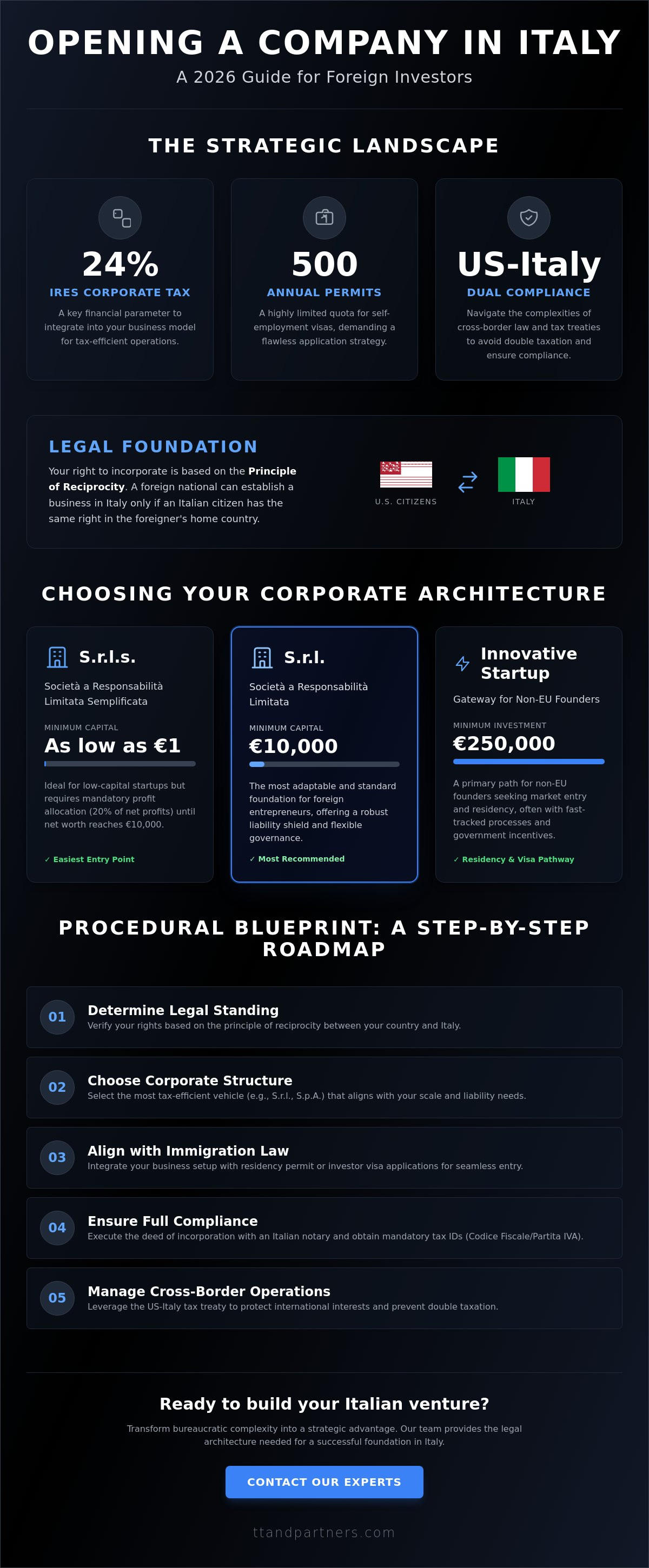
This guide provides the definitive legal architecture you need to establish a successful presence in 2026. We promise to demystify the process by treating your market entry as a high-stakes design project. You'll gain a clear roadmap for selecting the most tax-efficient structure, whether that's a standard S.r.l. with its €10,000 capital requirement or an innovative startup with a €250,000 investment threshold. We'll explore how to integrate your business setup with residency permits to ensure your foundation is as enduring as the Italian landscape it inhabits.
Key Takeaways
Determine your legal standing by understanding how the principle of reciprocity affects your right to incorporate based on your nationality.
Navigate the structural complexities of opening a company in Italy as a foreigner by choosing the most tax-efficient corporate vehicle for your specific scale.
It's essential to align your business goals with Italian immigration law to secure a seamless path toward a residency permit or an investor visa.
Implement a step-by-step procedural blueprint that ensures compliance with Italian notary requirements and mandatory tax identification protocols.
Protect your international interests by leveraging the US-Italy tax treaty to manage cross-border operations without the risk of double taxation.
Table of Contents
The Landscape of Entrepreneurship in Italy for Foreign Investors in 2026
Italy's economic environment in May 2026 presents a refined canvas for international capital. As the third-largest national economy in the European Union, the country has transitioned from a traditional manufacturing hub into a sophisticated ecosystem for digital and sustainable innovation. For those considering opening a company in Italy as a foreigner, success depends on more than just capital; it requires an understanding of the legal reciprocity that governs international relations. The current climate is defined by a push for "Made in Italy" excellence, where the government actively seeks founders who can contribute to the nation's technological and aesthetic heritage, a standard of performance also reflected in the prestigious international circles discussed at romanziemianmobility.it.
Market Opportunities and Legal Reciprocity
The principle of reciprocity is the invisible foundation of your Italian venture. It dictates that a foreign national can establish a business in Italy only if an Italian citizen enjoys the same right in the foreigner's home country. For US citizens, this bridge is firmly established through long-standing treaties. However, the complexity increases when you move from simple ownership to active management. This is where the Italian Business Register (Registro delle Imprese) acts as the official ledger of your corporate existence. Beyond the registry, the Italian Ministry of Enterprises and Made in Italy has prioritized sectors like green energy and high-end tech, offering significant incentives under the updated Startup Act. Specifically, the €250,000 investment threshold for innovative startups has become a primary gateway for non-EU founders seeking both market entry and residency. These incentives aren't just financial; they represent a fast-track through the typical administrative delays that once defined the Mediterranean business experience.
The Visionary Approach to Italian Business Expansion
Establishing a presence in 2026 requires moving beyond mere bureaucratic compliance. It's about strategic positioning within the European urban fabric. The Italian legal framework has modernized significantly, yet it retains a complexity that rewards those who treat their incorporation as an architectural project. You aren't just filling out forms. You're designing a structure that must withstand dual-taxation scrutiny and rigid immigration quotas. Opening a company in Italy as a foreigner involves navigating the fact that only 500 self-employment permits are allocated annually under the current multi-year decree. This limited supply means your application must be technically flawless. A holistic strategy ensures that your corporate structure, whether an S.r.l. or an S.p.A., aligns perfectly with your long-term residency goals. This is why a strategic partnership is vital. It transforms a foreign entity into a local stakeholder that respects the past while building for the future. If you're ready to begin this design process, you can contact our team to discuss how we can align your business goals with the Italian legal landscape.
Choosing the Right Corporate Architecture: S.r.l., S.p.A., or Branch?
Selecting the correct corporate vehicle is an exercise in structural integrity. When opening a company in Italy as a foreigner, you must decide whether to build a stand-alone subsidiary or an extension of your existing global entity. This choice dictates your liability exposure, tax efficiency, and the speed at which you can scale within the European market. Each structure offers a different load-bearing capacity for your investment, requiring a choice that balances immediate functionality with long-term vision.
The S.r.l. as the Standard for Foreign Entrepreneurs
The Società a Responsabilità Limitata (S.r.l.) remains the most adaptable foundation for international founders. With a standard minimum share capital of €10,000, it provides a robust shield for shareholders. While the simplified "S.r.l.s." allows for a symbolic capital as low as €1, it carries a mandatory requirement to allocate 20% of net profits to a legal reserve until the company's net worth reaches the €10,000 threshold. Governance can be tailored as a sole director or a board of directors, providing the flexibility needed to manage local operations from abroad. This structure effectively isolates risk, ensuring that the foreign parent or individual shareholder is protected from the subsidiary's liabilities.
Branch Offices: Expanding the US Parent Company
A Branch Office (Sede Secondaria) offers a different architectural approach. It isn't a separate legal entity; it's an extension of the parent company. This means the parent entity retains full liability for all Italian operations. Under the US-Italy tax treaty, branch income is taxed only on profits attributable to the Italian permanent establishment. However, administrative burdens are significant. The parent company must file its own financial statements with the Italian Business Register, which may expose sensitive global data to public record. If your goal is purely exploratory, a Representative Office (Ufficio di Rappresentanza) serves as a low-cost outpost for market research, though it's legally barred from generating revenue or performing commercial acts.
Comparative Framework for Structure Selection
Choosing between these options requires balancing setup costs, which typically range from €2,500 to €3,000 for a standard S.r.l., against long-term operational flexibility. Large-scale projects may require a Società per Azioni (S.p.A.), which demands a €50,000 minimum capital, with at least 25% paid upon incorporation. If you're also considering the Investor Visa for Italy program, your corporate structure must accommodate the specific investment thresholds required for residency. For those accustomed to American corporate norms, reviewing our LLC Incorporation: A Strategic Guide can provide a useful comparative lens. If you need a bespoke analysis of which structure fits your vision, feel free to contact our team for a consultation.
Navigating the Intersection of Business and Immigration Law
Opening a company in Italy as a foreigner is a project that fails if immigration and corporate law are treated as separate silos. You can't appoint yourself as a managing director without a legal status that permits you to perform that role. This intersection is where many entrepreneurs encounter friction. The first structural hurdle is the "Nulla Osta," a certificate of no impediment. It acts as the zoning permit for your personal residency, proving that your business plan meets the government's rigorous economic and legal standards before you ever set foot in a consulate.
Visa Options for Non-EU Founders
The Self-Employment Visa (Lavoro Autonomo) is the standard route for founders, yet it's constrained by the Decreto Flussi quotas. For 2026, the government has allocated only 500 permits for self-employed individuals, making it a highly competitive channel. You'll need to demonstrate an annual income from the previous fiscal year exceeding €8,500 and prove you have sufficient capital, typically around €14,000, to sustain your operations. For those seeking a more streamlined entry, the Italian Investor Visa serves as a high-speed corridor. By investing €500,000 in a limited company or €250,000 in an innovative startup, you bypass the quota system and receive a two-year permit. This option is increasingly popular for its pre-approval process, which reduces the financial risk of the application. If your strategy involves balancing US and Italian markets, our E-2 Visa Guide 2026 offers a strategic comparison of investment-based residency. For established companies, the Intra-Corporate Transferee (ICT) permit allows for the seamless relocation of managers to an Italian branch without the typical quota restrictions.
Securing Legal Residency Through Business
Securing your visa is only the first phase of the design. Upon arriving in Italy, you must apply for the Permesso di Soggiorno within eight days. This residency permit is the document that truly integrates you into the Italian urban and economic fabric. It grants you the right to work, access healthcare, and enjoy family reunification. Business owners can bring their families under a unified legal status, ensuring that the move is a holistic transition rather than a solitary venture. To maintain this permit, you must show that your business remains active and that your presence in Italy is consistent. It's a dynamic partnership between your entrepreneurial vision and the Italian state's requirements for long-term residency. This ongoing compliance ensures that your foundation remains stable as you scale your operations within the European Union.
The Procedural Blueprint: From Deed of Incorporation to VAT
Building a corporate structure in Italy requires a sequence of precise, chronological actions. Opening a company in Italy as a foreigner begins with the acquisition of a Codice Fiscale for all founders and directors. This tax identification number is the cornerstone of your legal identity, serving as the primary link between your international status and the Italian fiscal system. Once this foundation is laid, the focus shifts to drafting the Atto Costitutivo (Deed of Incorporation) and the Statuto (Bylaws). These documents act as the structural blueprint, defining the company's purpose, governance rules, and the relationship between shareholders. For a standard S.r.l., you'll need to deposit 25% of the share capital into an Italian corporate bank account before the deed is signed, a step that requires rigorous documentation to satisfy local banking compliance.
The Role of the Public Official
The Italian Notary is the master architect of the incorporation process. In the Italian civil law system, the Notary is a public official who ensures the legality of every corporate act. They perform mandatory anti-money laundering checks on all foreign investors, verifying the source of funds and the identities of the ultimate beneficial owners. You'll also need to establish a Posta Elettronica Certificata (PEC), which is a certified email address that carries the same legal weight as a registered letter. This digital mailbox, along with a digital signature, is essential for filing your deed with the Registro delle Imprese. While the total cost to incorporate a standard S.r.l. typically ranges from €2,500 to €3,000, including notary fees, the investment ensures your business is built on a legally sound foundation.
Fiscal and Labor Registration
Once the deed is registered, the company is assigned a Partita IVA (VAT number). The standard VAT rate in Italy is 22%, though reduced rates of 10%, 5%, or 4% apply to specific essential goods and services. This fiscal registration is followed by enrollment with INPS for social security and INAIL for workplace insurance, which are mandatory if your company will employ staff or if you serve as an active director. For businesses with physical locations, you must file a SCIA (Certified Notice of Start of Business) with the local municipality. This final administrative layer signals that your project is ready for occupancy and operation within the Italian market. If you're ready to execute this blueprint with precision, you can contact our team to manage your incorporation from start to finish.
Strategic Management of US-Italy Cross-Border Operations
The management phase of an Italian entity is where the initial structural design meets the friction of the global market. Opening a company in Italy as a foreigner isn't a singular event; it's a commitment to ongoing structural integrity and fiscal precision. Once your S.r.l. or S.p.A. is active, you must adhere to a strict rhythm of compliance. This includes filing annual financial statements with the Business Register and conducting shareholder meetings within 120 days of the fiscal year-end. You'll also navigate a tax landscape defined by the 24% IRES corporate tax and the 3.9% IRAP regional production tax. These figures aren't just costs. They're the maintenance requirements for your European foundation.
The US-Italy Tax Treaty provides the essential bridge for cross-border operations. It serves as a protective layer that prevents the double taxation of profits, ensuring that your Italian income is credited appropriately against your US obligations. Protecting your intellectual property is equally vital. In a market that prizes innovation and the "Made in Italy" brand, securing your trademarks and patents within the EU framework is a non-negotiable step for long-term value preservation. Without this protection, your business architecture remains vulnerable to local imitation or digital infringement.
Legal Security in a Global Environment
Disputes across jurisdictions require a specialized form of legal engineering. Managing international litigation involves understanding the enforcement of foreign judgments and the specific procedural nuances of the Italian courts. When friction arises between US parent companies and Italian subsidiaries, the presence of a bilingual legal team is indispensable. This ensures that the intent of your contracts isn't lost in translation or misinterpreted through the lens of a different civil law tradition. For a deeper analysis of managing these complexities, explore our International Litigation 2026 Guide, which outlines the strategic framework for US-Italy legal disputes.
The TT and Partners Advantage
Our approach to Italian expansion is rooted in the same precision we bring to architecture. We don't just facilitate filings; we design the strategic context for your growth. We understand that US investors require a specific type of transparency and responsiveness that bridges the gap between American speed and Italian procedural depth. By treating your market entry as a visionary project, we ensure that every element, from immigration to tax compliance, works in harmony. If you're ready to build your future in the Italian market with a partner that values intellectual content and technical accuracy, you can Contact Tosolini, Toniutti & Partners for a Consultation. We'll help you navigate the 2026 legal framework with the confidence that comes from expert craftsmanship.
Architecting Your Italian Future with Strategic Precision
Navigating the 2026 legal landscape requires more than just administrative filing; it demands a visionary approach to business architecture. You've seen how the selection of a corporate structure, such as the standard €10,000 S.r.l., must harmonize with your residency goals and the government's strict 500-permit annual quotas for self-employment. Opening a company in Italy as a foreigner is a multi-layered project where the Notary's public deed and the US-Italy Tax Treaty form the essential load-bearing walls of your expansion. Success depends on treating these legal requirements not as hurdles, but as the foundation of an enduring international presence.
At Tosolini, Toniutti & Partners, we specialize in the intricate intersection of US-Italy cross-border law. Our bilingual team, supported by our strategic presence in New York, provides the technical expertise required to manage both corporate and immigration sectors with architectural precision. Don't leave your international foundation to chance. Schedule a strategic consultation with our US-Italy legal experts to ensure your venture is built for permanence and profitability. Italy's market is ready for your unique contribution.
Frequently Asked Questions
Can a US citizen own 100% of an Italian company?
Yes, a US citizen can own 100% of the shares in an Italian entity. This right is guaranteed under the principle of reciprocity between the United States and Italy. When opening a company in Italy as a foreigner from a reciprocating nation, you can act as a sole shareholder without the need for local partners. This structure allows for total control over the corporate vision while isolating personal liability within the Italian legal system.
What is the minimum capital required to start an S.r.l. in Italy?
The standard minimum share capital for a Limited Liability Company (S.r.l.) is €10,000. At least 25% of this amount must be paid into a bank account during the incorporation process. While a simplified S.r.l. allows for capital between €1 and €9,999, it carries specific structural restrictions. You're required to allocate 20% of net profits to a legal reserve until the company's net worth reaches the standard €10,000 threshold.
Do I need to live in Italy to be the director of an Italian company?
You don't need to reside in Italy to serve as a director of an Italian company. Foreign directors can manage operations remotely, provided they possess a valid Italian tax ID (Codice Fiscale). However, if you intend to perform active, daily management on site, you'll need a valid residency permit. This distinction is critical for maintaining the structural integrity of your immigration status and ensuring compliance with local labor laws.
How long does it take to fully incorporate a company in Italy?
The full incorporation process typically spans two to four weeks. This timeline includes obtaining tax IDs, drafting the bylaws with a notary, and registering with the Chamber of Commerce. While the notarization itself is a single event, the subsequent registration with the Italian Business Register and the activation of VAT numbers require additional administrative processing. Remote formation via power of attorney is a standard practice that doesn't delay this schedule.
What is the difference between a subsidiary and a branch in Italy?
A subsidiary is a separate Italian legal entity, while a branch is a direct extension of the parent company. Subsidiaries like an S.r.l. provide a ring-fence for liability, protecting the parent firm's global assets from local risks. A branch doesn't possess separate legal personhood, meaning the parent company remains fully liable for all Italian obligations. For many, opening a company in Italy as a foreigner through a subsidiary offers superior structural security.
Can I get an Italian residency permit by starting a business?
Yes, starting a business is a recognized path to Italian residency through the Self-Employment Visa or the Investor Visa. The Investor Visa requires a €500,000 injection into an existing company or €250,000 into an innovative startup. Alternatively, the self-employment route is subject to the government's annual quotas, which allocated 500 permits for the 2025 period. These permits allow you to transition from a business founder to a legal resident with full rights.
Do I need an Italian bank account before I incorporate?
Yes, opening a corporate bank account is a mandatory step in the incorporation sequence. You must deposit the required share capital into this account before the public deed of incorporation is signed by the notary. This ensures the company has the necessary liquidity to begin its operations. In 2026, many founders use specialized legal intermediaries to facilitate this banking relationship, as anti-money laundering checks for foreign investors are increasingly rigorous.
What are the annual maintenance costs for an Italian company?
Annual maintenance involves corporate taxes and administrative fees. You'll face a flat 24% Corporate Income Tax (IRES) and a 3.9% Regional Production Tax (IRAP). Beyond taxes, you must account for annual Chamber of Commerce duties, certified email renewals, and professional fees for filing mandatory financial statements. These costs ensure your corporate structure remains compliant with the evolving Italian and European regulatory standards while preserving its standing in the Business Register.


Comments