

Permesso di Soggiorno for Self-Employment: The 2026 Strategic Guide
- Gianni Mendes Toniutti, Esq.

- Jul 1
- 12 min read
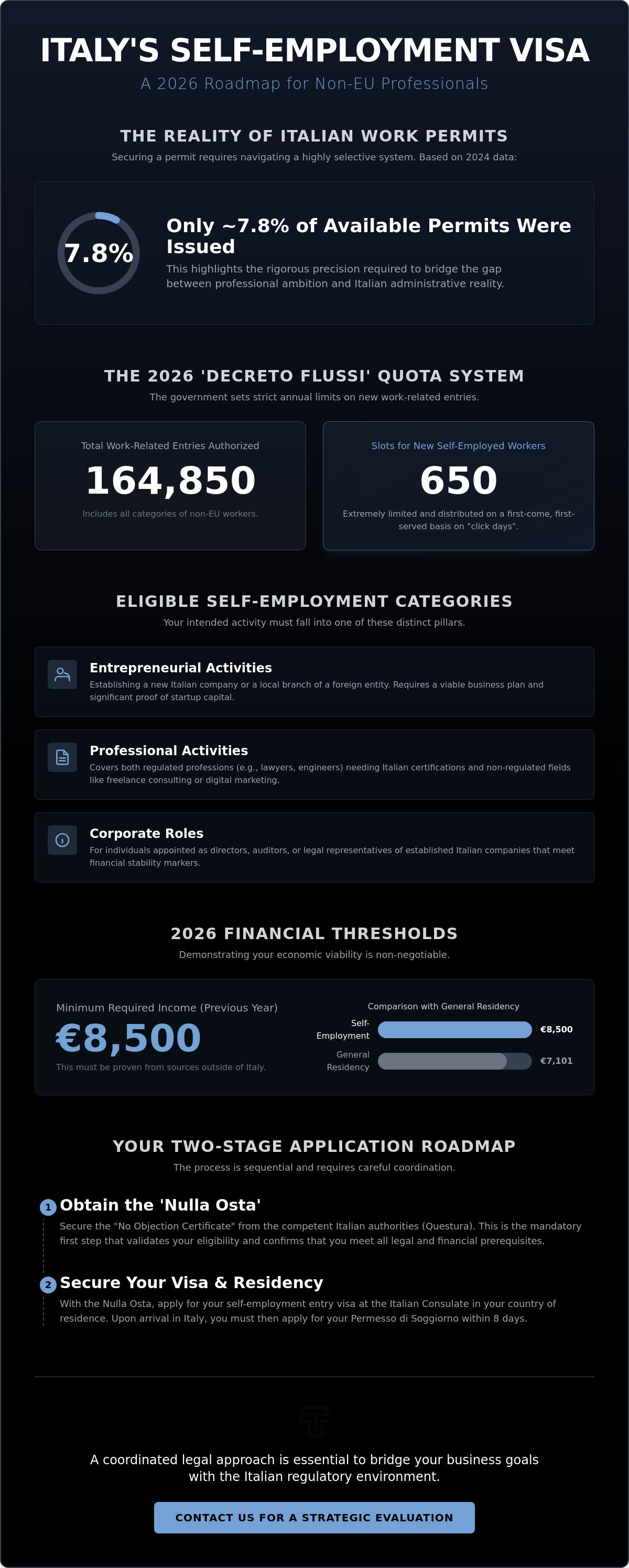
In 2024, only about 7.8% of available work permits were actually issued, a statistic that highlights the rigorous precision required to bridge the gap between professional ambition and Italian administrative reality. You likely recognize that establishing a business in Italy is an exercise in both creative vision and legal architecture, yet the opaque nature of the Decreto Flussi quota system often creates a sense of uncertainty. Securing a Permesso di Soggiorno for self-employment demands more than just a viable business plan; it requires a strategic alignment with evolving government mandates and specific financial thresholds.
We've designed this guide to transform that complexity into a clear, actionable roadmap for international entrepreneurs and professionals. You'll gain the confidence to meet the specific 2026 requirements, including the €8,500 minimum annual income for standard visas and the nuances of the 650 available slots for new entries. We will analyze the essential documentation, the mandatory Nulla Osta process, and the post-arrival formalities that ensure your successful integration into the Italian market.
Table of Contents
Understanding the Permesso di Soggiorno for Self-Employment
The Permesso di Soggiorno per Lavoro Autonomo serves as the essential legal foundation for any non-EU citizen seeking to establish a professional or entrepreneurial presence in Italy. It isn't merely a residency card; it's a validation of your economic utility within the Italian state. For those looking for a comprehensive Permesso di Soggiorno overview, it's vital to understand that this specific permit category is designed for individuals who don't have a fixed employer but instead generate value through independent activity. In the current regulatory climate, securing a Permesso di Soggiorno for self-employment represents a sophisticated legal undertaking that requires aligning your professional goals with Italy's strategic economic interests.
The Role of the Decreto Flussi
The path to a Permesso di Soggiorno for self-employment is fundamentally governed by the Decreto Flussi, a government decree that dictates the maximum number of non-EU workers allowed to enter Italy each year. For 2026, the Italian government has authorized a total of 164,850 work-related entries, yet the allocation for new self-employed individuals remains remarkably exclusive. Only 650 visas are available for new self-employed workers residing abroad in 2026. This quota includes entrepreneurs, freelancers, and startup creators. Because these spots are distributed on a first-come, first-served basis during designated "click days," timing your application with the decree's publication is critical. However, certain high-level executives and highly specialized professionals may find pathways that exist outside these rigid annual quotas, provided they meet specific criteria for corporate seniority or intellectual contribution.
Types of Self-Employment Activities Covered
Italian authorities categorize independent work into distinct pillars, each with its own administrative nuances. You must clearly identify which category your intended activity falls under to ensure a successful application:
Entrepreneurial Activities: This involves establishing a new Italian company or opening a local branch of an existing foreign entity. It requires a significant demonstration of startup capital and a viable business plan.
Professional Activities: This covers both regulated professions, such as lawyers or engineers who require specific Italian certifications, and non-regulated sectors like freelance consulting or digital marketing.
Corporate Roles: Individuals appointed as directors, auditors, or legal representatives of established Italian companies can apply under this framework, provided the company meets specific longevity and financial stability markers.
The 2026 regulations demand a more rigorous proof of economic interest than in previous years. Authorities are no longer just looking for a minimum income; they're evaluating how your presence will benefit the local economy or the technological landscape. If you're ready to begin the process of aligning your professional vision with these requirements, you can contact our team for a strategic evaluation of your eligibility.
Eligibility and Financial Thresholds for 2026
Moving beyond the conceptual framework of the quotas discussed previously, the practical acquisition of a Permesso di Soggiorno for self-employment hinges on tangible evidence of your financial and logistical stability. It's not enough to have a professional vision. The Italian state requires a rigorous demonstration of your ability to support yourself without burdening the national welfare system. This transition from intent to evidence is where many applications falter, as the requirements are both specific and non-negotiable for the 2026 fiscal year.
Demonstrating Economic Viability
For 2026, the baseline financial threshold is clearly defined. You must prove an annual income from the previous fiscal year of at least €8,500. This figure is purposefully set higher than the general residency requirement of €7,101.12, which is based on the 2026 social allowance. When reviewing the official self-employment visa requirements, entrepreneurs must also secure the "Attestazione dei parametri." This certificate, issued by the local Chamber of Commerce, confirms the specific financial resources needed to carry out your chosen activity. It's a nuanced calculation based on the typical operational costs of your specific industry within the Italian market.
Administrative Clearances and Certifications
Administrative clearances serve as the gatekeepers of the residency process. The Direzione Territoriale del Lavoro plays a pivotal role in verifying that your professional credentials align with Italian standards. If you're entering a regulated field, such as law, medicine, or engineering, you'll need additional validations from the respective Italian professional orders. The ultimate objective of this phase is the "Nulla Osta," a certificate of no impediment. This document is a mandatory authorization obtained from the Single Desk for Immigration (Sportello Unico per l’Immigrazione) and must be secured before you can apply for your entry visa.
Logistical readiness is equally vital to a successful Permesso di Soggiorno for self-employment application. You must present proof of suitable accommodation, which can be a registered lease agreement or a deed of ownership. This ensures you have a stable base for your business integration from the moment you arrive. If these administrative hurdles seem daunting, you may wish to contact our legal team to evaluate your specific financial documentation and ensure it meets these exacting 2026 standards. Precise preparation at this stage prevents the common errors that lead to visa rejections at the consular level.
The Application Roadmap: From Nulla Osta to Residency
Once you've established your eligibility and financial standing, the focus shifts to a multi-stage procedural sequence. Securing a Permesso di Soggiorno for self-employment is a journey that begins long before you touch down in Rome or Milan. It starts with the Nulla Osta from the Sportello Unico per l’Immigrazione (SUI). This document is the state's formal signal of no impediment, effectively green-lighting your entry based on the specific quotas and economic utility we analyzed in previous sections.
With the Nulla Osta in hand, you must approach the Italian Consulate in your home country to apply for the Type D National Visa. It's helpful to view the Permesso di Soggiorno as your domestic residency document, while the visa is merely your key to crossing the border. The visa application fee for this category is currently €116, and this phase requires a meticulous presentation of the same documentation used for the Nulla Osta to ensure consistency across different government branches.
The Consulate Phase: Common Hurdles
Consulate interpretations can vary significantly even within the United States. A requirement that seems standard in Boston might be scrutinized differently in San Francisco. During your interview, focus on the economic utility of your project. Don't just present documents; articulate a vision that aligns with Italian market needs. Remember that your visa is usually valid for one year, but it's only the first step. The residency permit will eventually replace this entry clearance as your primary legal standing once you are physically in Italy.
Post-Arrival Requirements in Italy
Your arrival in Italy triggers a strict 8-day countdown. You must visit a qualified post office, known as a Sportello Amico, to file the "Kit Giallo." This process involves paying a €30.00 service fee and a €30.46 electronic permit production fee. You'll receive a receipt that serves as your temporary legal status until your fingerprinting appointment at the Questura. Beyond the police headquarters, several administrative milestones await:
Integration Agreement: First-time applicants must sign the Accordo di Integrazione, committing to learn the Italian language and respect national social values.
Registry Office (Anagrafe): You'll need to register your residency at the local town hall to obtain a certificate of residency, which is essential for long-term integration.
Fiscal Setup: You must apply for a Codice Fiscale and open a Partita IVA to legally bill clients and track your professional income.
The final stage is the fotosegnalamento, or fingerprinting appointment. This can take weeks or months to schedule depending on the local province. Once processed, you'll return to the Questura to collect your electronic residency card. This card is the culmination of your strategic planning, granting you the full rights to live and work as an entrepreneur in the Italian territory.
Strategic Challenges: Conversions and Compliance
Securing your initial entry is merely the foundation of a long-term Italian residency strategy. For many professionals already residing in the country on a study or training permit, the transition to a Permesso di Soggiorno for self-employment represents a critical evolution of their legal status. This shift requires a proactive approach to compliance, ensuring that your professional activity remains aligned with the strict economic utility standards established for the 2026 fiscal year. Failure to maintain these benchmarks doesn't just complicate renewal; it creates a tangible risk of permit revocation if the business activity is deemed non-existent or insufficient.
Permit Conversion Strategies
The conversion process offers a distinct strategic advantage, particularly for international students who've completed their degrees in Italy. Unlike the competitive "click day" system for new entries, students can often access a separate quota of 650 slots allocated for the conversion of existing residence permits into self-employment status in 2026. To succeed, you must submit your request while your current permit is still valid. You'll need to demonstrate that your educational background directly supports your intended business activity, providing the same "Attestazione dei parametri" from the Chamber of Commerce required for new applicants. This internal transition bypasses many of the hurdles of the consular phase, making it the most efficient path for those already integrated into the Italian academic environment.
Renewal and Long-Term Planning
Maintaining your status requires meticulous administrative hygiene. You must file your renewal application within the 60-day window before your current permit expires. During this review, Italian authorities will scrutinize your tax compliance and social security (INPS) contributions to verify you've met the €8,500 minimum income threshold. If you're managing cross-border operations, you might find it beneficial to integrate your residency strategy with LLC incorporation to optimize your global business architecture. Consistent compliance over five years eventually paves the way for the Permesso di Soggiorno UE per soggiornanti di lungo periodo, a permit with no expiration that grants near-total parity with EU citizens.
Managing these regulatory shifts requires a vision that extends beyond the current fiscal year. If you're concerned about meeting the 2026 income thresholds or need assistance with a complex permit conversion, you should contact our immigration experts to secure your professional future in Italy.
The US-Italy Bridge: Professional Legal Support
For the American entrepreneur, the transition to an Italian professional life involves more than a physical relocation. It requires a sophisticated alignment of two distinct legal systems. Navigating the Permesso di Soggiorno for self-employment involves understanding how your existing US business structures, such as a domestic LLC, can support or complicate your Italian residency. Professional legal support ensures that your international portfolio doesn't just meet the 2026 minimum income requirements of €8,500 but does so in a way that remains tax-efficient and compliant across both jurisdictions. Without this coordination, entrepreneurs often face the "rejection risk" caused by financial proof errors or misaligned corporate documentation.
Tosolini, Toniutti & Partners specializes in this cross-border architectural approach. We don't just process paperwork; we conduct meticulous document auditing to mitigate the inherent risks of visa rejection. By simplifying the Nulla Osta process through direct coordination with the Single Immigration Desk (SUI), we provide a buffer against the inconsistencies often found at different Italian consulates. Our role is to act as the strategic bridge, ensuring your American business interests are translated accurately into the Italian regulatory language, providing you with the confidence needed to integrate into the Italian market.
Coordinated Legal Architecture
A holistic residency strategy often involves more than a single permit. You might need to align your own professional move with E-2 Visa strategies for family members or business partners who remain focused on US-based treaty investments. Managing the tax implications of dual residency is equally vital. The US-Italy Tax Treaty provides specific frameworks to avoid double taxation on your global income, but these must be triggered through correct filing and residency declarations. Should administrative challenges arise, our team provides strategic litigation support to handle complex immigration appeals or disputes with the Questura regarding permit renewals or conversions.
Next Steps for Your Italian Venture
Your journey toward a Permesso di Soggiorno for self-employment begins with a clear-eyed assessment of your current professional credentials and financial standing. We develop a customized roadmap tailored to your specific industry, whether you're a freelance consultant or an entrepreneur launching a new Italian branch. This initial audit ensures that you meet the 2026 thresholds before you commit to the lengthy application process. To begin building your professional future in Italy with a team that understands the complexities of international law, contact our experts for a personalized consultation and a strategic evaluation of your case.
Architecting Your Italian Professional Future
Securing a Permesso di Soggiorno for self-employment is a transformative step that requires a harmony of legal foresight and administrative precision. Success in 2026 rests on your ability to navigate the restricted Decreto Flussi quotas while maintaining the rigorous financial thresholds mandated by the Italian state. Whether you're initiating a new venture from abroad or converting an existing study permit, the path to residency is defined by meticulous documentation and a clear demonstration of economic utility.
Our firm brings decades of experience in US-Italy immigration law to this complex process. As a boutique legal practice with national US coverage, we specialize in cross-border business architecture that aligns your American interests with Italian requirements. We provide the technical clarity needed to move beyond bureaucracy and into the vibrant Italian marketplace. Secure your Italian residency strategy with a professional consultation to begin this journey. Italy's unique landscape of opportunity awaits those who build their foundation with precision.
Frequently Asked Questions
Can I apply for a self-employment permit if the annual quota is full?
No, you generally can't apply for a new entry once the annual Decreto Flussi quotas are exhausted. For 2026, the Italian government has limited new self-employed entries from abroad to just 650 visas. If these slots are filled during the initial application window, you must wait for the next decree's publication, although certain high-level executives may qualify for specific out-of-quota exemptions based on their corporate roles.
How much money do I need to show for an Italian self-employment visa?
You must demonstrate a minimum annual income of at least €8,500 from the previous fiscal year to meet the standard requirements. While the general residency baseline is €7,101.12, the self-employment category demands this higher threshold to ensure economic stability. You'll also need to prove the availability of adequate resources to carry out your specific business activity as certified by the local Italian Chamber of Commerce.
Is it possible to convert a study permit to a self-employment permit?
Yes, converting a study permit is one of the most effective ways to secure a Permesso di Soggiorno for self-employment. The 2026 decree allocates a specific quota of 650 slots specifically for these internal conversions. It's vital to initiate this process while your current permit is still valid, as this allows you to bypass the more competitive "click day" system used for new entries originating from abroad.
How long does the Permesso di Soggiorno for self-employment last?
An initial Permesso di Soggiorno for self-employment is typically issued for a duration of one or two years. It's renewable indefinitely as long as you continue to meet the income thresholds and professional requirements. After five years of continuous legal residency and tax compliance, you may become eligible to apply for a long-term EU residence permit, which provides permanent status without the need for frequent renewals.
Do I need an Italian company to get a self-employment permit?
No, you don't necessarily need to form a corporation to qualify for this permit. You can operate as a freelance professional or an individual entrepreneur, provided you obtain a Partita IVA and register with the appropriate professional bodies or the Chamber of Commerce. The key requirement is demonstrating that your activity has a legitimate economic interest and that you possess the necessary certifications to practice your profession in Italy.
What is the "Nulla Osta" and why is it mandatory?
The Nulla Osta is a certificate of no impediment issued by the Sportello Unico per l’Immigrazione that authorizes your entry into Italy for work. It's mandatory because it serves as the primary security and administrative clearance required by the Italian Consulate before they can issue a visa. Without this document, which verifies your position within the annual quotas, the consulate won't have the legal basis to grant your entry clearance.
Can I bring my family to Italy with a self-employment permit?
Yes, you can bring your family members through the family reunification process once your own residency is established. You'll need to demonstrate a higher annual income, such as at least €14,202.24 for a household of two, and provide proof of suitable housing that meets local health and safety standards. Each family member will receive their own permit, allowing them to reside and, in many cases, work or study in Italy.
What happens if my self-employment permit application is rejected?
You have the right to appeal a rejection before the Regional Administrative Court (TAR) within a specific timeframe, usually 60 days. Rejections often occur due to missing certifications or errors in financial documentation, so a formal appeal requires a detailed legal review of the administrative decision. Strategic litigation can often overturn rejections if it's proven that the applicant met all the statutory requirements at the time of the request.


Comments