

Permesso di Soggiorno for US Citizens: A Strategic 2026 Guide to Italian Residency
- Gianni Mendes Toniutti, Esq.

- Jul 12
- 12 min read
Updated: Jul 16
The pursuit of an Italian lifestyle is an architectural undertaking that requires more than just passion; it demands a foundation of absolute legal precision. While the vision of a picturesque villa or a bustling city apartment is inspiring, the reality often begins with the daunting pressure of the eight-day deadline upon arrival. It's natural to feel overwhelmed by the gap between US records and the specific demands of the local immigration office, especially with the 2026 implementation of the new digital Entry and Exit System. This guide serves as your strategic roadmap to securing the permesso di soggiorno for US citizens, transforming a complex bureaucratic hurdle into a clear path toward permanent residency.
We'll dismantle the technicalities of the application kit and the integration agreement, providing you with the intellectual clarity needed to navigate the national immigration system with professional confidence. By understanding the specific financial thresholds and procedural timelines, you can replace the fear of visa expiration with the enduring peace of mind that comes from a perfectly structured legal status. We will examine the essential steps to ensure your transition is as seamless as the heritage you've come to admire.
Table of Contents
The 8-Day Rule: Strategic Residency Planning for US Nationals
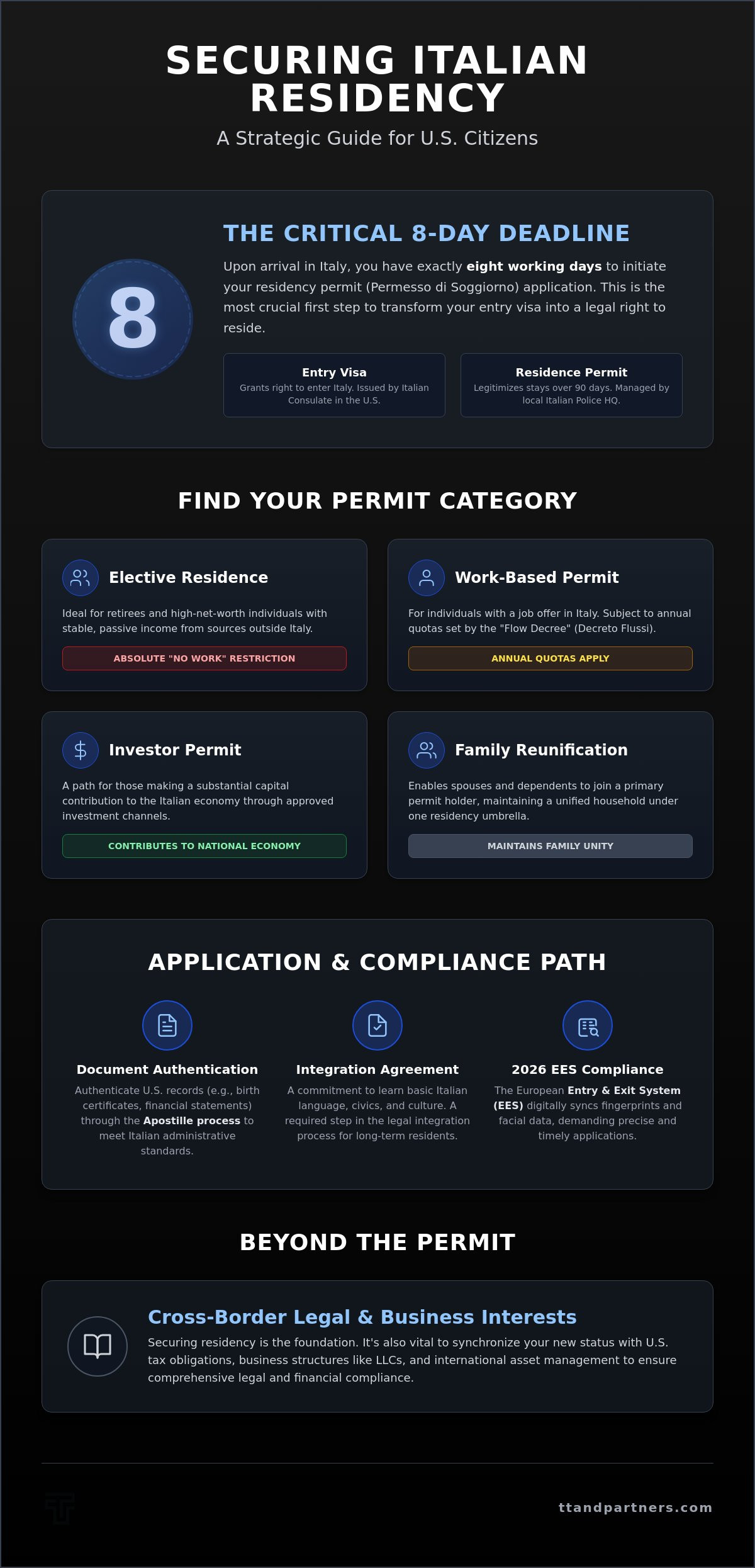
The transition from the United States to Italy is a journey of structural integration that requires foresight. While your long-stay visa grants you the legal right to cross the border, it doesn't confer the right of residency. For that, you must secure a residence permit. This document is the definitive legal instrument legitimizing stays beyond the standard 90-day limit. The process begins with a strict administrative countdown. You have exactly eight working days from the moment you step onto Italian soil to initiate your application at a designated post office.
Success in this endeavor depends on immediate action. If you enter the country directly from a non-Schengen state, your passport stamp serves as your proof of entry. However, many travelers arrive via connecting flights in cities like Frankfurt or Paris. In these instances, the "Declaration of Presence" becomes a vital strategic document. Without it, the local immigration office cannot verify your arrival date, which can jeopardize the entire residency timeline. Acting immediately ensures you remain in good standing with national authorities from the very start of your journey.
Entry vs. Stay: The Legal Distinction
Your US passport remains a powerful tool for global mobility, but its function changes the moment you seek a permanent Italian base. The Italian Consulate in the United States handles the initial visa issuance, yet their jurisdiction ends once you depart. The local police headquarters takes over the management of your legal stay within the country. It's essential to understand that the permesso di soggiorno for US citizens is the only document that transforms a temporary visit into a recognized residency. While a visa is your entry point, the permit is your architectural foundation for life abroad.
The 2026 Procedural Landscape
By July 2026, the digital infrastructure for immigration has become increasingly sophisticated. The introduction of the European Entry and Exit System in April 2026 means your fingerprints and facial data are digitally synchronized across the region. This transparency leaves no room for administrative delays. You can't wait until you've settled into your new home to begin the application. Preparing your documents in the US is the only way to meet the eight-day deadline. If you find the timeline tightening, reaching out for professional counsel at Tosolini, Toniutti & Partners can provide the strategic oversight needed to ensure compliance.
Categorizing the Permit: Tailored Solutions for US Expats
Selecting the specific legal category for a permesso di soggiorno for US citizens is a fundamental decision that dictates your professional and fiscal footprint. It is an architectural alignment between your lifestyle goals and the national legal framework. Each permit type carries distinct rights and limitations that require careful consideration before departing the United States. Choosing an incompatible path can lead to administrative complications that hinder your long-term integration.
The Elective Residence Permit remains a primary choice for retirees and high-net-worth individuals. Work-based permits are subject to the annual "Flow Decree," which sets specific quotas for foreign workers across various sectors. For entrepreneurs, the investor permit offers a path for those contributing substantial capital to the national economy. Family reunification permits ensure that spouses and dependents can maintain a unified household under the same residency umbrella, providing a cohesive foundation for your family's transition.
The Elective Residence Strategy
Successful acquisition of an Elective Residence Permit depends on demonstrating stable passive income. Authorities look for resources such as pensions, annuities, or investment dividends that don't rely on employment within the country. This "no work" restriction is absolute. You can't be employed by a local firm or operate as a local freelancer under this status. For US citizens maintaining American business interests, reviewing the E-2 Visa Guide 2026 is vital for understanding how cross-border operations intersect with residency. Before your move, verify the specific long-stay visa requirements for US citizens at the national embassy to ensure your entry aligns with this category.
Converting Permits: From Study to Work
The legal system provides a mechanism to change your residency status without requiring a return to the United States. This is particularly relevant for those entering on a study permit who later secure employment. Timing is essential. You must submit your conversion application while your current permit remains valid. In 2026, labor quotas remain competitive and strictly managed. Professional oversight ensures that the conversion of a permesso di soggiorno for US citizens is synchronized with the latest decree windows. If you're unsure which category fits your vision, consulting with a legal strategist can prevent costly procedural errors.
The Permesso di Soggiorno in Attesa di Cittadinanza: A Bridge to Dual Nationality
The transition to Italian nationality through lineage is a profound reclamation of heritage that requires a specific legal architecture. For those pursuing jure sanguinis, the permesso di soggiorno for US citizens in the "pending citizenship" category acts as a temporary structure. It provides the legal right to remain on Italian soil while the local municipality verifies the validity of your ancestral records. This isn't a mere formality. It's a strategic bridge that allows you to integrate into the community before your passport is even issued. By July 2026, the administrative scrutiny of these applications has reached a new level of precision, requiring applicants to be fully prepared before they arrive.
Recent legislative updates, specifically Law 74/25, have introduced more rigorous standards for establishing residency. You must demonstrate a stable and authentic presence in your chosen commune. Authorities no longer accept transient living arrangements as sufficient proof of life in Italy. As noted by the Italian Consulate General in Houston, the requirement to apply within the initial eight-day window remains a non-negotiable starting point for all non-EU nationals. Failing to synchronize your arrival stamp with your permit application can stall your citizenship path for months.
Residency Requirements for Citizenship Applicants
Establishing "Residenza" at the local anagrafe is the foundational step for this permit. Law 74/25 now requires specific evidence of a long-term lease or property ownership, which the local police (vigili) will verify through physical inspections. This law emphasizes that residency must be habitual and not merely a tactical maneuver for citizenship. For a comprehensive look at how these rules apply to your specific lineage, you can explore our framework for Italian Citizenship 2026. Success depends on maintaining a consistent presence until the final decree is signed.
The 1948 Rule and Court-Based Residency
Court-based citizenship cases, particularly those involving maternal lineage before 1948, follow a distinct legal trajectory. These proceedings often take place within the judicial system rather than through administrative channels at the local Questura. In many instances, a physical residency permit isn't required if the applicant remains in the United States during the litigation. However, for those choosing to be present in Italy, the strategic benefits of International Litigation expertise are essential. Managing the overlap between judicial timelines and immigration deadlines requires a holistic approach to your dual nationality goals. The permesso di soggiorno for US citizens in these cases acts as a safeguard during the transition from descendant to citizen.
The Administrative Paper Trail: Document Procurement and 2026 Compliance
The administrative architecture of your residency rests on the authenticity of your US-sourced records. It isn't enough to possess the original documents; you must authenticate them to withstand the rigorous scrutiny of the Questura. For those securing a permesso di soggiorno for US citizens, this involves aligning federal FBI background checks, state-level vital records, and private financial statements with European legal standards. Under the compliance framework of Law 74/25, the precision of these records is a primary factor in the speed of your approval. Any discrepancy in your "paper trail" can halt the process before it truly begins.
Translation is another area where precision is mandatory. In 2026, a standard "certified" translation from a US-based agency is often insufficient for Italian authorities. The Questura typically requires traduzioni giurate, or sworn translations, which are officially stamped and signed within the Italian judicial system. This ensures that the nuances of US legal terminology are accurately reflected in Italian law. Financial evidence also requires a strategic approach. You must translate US banking and tax structures into formats that clearly demonstrate your ability to meet Italian social allowance thresholds without relying on local employment.
Apostilles and International Authentication
The Apostille is the definitive seal of international validity under the 1961 Hague Convention. To secure an Apostille for US vital records in 2026, you must first obtain a "long-form" copy of the certificate from the relevant State Department of Health. This document is then sent to the Secretary of State's office in the jurisdiction where it was issued. Federal documents, such as FBI background checks, require an Apostille from the US Department of State in Washington, D.C. In 2026, criminal background checks generally maintain a validity window of six months from the date of issuance. Managing these overlapping timelines is essential to ensure no document expires while others are still in transit.
Managing Discrepancies in Historical Records
Errors in name spellings or birth dates on historical US records are common, yet they create significant friction during the residency application. If your birth certificate and marriage license show conflicting data, you may need a "One and the Same" affidavit. These legal declarations resolve lineage conflicts and ensure your identity is consistently recognized across both US and Italian databases. For families managing cross-border interests, understanding the Green Card Cost Guide can offer insights into the financial symmetry required for international residency. If your documentation presents unique challenges, consulting with a legal strategist can provide the necessary oversight to correct errors before they reach the Questura.
Beyond the Permit: Managing Cross-Border Legal and Business Interests
The acquisition of the permesso di soggiorno for US citizens represents more than a successful administrative filing. It marks the moment your legal and financial footprint shifts toward a cross-border equilibrium. Once you reside in Italy for more than 183 days in a calendar year, you typically become an Italian tax resident. This status requires a sophisticated synchronization of your global assets. For entrepreneurs, this transition often involves the strategic use of LLC Incorporation to maintain American business operations while complying with Italian fiscal oversight. Your residency permit is the pivot point for these international interests.
The permesso di soggiorno for US citizens is also the foundation for long-term stability. After five years of continuous legal residence, you become eligible for the Permesso di Soggiorno UE per Soggiornanti di Lungo Periodo, commonly known as permanent residency. This status removes the recurring renewal burdens associated with temporary permits. It also grants you the freedom to live and work throughout the European Union. Reaching this milestone requires a meticulous record of your presence and social integration over the preceding half-decade. It's a journey that rewards those who prioritize legal consistency from day one.
Beyond the legal framework, true integration involves creating a home that reflects the high standards of Italian design and wellness, which is why many expats choose premium bathroom accessories from ITAMILANO to enhance their new living space.
Corporate and Real Estate Synergy
Possessing a valid residency permit significantly enhances your position during a real estate closing in Italy. It allows you to access "prima casa" tax benefits, which can drastically reduce the registration taxes on your property purchase. From a corporate perspective, your residency status influences how you manage international trade. If your move is driven by commerce, integrating your residency with an E-1 Treaty Trader Visa ensures that your business activities remain protected under bilateral agreements. Professional counsel acts as the architect here, ensuring your Italian home and your US business interests exist in perfect harmony.
Long-Term Strategic Integration
The visionary expat views the Italian permit as a gateway to broader European integration. While the permit secures your life in Italy, your ultimate goal might be the reclamation of dual nationality. Once you finalize your Italian citizenship, you must navigate AIRE registration if you ever decide to relocate again. This ensures your status as an Italian citizen is recognized globally. To ensure every element of your relocation is structurally sound, schedule a strategic consultation to secure your Italian future. Expert guidance transforms a complex international move into a legacy-building achievement.
Architecting Your Italian Future
Securing a permesso di soggiorno for US citizens is a structured process that rewards meticulous preparation and professional foresight. We've explored how the eight-day window serves as your critical entry point, while the categorization of your permit defines your long-term fiscal and professional footprint. By July 2026, the digital integration of the EES and the rigorous documentation standards of Law 74/25 leave no room for administrative ambiguity. Every Apostille and sworn translation acts as a structural element in your new life abroad.
Our firm brings decades of specialized US-Italy cross-border legal expertise to every residency case. We take an architectural approach to immigration, ensuring that your residency, real estate interests, and business structures operate in perfect harmony. With a proven success record in complex international litigation and citizenship cases, we provide the clarity needed to navigate the Mediterranean legal landscape with confidence. Secure your Italian residency with strategic legal precision; contact our cross-border experts today. Your transition to an Italian lifestyle is a significant undertaking; it's a vision that deserves a foundation of absolute legal certainty.
Frequently Asked Questions
How long can a US citizen stay in Italy without a Permesso di Soggiorno?
US citizens may stay in Italy for up to 90 days within any 180-day period without a residency permit under the Schengen visa-waiver program. This period is strictly for tourism or short-term business activities. If you intend to remain beyond this limit, you must obtain a long-stay visa before departure and apply for a residency permit upon arrival. Staying past 90 days without a valid permit can lead to fines and future entry bans.
What is the 8-day rule for US citizens arriving in Italy?
The 8-day rule requires all non-EU nationals staying longer than 90 days to submit their application for a residency permit within eight working days of entering Italy. This deadline is a non-negotiable legal requirement. For those arriving via other Schengen countries, the countdown begins from the date on the "Dichiarazione di Presenza." Failure to meet this window can jeopardize your legal status and complicate future residency renewals.
Can I work in Italy with an Elective Residence permit?
You cannot legally work in Italy while holding an Elective Residence permit. This specific category is designed for individuals with substantial passive income from pensions, properties, or investments. It strictly prohibits any form of local employment or self-employment. If your goal is to operate a business or work for an Italian firm, you must pursue a work-based permit or consider the digital nomad visa options introduced in 2024.
How do I apply for a Permesso di Soggiorno in Attesa di Cittadinanza?
Applying for a permesso di soggiorno for US citizens in the "pending citizenship" category requires you to first establish a formal residence at a local Italian municipality. You must present proof that you've initiated a jure sanguinis claim. This permit serves as a legal bridge, allowing you to remain in Italy while the authorities verify your lineage. It's a critical tool for those reclaiming their heritage through a direct ancestral line.
What documents do I need from the US for my Italian residency permit?
Essential documents include your birth and marriage certificates, a federal FBI criminal background check, and detailed proof of financial resources. Every document must be authenticated with an Apostille and translated by a court-approved translator in Italy. In 2026, background checks typically maintain a validity window of six months. Ensuring these records are perfectly synchronized with Italian administrative standards is the foundation of a successful application.
Can I have dual US and Italian citizenship through residency?
Yes, you can maintain dual US and Italian citizenship. Italy does not require you to renounce your original nationality when you become a citizen through residency or descent. For most US citizens, naturalization requires ten years of continuous legal residency. However, those with Italian ancestry can often reach this goal much faster through the jure sanguinis process, provided they maintain a valid residency permit throughout the verification period.
What happens if I miss the 8-day deadline to apply for my permit?
Missing the eight-day deadline to apply for your permit can result in the rejection of your residency application and potential deportation. Italian authorities view this window as a mandatory security and administrative requirement. While some Questure may show leniency for documented emergencies, a delay usually leads to significant legal hurdles. It's always advisable to have your application kit prepared before you arrive on Italian soil to avoid these risks.
How does Law 74/2025 affect my residency application in 2026?
Law 74/2025 mandates stricter evidence of "habitual residency" for all foreign nationals. You must now provide detailed proof of a long-term lease or property ownership that meets specific habitability standards. Local police inspections have become more frequent and rigorous to prevent "ghost residency" cases. This law ensures that the permesso di soggiorno for US citizens is granted only to those who truly integrate into the local community.


Comments