

Proving Italian Ancestry for Citizenship: The 2026 Strategic Guide
- Gianni Mendes Toniutti, Esq.

- Jun 6
- 13 min read
What if the ancestral link you've spent years researching no longer meets the legal threshold for a European passport? With the enactment of Law No. 74 of 2025, the path to proving Italian ancestry for citizenship has shifted from a broad historical search to a rigorous exercise in direct legal continuity. You likely feel the pressure of these new generational limits and the fear that a single administrative discrepancy in a small commune could jeopardize your entire lineage. It's a valid concern in an era where the Italian government has prioritized closer, more immediate ties over distant heritage.
This strategic guide offers the professional clarity you need to master these complex document standards and secure your recognition. You'll gain a clear roadmap through the latest 2026 regulations, from navigating the centralized Ministry of Foreign Affairs system to resolving the infamous minor issue. We'll examine the specific evidentiary requirements that transform a family story into a legally binding right to an Italian passport. By the end of this analysis, you'll possess the intellectual framework to navigate the transition from historical curiosity to documented legal reality.
Key Takeaways
Analyze the implications of Law No. 74 of 2025 to determine how recent legal reforms impact the generational transmission of your Italian heritage.
Learn the technical requirements for proving Italian ancestry for citizenship, focusing on the critical timing of naturalization and the preservation of legal continuity.
Identify the precise document portfolio needed to bridge the gap between historical commune records and modern administrative standards.
Evaluate the strategic importance of the 1948 Rule and the minor issue controversy in overcoming historical gender and age based disqualifications.
Discover how a structured legal approach facilitates the integration of your Italian passport with long term global mobility and residency objectives.
Table of Contents
Understanding Jure Sanguinis and the 2025 Legal Reform
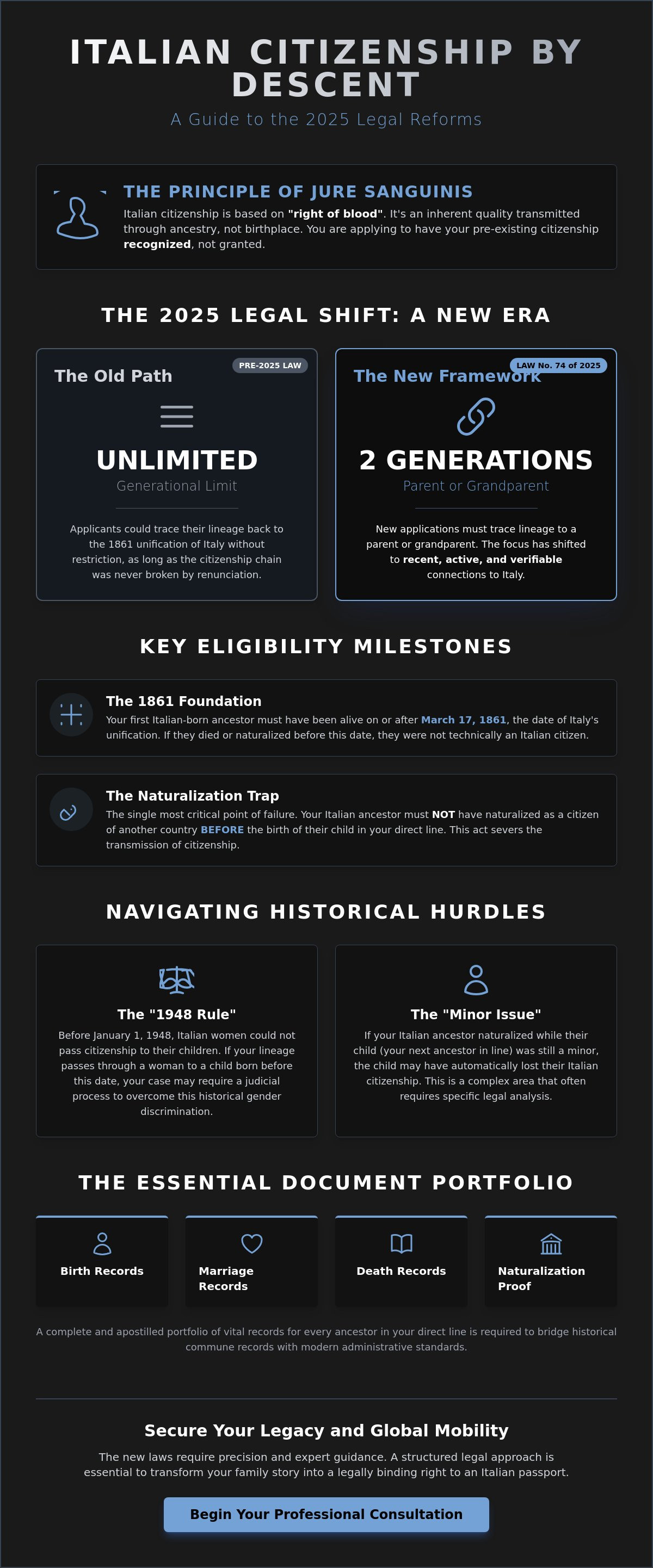
The legal architecture of Italian identity rests upon a singular, powerful concept: citizenship is an inherent quality of the person, transmitted through the bloodline rather than the soil of one's birth. This principle, known as jure sanguinis, operates on the legal fiction that a person is born Italian regardless of geography. However, the methodology for proving Italian ancestry for citizenship underwent a transformative shift on May 24, 2025. With the implementation of Law No. 74 of 2025, the Italian state moved away from an unlimited historical search toward a model that prioritizes recent and active connections to the Republic.
Understanding this shift requires a sharp distinction between the recognition of an existing right and the process of naturalization. When you apply through descent, you aren't asking the Italian state to grant you a new status. Instead, you're providing evidence that you've been a citizen since birth, even if that status remained dormant. The 2025 reforms haven't changed this underlying philosophy, but they've significantly narrowed the window of eligibility for those whose ancestors emigrated many generations ago. The new legal landscape demands a focus on continuity and closer familial proximity.
The Core Principle: Law No. 91 of 1992
Until the recent amendments, Italian nationality law was governed primarily by the foundational Law No. 91 of 1992. This statute established that the bloodline remains unbroken as long as no ancestor in the chain explicitly renounced their Italian citizenship before the birth of the next generation. Under these rules, applicants could trace their lineage back to the unification of Italy in 1861 without generational limits. While this framework still applies to applications submitted before the March 27, 2025 deadline, the new landscape requires a more direct ancestral link.
New Requirements Under Article 3-bis
The introduction of Article 3-bis via Law No. 74 of 2025 represents the most significant structural change in decades. For new applications, the previously unlimited line of descent is now generally restricted to two generations. Proving Italian ancestry for citizenship now requires showing that a parent or grandparent held exclusively Italian citizenship at the time of the applicant's birth or death. Alternatively, eligibility may be established if a parent resided in Italy for at least two consecutive years after acquiring citizenship but before the applicant's birth.
This reform signals a clear intent to favor "active" links. Consulates now possess greater discretion to scrutinize the "genuine link" an applicant maintains with Italy. In practice, this means documentation must go beyond mere birth certificates. It must reflect a continuous legal presence or a direct, verifiable connection to an Italian citizen parent or grandparent. The era of tracing back to a great-great-grandfather who left Italy in the late 19th century has effectively ended for new applicants.
Determining Your Eligibility: The Continuity of the Bloodline
The path to proving Italian ancestry for citizenship starts with a single, non-negotiable date: March 17, 1861. This is the day the Kingdom of Italy was unified. If your ancestor passed away before this date or emigrated and never returned to claim their new status, they weren't technically an Italian citizen. While historical research often looks back centuries, the legal reality for a 2026 applicant is centered on proving that the chain remained intact through the generations. The continuity of this bloodline is a legal thread that must never have been intentionally cut.
The "Naturalization Trap" remains the most common point of failure in heritage claims. It's a simple but unforgiving rule. If your ancestor became a citizen of another country before the birth of their child, they effectively severed the transmission of Italian rights. As the Italian Consulate General guidance emphasizes, you must provide definitive proof of the naturalization date to validate your claim. This requirement ensures that the "right of blood" was actively held at the moment of the next generation's birth. Identifying these potential breaks requires a meticulous audit of census records and court oaths.
The Naturalization Timeline
For decades, Law No. 555 of 1912 dictated the terms of Italian identity. Under this statute, an Italian citizen who naturalized abroad automatically lost their original citizenship. This makes the date of the foreign oath the most critical data point in your portfolio. If your ancestor never naturalized, they remained an "alien" in their new country. In these cases, we look for "Alien Registration" files or A-Files to prove they never renounced their Italian status. This "non-naturalization" path is often the strongest foundation for proving Italian ancestry for citizenship when records from the early 20th century are scarce.
The 1992 Turning Point
A major shift occurred on August 15, 1992, when Law No. 91 took effect. This legislation finally allowed Italians to acquire a second citizenship without losing their original one. If your parent or grandparent naturalized after this specific date, it doesn't affect your eligibility. The law recognized the modern reality of global mobility and the desire to maintain multiple identities. For many families, this date represents the moment when the forced choice between two homelands ended. Determining these dates with precision is the cornerstone of a successful filing. If your lineage involves complex naturalization timelines, consulting with a legal strategist can ensure your evidence meets the current 2026 standards.
The Essential Document Portfolio: Proving the Ancestral Chain
Constructing a document portfolio for an Italian citizenship claim is an exercise in archival precision. It requires more than a simple collection of names; it demands a curated sequence of legal evidence that demonstrates an uninterrupted transmission of rights. Each document serves as a structural component in your narrative of identity. For those proving Italian ancestry for citizenship in 2026, the evidentiary standards have become increasingly rigorous. Every vital record must be sourced, legalized, and translated to satisfy the high expectations of the Ministry of Foreign Affairs.
The foundation of any successful application is the Italian birth certificate, specifically the Estratto dell’Atto di Nascita. This document must be requested directly from the Ufficio dello Stato Civile in your ancestor's commune of birth. Beyond this, you must secure birth, marriage, and death certificates for every individual in the chain. As noted by Forbes on Italian Citizenship for Americans, the administrative burden is significant, but a well organized portfolio is the only way to navigate the 36 month administrative review period effectively. If an ancestor never naturalized, a "Certificate of Non-Existence" from USCIS or a "Letter of No Record" from the National Archives becomes the most valuable asset in your file.
Sourcing Records from Italy
Contacting a small Italian commune requires patience and professional etiquette. When requesting records, it's essential to ask for the long form or multilingual versions. These formats provide the detailed marginal notations necessary to prove that your ancestor didn't renounce their citizenship. Discrepancies in names are a common challenge. If "Giuseppe" became "Joe" upon arrival in the United States, you may need to secure "One and the Same" certificates or court orders to reconcile these variations. For those facing complex record gaps in remote municipalities, seeking specialized legal assistance can help bridge the distance between modern requirements and historical archives.
The Apostille and Translation Process
All documents issued outside of Italy must undergo a specific legalization process known as the Apostille. This international certification, established by the Hague Convention, validates the signature of the issuing official for use in Italy. Once a document is apostilled, it must be translated by a recognized professional. Consulates frequently reject applications due to poor translation quality or the use of automated tools. To avoid these setbacks, ensure your translations are certified and reflect the precise legal terminology required by Italian authorities. This meticulous approach ensures that your portfolio isn't just a collection of papers, but a legally sound representation of your heritage.
Navigating the 1948 Rule and the Minor Issue Controversy
While most applicants focus on consular appointments, a significant portion of the community must engage with the Italian judicial system to secure their rights. This necessity arises from historical gender discrimination and modern legal debates regarding minor children. For those proving Italian ancestry for citizenship through a maternal line where the child was born before January 1, 1948, the administrative path is closed. These 1948 cases are based on the premise that the 1912 law unconstitutionally prevented women from passing citizenship to their children. Since the Italian Constitution only took effect in 1948, the courts must retroactively correct this imbalance through a judicial decree.
The strategic advantage of this path is increasingly clear in 2026. While consulates may have waitlists spanning several years, the Italian courts typically reach a decision within 6 to 18 months. This makes the judicial route a premium alternative for families who value efficiency and professional certainty. It's a process handled entirely by an Italian attorney; they represent you in court while you remain in your home country. Your case is argued in the regional court corresponding to your ancestor’s commune, offering a direct resolution that bypasses the administrative bottleneck of the centralized Ministry system.
Judicial vs. Administrative Paths
Choosing between a consulate and a court case depends on the specific break in your lineage. The 1948 rule was found unconstitutional because it violated the principle of equality between men and women. Unlike the administrative process, which is a rigid review of records, the judicial path allows for a nuanced legal argument. Your attorney manages the filing of the €600 per-petitioner court fee and navigates the procedural requirements. This method has a high success rate in Italian courts, as judges consistently uphold the right of blood regardless of gender.
The 2025 Perspective on Minor Naturalization
The "Minor Issue" has emerged as a complex legal hurdle following recent 2024 and 2025 rulings by the Court of Cassation. This controversy centers on whether an Italian child automatically lost their citizenship when their parent naturalized in a foreign country. While historical practice suggested the child's right remained intact, new interpretations have created conflicting precedents. "Minor Issue" cases currently require expert litigation support to navigate these shifting court perspectives and ensure your lineage remains valid. If you suspect your ancestor naturalized while their children were still minors, contacting a legal specialist is the most effective way to evaluate your judicial options.
Securing Your Legacy: Professional Legal Representation
The process of proving Italian ancestry for citizenship is fundamentally a legal endeavor, not a genealogical hobby. While many applicants begin their journey by exploring family trees, the transition to a recognized dual citizen requires a sophisticated understanding of international law and administrative procedure. A law firm offers a level of protection that a standard citizenship assistance agency cannot match. Agencies often lack the authority to represent clients in the Italian judicial system, leaving families vulnerable when complex issues like the 1948 rule or minor naturalization arise. Professional legal counsel ensures that your application is viewed through the lens of a broader cross-border strategy, protecting your interests in both the United States and Italy.
Expert review acts as a critical safeguard against the 36 month administrative review period established by recent reforms. A preliminary legal audit identifies discrepancies in historical records before they reach a consulate officer; this prevents years of wasted effort on an ineligible line. This concierge approach extends to document procurement and legalization, ensuring every apostille and translation meets the exacting standards of the Ministry of Foreign Affairs. By addressing potential conflicts early, you transform a precarious claim into a documented legal certainty. The goal is to present a portfolio that is beyond reproach, minimizing the risk of rejection in an increasingly strict regulatory environment.
The Value of Expert Review
A professional audit goes beyond checking dates. It involves a deep analysis of the legal continuity of your bloodline. This includes verifying that no ancestor renounced their rights before the next generation was born. For those proving Italian ancestry for citizenship in 2026, the centralized Ministry of Foreign Affairs system in Rome demands a level of precision that was not required in previous years. Discrepancies in names or dates that were once overlooked are now grounds for significant delays. A legal team ensures that these variations are reconciled through proper judicial or administrative channels before the final submission.
Beyond the Passport
Acquiring a passport is often just the first step in a larger global vision. Dual citizenship serves as a catalyst for mobility and business expansion. It can be integrated into broader immigration goals, such as E-2 Visa or Green Card planning. For the modern entrepreneur, an Italian passport facilitates LLC incorporation and European market entry with reduced regulatory friction. However, this new status also necessitates an understanding of cross-border tax implications to ensure your global assets remain optimized. The final step of this journey is registration in the AIRE system, which formalizes your residence abroad and secures your right to passport issuance. To begin your journey with professional precision, contact Tosolini, Toniutti & Partners for a strategic citizenship consultation.
Architecting Your Legacy: The Path to Italian Recognition
The evolution of Italian nationality law through the 2025 reforms has transformed the landscape of dual citizenship. Success now depends on demonstrating a precise legal continuity that respects new generational boundaries and rigorous document standards. Whether your path involves navigating the administrative complexities of a centralized Ministry or pursuing a judicial correction through a 1948 case, the integrity of your evidence is the deciding factor in proving Italian ancestry for citizenship. It's a journey that requires a balance of historical respect and modern legal precision.
Securing this legacy requires more than archival research; it demands a comprehensive legal strategy that bridges the gap between US and Italian jurisdictions. Tosolini, Toniutti & Partners provides specialized US-Italy cross-border legal expertise to guide you from initial document sourcing to final passport issuance. Our team is uniquely positioned to handle complex 1948 and Minor Issue litigation, ensuring your rights are defended in the Italian courts. By integrating your heritage with your global professional and personal goals, you create a foundation for lasting mobility and opportunity.
While the legal process focuses on documentation, many find that embracing Italian culture through its world-renowned cuisine is a meaningful way to celebrate their newfound status; you can learn more about Amore Mio to explore how traditional flavors are preserved as part of this heritage.
Schedule a Strategic Consultation for Italian Citizenship to begin your transformation into a global citizen. Your ancestral past is the key to a visionary future.
Frequently Asked Questions
How far back can I go to prove Italian ancestry for citizenship?
The foundational date for all claims is March 17, 1861, the day the Kingdom of Italy was unified. However, Law No. 74 of 2025 has introduced significant restrictions for applications submitted after March 2025. For these new filings, you generally cannot go back further than two generations, meaning you must have a parent or grandparent who held Italian citizenship at the time of your birth or their death.
What happens if my Italian ancestor naturalized as a US citizen?
The timing of naturalization determines whether the bloodline remained intact or was legally severed. If your ancestor became a US citizen before the birth of the next person in your lineage, the transmission of citizenship was interrupted. If they naturalized after the birth of the next generation, the chain is typically preserved, though specific rules apply to naturalizations that occurred before the 1912 Law or after the 1992 turning point.
Do I need to speak Italian to apply for citizenship by descent?
No language proficiency is required for those proving Italian ancestry for citizenship through the jure sanguinis path. Unlike citizenship through marriage or residency, which requires a B1 level language certificate, descent claims are based on the recognition of a right you've held since birth. Your ability to speak the language doesn't influence the legal validity of your ancestral claim.
How long does the entire process of proving ancestry take in 2026?
The timeline depends on whether you pursue an administrative or judicial path. Under the 2026 centralized system, administrative reviews at the Ministry of Foreign Affairs can take up to 36 months. In contrast, judicial cases filed in the Italian regional courts typically reach a resolution within 6 to 18 months. These timelines don't include the initial period required for document procurement and legalization.
Can I apply for Italian citizenship if my ancestor was a woman?
Yes, but the procedure depends on when her child was born. If the child was born on or after January 1, 1948, you can apply through a standard administrative process at a Consulate. If the child was born before 1948, you must file a judicial case in the Italian courts to challenge the historical gender discrimination that prevented women from passing citizenship to their children.
What is the "Minor Issue" and will it disqualify my application?
The "Minor Issue" involves a legal debate over whether a child automatically lost their Italian citizenship when their parent naturalized in a foreign country. While this was once a rare hurdle, recent 2024 and 2025 Supreme Court rulings have made it a central focus for those proving Italian ancestry for citizenship. These cases currently require specialized litigation support to navigate conflicting court precedents and successfully argue for the child's independent right to citizenship.
Are there any tax obligations if I obtain Italian dual citizenship?
Italian citizenship alone doesn't trigger tax obligations on your global income. Italy's tax system is primarily based on residency, not citizenship. Unless you reside in Italy for more than 183 days in a calendar year or center your economic interests there, you aren't considered a tax resident. It's always advisable to consult with a cross-border tax professional to understand how your specific assets might be affected by EU status.
What is an Apostille and why is it required for my documents?
An Apostille is an international certification that legalizes a public document for use in another country under the Hague Convention. It validates the signature and seal of the official who issued your birth, marriage, or death certificate. Every non-Italian document in your portfolio must have an Apostille to be accepted by the Italian authorities, as it provides the necessary legal bridge between different national administrative systems.


Comments