

Reacquiring Italian Citizenship After Renunciation: The 2026 Strategic Guide
- Gianni Mendes Toniutti, Esq.

- Jul 29
- 11 min read
Most former citizens believe that a formal renunciation represents a permanent severance from their Italian heritage, yet the current legal landscape offers a sophisticated "reset" button that many didn't think possible. If you're considering reacquiring Italian citizenship after renunciation, you're likely facing the anxiety of rigid residency requirements and the pressure of the 2025-2027 temporary legislative window. It's understandable to feel overwhelmed by the technical distinction between an involuntary loss of status and a formal act of surrender; the path back often feels obscured by bureaucratic density.
This guide serves as a strategic map to help you traverse these complex legal corridors with professional precision. You'll learn how to utilize the Law 74/2025 window, which remains open until December 31, 2027, to restore your nationality through a simplified declaration process. We'll explore the fastest legal pathways to your passport and how to maintain your dual status without compromising your international tax position. By the end, you'll understand the specific residency obligations and the structural framework needed to reclaim your place within the Italian state.
Table of Contents
The Legal Evolution of Italian Citizenship Loss and Renunciation
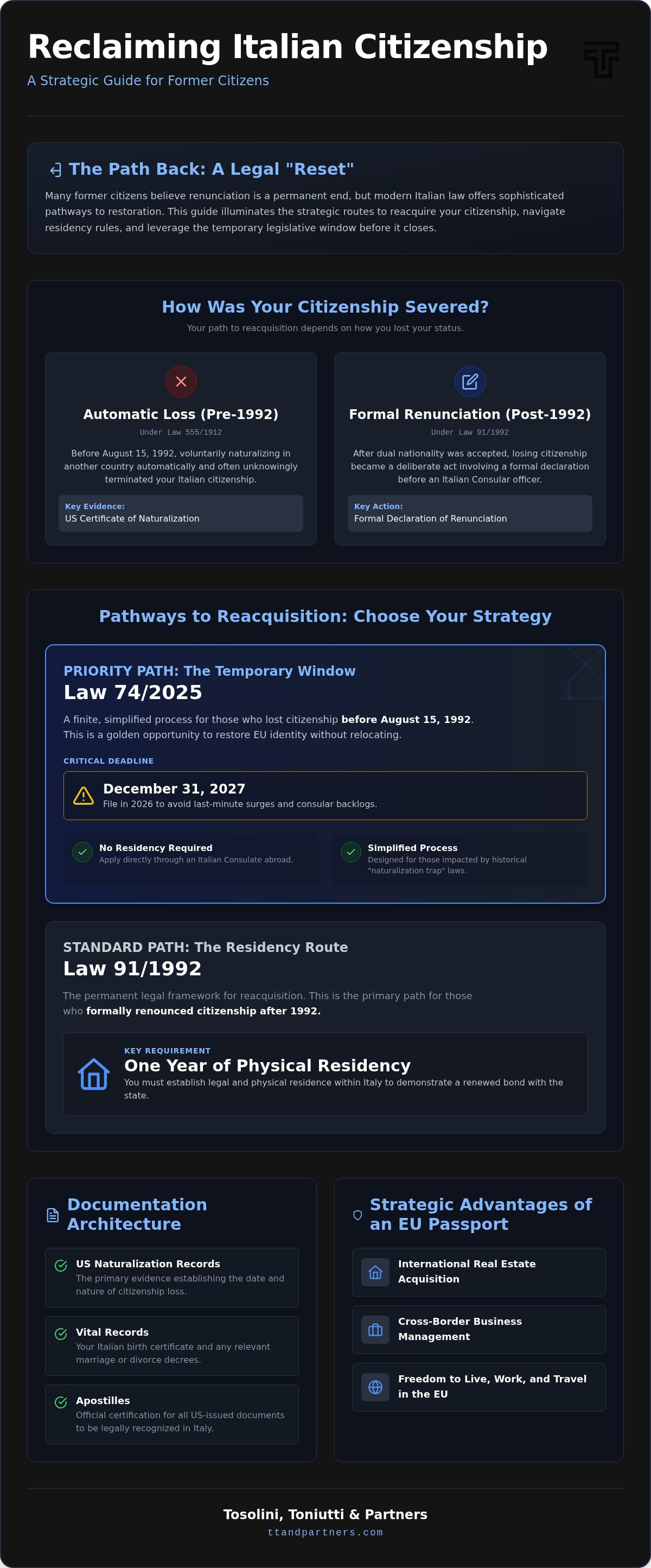
The legal architecture of Italian nationality law has undergone a profound transformation over the last century, moving from a rigid, singular identity to a more fluid, globalized framework. For decades, the foundational Law 555 of 1912 dictated a strict philosophy where any Italian citizen who voluntarily naturalized in another country, such as the United States, automatically forfeited their Italian status. This legislative era effectively ended on August 15, 1992, with the implementation of Law 91 of 1992. This modern statute finally embraced the concept of dual nationality. Understanding this timeline is the first step toward reacquiring Italian citizenship after renunciation, as the legal remedies available to you depend entirely on how and when your status was lost.
It's vital to recognize that reacquisition is a distinct legal pathway compared to citizenship by descent. While claims based on ancestry focus on proving that citizenship was passed down uninterrupted through generations, reacquisition involves a deliberate restoration of a status that was once held but subsequently severed. One process proves you never lost your rights; the other acknowledges the loss and seeks a formal path back to the Italian community.
Automatic Loss Due to Naturalization
Before the 1992 reform, acquiring a foreign passport wasn't just a personal milestone; it was a legal trigger for the involuntary loss of Italian nationality. The Italian state viewed the oath of allegiance to a foreign power as a definitive break from the motherland. Many former citizens are surprised to learn that they technically lost their citizenship decades ago without ever signing a single document of surrender. In these cases, the Certificate of Naturalization acts as the primary forensic evidence. It establishes the exact date the loss occurred and determines whether you fall under the older, more restrictive statutes or the modern reacquisition protocols.
Voluntary Renunciation Post-1992
In the modern era, losing citizenship is rarely an accident. Voluntary renunciation typically involves a formal declaration made before an Italian Consular officer. This is often driven by professional requirements, such as seeking high-level security clearances or government positions in the United States that prohibit dual allegiance. While Law 91 of 1992 made it easier to keep both passports, it also established a high bar for those who choose to walk away. Reacquiring Italian citizenship after renunciation requires a conscious, strategic effort to rebuild that legal bridge. This usually involves specific residency commitments or taking advantage of temporary legislative windows that demonstrate a renewed bond with the Italian state.
The Law 74/2025 Temporary Window: A 2026 Priority
Law No. 74 of May 23, 2025, represents a significant shift in how the Italian state perceives its global diaspora. It offers a finite, simplified pathway for individuals who lost their status under previous, more restrictive regimes. For those considering reacquiring Italian citizenship after renunciation, this temporary window is a strategic priority that demands immediate attention. The window opened on July 1, 2025, and is scheduled to close on December 31, 2027. This timeline makes 2026 the critical year for filing. Waiting until 2027 risks being caught in a surge of last-minute applications that could exceed consular capacity. Unlike the permanent mechanisms found in Law 91/1992, which often require establishing residency in Italy, Law 74/2025 allows eligible former citizens to reclaim their nationality directly through an Italian Consulate abroad.
Eligibility for the Simplified Process
This simplified procedure is specifically tailored for individuals born in Italy who lost their citizenship before August 15, 1992. It effectively addresses the historical "naturalization trap" where acquiring a US passport triggered an involuntary loss of Italian status. It's a precise legal remedy for those who didn't choose to leave their heritage but were forced to by the laws of the time. However, this specific window generally excludes those who formally and voluntarily renounced their citizenship *after* 1992. For retirees and established professionals in the United States, this law is a golden opportunity to restore an EU identity without the logistical burden of relocating their lives or businesses to the Italian peninsula.
The Application Timeline and Consular Role
Your application must be submitted to the Italian Consulate with jurisdiction over your legal residence. For the period of July 1 to September 30, 2026, the consular fee for the declaration of reacquisition is set at $291.30, though this is subject to quarterly updates. Processing times at major US consulates in 2026 remain substantial, with some locations experiencing backlogs that extend several years. Meticulous document preparation is the only way to ensure your file is accepted before the 2027 cutoff. A single missing apostille or an uncertified translation can delay your declaration past the expiration date. If you're unsure about the nuances of your documentation architecture, you may wish to consult with a legal strategist to verify your eligibility and secure your place in the queue.
Standard Pathways to Reacquisition Under Law 91/1992
While the temporary window of Law 74/2025 offers a specialized reprieve, the permanent structural foundation for restoring status lies within Law 91 of 1992. These standard pathways are essential for individuals who don't qualify for the simplified consular window or who miss the 2027 deadline. One significant advantage of these routes is the absence of a B1 language certificate requirement. Unlike the rigorous linguistic standards mandated for citizenship by marriage, reacquisition focuses on the restoration of a prior legal bond rather than the integration of a new citizen. This makes the process accessible to those who may have lost their fluency but retain a deep cultural and legal connection to Italy.
The Official Procedures for Reacquiring Italian Citizenship outline two primary residency-based routes under Article 13. Understanding these options is vital for anyone reacquiring Italian citizenship after renunciation:
Path A (Article 13, par. 1, letter c): Reacquisition through a formal statement of intent followed by the establishment of legal residency in Italy within one year.
Path B (Article 13, par. 1, letter d): Automatic reacquisition after one year of legal residency, provided the individual doesn't explicitly renounce the restoration during that period.
Path C (Article 13, par. 1, letters a and b): Reacquisition through military service or public employment under the Italian state, though these are rarely utilized by US-based residents.
The Residency Requirement: Legal vs. Physical Presence
Establishing residency is more than a logistical hurdle; it's a legal commitment to an Italian Municipality. You must register at the local Civil Registry Office and successfully navigate the official verification check. This is a police verification process that typically occurs within 45 days of your application. The verification officer must confirm you're physically living at the declared address. For high-net-worth individuals managing US business interests, this requires a balanced strategy. You must maintain "good standing" with local authorities while ensuring your international operations continue without interruption. It's not about a permanent move in every case, but it does require a genuine center of life within the territory for that critical year.
The Declaration of Intent
If you choose the proactive route under letter c, you'll sign a declaration at your local Italian Consulate. This act starts a 12-month clock. You must establish legal residency in Italy within exactly one year of that signature. Failing to meet this deadline renders the declaration void, requiring you to restart the process from the beginning. This pathway is often preferred because it offers a clear, documented intent that simplifies the eventual transition back to an Italian passport. It's a structured approach that aligns well with long-term legacy planning for those reacquiring Italian citizenship after renunciation.
Documentation Architecture for a Successful Filing
Success in reacquiring Italian citizenship after renunciation hinges on the structural integrity of your document portfolio. You must first secure the US Certificate of Naturalization or the specific records of your formal renunciation. These aren't just papers; they're the legal proof of when and how your status shifted. Once obtained, you'll need Certified True Copies. Standard photocopies won't suffice for the rigorous standards of the Italian Ministry of the Interior. Coordinating with the Italian Municipality for the Civil Status registration is the final, most delicate step. This involves ensuring the local authorities recognize your previous records before they can process your reacquisition declaration. Without this foundational alignment, even the most compelling application will fail to pass administrative scrutiny.
The Critical Role of the Apostille
Standard notarization is insufficient because it only verifies the identity of the signer, not the legitimacy of the document itself. For state-level records like birth or marriage certificates, you must obtain an Apostille from the Secretary of State where the event occurred. Federal documents, such as naturalization records, require an Apostille from the US Department of State in Washington, D.C. This distinction is critical; sending a federal document to a state office results in immediate delays. The Apostille is the single most common point of failure, serving as the primary reason authorities reject application files during the initial review.
Vital Records and Registry Synchronization
Your documentation must reflect a seamless narrative of your life events. This includes ensuring all marriages and births are registered in Italy through proper registration in the Registry of Italians Residing Abroad for any family members involved. Minor discrepancies in name spellings, such as a transition from a traditional Italian name to an anglicized version on US records without a legal name change decree, can stall your process for months. Every document requires professional translation into Italian by certified or sworn translators to meet the linguistic precision required by the Municipality's Civil Status Office. This synchronization ensures that your family's legal status remains consistent across both jurisdictions, preventing future complications with inheritance or property rights. Errors in these records are difficult to correct once the filing window begins to close.
If you require a strategic audit of your current records to ensure they meet the 2026 standards, contact our legal team for a professional consultation.
Strategic Integration: Citizenship, Business, and Legacy
Reclaiming your nationality is a transformative act that extends far beyond personal identity; it's a calculated enhancement of your global professional portfolio. For the modern entrepreneur, reacquiring Italian citizenship after renunciation provides a dual-jurisdiction foundation that supports sophisticated LLC Incorporations in the United States while securing an unfettered foothold in the European Union. An Italian passport acts as a key to the continent, simplifying cross-border real estate acquisitions by removing the administrative friction often faced by non-EU investors. For families with a vision for international expansion, this restoration serves as a strategic cornerstone for an E-2 Visa strategy. It allows your family members to leverage treaty investor status, facilitating the creation of US-based enterprises with a level of flexibility that single-nationality applicants rarely enjoy.
Professional legal oversight is indispensable for high-net-worth families managing complex, multi-jurisdictional assets. The process of reacquiring Italian citizenship after renunciation requires a holistic view that considers how your new status interacts with existing trust structures and corporate holdings. Without a coordinated plan, the transition can trigger unintended administrative hurdles that complicate your long-term legacy goals. Professional architects of citizenship ensure that every legal move strengthens your family's global position rather than creating new liabilities.
Cross-Border Tax and Estate Considerations
Many individuals hesitate due to the "World-Wide Taxation" myth, fearing that an Italian passport brings an immediate fiscal burden. In reality, the existing US-Italy tax treaty provides a sophisticated framework designed to prevent double taxation and protect your assets. Restoring your status actually simplifies the transition of wealth across borders. It streamlines inheritance and property transfers within Italy, ensuring your legacy is preserved without the prohibitive costs and delays of international probate. Specialized counsel is essential to manage the nuances of fiscal residency, ensuring your global income remains protected while you enjoy the mobility and security of dual status.
The Tosolini, Toniutti & Partners Advantage
Our firm approaches these matters with a philosophy of restrained elegance and professional precision. We don't just process paperwork; we act as strategic architects for families reclaiming their heritage and expanding their global reach. We bridge the gap between the rigid expectations of US legal standards and the intricate, often opaque, requirements of Italian bureaucracy. Our dual-jurisdiction expertise allows us to provide a vision that is both professional and inspiring, ensuring your transition is seamless and secure. We invite you to consult with our US-Italy legal experts to restore your citizenship and secure your family's international future.
Reclaiming Your Heritage as a Strategic Asset
The temporary window provided by Law 74/2025 offers a rare, time-sensitive opportunity to restore your status through a simplified consular declaration. This path, alongside the permanent residency-based options under Law 91/1992, ensures that reacquiring Italian citizenship after renunciation is a tangible reality for those who act with precision. Success requires more than just intent; it demands a meticulously constructed documentation architecture where every Apostille and vital record serves as a cornerstone for your legal standing.
Navigating these cross-border complexities requires a partner who understands the dual-jurisdiction landscape of both US and Italian law. With over 20 years of experience in Italian immigration and cross-border litigation, our legal team provides the specialized oversight necessary to bridge these bureaucratic divides. We invite you to Schedule a Strategic Consultation with Our Citizenship Attorneys to begin the process of restoring your nationality. Reclaiming your place within the Italian community is not just a return to the past; it's a visionary investment in your family's global future.
Frequently Asked Questions
How long does it take to reacquire Italian citizenship in 2026?
Processing times depend significantly on the legal pathway you select and your geographical jurisdiction. If you pursue reacquisition through residency, the statutory requirement is one year of physical presence in Italy. Conversely, declarations filed under the Law 74/2025 consular window are subject to significant backlogs; some US consulates currently report wait times ranging from three to over nine years for finalization.
Do I lose my US citizenship if I reacquire my Italian passport?
No, you won't lose your US citizenship by restoring your Italian nationality. Both Italy and the United States permit dual nationality, which allows you to maintain your American passport while holding an EU travel document. This dual status provides a versatile legal framework for international travel and cross-border business operations without compromising your original allegiance.
Can my children automatically become Italian citizens if I reacquire mine?
Minor children who are living with you at the exact moment you reacquire your citizenship automatically become Italian citizens. If your children have already reached the age of 18, the process is no longer automatic. Adult children must pursue their own independent legal claims, although your restored status often simplifies their future residency applications or ancestry-based filings.
What is the difference between Law 91/1992 and the new Law 74/2025?
Law 91/1992 is the permanent statutory framework that generally requires a year of residency in Italy for the restoration of status. Law 74/2025 is a temporary legislative window open only until December 31, 2027. This newer measure allows eligible individuals who lost their status before 1992 to apply directly through a consulate, removing the need for a physical move to Italy.
Is there a language test required for reacquiring Italian citizenship?
No language test is required when you're reacquiring Italian citizenship after renunciation. While other pathways, such as citizenship by marriage, mandate a B1 level of linguistic proficiency, reacquisition is legally viewed as the restoration of a prior bond. This makes the process accessible for former citizens who may have lost their native fluency over decades spent abroad.
Can I reacquire citizenship if I renounced it for tax reasons?
Yes, your original motivation for renouncing citizenship doesn't legally disqualify you from reacquiring it. Whether the choice was driven by tax considerations, professional security clearances, or personal reasons, the legal pathways for restoration remain available. You must simply meet the standard eligibility criteria for reacquiring Italian citizenship after renunciation through either residency or the temporary consular window.
What happens if I cannot fulfill the one-year residency requirement in Italy?
If you cannot fulfill the residency requirement, you must verify if you qualify for the Law 74/2025 simplified consular process. If you're ineligible for that window, establishing a legal and physical center of life in an Italian municipality for 12 months is mandatory. Failing to stay in good standing with local authorities during the verification period will result in the rejection of your application.
Does the FBI background check expire during the reacquisition process?
Yes, FBI background checks and other vital records have finite validity periods, typically expiring six months after issuance. It's essential to synchronize the procurement of these documents with your scheduled appointment or filing date. Expired documents are a primary cause of administrative delays, often requiring applicants to restart the costly collection and apostille process from the beginning.


Comments