

Real Estate Lawyer for Italians in New York: A 2026 Strategic Guide to US Property
- Gianni Mendes Toniutti, Esq.

- May 8
- 12 min read
Could the distance between a Milanese notary's office and an American closing table be measured in more than just miles? For the sophisticated investor, the 44% surge in international U.S. property acquisitions during 2025 highlights a clear reality: success depends on structural integrity, not just location. Engaging a specialized real estate lawyer for italians in New York is the first step in translating Italian capital into a secure American asset. We understand that you view a property as a legacy, yet the fear of a 15% FIRPTA withholding or the complexity of evolving tax regulations, such as those on high-value residences, can feel like a significant barrier to entry.
You deserve a transaction that mirrors the precision of a well-executed architectural plan. This guide promises to provide a cross-border legal framework that protects your interests, minimizes tax liabilities through the 1999 U.S.-Italy treaty, and ensures a seamless closing from abroad. We'll examine the critical role of title companies versus notaries and provide the strategic data you need to navigate diverse market conditions and valuations with absolute confidence. It's time to bridge the gap between two distinct legal systems with professional clarity.
Key Takeaways
Master the 5-step U.S. closing framework to ensure your investment is protected by rigorous pre-contract due diligence and a robust Purchase and Sale Agreement.
Understand the fundamental differences between a New York closing attorney and an Italian "Notaio" to navigate the contractual freedom of the American common law system.
Identify strategies to avoid the 15% FIRPTA withholding trap and manage the new 2026 NYC "pied-à-terre" tax through optimized ownership structures.
Partnering with a specialized real estate lawyer for italians in New York ensures the multilingual precision required to bridge the gap between Italian civil law and U.S. property regulations.
Leverage the U.S.-Italy tax treaty to minimize fiscal liability and secure a seamless closing process while managing your international portfolio from abroad.
Table of Contents
Navigating US Real Estate as an Italian National in 2026
The 2026 New York real estate market operates with the complexity of a high-performance building. With active listings down 9% compared to last year and median prices reaching $867,500, the stakes for international buyers have never been higher. For Italian nationals, the U.S. market represents more than a transaction; it's a strategic pillar of asset diversification. You shouldn't navigate this landscape with a fragmented legal perspective. A dedicated real estate lawyer for italians in New York provides the cross-border vision necessary to align Italian financial goals with American property realities. Tosolini, Toniutti & Partners serves as this essential link, applying a precision-oriented mindset to every closing.
The Italian Investment Landscape in the US
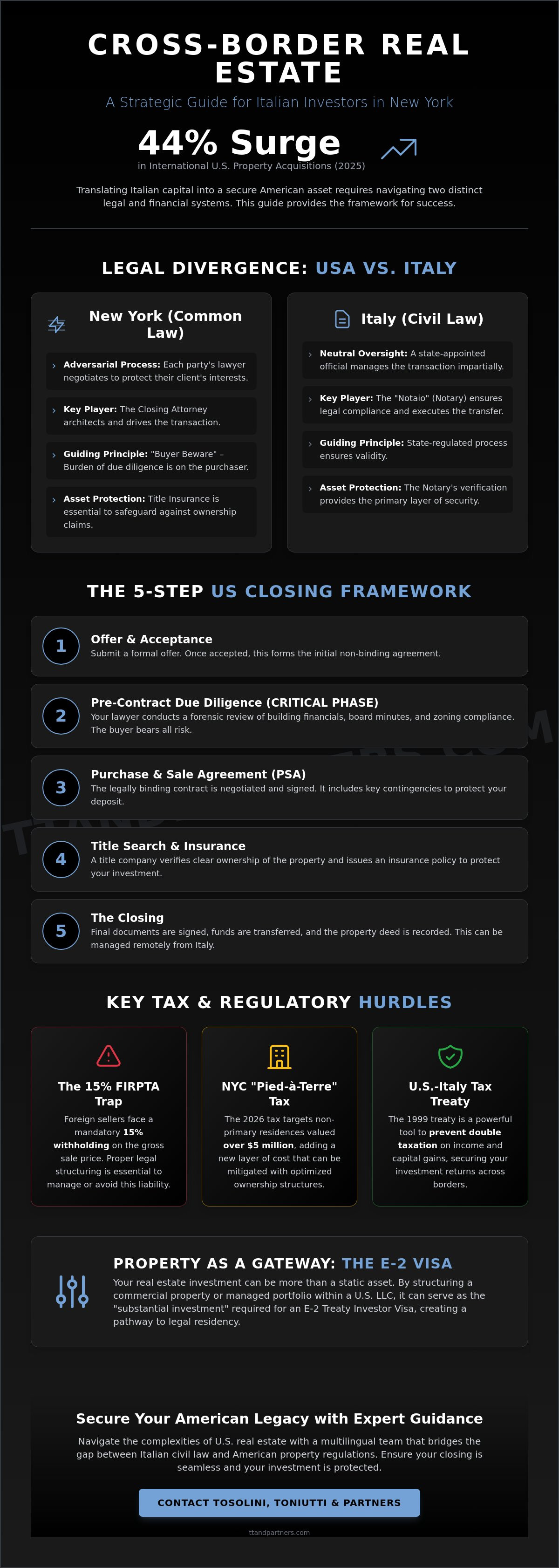
The flow of Italian capital into New York is driven by a desire for stability and the favorable provisions of the 1999 U.S.-Italy tax treaty. This agreement remains a cornerstone for preventing double taxation on income and gains. However, the regulatory environment is shifting. The May 2026 "pied-à-terre" tax now targets non-primary residences valued over $5 million, adding a new layer of cost for high-end investors. Compliance with the Foreign Investment in Real Property Tax Act of 1980 (FIRPTA) is equally critical. Without proper legal structuring, sellers face a 15% withholding on the gross sale price. We analyze these variables to ensure your investment remains both liquid and profitable.
Property as a Gateway: Real Estate and Immigration
Real estate isn't just a static asset; it's often the first step toward a broader American presence. For many clients, property holdings intersect with immigration goals, specifically regarding the E-2 Visa. While residential property for personal use doesn't qualify for treaty investor status, commercial units or managed portfolios can satisfy the "substantial investment" requirement. By placing property within a correctly structured LLC, we help transform your real estate interests into a platform for legal residency. This integrated approach ensures that your legal architecture supports both your financial portfolio and your family's future in the United States. Choosing an experienced real estate lawyer for italians in New York ensures that your property purchase isn't an isolated event, but a strategic move toward your long-term American vision.
The Anatomy of a US Real Estate Closing: A 5-Step Framework
The U.S. real estate transaction is a technical sequence that demands meticulous coordination between multiple parties. Unlike systems where a neutral official oversees the transfer, the New York process is inherently adversarial and driven by the specific language of the contract. Every detail must be negotiated and verified to ensure the asset's long-term performance. A real estate lawyer for italians in New York serves as the architect of the transaction, coordinating with lenders, title companies, and sellers to ensure every phase of the acquisition aligns with your strategic goals. Given the competitive nature of the current market, the pace of these transactions requires immediate and precise legal action to secure a favorable position.
Due Diligence and Contractual Safeguards
In New York, the legal principle of buyer beware remains the governing standard for property transfers. This means the burden of discovery lies entirely with the purchaser, making pre-contract due diligence a critical phase of the investment. This process goes beyond a physical walkthrough; it includes a forensic review of building financials, condominium or cooperative board minutes, and local zoning compliance. The Purchase and Sale Agreement (PSA) is the definitive blueprint for the transfer of equity. For the international investor, this contract must include specific contingencies to protect deposits in the event of financing hurdles. It's also the stage where we address the withholding requirements established by the official IRS guidance on FIRPTA, ensuring that the necessary documentation is prepared well in advance of the closing date.
The Role of Title Insurance in the US
The American system relies on private title insurance to mitigate risk and guarantee the integrity of the ownership chain. This insurance is the single most important protection for a foreign buyer, acting as a financial shield against hidden defects such as unpaid property taxes, undisclosed heirs, or fraudulent previous transfers. We distinguish between the Lender’s Policy, which protects the financial institution, and the Owner’s Policy, which protects your personal equity. Common defects often overlooked by those unfamiliar with local practice include municipal liens or ancient easements that could restrict future development of the site. For a detailed review of your specific investment goals, consult with our strategic team to ensure your legal architecture is sound.
The final stage occurs at the closing table, where the actual transfer of ownership is executed through the exchange of the deed and the distribution of funds. This is a complex assembly that involves title closers and bank representatives alongside legal counsel. For those managing their portfolio from abroad, our firm utilizes secure digital platforms and powers of attorney to finalize the process without requiring a physical presence in the United States. This ensures that your capital is deployed efficiently and that the transfer of title is recorded with absolute precision in the public record.
Legal Divergence: Italian Civil Law vs. US Common Law
Navigating the transition from the Italian Civil Code to the American common law system is like moving from a pre-defined architectural template to a bespoke, ground-up design. In the Italian civil law tradition, the statutes provide a rigid framework that governs most aspects of a transaction. New York, however, operates on the principle of contractual freedom. This means the parties have the liberty to define nearly every term of their engagement, but it also places the entire burden of protection on the language of the contract itself. Without a specialized real estate lawyer for italians in New York to draft these specific safeguards, an investor remains exposed to risks that the Italian code would normally mitigate by default.
The Absence of the Italian Notary
The most striking difference for an Italian national is the total absence of the Italian Notary. In Italy, the notary is a neutral public official who guarantees public faith and ensures the legality of the deed. In the United States, this role is decentralized. Legality isn't guaranteed by a public office but is instead secured through private title insurance and the diligent advocacy of your legal counsel. The U.S. attorney is the fiduciary of the client, not a neutral public official. This shift requires you to rely on a professional whose sole loyalty is to your interests, ensuring that the title is clear and the transfer of equity is architecturally sound.
Asset Protection and Corporate Structuring
Purchasing U.S. property in an individual name is often a strategic error for Italian residents. It exposes the asset to aggressive U.S. estate taxes and creates a direct line of liability to the owner’s personal estate in Italy. To build a more resilient investment, we often recommend LLC Incorporation. This corporate structure provides a layer of privacy and protects your global assets from local property disputes. It also simplifies the resolution of potential International Litigation, as the entity serves as a clear legal boundary. Proper structuring also addresses the complexities of FIRPTA income tax withholding, ensuring that your capital remains protected from the moment of acquisition through the eventual sale. By aligning your U.S. holdings with your Italian estate plan, you create a seamless bridge between your domestic and international portfolios.
Tax and Regulatory Compliance: Navigating FIRPTA in 2026
Fiscal discipline is the foundation of any resilient international property portfolio. In the 2026 market, where New York property values have grown by 5.8% annually, the Foreign Investment in Real Property Tax Act (FIRPTA) remains the most significant regulatory hurdle for non-residents. It's a common misconception that FIRPTA is a direct tax on profit. Instead, it functions as a mandatory withholding of 15% on the gross sale price to ensure foreign sellers meet their U.S. tax obligations. For an Italian investor, this can lead to a substantial liquidity crisis if not managed by a specialized real estate lawyer for italians in New York.
The FIRPTA Withholding Mechanism
The burden of FIRPTA compliance falls on the buyer, who's legally required to withhold the funds and remit them to the IRS. However, specific exemptions exist that can preserve your capital. If the property is sold for between $300,001 and $1,000,000 and the buyer intends to use it as a primary residence, the withholding rate drops to 10%. For transactions under $300,000 with the same residency intent, the rate is 0%. To avoid the standard 15% hit on larger transactions, we help clients apply for a Withholding Certificate. In 2026, IRS processing times for these certificates typically range from 90 to 120 days. Securing this document before the closing table ensures that only the actual tax due is retained, rather than a flat percentage of the total contract price.
Ongoing Tax Obligations for Italian Owners
Ownership brings a continuous set of reporting requirements that demand architectural precision. Rental income from New York holdings is subject to a default 30% flat tax on gross receipts. However, Italian owners can elect to treat this as "Effectively Connected Income" (ECI). This election allows you to deduct mortgage interest, property taxes, and depreciation, often reducing the effective tax rate significantly. Annual property taxes and the new May 2026 "pied-à-terre" tax on luxury units over $5 million must also be factored into your carrying costs. The 1999 update to the U.S.-Italy Tax Treaty serves as your primary defense against double taxation, allowing for credits in Italy for taxes paid in the United States. To ensure your investment remains tax-efficient across both jurisdictions, schedule a strategic consultation with our tax specialists today. We provide the technical oversight necessary to harmonize your American assets with your Italian fiscal residency.
Strategic Cross-Border Support with Tosolini, Toniutti & Partners
Successful international investment requires more than a standard transactional approach; it demands a legal architecture that accounts for the nuances of two distinct cultures. As a specialized real estate lawyer for italians in New York, our firm doesn't simply process deeds. We design comprehensive frameworks that protect your capital while aligning with your broader life goals. The 44% surge in international U.S. property acquisitions seen in the past year confirms that the market remains a primary destination for Italian wealth. However, the complexity of this urban fabric requires a partner who understands the intellectual content behind every contract and the specific needs of the expat community.
Our Integrated Legal Architecture
We operate as strategic thinkers rather than mere service providers. Our boutique approach ensures that every transaction is viewed through a holistic lens, integrating real estate with corporate structuring and immigration strategy. While competitors often treat property as a standalone asset, we recognize that a well-placed investment is frequently the first step toward a Green Card or an E-2 Visa. This integrated perspective is vital when managing high-value transactions in a market where active listings have tightened by 9% since last year. We maintain a continuous dialogue with your Italian tax advisors and accountants, ensuring that your New York holdings are perfectly synchronized with your fiscal obligations in Italy. This coordination prevents the friction that often arises when two legal systems meet without a professional bridge.
Secure Your Investment Today
Precision at the beginning of a project determines the quality of the final result. In the New York market, the most critical moment occurs before you sign a binder or a Letter of Intent (LOI). These preliminary documents can carry significant legal weight and often lack the protections an Italian investor requires to mitigate FIRPTA risks or the new 2026 luxury tax assessments. Early legal intervention is the only way to ensure your equity is shielded from the start. Our multilingual expertise allows us to translate complex American common law concepts into terms that resonate with the Italian legal tradition, providing you with absolute clarity at every stage.
To begin your journey with the confidence that only specialized counsel can provide, we invite you to contact Tosolini, Toniutti & Partners for a preliminary strategic review. We'll help you navigate the $867,500 median market entry point with a focus on longevity, functionality, and legal security. Your U.S. property should be more than a purchase; it should be a resilient asset within a global portfolio, built on a foundation of professional excellence and cross-border foresight.
Building Your American Legacy with Precision
We've explored how the transition from the Italian notary system to the US closing framework demands more than just a signature; it requires a robust legal architecture. Protecting your capital against the 15% FIRPTA withholding and navigating the May 2026 tax updates for luxury properties are not merely administrative tasks. They're essential safeguards for your wealth. Partnering with a dedicated real estate lawyer for italians in New York ensures that every detail, from title insurance to corporate structuring, is handled with the bilingual precision your portfolio deserves.
Our firm brings decades of cross-border experience and specialized expertise in integrating property acquisitions with E-2 and O-1 visa requirements. Our bilingual attorneys are licensed across multiple jurisdictions, providing the holistic support needed to bridge the gap between Milan and Manhattan. Consult with our cross-border real estate experts to begin your acquisition with absolute clarity. The New York market continues to offer unparalleled opportunities for those who approach it with the right strategic vision. It's time to turn your American property goals into a secure, lasting reality.
Frequently Asked Questions
Do I need to be in the US to close on a property?
Physical presence is not a requirement for finalizing a property acquisition in the United States. International investors regularly utilize a specific Power of Attorney that authorizes their legal counsel to execute all necessary documents at the closing table. In the 2026 market environment, the use of secure digital closing platforms has become the standard, allowing for the precise and remote transfer of equity while you remain in Italy.
What is the role of an Italian-speaking real estate lawyer in a US transaction?
An Italian-speaking real estate lawyer for italians in New York acts as a strategic architect who translates complex American common law principles into a framework compatible with your European legal background. This role involves more than linguistic translation; it requires a forensic understanding of how the absence of an Italian Notary changes the risk profile of your transaction. By providing this specialized oversight, the attorney ensures that the contract reflects the precise intentions of the buyer while navigating the unique regulatory landscape of the five boroughs.
How does the US-Italy tax treaty affect my real estate investment?
The 1999 U.S.-Italy tax treaty serves as the primary structural defense against double taxation on income and capital gains. It establishes clear rules for which jurisdiction has the primary right to tax property-related earnings, generally favoring the country where the asset is located. By correctly applying treaty benefits, investors can ensure that taxes paid to the IRS are appropriately credited against their fiscal obligations in Italy, maintaining the overall health of their global portfolio.
Can I buy US property through an Italian company?
While legally permissible, holding U.S. real estate through an Italian entity often introduces unnecessary administrative friction and complex tax reporting requirements. Most sophisticated investors choose to establish a U.S. Limited Liability Company (LLC) to hold the deed. This domestic structure provides a robust layer of liability protection and simplifies the management of the asset, ensuring that the property remains a clean, functional component of your international business architecture.
What are the closing costs for a foreign buyer in the US?
Closing costs for international buyers typically range between 2% and 5% of the purchase price for cash transactions. These costs include title insurance, recording fees, and the New York State transfer tax. If you are financing the purchase, these figures will increase due to mortgage recording taxes and bank-related fees. It is essential to account for these variables early in the planning phase to ensure your capital allocation remains accurate and sufficient.
How can I avoid FIRPTA withholding when I sell my US property?
To mitigate the immediate impact of the 15% withholding on the gross sale price, sellers should apply for a Withholding Certificate from the IRS. This document allows the withholding to be based on the actual anticipated tax on the gain rather than a flat percentage of the total contract value. Given the 90 to 120 day processing time observed in 2026, your real estate lawyer for italians in New York must initiate this process well before the closing date to preserve your liquidity.
Is title insurance mandatory for international buyers?
Title insurance is a non-negotiable component of a secure U.S. real estate transaction. While a lender will always require a policy to protect their interest, an Owner’s Policy is the only way to safeguard your personal equity against hidden defects in the chain of title. In a system without an Italian Notary to guarantee the public record, this private insurance provides the necessary indemnity against unforeseen liens, encumbrances, or fraudulent previous transfers.
Can a real estate purchase help me get a Green Card?
A property purchase alone does not provide a direct path to a Green Card or permanent residency. However, real estate can be a cornerstone of a successful treaty investor application if the property is part of an active, job-creating business. For example, commercial holdings or managed residential portfolios can satisfy the investment requirements for certain visa categories, provided the capital is committed to a dynamic enterprise rather than a passive personal residence.


Comments