

Residence Permit for US Citizens: 2026 Strategic Guide

The assumption that an entry visa granted by an Italian consulate marks the end of the relocation process is a common misconception that can lead to significant legal friction. In reality, the visa is merely a precursor to the essential administrative step of securing a permesso di soggiorno for US citizens once you arrive on Italian soil. With a mandatory eight-working-day window to initiate the application, there's little room for error or hesitation in a landscape where precision is the only currency that matters.
You're likely aware that the bridge between your current life in the United States and a permanent residence in Italy is built on rigorous documentation and strict deadlines. This 2026 strategic guide provides a clear roadmap to navigate these complexities, from the initial postal kit submission to the final appointment at the Questura. We'll examine the specific requirements for long-term residency, the updated fee structures for 2026, and how to integrate your legal status with your broader business or investment goals for a harmonious transition.
Table of Contents
The Residence Permit Architecture: Visa vs. Permesso di Soggiorno
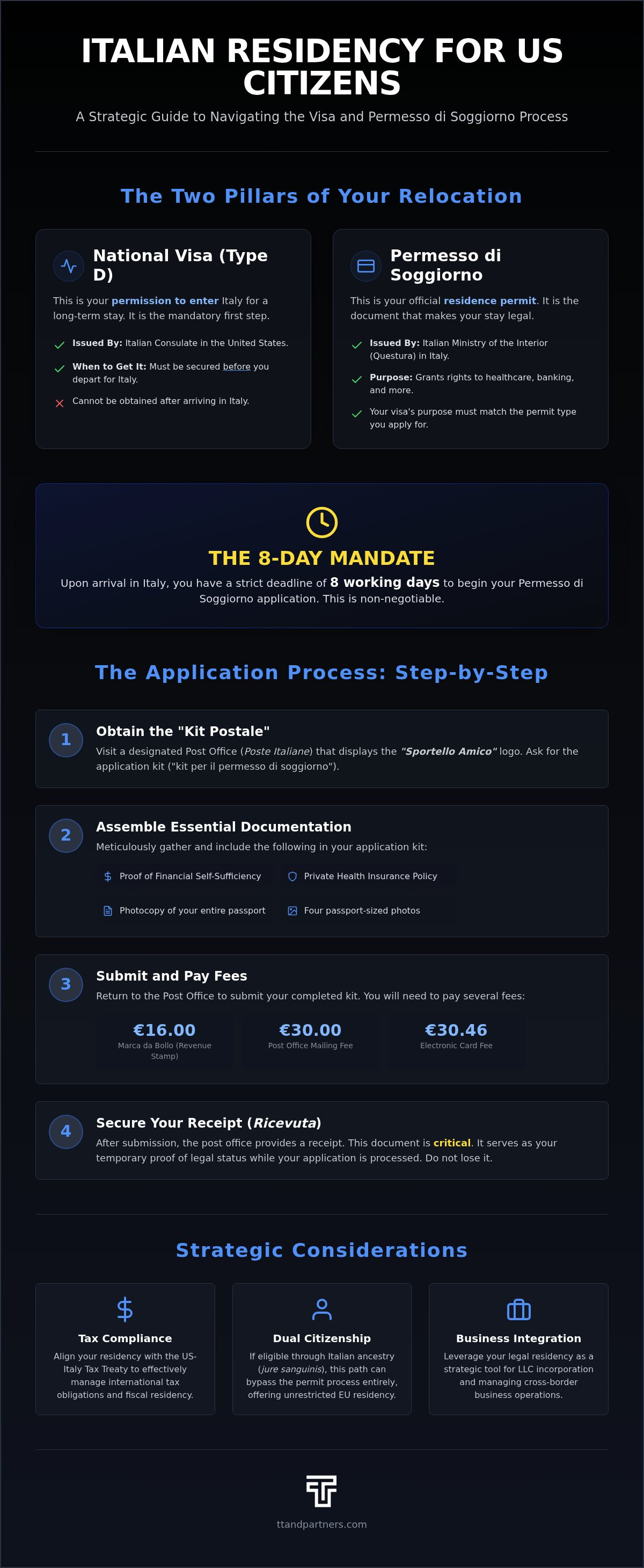
Understanding the legal architecture of Italian residency begins with a clear distinction between an entry visa and a residence permit. For many, the journey starts with the realization that a standard tourist stay is limited. While US passport holders enjoy visa-free entry for short visits, obtaining a permesso di soggiorno for US citizens is the only way to reside in the country legally for more than 90 days. This document serves as the administrative backbone of your stay, granting rights that range from accessing the national healthcare system to opening a local bank account with ease.
The process is strictly sequential. You can't simply arrive in Italy and request residency without prior authorization. A National Visa (Type D) must be secured from an Italian Consulate in the United States before you depart. This visa acts as a specific authorization for a long-term stay, whether for work, investment, or elective residency. Without this precursor, the Questura won't accept your application for a Permesso di Soggiorno. Choosing the right category at this stage is vital. Your permit's purpose must match your visa's intent exactly; you cannot enter on a study visa and expect to receive a work permit without a complex conversion process later.
The Functional Difference Between Entry and Residency
The visa and the permit operate in two distinct jurisdictions. Your visa is a product of international diplomacy, issued by the Ministry of Foreign Affairs through its consular network. It grants you the legal right to cross the border for a specific duration. In contrast, the permit is a domestic administrative matter handled by the Ministry of the Interior. It's the physical card that proves you're a legal resident with the right to stay. US citizens can't bypass the consular phase. The permit is a localized extension of the visa's authority, and maintaining it requires adherence to local laws that the visa alone doesn't cover.
Dual Citizenship and Residency Considerations
There's an alternative path that bypasses the need for a residence permit entirely. If you have Italian ancestors, you might be eligible for citizenship through jure sanguinis. Holding an Italian passport provides unrestricted residency throughout the European Union, removing the need for recurring renewals and strict filing deadlines. For those exploring this route, professional guidance on Italian immigration and citizenship is often the most efficient way to determine eligibility. While the permit is a robust solution for many, citizenship represents the ultimate integration into the Italian social and legal fabric.
The 8-Day Mandate: Procedural Steps Upon Arrival in Italy
Arrival in Italy marks the transition from planning to execution. The most critical requirement is the obligation to apply for a Permesso di Soggiorno (Residence Permit) within 8 days of your arrival. This isn't a suggestion; it's a strict administrative deadline that anchors your legal status. US citizens must visit a designated post office, known as Poste Italiane, displaying the Sportello Amico logo to obtain and submit the "Kit Postale". This envelope contains the forms necessary to initiate the permesso di soggiorno for US citizens.
Once you submit the kit and pay the associated fees, the post office issues a ricevuta, or receipt. This small slip of paper is your most valuable asset during the waiting period. It serves as legal proof of your pending status, allowing you to remain in Italy and even travel back to the United States while the Questura processes your file. Losing this receipt can cause significant legal friction, so it's best to treat it with the same care as your passport.
The Application Package: Essential Documentation
The kit requires a meticulous assembly of records. You'll need to provide evidence of financial self-sufficiency, often through US-based bank statements or investment portfolios, to prove you won't become a burden on the Italian state. Private health insurance is also mandatory for US citizens, providing coverage that meets national standards. Before submission, you must purchase a Marca da Bollo, a revenue stamp, for €16.00 from a local tobacco shop. At the post office, expect to pay a €30.00 mailing fee and a €30.46 fee for the electronic card production. Depending on the permit's duration, a government contribution fee ranging from €40.00 to €100.00 will also apply. For a standard one-year permit, the total administrative cost typically reaches €116.46.
The Biometrics Appointment and Final Issuance
Submitting the kit is only the first phase. The post office will provide a document stating the date and time for your appointment at the Questura, or Police Headquarters. During this meeting, officials verify your original documents and collect biometric data, including fingerprints. In 2026, processing times generally range between three and six months. While this duration requires patience, the precision of your initial filing dictates the speed of approval. If the bureaucratic landscape feels overwhelming, seeking expert legal counsel can ensure your submission is flawless from the first day. Once approved, you'll receive a notification to collect your electronic residency card, completing the transition from visitor to resident.
Permit Categories for US Professionals and Investors
Selecting the appropriate category for your residency isn't merely an administrative choice; it's a strategic decision that dictates your professional and financial flexibility in Europe. The permesso di soggiorno for US citizens is issued under specific legal headings, each providing a distinct set of rights and limitations. While some seek the tranquility of retirement, others view Italy as a launchpad for Mediterranean business expansion. Understanding these distinctions is the first step in aligning your residency with your long-term lifestyle goals.
Family members don't need to navigate this journey in isolation. The Italian legal framework provides robust paths for family reunification, allowing US dependents to secure residency based on the primary applicant's status. This ensures the transition is a collective move, preserving the family unit while establishing a new home abroad. Whether you're an executive or an entrepreneur, the architecture of your permit must support both your immediate needs and your future growth.
The Elective Residency Trap: Passive Income Rules
Many US applicants encounter friction by misinterpreting the "passive income" requirement. To qualify for Elective Residency, you must prove substantial recurring income from sources such as pensions, annuities, rental properties, or stable dividends. Active employment is strictly prohibited. If you're a remote worker or a business owner providing ongoing services to a US entity, this category is likely unsuitable. Consulates frequently deny applications when the financial records suggest active professional engagement, as the permit's intent is purely residential, not economic.
Investor and Entrepreneurial Paths
For those intending to contribute capital to the Italian economy, the Investor Visa offers a streamlined, high-priority route. With investment thresholds set at €250,000 for innovative startups or €500,000 for established Italian companies, the program has become a premier choice for high-net-worth individuals. This framework shares a strategic philosophy with the E-2 Visa Guide 2026: The Strategic Framework for Treaty Investors, though it operates within the specific regulatory context of the Eurozone.
A critical technical hurdle for work and investor permits is the Nulla Osta. This security and administrative clearance must be issued by Italian authorities before the visa application can be finalized at a US consulate. It acts as the state's preliminary approval, confirming that your proposed business or investment activity complies with national interests. Managing these cross-border requirements requires a firm that understands both the New York corporate environment and the intricacies of Italian administrative law.
Cross-Border Compliance: Tax and Legal Considerations
Securing a permesso di soggiorno for US citizens is often viewed as a purely administrative milestone, yet it triggers a series of complex bilateral obligations. Legal residency in Italy doesn't exist in a vacuum; it's tethered to your global financial profile. The primary catalyst for change is the distinction between legal residency, which is your right to inhabit the territory, and fiscal residency, which is your obligation to contribute to the national treasury. Under Italian law, spending more than 183 days in the country within a calendar year typically establishes you as a tax resident, making your worldwide income subject to Italian taxation regardless of its source.
The US-Italy Tax Treaty serves as a vital safeguard against double taxation, offering mechanisms to harmonize your liabilities. It provides tools like the Foreign Tax Credit and the Foreign Earned Income Exclusion to ensure you aren't penalized for your international lifestyle. These provisions require precise application. Even with a valid residence permit, US citizens remain subject to citizenship-based taxation. This unique American requirement follows you across borders, necessitating a dual-pronged approach to annual filings that respects both IRS mandates and Italian statutory requirements.
US Tax Obligations for Expats in Italy
Living in Italy doesn't absolve you of your duties to the IRS. You'll need to maintain transparency by filing annual US tax returns and disclosing foreign financial assets. This includes the Foreign Bank and Financial Accounts (FBAR) report and Form 8938 under FATCA if your Italian holdings exceed specific thresholds. These reporting layers are essential for maintaining your standing in the United States while building a life in the European Union. Precise record-keeping is the only way to navigate the intersection of these two distinct regulatory environments without incurring significant penalties.
Legal Protection and Dispute Resolution
Your legal footprint in Italy often extends into real estate transactions or commercial ventures. Managing these assets from abroad, or defending your interests in a foreign court, requires a strategy that spans the Atlantic. For those facing complex legal challenges, our International Litigation 2026: A Strategic Guide to US-Italy Legal Disputes provides deeper insight into resolving cross-border conflicts. Success in these matters depends on a legal partner who operates with equal proficiency in both US and Italian law. If you're ready to align your residency status with a robust legal framework, contact our dual-jurisdiction team for a comprehensive consultation.
Integrating Residency with US-Italy Business Strategy
For the American entrepreneur, a residency permit is more than a certificate of stay; it's a strategic asset that bridges the Atlantic. Obtaining a permesso di soggiorno for US citizens removes the friction of the 90-day Schengen limitation, allowing for the consistent, hands-on management required to scale a European venture. While a visa grants you entry, residency grants you the ability to sign contracts, hire local talent, and lease commercial spaces without the administrative hurdles faced by non-residents. This integration is most effective when supported by a robust corporate foundation. Often, this begins with LLC Incorporation: A Strategic Guide to US Business Architecture in 2026, ensuring that your US entity and Italian operations remain legally distinct yet operationally harmonious.
The decision to relocate is a pivot point for any international business. A permesso di soggiorno for US citizens acts as a catalyst, transforming a foreign executive into a local stakeholder. This shift is particularly advantageous for international trade managers who need to oversee supply chains or service delivery within the Eurozone. By establishing a physical presence, you signal a long-term commitment to the Italian market, which is essential for building trust with local partners and regulatory bodies alike.
The Role of Corporate Structure in Residency
Your permit type is often dictated by your corporate architecture. Establishing an Italian branch or a subsidiary can provide the necessary legal basis for intra-company transfers or self-employment permits. For those involved in substantial trade between the two nations, the E-1 Treaty Trader Visa: The 2026 Strategic Guide for International Business offers a specialized path. This status allows managers and essential employees to move fluidly between jurisdictions, provided the underlying trade volume meets treaty requirements. Managing these cross-border teams requires a sophisticated understanding of both Italian labor laws and US corporate governance.
Next Steps: Consultation and Relocation Planning
A successful relocation requires more than just filing forms; it demands a comprehensive pre-relocation legal audit. This process examines the intersection of your immigration status, tax liabilities, and business goals to prevent unforeseen compliance issues. At Tosolini, Toniutti & Partners, we manage the end-to-end residency process, serving as a bridge between US professional expectations and Italian administrative reality. Our dual-jurisdiction expertise ensures that every step, from the initial visa to the final issuance at the Questura, aligns with your broader vision. Contact our experts for a personalized Italian residency strategy to begin your transition with confidence.
Establishing Your Permanent Legacy in Italy
Establishing your permanent legacy in Italy requires a strategic alignment of your legal status, tax obligations, and professional ambitions. The journey from the initial consular visa to the final issuance of the permesso di soggiorno for US citizens is a multi-layered process that demands absolute precision at every turn. By addressing the eight-day filing mandate and selecting the correct permit category, you create a secure foundation for your life abroad. It's a transition that shouldn't be managed without expert guidance.
As you navigate these cross-border complexities, a partner with dual-jurisdiction expertise in New York and Italy becomes indispensable. Tosolini, Toniutti & Partners specializes in complex residency and citizenship cases, providing the comprehensive corporate and litigation support needed to protect your global interests. Secure Your Italian Residency – Contact Tosolini, Toniutti & Partners to ensure your relocation is as seamless as it is legally sound. Your future in Italy deserves a foundation built on professional excellence and visionary planning.
Frequently Asked Questions
Do US citizens need a visa to stay in Italy for more than 90 days?
Yes. While US citizens can enter the Schengen Area for tourism without a visa for up to 90 days, any stay exceeding this limit requires a National Visa (Type D). You must obtain this visa from an Italian Consulate in the United States before your departure. This document is the mandatory prerequisite for securing the permesso di soggiorno for US citizens once you arrive on Italian soil.
How long does it take to get a Permesso di Soggiorno in 2026?
In 2026, the processing time generally ranges between three and six months from the date of your biometrics appointment at the Questura. Although you'll receive a receipt immediately upon filing the postal kit at the post office, the production of the electronic card involves several administrative layers. During this waiting period, your legal stay is protected by the official receipt, which serves as your temporary proof of status.
Can I work in Italy with a Permesso di Soggiorno for Elective Residency?
No, the Elective Residency permit strictly prohibits any form of active employment or self-employment within Italy. Applicants must demonstrate substantial passive income from sources like pensions, dividends, or rental properties to qualify. If you intend to engage in professional activities or manage an Italian business, you should pursue a work permit or an Investor Visa to ensure your activities align with Italian immigration law and your residency status.
What happens if I miss the 8-day deadline to apply for the permit?
Missing the eight-day mandate can lead to serious legal complications, including the potential denial of your residency and a formal order to leave the country. Italian authorities view this deadline as a critical requirement for all non-EU arrivals. If an emergency prevents timely filing, you must provide documented evidence of the delay. Seeking immediate legal counsel is advisable to mitigate risks and attempt a late submission through the appropriate channels.
Is the Permesso di Soggiorno the same as permanent residency?
No, the initial permesso di soggiorno for US citizens is a temporary residence permit usually valid for one or two years. Permanent residency, known as the EU long-term residence permit, is only available after five years of continuous legal residence in Italy. This long-term status provides greater stability and fewer renewal requirements, but it requires meeting specific income thresholds and passing a basic Italian language proficiency exam to qualify.
Can I bring my family to Italy on my residency permit?
Yes, the Italian legal framework allows for family reunification, enabling you to bring dependents such as spouses and minor children. You must demonstrate adequate housing and sufficient financial resources to support the entire family unit according to national standards. The process involves obtaining a clearance known as a Nulla Osta for family members, which then allows them to apply for their own residency permits linked to your primary status.
Does getting a residence permit in Italy affect my US citizenship?
Obtaining an Italian residence permit has no impact on your US citizenship status. You remain a US citizen with all associated rights and responsibilities, including the obligation to file annual US tax returns on your global income. Residency is a permission to live in a foreign country; it is not the same as naturalization. Your US passport remains your primary travel document and proof of nationality throughout your stay in Italy.
How do I renew my Permesso di Soggiorno from the United States?
You cannot renew your residence permit from the United States because the process requires you to be physically present in Italy. Renewal applications must be submitted via the postal kit system at an Italian post office at least 60 days before your current permit expires. If you are in the US when your permit lapses, you may face significant difficulties re-entering Italy. It's essential to plan your travel around these mandatory renewal windows.


Comments