

Serving Legal Documents in Italy from the US: The 2026 Strategic Guide
- Gianni Mendes Toniutti, Esq.

- Jun 27
- 12 min read
What if the structural integrity of your multi-year litigation depends entirely on the linguistic precision of a single document delivered months before the first hearing? For legal professionals, serving legal documents in Italy from the US is far more than a logistical hurdle; it's a foundational act of strategy that dictates the future enforceability of a judgment. You likely understand the anxiety of the typical three to six month waiting period and the fear that treaty non-compliance could dismantle your progress. It's a complex environment where technical accuracy meets international diplomacy.
We promise to help you navigate these complexities with a focus on both US due process and Italian treaty obligations. This guide explores the mandatory translation requirements, the specific functions of the central bailiff office in Rome, and the strategic choice between formal government channels and local judicial officers. We'll also look at how 2026 legislative shifts and the expansion of certified digital notification systems are refining the process. You'll gain the clarity needed to ensure your service is bulletproof, securing the path for successful enforcement in the years to come.
Table of Contents
The Hague Service Convention: Framework for US-Italy Legal Transmission
Authorized Methods: Formal vs. Alternative Channels under Article 10
Translation Requirements and the Risk of Procedural Invalidity
Digital Service and PEC: Navigating Italy’s Modern Legal Infrastructure
Strategic Litigation: Ensuring Service Leads to Enforceable Judgments
The Hague Service Convention: Framework for US-Italy Legal Transmission
The Hague Service Convention acts as the definitive multilateral treaty for the cross-border delivery of judicial papers. Italy's adherence to these protocols since the early 1980s established a rigorous standard for legal certainty that bridges two distinct legal traditions. When you're serving legal documents in Italy from the US, this treaty isn't a mere procedural option. It's a constitutional necessity that shields your litigation from being declared invalid from the start. Bypassing these established channels often results in a total loss of jurisdiction, rendering your entire legal effort powerless in the eyes of international law.
US courts generally view the treaty's requirements as mandatory when the recipient's address is known. While domestic rules might seem flexible, the treaty takes precedence under the constitutional hierarchy of the United States. This procedural discipline is essential for the long-term health of your case. It prevents future appeals based on improper notice and ensures that any resulting judgment carries the weight needed for recognition across the Atlantic. Serving legal documents in Italy from the US through these formal channels creates a record that is difficult for any defendant to challenge later.
The Role of the Italian Central Authority
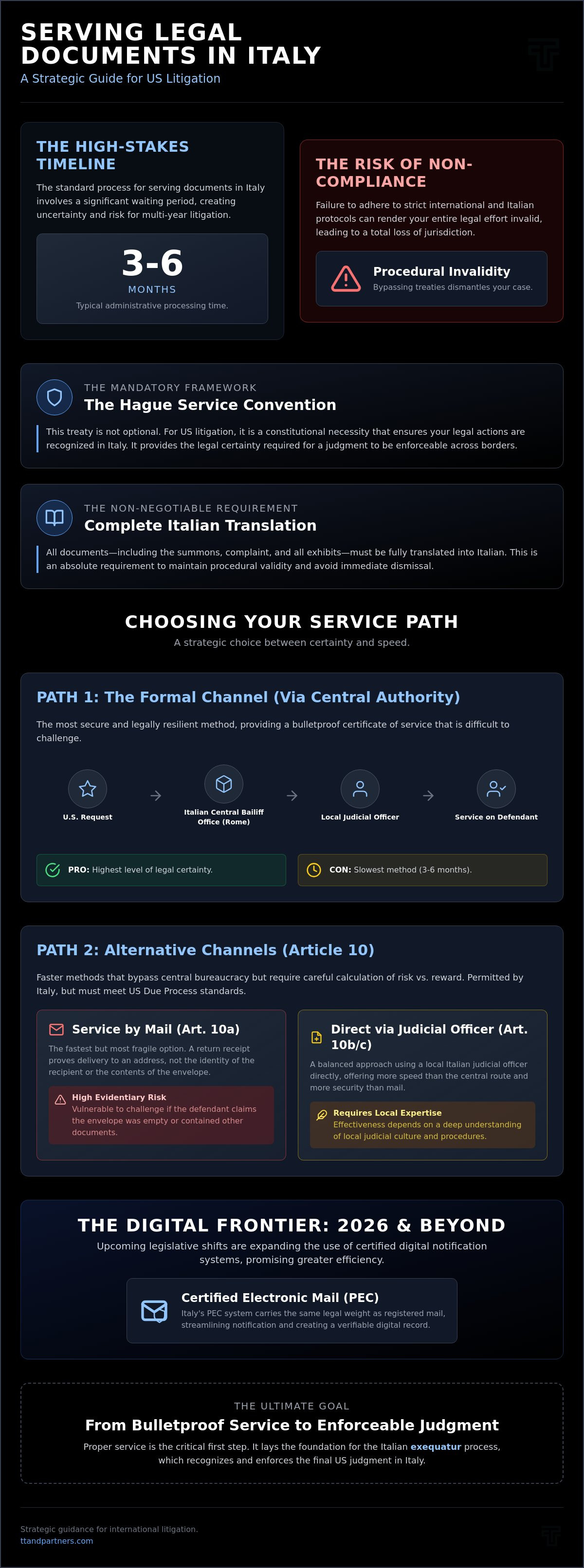
The Italian Ministry of Justice coordinates all incoming requests through a central office of bailiffs located at the appeals court in the capital. This office serves as the primary gatekeeper, verifying that each request adheres to international standards before delegating the physical delivery to local judicial officers in the defendant's specific municipality. These officers act with the authority of the state to ensure the documents reach the correct party. In 2026, the administrative processing time typically ranges from three to six months. This period reflects the thorough verification required to produce a legally binding certificate of service that withstands judicial review.
Treaty vs. Informal Service: Why Certainty Matters
International law draws a sharp line between simply notifying a party and formally serving them with legal force. Notice might inform a defendant that a case exists, but only formal service grants a court the authority to issue a binding ruling. US judges increasingly demand strict adherence to these protocols to protect the case record. The Hague Service Convention is the mandatory channel for service when a defendant's address is known. Relying on informal methods often fails to meet the standards of public policy, making future enforcement nearly impossible for any business or individual.
Authorized Methods: Formal vs. Alternative Channels under Article 10
While the central government route provides a shielded path for serving legal documents in Italy from the US, Article 10 of the Convention introduces more agile alternatives. These channels allow for direct communication between the state of origin and the destination, often bypassing the Ministry of Justice's central bureaucracy. However, the choice between these methods isn't merely a matter of speed. It's a calculation of risk versus procedural resilience. The U.S. Department of State guidance on service in Italy confirms that Italian authorities don't formally object to these alternative channels, yet their practical application requires a deep understanding of local judicial culture. Each method must pass the "US Due Process" test, ensuring the defendant receives actual, verifiable notice of the proceedings.
The Risks of Service by Mail (Article 10a)
Service via international registered mail is often the first instinct for litigants seeking efficiency. Italy permits this under Article 10(a), but it remains the most fragile method from a due process perspective. In the US, "actual notice" is the threshold. In Italy, a simple return receipt only confirms that an envelope reached an address. It doesn't verify the identity of the signatory or the specific contents of the package. If a defendant later claims the envelope was empty or contained unrelated papers, you face a significant evidentiary hurdle. For high-stakes international litigation, saving a few weeks through mail service rarely justifies the risk of having your eventual judgment challenged on the grounds of insufficient notice.
Direct Service through Italian Counsel
Articles 10(b) and 10(c) permit service through judicial officers or other competent persons. In the Italian context, this translates to engaging local counsel to petition a local court's bailiff directly. This method bridges the gap between the slow central path and the uncertainty of mail. An Italian judicial officer carries the full weight of the state. Their certificate of service is an official public document, meaning it carries a presumption of truth that is nearly impossible to overturn. This approach is particularly effective when time is of the essence but you still require a bulletproof record for future enforcement. It ensures that the act of serving legal documents in Italy from the US satisfies both the technical requirements of the treaty and the rigorous standards of Italian civil procedure.
Translation Requirements and the Risk of Procedural Invalidity
Linguistic precision is the silent architect of a successful international service. When serving legal documents in Italy from the US, the requirement for a complete Italian translation isn't a mere courtesy; it's a mandatory procedural safeguard. Italy's declaration to the Hague Conference specifies that all judicial documents must be accompanied by a translation into the Italian language. This rule extends beyond the primary summons and complaint to include every exhibit and supporting document referenced in the pleadings. If a document is central to the litigation, it must be accessible to both the Italian judicial officer and the recipient in the nation's official tongue. Failure to translate the summary of the document can lead to a refusal of service by the Central Authority.
The "Understanding" rule adds another layer of complexity to the process. While a defendant might be a US expat fluent in English, the Italian bailiff acts as an agent of the Italian state. Their authority is bound by the laws of the Republic, which recognize Italian as the exclusive language of legal record. Providing a translation prevents the defendant from later claiming they didn't understand the nature of the proceedings, a common tactic used to challenge the validity of service during enforcement. To reach the highest level of certainty, litigants often turn to a Traduzione Giurata, or sworn translation, which carries the official seal of an Italian court.
Sworn vs. Certified Translations
There's a significant distinction between a US certified translation and an Italian sworn translation. In the US, a translator typically signs an affidavit before a notary public. In contrast, an Italian Traduzione Giurata requires the translator to appear before a clerk at a local Tribunale to swear an oath of accuracy. Italian courts and the Central Authority heavily prefer documents verified by a local court official. Using improper legal terminology, such as confusing a "deposition" with an Italian "interrogatorio," can lead to immediate challenges. Precision in vocabulary ensures the Italian official understands exactly what action is being requested under the full text of the Hague Service Convention.
Protecting the Record for US Court Review
While satisfying Italian authorities is vital, you must also maintain a clean record for the US judge. The translation should be physically appended to the original English documents to form a single, cohesive package. It's best practice to include a detailed Affidavit of Translation that outlines the translator's qualifications and the specific documents they've processed. This transparency prevents opposing counsel from questioning the integrity of the service. By treating translation as a core component of your strategy for serving legal documents in Italy from the US, you build a foundation that supports both the initial service and the eventual recognition of the final judgment.
Digital Service and PEC: Navigating Italy’s Modern Legal Infrastructure
Italy's digital transformation has introduced a sophisticated layer to its legal infrastructure, offering tools that were once considered experimental. Central to this evolution is the Posta Elettronica Certificata (PEC), a certified email system that carries the same legal weight as a registered letter with return receipt under Italian law. By 2026, the mandate for all Italian businesses and registered professionals to maintain an active PEC address has created a transparent, digital map of potential recipients. When you're serving legal documents in Italy from the US, this infrastructure provides a high-velocity alternative or supplement to traditional paper-based service. While the Hague Convention remains the primary formal channel, the Italian system's digitalization allows for a more robust demonstration of actual notice.
Serving a US subpoena via PEC involves navigating complex admissibility hurdles. The Italian "Correttivo Cartabia" reforms have refined how these notifications are handled, yet their use in international litigation requires careful coordination. It's not enough to simply send an email. The transmission must be structured to satisfy both the technical requirements of the Italian provider and the evidentiary standards of a US court. This digital path doesn't replace the Hague Convention, but it creates a modern bridge for communication that was previously impossible.
The Evidentiary Weight of PEC Receipts
The strength of the PEC system lies in its automated generation of time-stamped receipts. The Accettazione receipt confirms the sender's provider has accepted the message, while the Consegna receipt provides definitive proof that the document has reached the recipient's certified mailbox. These logs are increasingly valuable in US federal courts, where they serve as objective evidence of delivery. However, it's vital to distinguish between corporate entities and private individuals. While professionals and companies are legally bound to check their PEC, private citizens often aren't, which can create hurdles in proving they had a meaningful opportunity to respond to a foreign summons.
When to Use Digital Service
Strategic litigants often use PEC as a secondary method to bolster a formal Hague request. This approach ensures that even if the Central Authority process is slow, the defendant has received actual notice, making it difficult for them to claim ignorance later. In specific circumstances, US judges may authorize electronic service as the primary method under Federal Rule of Civil Procedure 4(f)(3). This often requires demonstrating that traditional methods are impractical or have failed. Validating these digital paths requires the insight of International Litigation experts who understand the interplay between Italian digital mandates and US court expectations. If you need to verify a recipient's certified address or initiate a digital service plan, you should contact our legal team for a precise evaluation of your case's technical requirements.
Strategic Litigation: Ensuring Service Leads to Enforceable Judgments
Litigation is rarely an end in itself. For most US plaintiffs, a court victory only gains value when it can be liquidated or enforced against Italian assets. This is where the strategic foresight of serving legal documents in Italy from the US proves its worth. If the initial service is flawed, you face the "Reverse Challenge." This happens when an Italian court refuses to recognize a US judgment because the defendant's right to defend was compromised by improper notification. It's a costly mistake that often surfaces years after the original filing, effectively rendering a hard-won victory moot.
Strategic litigation requires looking beyond the immediate procedural win. You must ensure the method of service aligns with the Italian Exequatur process, the judicial mechanism for domesticating foreign rulings. Whether you are managing an LLC Incorporation for a trans-Atlantic venture or navigating an E-2 Visa investment, the validity of your legal standing in Italy depends on this initial procedural step. It's about building a foundation that withstands the scrutiny of a foreign jurisdiction's public policy requirements.
The Long Game: Enforcement in Italy
Article 64 of Law 218/1995 outlines the strict criteria for recognizing foreign judgments in the Italian Republic. The most significant hurdle is proving that the defendant was properly served according to both the law of the place where the trial was held and the international treaties in force. Italian judges prioritize the "right to defend" above almost all other procedural considerations. A meticulous Hague service record preempts common Italian defense tactics. It leaves the defendant with no room to argue they weren't given sufficient time or clear notice to prepare their case. Without this foundation, your US judgment remains a piece of paper with no power over Italian bank accounts or real estate holdings.
Coordinating with Cross-Border Experts
Success in cross-border disputes demands a firm that operates with a dual perspective. You need counsel who understands the nuances of US litigation while simultaneously mastering Italian procedural law. We've seen multi-million dollar commercial disputes saved simply because the service was executed with the eventual enforcement in mind. Every detail, from the translation quality to the bailiff's certificate, must be perfect. For tailored assistance with your cross-border matter, contact Tosolini, Toniutti & Partners. Our team ensures that your strategy for serving legal documents in Italy from the US is an investment in a final, enforceable result rather than a temporary procedural hurdle.
Securing Your Global Litigation Strategy
Securing the future of your trans-Atlantic legal proceedings requires a synthesis of procedural discipline and strategic vision. We've explored how the Hague Convention serves as a mandatory framework and why meticulous Italian translations are the bedrock of a valid case record. In 2026, the integration of digital tools like PEC offers new efficiencies, but these must be balanced against the rigorous standards of the Italian exequatur process to ensure a judgment can actually be enforced. Mastering the nuances of serving legal documents in Italy from the US is a foundational step that safeguards your interests from the first filing to the final collection of assets.
Our bilingual legal team, based in the US, brings deep expertise in cross-border litigation, US-Italy treaties, and international business law, including E-1 and E-2 visa matters. You don't have to manage these technicalities alone. Schedule a strategic consultation for your US-Italy litigation needs and ensure your international legal efforts lead to tangible results. With the right architectural approach to your legal strategy, you can turn complex international requirements into a distinct competitive advantage.
Common Questions Regarding Service of Process in Italy
Is service by mail under Article 10a legally sufficient for US defendants in Italy?
Service by mail is technically permitted because Italy hasn't filed a formal objection to Article 10(a) of the Hague Convention. However, many US courts find this method insufficient for establishing personal jurisdiction if proof of actual receipt is missing. When you're serving legal documents in Italy from the US, relying on mail alone is risky. It doesn't provide the same evidentiary weight as a bailiff's certificate, which can lead to challenges during the enforcement phase.
How long does it typically take to serve documents via the Italian Central Authority?
The typical timeline for service through the Italian Central Authority is approximately three to six months. This duration covers the administrative processing by the Ministry of Justice and the physical delivery by local judicial officers. While digitalization is improving some internal efficiencies, the bureaucratic path from the Rome Court of Appeal to a local municipality remains a deliberate process. You should plan your litigation calendar with these structural delays in mind.
Do I need to hire an Italian lawyer to serve papers in Italy from the US?
You don't strictly need an Italian lawyer if you use the formal Central Authority channel, but hiring local counsel is essential for alternative methods. Local attorneys can petition a local court to expedite the process through a judicial officer directly. This professional coordination ensures that the service meets both US due process standards and Italian civil procedure requirements, preventing future challenges to the validity of your judgment.
What happens if the defendant in Italy refuses to accept the documents?
If a defendant refuses to accept the documents, the Italian judicial officer records the refusal in an official certificate. Under Italian law, a documented refusal by the recipient or a capable member of their household often constitutes valid service. This protocol prevents defendants from avoiding litigation through simple evasion. The bailiff's formal report serves as definitive proof that the defendant had the opportunity to receive the summons.
Can I serve legal papers via email or WhatsApp to an Italian citizen?
Serving legal papers via WhatsApp or standard email isn't recognized as a valid primary method of service in Italy. While US courts might allow it as a secondary "actual notice" method under Rule 4(f)(3), it lacks the formal standing required for the Italian exequatur process. Only the Certified Electronic Mail (PEC) system carries legal weight equivalent to registered mail. Standard digital platforms don't meet the rigorous evidentiary standards of the Italian Republic.
Is a translation required if the defendant in Italy speaks fluent English?
A full Italian translation is mandatory regardless of the defendant's English proficiency. The Italian Central Authority requires all documents to be translated so the judicial officer can verify the nature of the request. Serving legal documents in Italy from the US without a translation is a leading cause of service being rejected at the administrative level. Precision in language is a procedural requirement that transcends the recipient's personal skills.
What is the cost of international service of process in Italy?
There are currently no service costs for documents sent from abroad to be served through the Italian Central Authority under the Hague framework. However, you'll still incur expenses for professional translations, US process server coordination, and potentially Italian legal fees for alternative channels. These administrative costs are necessary investments in the procedural integrity of your case. They ensure the final judgment is recognized by both US and Italian authorities.
Can I serve an Italian company through its US-based subsidiary?
You can only serve an Italian parent company through its US subsidiary if the subsidiary is legally considered an "alter ego" or an authorized agent. US courts apply strict tests to determine if the corporate relationship justifies bypassing the Hague Convention. If the subsidiary is a distinct legal entity, you must follow the formal treaty protocols in Italy. This ensures the resulting judgment remains enforceable against the parent company's European assets.


Comments