

Serving Legal Documents in Italy from US: The 2026 Strategic Guide
- Gianni Mendes Toniutti, Esq.

- May 21
- 12 min read
A single procedural oversight in Rome can dismantle years of meticulous litigation built in a US courtroom. When serving legal documents in Italy from US jurisdictions, the distance is measured less in miles and more in the rigorous adherence to international treaties. You likely recognize the tension inherent in this process, where a three to six month waiting period at the Italian Central Authority can end in either a valid certificate of service or a catastrophic case dismissal. It's a high-stakes environment where the fear of improper service is a rational response to a system that demands absolute technical precision.
This 2026 strategic guide provides the clarity needed to master these complexities, ensuring your international litigation remains valid and enforceable. We will detail the mandatory Italian translation requirements and the specific protocols of the Roman Court of Appeals. By aligning your strategy with both the Hague Convention and local civil procedure, you can secure a result that holds up under the scrutiny of both legal systems. We will explore the essential steps to transform a complex administrative mandate into a successful pillar of your legal strategy.
Key Takeaways
Identify why the Hague Service Convention serves as the mandatory legal framework for transmitting judicial documents when the defendant's Italian address is established.
Navigate the formal Article 5 requirements for serving legal documents in Italy from US courts to secure a valid certificate of service from the Roman Central Authority.
Assess the jurisdictional risks associated with Article 10 alternative methods, such as international mail, which may compromise the validity of your litigation.
Master the essential compliance mandates, including strict Italian translation protocols and the specialized procedures required for international subpoenas.
Integrate service of process into a cohesive international litigation strategy to ensure your US judgment is positioned for successful enforcement in Italy.
Table of Contents
The Hague Service Convention Framework in 2026
The architecture of international litigation rests upon a single, foundational treaty. For legal professionals serving legal documents in Italy from US courts, the Hague Service Convention Framework provides the essential structural integrity required for cross-border enforcement. Since Italy's accession in 1981, this multilateral agreement has standardized the transmission of judicial and extrajudicial documents. It's not just a procedural convenience; it's a jurisdictional mandate. When a defendant's physical address is known, the Convention represents the exclusive legal channel. Bypassing these protocols doesn't just delay a case. It often renders the final US judgment unenforceable within the Italian Republic, creating a void where a resolution should exist.
Legal Basis for US-Italy Service
The treaty's authority is rooted in Article 1, which applies in all civil or commercial matters where there's an occasion to transmit a document for service abroad. This aligns with US Federal Rule of Civil Procedure 4(f)(1), which directs that service at a place not within any US judicial district must follow internationally agreed means. In the context of serving legal documents in Italy from US jurisdictions, failing to adhere to these treaty obligations creates a fatal flaw. Italian courts won't recognize an American judgment if the initial service didn't respect their sovereign standards. This precision ensures that the rights of all parties are preserved through a transparent, verifiable chain of custody.
The Ufficio unico degli ufficiali giudiziari presso la corte di appello di Roma serves as the designated Central Authority for Italy. They act as the primary gatekeeper, receiving requests and coordinating with local judicial officers to effectuate service. This process distinguishes between judicial documents, like summons and complaints, and extrajudicial documents, such as formal legal notices that carry weight outside of active court proceedings. Understanding this distinction is vital for maintaining the harmony of the legal process.
The 2026 Regulatory Landscape
As of May 2026, the Italian Ministry of Justice continues to integrate digitalization updates to streamline communication between the Roman Central Authority and regional offices. While these efforts aim to reduce friction, the practical timeline for service remains between three and six months. There are no government fees charged by Italy for the execution of service when utilizing the Central Authority route. However, logistical costs for mandatory translations and preparation on the US side are significant factors. The current landscape emphasizes a dual-track approach where digital tracking meets traditional physical delivery to ensure every document reaches its destination with absolute legal certainty. For those managing complex cross-border cases, securing expert guidance through a strategic consultation is often the most effective way to ensure jurisdictional integrity.
The Formal Route: Serving via the Italian Central Authority
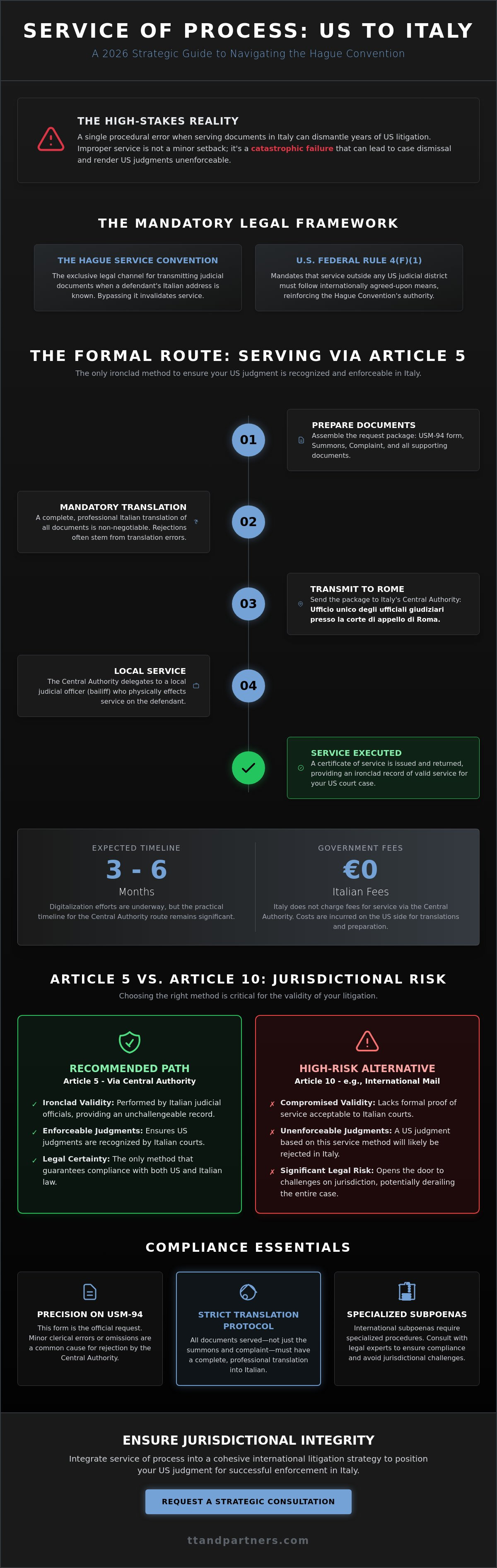
The formal mechanism under Article 5 of the Hague Convention remains the most resilient method for serving legal documents in Italy from US jurisdictions. This path ensures that the service is performed by the host state's own judicial officials, providing an ironclad defense against future challenges to jurisdiction. The process begins with the transmission of documents to the Roman Central Authority, which then delegates the task to a local bailiff. While this route is fee-free on the Italian side, it requires a commitment to a three to six month timeline. Success depends on the meticulous assembly of the request package. This package must include the mandatory USM-94 form and a complete Italian translation of all materials. For those navigating the complexities of international litigation, understanding this bureaucratic sequence is the first step toward a valid judgment.
Preparing the USM-94 and Summons
The USM-94 serves as the formal request for service abroad. Under current U.S. State Department guidance on serving documents in Italy, this form can be signed by a court official or a licensed attorney. Precision is non-negotiable. Rejections often stem from minor clerical discrepancies. A mismatched address between the summons and the USM-94 or the failure to provide two identical sets of documents will cause delays. Every page, including the summons, complaint, and any exhibits, must be translated and duplicated to meet the Italian Central Authority's strict standards.
The Role of the Ufficiale Giudiziario
The final mile of service is executed by the Ufficiale Giudiziario, the Italian judicial officer. Unlike private process servers in the United States, these bailiffs are public officials who follow specific domestic protocols. They prioritize personal service at the defendant's residence or place of business. If the defendant is absent, they may perform substituted service by leaving the documents with a relative or an employee. The officer then generates a Relata di Notifica. This formal certificate of service is the definitive proof required by both US and Italian courts to move forward with the case. It's a vital document that confirms the defendant was notified according to Italian law, ensuring the proceeding's integrity.
Alternative Methods: Evaluating Article 10 Risks
While Article 5 represents the formal architecture of international service, the Hague Convention also provides for alternative channels under Article 10. For legal practitioners serving legal documents in Italy from US jurisdictions, these alternatives often appear as enticing shortcuts. Italy hasn't filed a formal objection to Article 10; this fact is often cited by US process servers as proof of validity. However, a vital distinction exists between what is technically permitted by treaty and what is effectively recognized by an Italian judge during enforcement. Relying on these methods without a deep understanding of local civil procedure can jeopardize the long term viability of your litigation. The official status of Italy's Central Authority under the Hague Convention confirms the lack of objection, yet the practical reality in Italian courts is more nuanced. US courts may accept proof of service that an Italian court later deems insufficient. This discrepancy creates a jurisdictional trap where a valid US judgment becomes a static piece of paper, unable to cross the threshold of Italian enforcement.
Service by Mail: A Dangerous Shortcut?
Article 10(a) allows for the sending of judicial documents by postal channels directly to persons abroad. It's often the fastest way to initiate a case, but it's frequently the most fragile. Italian law requires strict proof of receipt for a notification to be considered legally binding. A standard international registered mail receipt often lacks the specific details required by Italian civil procedure. If the goal is merely to provide notice for low stakes administrative matters, mail might suffice. If the goal is a high value judgment, mail service often fails the due process test during the Exequatur phase. The risk of a defendant claiming they never received the documents is simply too high for most professional litigators to accept.
Direct Service via Italian Counsel
Articles 10(b) and 10(c) permit service through judicial officers or other competent persons of the state of destination. This allows a US plaintiff to engage an Italian attorney to work directly with a local bailiff, bypassing the potentially slow queue of the Central Authority. This method is significantly faster than the Article 5 formal route. However, it requires a sophisticated understanding of the local Ufficiale Giudiziario's jurisdiction. In some instances, a specific US court order authorizing this direct method is necessary to satisfy both American and Italian judicial standards. For complex cases where time is a critical factor, a strategic consultation can help determine if the speed of Article 10 outweighs the procedural certainty of Article 5. Choosing the right path is a balance of risk and necessity. Practitioners must decide if the immediate gain in speed is worth the potential long term challenge to the judgment's validity in serving legal documents in Italy from US courts.
Compliance Essentials: Translations and Subpoenas
Linguistic precision is the silent guardian of jurisdictional integrity. When serving legal documents in Italy from US jurisdictions, the process involves more than the physical transmission of paper; it requires a complete conceptual translation into the Italian legal framework. Under Article 5(3) of the Hague Convention, the Central Authority in Rome reserves the right to refuse service if the documents aren't accompanied by a faithful Italian translation. This is not merely a courtesy. It's a fundamental requirement of due process, ensuring that an Italian defendant fully understands the nature of the allegations and the specific actions required to defend their interests. Without this linguistic bridge, the entire service process risks a formal rejection, leading to costly delays and potential statute of limitations issues.
One of the most frequent errors in cross-border cases is the "Subpoena Trap." Practitioners often assume that the Hague Service Convention applies to all legal documents, but this treaty is strictly limited to the notification of judicial and extrajudicial acts. It doesn't extend to the collection of evidence or the compelling of testimony. If you need to depose a witness or obtain records from a third party in Italy, you must pivot to the Hague Evidence Convention. Attempting to serve a subpoena as if it were a summons is a procedural dead end that Italian courts won't recognize. Navigating these distinct treaties requires a sophisticated approach to international litigation where each document is categorized by its intended legal function.
Translation Standards for 2026
In 2026, the Italian Ministry of Justice maintains high standards for document clarity. You must translate the summons, the full complaint, and every exhibit attached to the filing. While some jurisdictions accept certified translations, Italian officials often show a strong preference for sworn translations (traduzioni giurate) performed by professionals registered with an Italian court. A single mistranslated legal term can lead to a refusal of service or, worse, a successful challenge by the defendant during the enforcement phase. Precision in the target language is just as vital as the legal theory behind the case.
Obtaining Evidence and Testimony
Compelling a witness in Italy to testify for a US proceeding involves the issuance of Letters Rogatory or a formal Hague Evidence Request. This process is distinct from the service of process and typically follows a different timeline, often exceeding the six month window common for summons notification. The Italian judicial system treats the compulsion of evidence as a matter of state sovereignty. Consequently, the request must be drafted with extreme specificity to avoid being characterized as an overly broad "fishing expedition," which Italian judges are likely to reject. If your case depends on Italian testimony, you should contact our legal team to coordinate the necessary evidence requests early in the discovery phase.
Strategic Support for Cross-Border Litigation
Effective service is the silent prerequisite for the ultimate goal of any lawsuit: the collection of a judgment. When serving legal documents in Italy from US courts, the procedural path chosen today dictates the enforceability of the case years from now. Many practitioners treat the Hague Convention as a mere administrative hurdle. In reality, it's the first step in a sequence that ends with the Exequatur, the formal recognition of a foreign judgment by the Italian Court of Appeals. If the initial notification is flawed, the entire litigation structure remains fragile. Strategic support ensures that every document served is resilient enough to withstand the scrutiny of Italian judges during the final enforcement phase.
Bridging the gap between American litigation and Italian enforcement requires a holistic perspective. When serving legal documents in Italy from US jurisdictions, the objective isn't just to start a case but to ensure it can reach a meaningful conclusion. This involves navigating the intersection of two distinct legal cultures. We focus on the harmony between US Federal Rules and the Italian Code of Civil Procedure, ensuring that no technicality is left exposed to a future challenge. This foresight is what transforms a standard notification into a robust pillar of your legal strategy.
Ensuring Enforceability of US Judgments
The most common obstacle to recognizing a US judgment in Italy is the "Lack of Notice" defense. Under Italian Law 218/1995, a foreign judgment won't be recognized if the defendant wasn't given adequate notice in a way that respects their right to a fair trial. Proper execution of service under the Hague Convention provides the documentation needed to defeat these appellate challenges. For complex corporate disputes, a proactive approach prevents the loss of jurisdictional ground. It's vital to anticipate these defenses at the very beginning of the case to protect the integrity of the eventual outcome.
Comprehensive Legal Counsel
Our firm operates at the edge of international legal innovation. We provide more than just procedural assistance; we offer a unified vision for international litigation that spans the Atlantic. This includes integrating service protocols with broader corporate structures, such as LLC incorporation for entities operating in both jurisdictions. By aligning US litigation goals with Italian civil procedure, we remove the friction that often stalls cross-border cases. We invite you to contact our experts for a tailored litigation strategy that secures your interests from the first summons to the final enforcement.
Securing Jurisdictional Integrity for the Future
A successful cross-border resolution rests on a commitment to procedural absolute. Navigating the Hague Convention requires more than a checklist; it demands an understanding of how Roman judicial officials interact with American court mandates. The formal route under Article 5 provides the most secure foundation for future enforcement, while the nuances of Italian translation and evidence collection ensure your litigation remains resilient. Every procedural choice made at the start of a case determines the strength of the final judgment.
Successfully serving legal documents in Italy from US courts is a strategic endeavor that bridges two distinct legal worlds. At Tosolini, Toniutti & Partners, we bring decades of experience in US-Italy cross-border law to every engagement. With deep expertise in both New York and Italian jurisdictions, our firm maintains a proven track record in complex international litigation. We ensure that your procedural steps today support your enforcement goals tomorrow. Consult with our international litigation experts to secure your cross-border interests. Your global legal strategy deserves the precision and visionary insight that only a specialized partnership can provide.
Strategic Guidance for International Service of Process
How long does it take to serve legal documents in Italy from the US?
It typically takes between three and six months to complete the process of serving legal documents in Italy from US jurisdictions when using the formal Central Authority route. This timeline accounts for the transmission of documents from the Roman Court of Appeals to the regional bailiff's office. While digitalization efforts aim to streamline these phases, the administrative queue remains a significant factor in the total duration of the procedure.
Is translation into Italian mandatory for Hague Service?
Translation into Italian is strictly mandatory for all documents to be served under Article 5 of the Hague Convention. The Italian Central Authority reserves the right to refuse any request that doesn't include a complete and faithful translation of the summons, complaint, and any accompanying exhibits. Using a sworn translator ensures that the linguistic bridge meets the high standards of the Italian judicial system, preventing procedural rejections.
Can I serve an Italian company via email or fax?
Formal service via email or fax isn't recognized as a valid method under the Hague Service Convention for US-Italy legal transmission. While these methods might provide informal notice, they don't satisfy the treaty requirements necessary for a US court to maintain jurisdictional integrity or for an Italian court to later enforce a judgment. Practitioners should rely on the formal channels established by the treaty to ensure the legal standing of their litigation.
What happens if the defendant refuses to accept the documents?
If a defendant refuses to accept the documents, the Ufficiale Giudiziario records this refusal in the Relata di Notifica. Under Italian civil procedure, a formal refusal is legally equivalent to successful service. The judicial officer's certificate serves as definitive proof that the defendant was given the opportunity to receive the notice, allowing the US litigation to proceed without being stalled by the defendant's lack of cooperation.
How do I serve a subpoena on a witness located in Italy?
You cannot serve a subpoena using the same protocols as a summons because the Hague Service Convention doesn't apply to the collection of evidence. Compelling a witness in Italy to testify requires a separate process under the Hague Evidence Convention, typically involving Letters Rogatory. This procedure is handled by different judicial departments and involves a more complex set of requirements to respect Italian state sovereignty during discovery.
What is the cost of serving process in Italy through the Central Authority?
There are no government fees charged by the Italian Central Authority for executing a request for service under the Hague Convention. While the Italian government doesn't impose a fee for the bailiff's actions in this specific treaty context, plaintiffs must still account for their own costs. These typically include mandatory Italian translations, US court filing fees, and any logistical expenses involved in preparing the USM-94 request package.
Can I use a private process server in Italy?
Private process servers aren't recognized as competent authorities for executing service within the Italian Republic. All formal service must be performed by a state official known as an Ufficiale Giudiziario. While you can engage an Italian attorney to coordinate with these officials, a private individual cannot bypass the judicial officer to deliver documents. Relying on unauthorized personnel can lead to the immediate invalidation of the service and the eventual case dismissal.
Will a US default judgment be recognized in Italy if service was via mail?
A US default judgment based on service via mail faces a high risk of being rejected by Italian appellate courts during the enforcement phase. While some US courts might accept mail service under Article 10(a), Italian judges often view it as a violation of due process if a formal certificate of service isn't present. To ensure your judgment remains enforceable in Italy, adhering to the formal Article 5 route is the most strategic choice for serving legal documents in Italy from US courts.


Comments