

Setting Up a Business in Italy as a Foreigner: The 2026 Legal Framework
- Gianni Mendes Toniutti, Esq.

- May 4
- 12 min read
Establishing a presence in the Mediterranean market isn't merely a matter of filing paperwork; it's a deliberate act of corporate architecture where your legal structure must harmonize with your immigration status. Setting up a business in Italy as a foreigner requires more than an entrepreneurial vision. It demands a precise understanding of the 2026 legal framework. You likely feel the weight of Italian bureaucracy and the pressure to meet exact visa eligibility requirements while fearing the complexities of the 24% IRES corporate tax rate.
We understand that building a legacy abroad requires a foundation of absolute compliance and strategic foresight. This article provides a comprehensive roadmap to help you navigate the nuances of the S.r.l. versus the €50,000 minimum S.p.A. structure and the successful acquisition of a self-employment visa. We'll examine the specific financial requirements, such as the €21,303.36 certification threshold confirmed in April 2026, and the essential steps to secure your Permesso di Soggiorno. You'll gain the clarity needed to transform a complex regulatory environment into a functional, thriving Italian enterprise.
Key Takeaways
Identify how the Reciprocity Principle dictates your legal eligibility to establish an entity based on the bilateral standing between your home country and Italy.
Compare the standard Self-Employment Visa with the fast-track Italy Startup Visa to determine the most efficient route for setting up a business in Italy as a foreigner.
Evaluate the structural nuances between the versatile S.r.l. and the simplified S.r.l.s. to ensure your corporate architecture aligns with your capital and growth projections.
Follow a precise five-step execution roadmap to manage administrative essentials, from securing a Codice Fiscale to formalizing the Atto Costitutivo with a notary.
Learn how to mitigate cross-border friction by integrating Italian immigration requirements with global corporate compliance through strategic legal partnership.
Table of Contents The Landscape of Italian Entrepreneurship for Foreign Nationals Securing the Legal Right to Operate: Visas and Residency Structural Architecture: Choosing the Right Italian Corporate Form The 5-Step Execution: From Tax Code to Commercial Registry Navigating Cross-Border Complexity with TT and Partners
The Landscape of Italian Entrepreneurship for Foreign Nationals
Italy represents a unique intersection of tradition and digital evolution. For the international founder, the decision involves more than just market entry. It requires an alignment with a specific legal philosophy. The Landscape of Italian Entrepreneurship in 2026 is defined by a renewed focus on high-value production and technological sovereignty. This vision is championed by the Italian Ministry of Enterprises and Made in Italy, which has streamlined incentives for innovative ventures. Setting up a business in Italy as a foreigner is now supported by the Italian Startup Act, a framework designed to foster businesses with high technological value through tax credits and simplified labor regulations. Government initiatives in 2026 continue to prioritize digital transformation, making the country a strategic hub for those looking to blend heritage with modern functionality.
The Reciprocity Principle Explained
Before a single document is filed, the Italian government applies the Condizione di Reciprocità. This legal gatekeeper verifies whether an Italian citizen would be granted the same rights to establish a business in your home country. It's a foundational step that many generic guides overlook, yet it dictates the entire structural feasibility of your project. For United States citizens, this is largely facilitated by long-standing bilateral treaties, including the E-1 and E-2 visa frameworks. These agreements ensure that the path to residency and corporate ownership remains open. Without verifying this reciprocity, your application could stall before it begins. Our team ensures this legal context is established early to avoid bureaucratic friction.
Opportunities in the Italian Market
Italy currently hosts approximately 5.9 million registered companies, reflecting a dense and vibrant economic fabric. In 2026, the focus has shifted toward sustainability and high-tech sectors, where innovative startups can access specific government grants with a minimum capital of €50,000. An Italian entity serves as a sophisticated gateway to the European Single Market, offering a compliant base within the Eurozone. Beyond the 24% IRES corporate tax rate, the "Made in Italy" brand remains an intangible yet powerful asset. It suggests a commitment to quality and aesthetic precision that few other jurisdictions can match. This cultural capital, combined with modern infrastructure, provides a resilient foundation for international expansion. Success depends on a holistic approach that balances local regulations with global ambitions. If you're ready to explore these structural requirements, you can reach out for a consultation through our contact page to begin your journey.
Securing the Legal Right to Operate: Visas and Residency
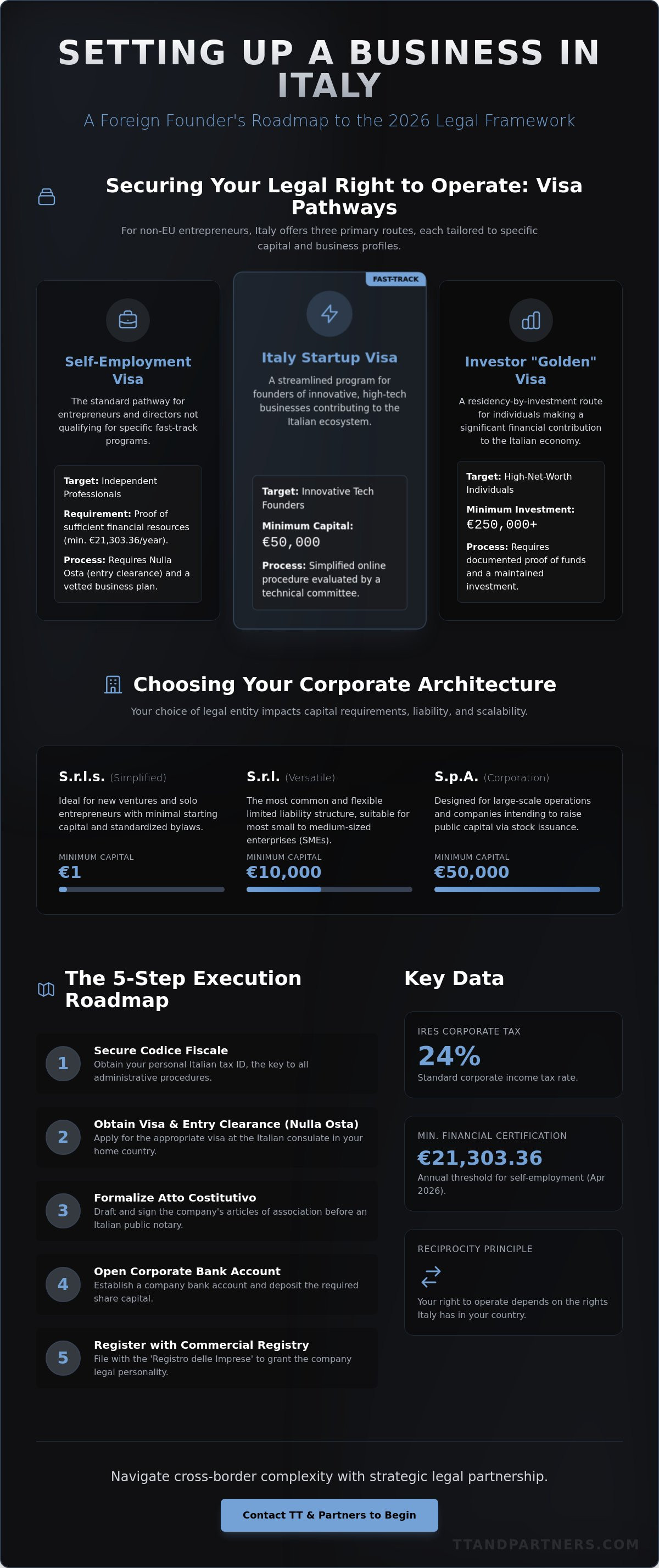
The structural integrity of a new venture depends on the legal standing of its founders. When setting up a business in Italy as a foreigner, your immigration status isn't a secondary concern; it's the foundation upon which your corporate entity rests. For non-EU entrepreneurs, the 2026 legal landscape offers three primary pathways: the Self-Employment Visa, the Italy Startup Visa, and the Investor Visa. Each route requires a specific alignment of capital, professional qualifications, and intent. Understanding the EU business guidance for Italy is essential to ensure your entry strategy complies with both national and Union-wide regulations. The choice between these pathways dictates the speed of your market entry and the complexity of your initial filing.
The Italy Startup Visa remains a highly efficient fast-track for innovative entrepreneurs. It requires a minimum capital investment of €50,000, as confirmed in January 2026. This program targets high-tech ventures that contribute to the Italian "innovative startup" ecosystem. Alternatively, the Investor Visa, often called the "Golden Visa," provides a route for those with significant capital. Minimum thresholds include €250,000 for innovative startups or €500,000 for an Italian limited company. These pathways offer streamlined procedures compared to traditional routes, though they demand rigorous documentation of the funds' origin and the business's potential impact on the local economy.
The Self-Employment Visa Pathway
For those not fitting the "innovative" criteria, the Visto per Lavoro Autonomo is the standard mechanism. This process begins with obtaining a "Nulla Osta" (Certificate of No Impediment) from the local Chamber of Commerce. You must prove professional qualifications and demonstrate financial resources exceeding three times the annual social allowance. As of April 7, 2026, this financial requirement is set at €21,303.36. Availability is governed by the Decreto Flussi, an annual decree that sets quotas for foreign workers. Securing a spot within these quotas requires precision in timing and documentation, as the window for applications can close rapidly once limits are reached.
Residency Permits and Long-term Compliance
Entry into Italy is only the first phase of your legal presence. Within eight working days of arrival, you must apply for the Permesso di Soggiorno (residency permit) at the local Questura. This document legitimizes your stay and allows you to manage your business operations locally. Maintaining this status requires consistent business activity and tax compliance. For entrepreneurs managing interests between the United States and Europe, understanding the E-2 Visa Guide 2026 can provide valuable context on how these jurisdictions interact. If you're navigating these dual requirements, our team can help you design a compliant residency strategy that supports your long-term commercial vision.
Structural Architecture: Choosing the Right Italian Corporate Form
Selecting a corporate vehicle is a deliberate act of long-term design. It requires more than a simple registration; it involves choosing a structure that supports both current operations and future growth. When setting up a business in Italy as a foreigner, the Società a Responsabilità Limitata (S.r.l.) stands as the most versatile option. It provides a robust shield for shareholders while allowing for a highly customized governance model. In 2024, limited liability companies saw a 3.25% growth, reflecting their dominance in the Italian market. Whether you're launching a boutique consultancy or a high-tech manufacturing facility, the corporate form you select will dictate your tax liabilities, such as the 24% IRES, and your relationship with local creditors.
The SRL vs. SRLS Debate
The choice between a standard S.r.l. and a Simplified S.r.l. (S.r.l.s.) often centers on initial capital and governance flexibility. A standard S.r.l. can be established with as little as €1, though capital below €10,000 requires a specific portion of profits to be set aside for a legal reserve. This structure offers maximum flexibility in drafting bylaws, which is vital for international partnerships that require tailored voting rights or exit strategies. Conversely, the S.r.l.s. is restricted to a capital range of €1 to €9,999 and uses a rigid, non-modifiable statutory template. For those familiar with American structures, our guide on LLC Incorporation offers a comparative lens. While the S.r.l.s. reduces initial notary fees, the standard S.r.l. remains the preferred choice for sophisticated corporate architecture due to its adaptability to foreign shareholder needs.
Branch Offices and Representative Offices
For established international firms, the decision often rests between a subsidiary and a branch. A branch office is not a separate legal entity; the foreign parent company remains fully liable for all Italian obligations. While this can simplify some internal accounting, it exposes the headquarters to local risks. A Representative Office serves a narrower purpose, limited to promotional activities and market research. It doesn't allow for direct sales or commercial transactions but avoids the complexities of Italian corporate tax residency. Larger ventures requiring significant capital injections often turn to the Società per Azioni (S.p.A.), which requires a minimum capital of €50,000 and is designed for complex governance and potential public listings. Each structure carries distinct implications for your 2026 fiscal strategy and the functional longevity of your Italian presence.
The 5-Step Execution: From Tax Code to Commercial Registry
The transition from a conceptual strategy to an operational entity requires a sequence of precise administrative actions. Setting up a business in Italy as a foreigner is a process of legal assembly where each step must be completed in a specific order to ensure structural integrity. The sequence begins with the acquisition of a Codice Fiscale (Tax Identification Number) for all directors and shareholders. This unique identifier, issued by the Agenzia delle Entrate, is the prerequisite for every subsequent legal act, from signing contracts to opening corporate bank accounts. Without this foundational element, the bureaucratic framework cannot be accessed.
Following the tax identification, the focus shifts to the digital infrastructure of the business. Every Italian company must maintain a Posta Elettronica Certificata (PEC), a certified email address that carries the legal weight of a registered letter. Additionally, all directors must obtain a digital signature kit compliant with Italian standards. These tools are not merely conveniences; they are the primary channels for communication with the Chamber of Commerce and the Tax Authority. Once these digital assets are in place, the initial capital must be deposited. For a standard S.r.l., founders typically deposit at least 25% of the share capital into a local bank account before the formal act of incorporation occurs.
The Role of the Italian Notary
The Italian Notary is a public official who acts as the architect of the company’s legal birth. Unlike in common law jurisdictions, the notary carries the responsibility of verifying that the Atto Costitutivo (Deed of Incorporation) and the Statuto (Bylaws) strictly comply with Italian law. During this phase, the notary performs rigorous Anti-Money Laundering (AML) checks, particularly when foreign capital is involved. As of January 2026, notary fees for a standard S.r.l. are estimated between €1,500 and €2,000. Their intervention concludes with the execution of the public deed, which is then submitted to the commercial registry.
Post-Incorporation Compliance
The signing of the deed is followed by the activation of the Partita IVA (VAT number) and the final registration in the Registro delle Imprese (Chamber of Commerce). This registration involves a Trade Register Fee, which was confirmed at a maximum of €520 in March 2026. At this stage, the role of the "Commercialista" (certified accountant) becomes indispensable. They manage the mandatory registrations with INPS for social security and INAIL for workplace insurance. Initial accountant fees for this setup phase generally average around €1,000. Maintaining these filings is a continuous requirement to ensure the company remains in good standing. If you require assistance with the technicalities of these filings, you can consult our corporate specialists to ensure every detail of your incorporation meets the 2026 standards.
Navigating Cross-Border Complexity with TT and Partners
Establishing a commercial presence in Italy is an exercise in structural harmony. It requires more than just meeting the 2026 regulatory minimums; it demands a bridge between the specificities of Italian civil law and the expectations of international corporate governance. Setting up a business in Italy as a foreigner often reveals a gap between vision and execution. Our "Legal Architect" approach treats your business entity like a well-designed structure. We ensure that the foundation, from your initial tax identification to your long-term residency status, is built to withstand the pressures of cross-border operations. This holistic perspective prevents the bureaucratic friction that often stalls international expansion.
Our partnership model integrates immigration, corporate law, and fiscal strategy into a single, cohesive workflow. This eliminates the need to coordinate between disconnected providers. We manage the dialogue between the Italian Ministry of Enterprises and your global headquarters, ensuring that every document, from the Atto Costitutivo to the Permesso di Soggiorno application, serves a unified purpose. By aligning your corporate architecture with your personal immigration goals, we create a functional environment where innovation can thrive without legal distraction. Precision in these early stages defines the longevity of your Italian venture.
Why a Cross-Border Specialist is Essential
Operating across jurisdictions introduces risks that standard local firms might overlook. Contractual disputes or misunderstandings of Italian labor laws can lead to significant setbacks. Our expertise in International Litigation allows us to anticipate these challenges before they manifest. We provide strategic tax planning that considers the 24% IRES rate alongside your existing international obligations. This foresight is critical for maintaining compliance while optimizing your global fiscal footprint. We don't just solve problems; we design systems that prevent them from occurring in the first place.
Start Your Italian Journey Today
Whether you're an individual entrepreneur or a large corporate group, your market entry deserves a personalized strategy. Our team provides full-service support that extends from the initial visa application to the final real estate closing. We understand that setting up a business in Italy as a foreigner is a transformative step for your organization. We offer the professional counsel necessary to mitigate bureaucratic risk and ensure a seamless transition into the Italian economic fabric. Your vision for an Italian legacy requires a foundation of absolute legal clarity. You can schedule a consultation with our US-Italy legal experts to begin designing your path to success in 2026.
Building Your Italian Legacy
Establishing a commercial presence in the Mediterranean requires a deliberate alignment of corporate architecture and immigration law. We've detailed how navigating the Reciprocity Principle and meeting the €21,303.36 financial threshold are essential milestones for success in 2026. Setting up a business in Italy as a foreigner isn't just about filing paperwork; it's about designing a functional, compliant entity that supports your long-term vision. Whether you're selecting an S.r.l. structure or applying for an innovative startup visa, each decision must be made with precision and foresight.
Our team brings specialized US-Italy cross-border expertise to every project. We provide comprehensive support across immigration and corporate law, drawing on a proven track record of securing residency permits for international founders. We'll help you bridge the gap between jurisdictions with the same care an architect applies to a landmark building. Contact Tosolini, Toniutti & Partners for expert guidance on your Italian business setup. Your entrepreneurial journey in Italy starts with a foundation of absolute legal clarity and strategic design.
Frequently Asked Questions
Can a foreigner own 100% of a company in Italy?
Yes, a foreigner can own 100% of an Italian company provided the Reciprocity Principle between Italy and their home country is satisfied. This legal condition ensures that Italian citizens are granted similar rights in the founder's jurisdiction. While approximately 50% of Italian entities are registered as sole proprietorships, the limited liability structure remains the preferred choice for full foreign ownership due to its robust legal protections.
How much capital do I need to start an SRL in Italy in 2026?
You can establish a standard S.r.l. with as little as €1 in share capital as of March 2026. However, if your starting capital is below the €10,000 threshold, the law requires you to allocate 20% of annual profits to a legal reserve until the total reaches €10,000. For larger operations requiring complex governance, the S.p.A. structure requires a confirmed minimum capital of €50,000.
Does starting a business in Italy automatically grant me a visa?
No, incorporating an entity does not automatically grant a residency permit or a visa. Setting up a business in Italy as a foreigner is a corporate action, while the right to live and work there is governed by specific immigration quotas. You must separately apply for a Visto per Lavoro Autonomo or an Innovative Startup Visa to legally reside and manage your operations in the country.
What is the "Codice Fiscale" and how do I get one as a non-resident?
The Codice Fiscale is a unique alphanumeric tax identifier essential for every legal and fiscal transaction within the Italian territory. Non-residents can obtain this code through the Italian Consulate in their home country or via the Agenzia delle Entrate within Italy. It's the first technical requirement for any director or shareholder involved in the incorporation process and precedes the opening of any bank account.
How long does the entire process of setting up a company in Italy take?
The technical incorporation of a company typically takes 2 to 3 weeks once all preliminary documentation is finalized. This timeline includes the meeting with the notary and the subsequent registration in the Italian Business Register managed by the Chamber of Commerce. Obtaining the necessary visas and residency permits can extend the overall timeline by several months depending on the specific quota availability in 2026.
Do I need to be physically present in Italy to incorporate a business?
Physical presence is not strictly required if you grant a Power of Attorney to a legal representative. This allows a professional to sign the public deed of incorporation before the notary on your behalf. However, you'll still need to visit Italy later to finalize your residency permit within eight working days of your arrival. Digital signature kits also facilitate many administrative steps from abroad.
What are the ongoing maintenance costs for an Italian company?
Maintenance involves the 24% IRES corporate income tax and the 3.9% IRAP regional production tax as confirmed in early 2026. You must also account for annual Chamber of Commerce fees, which can reach up to €520, and the mandatory services of a Commercialista for accounting. These costs ensure your entity remains compliant with the evolving Italian fiscal framework and the annual filing obligations.
Can I use my Italian business to sponsor employees from my home country?
Yes, an Italian entity can sponsor foreign employees, but the process is subject to the annual quotas defined by the national government. Setting up a business in Italy as a foreigner allows you to access the "Decreto Flussi" for hiring non-EU staff. Highly skilled workers may also qualify for the EU Blue Card, which offers a more streamlined path outside the standard annual quota system.


Comments