

The 1948 Case for Italian Citizenship: A Strategic Legal Guide for 2026
- Gianni Mendes Toniutti, Esq.

- Jun 21
- 12 min read
What if the historical discrimination that once barred your female ancestors from passing on their heritage is actually your most reliable path to an EU passport today? You likely feel the weight of confusion over Italy's shifting legal landscape, especially following the 2025 Tajani Decree and the "minor issue" that continues to cause anxiety for many descendants. It's natural to worry that a century-old technicality might block your path, particularly as administrative routes become increasingly restricted to just two generations.
This guide will show you how a 1948 case for Italian citizenship serves as a sophisticated judicial tool to reclaim your rights, navigating the complexities of the local courts with surgical precision. We'll explore the strategic advantages of the 2026 legal climate, the impact of recent Court of Cassation rulings on consular delays, and the exact steps required to establish a permanent legacy for your family through expert litigation. By the end, you'll understand why judicial action is the most visionary approach to securing your place in the Italian community and ensuring global mobility for future generations.
Key Takeaways
Understand how a 1948 case for Italian citizenship serves as a sophisticated judicial remedy for historical gender discrimination, restoring heritage rights through the maternal line.
Navigate the decentralized judicial framework where regional district courts now hold jurisdiction based on your ancestor's specific place of birth rather than a centralized court in Rome.
Explore the strategic benefits of collective litigation, which allows multiple family members to join a single proceeding for a more efficient path to an EU passport.
Uncover the latest 2026 legal trends concerning the "minor issue" to ensure your documentation survives the evolving scrutiny of the Italian Court of Cassation.
Recognize the essential role of specialized cross-border representation in translating complex international records into successful judicial outcomes within the Italian legal system.
Table of Contents
What is a 1948 Case for Italian Citizenship?
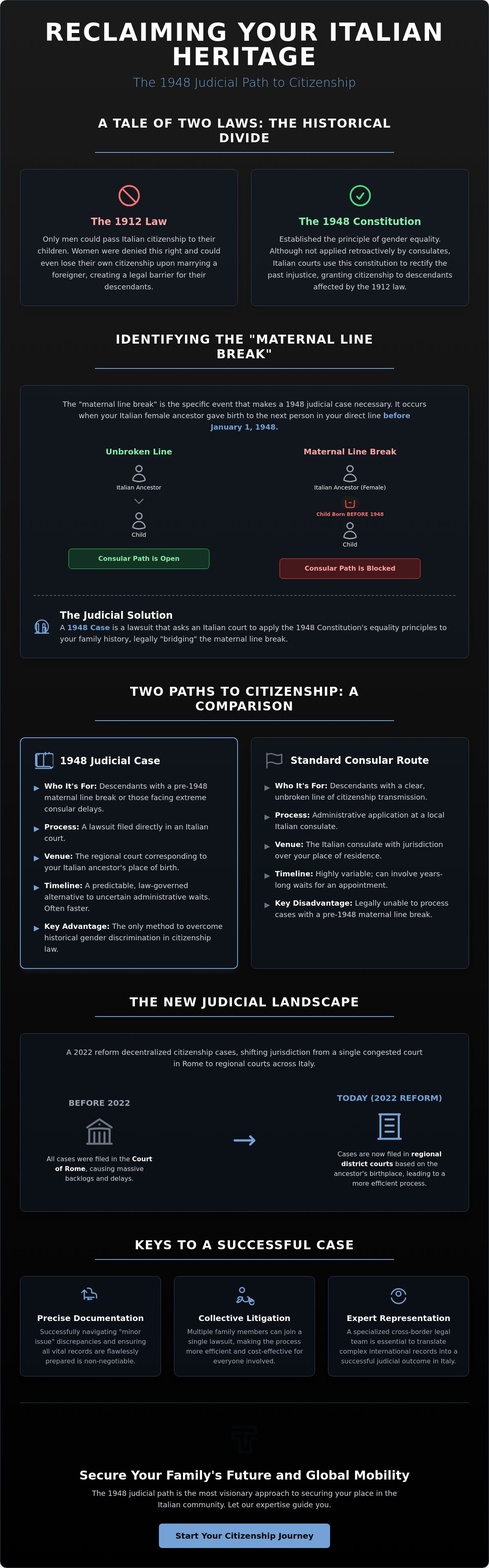
A 1948 case for Italian citizenship is a specialized judicial proceeding designed to rectify a historical injustice rooted in gender discrimination. Under the previous legal framework established by the 1912 Law on citizenship, only men possessed the legal capacity to transmit their nationality to their children. Women who married non-citizens often saw their own rights stripped away; they were strictly prohibited from passing their heritage to any children born within those unions. This created a profound legal disconnect for descendants who, despite their deep ancestral ties, found themselves excluded from their rightful heritage based solely on the gender of their ancestor. It was a systemic denial of identity.
The landscape of Italian nationality law changed fundamentally on January 1, 1948, with the adoption of a new Constitution that championed equality for all citizens. While this document established that women should have the same rights as men, the administrative authorities refused to apply these principles to children born before the Constitution took effect. This rigid interpretation forced descendants to seek justice through the court system rather than through a consulate. By initiating a lawsuit, applicants can challenge the outdated 1912 statutes and secure recognition through a judge's decree. This process transforms a historical exclusion into a modern legal victory.
The Maternal Line Break Explained
A maternal line break occurs specifically when an Italian female ancestor gave birth to her child before January 1, 1948. If your family tree contains this specific sequence, the administrative path to citizenship is effectively closed because consulates are bound by the law as it existed at the time of birth. A 1948 case for Italian citizenship provides the only viable solution, allowing a judge to apply modern constitutional standards to your family history and restore the transmission of rights that was previously denied by discriminatory legislation. It's the essential bridge to your past.
The 1912 Law vs. The 1948 Constitution
The 1912 Law was anchored in the doctrine of family unity, which essentially subsumed a woman's legal identity under that of her husband. This often meant her citizenship was tied to his status, regardless of her own wishes or heritage. In stark contrast, Article 3 of the 1948 Constitution mandates that all citizens are equal before the law without distinction of sex. The 2009 ruling by the Supreme Court of Cassation serves as the definitive turning point for gender equality in Italian citizenship law, establishing that the discriminatory provisions of the 1912 law could no longer prevent the transmission of heritage through the maternal line. For those navigating these complex historical and legal waters, the strategic guidance offered by Tosolini, Toniutti & Partners ensures your claim is built on a foundation of intellectual rigor and professional precision.
The Judicial Framework: Navigating Italian Courts in 2026
The Italian judicial system underwent a transformative shift in 2022 that redefined how descendants engage with their heritage. Before this reform, the Court of Rome served as the exclusive venue for every 1948 case for Italian citizenship, leading to significant administrative congestion and prolonged wait times. Today, jurisdiction follows a decentralized model where the specific municipality of your ancestor's birth determines the court venue. This structural change means your case is heard by a judge in the regional district court associated with that specific municipality, allowing for a more distributed and often more efficient legal process.
This regional distribution has fundamentally altered processing speeds as we move through 2026. While the Court of Rome remains an option for those whose ancestors were born abroad to Italian parents, most applicants now find their cases moving through regional capitals like Naples, Palermo, or Venice. This shift has balanced the judicial workload across Italy, frequently resulting in a faster path than the standard administrative route. A landmark May 12, 2026, ruling by the Court of Cassation further solidified this path, affirming that applicants facing extreme consular backlogs have the right to seek direct judicial intervention. When consular appointments are booked years into the future, the court system offers a predictable, law-governed alternative.
Determining the Correct Venue
Determining the correct venue requires identifying the exact Italian municipality where your lineage began. The District Court in the regional capital serving that municipality now holds the authority to recognize your citizenship. This localized approach allows for a more focused review of your family's historical records. It's a strategic advantage; many regional courts currently demonstrate faster turnaround times and greater judge availability than the larger metropolitan centers. Understanding these geographic nuances is vital for a successful filing.
The Litigation Timeline
The litigation process is a journey of precision and patience. It begins with Phase 1, where you collect vital records and secure expert legal translations to bridge the gap between international documents and Italian court standards. Phase 2 involves the formal filing of the appeal and the subsequent hearing where your legal representative argues the merits of your claim based on constitutional equality. The process culminates in Phase 3 with the final judgment. Once the judge's ruling is finalized, it's registered in the Italian municipality, officially restoring your status. For those navigating these technical parameters, seeking expert legal counsel ensures every detail aligns with the current judicial standards.
1948 Case vs. Consular Jure Sanguinis
Choosing between the administrative path at a consulate and the judicial path in the Italian courts is a decision that defines the trajectory of your citizenship journey. While the standard jure sanguinis process relies on the efficiency of Italian consulates, these institutions often face overwhelming backlogs that can delay recognition for years. In contrast, a 1948 case for Italian citizenship bypasses the consular "bottleneck" entirely by placing your claim directly before a judge. This judicial route isn't just a workaround; it's a sophisticated legal strategy that offers a structured timeline and a level of finality that administrative officers simply cannot provide.
One of the most compelling advantages of the judicial path is the lack of a travel requirement. Your presence in Italy is not necessary. An Italian-qualified attorney represents you throughout the proceedings, managing everything from the initial filing to the final decree. When you weigh the investment of legal fees against the years of uncertainty inherent in the consular system, the court route often emerges as the more pragmatic choice. This is especially true given that consular fees rose to €600 per adult applicant in 2025, matching the court's filing fee per petitioner. The judicial path allows you to trade administrative frustration for a law-governed process with predictable phases.
Efficiency and Scalability
The judicial route is uniquely scalable, allowing siblings, cousins, and other descendants of the same ancestor to join a single lawsuit. This collective approach distributes the legal costs across the group, making the process significantly more accessible for large families. While a consular officer's decision can sometimes feel subjective or influenced by changing internal policies, a court decree is the most secure form of citizenship recognition because it is a binding judicial act that administrative authorities cannot easily challenge. It provides a permanent legal foundation for your family's future.
When the Judicial Path is Mandatory
In many instances, the judicial path is the only available option. Consulates are legally barred from recognizing citizenship through the maternal line if the child was born before 1948, as they must follow the strict letter of the 1912 law. Court intervention is also necessary to overcome "involuntary naturalization" issues or complex lineage disputes that require deep legal analysis. By leveraging international litigation expertise, you can resolve these historical anomalies and secure the heritage that the administrative system is unable to acknowledge. If you are ready to begin this process, the first step is to contact our team for a precise evaluation of your family line.
Overcoming the "Minor Issue" and Document Hurdles
The "Minor Issue" is a sophisticated legal challenge that surfaces when an Italian parent sought naturalization in a foreign country while their child was still a minor. Under a rigid interpretation of historical statutes, this act was often viewed as a terminal break in the transmission of citizenship. However, within the framework of a 1948 case for Italian citizenship, we confront this obstacle by prioritizing constitutional protections over outdated administrative directives. The legal environment reached a defining moment on April 14, 2026, when the highest judicial authorities in Italy met to harmonize the standards for these specific scenarios, offering a more predictable path for descendants whose lineages were previously questioned.
Overcoming these hurdles requires a meticulous approach to document authentication. It's not enough to simply present records; one must ensure every piece of evidence is formatted and validated according to current judicial expectations. This involves obtaining long-form vital records and securing international authentication stamps for every document issued outside of Italy. Each record must then be accompanied by a certified translation that captures the technical nuances of the original text with absolute clarity. Without this level of precision, even the most compelling family history can be undermined by a simple clerical discrepancy or an outdated certification.
Strategic Defense Against the Minor Issue
Our legal strategy rests on the argument that a child born on foreign soil possesses an inherent right to their nationality that cannot be unilaterally extinguished by a parent's later actions. We assert that the 1912 law shouldn't apply to those who acquired their status through birthright citizenship. Rulings in the early months of 2026 have increasingly favored this perspective, affirming that the constitutional rights established in 1948 protect the lineage of those born before the parent's naturalization. We construct our appeals to proactively address these complexities, ensuring that the judge sees a continuous and valid chain of descent.
Document Precision and Authentication
Achieving successful recognition requires a document portfolio free of discrepancies. Minor errors in name spellings or birth dates can become significant obstacles if not addressed before the filing. In 2026, the criteria for verifying an ancestor's naturalization status have become more stringent, particularly regarding the "Certificate of Non-Existence" issued by immigration services. This document must account for every alias and name variation used by the ancestor during their lifetime. If you are concerned about inconsistencies in your family records, consult with our legal experts to ensure your evidence meets the rigorous standards of the Italian courts.
Why Expert Cross-Border Representation is Essential
The success of a 1948 case for Italian citizenship hinges on more than just genealogical research; it requires a sophisticated bridge between two distinct legal cultures. An Italian-qualified attorney is a mandatory requirement for litigation within the regional courts, yet the process begins thousands of miles away with the procurement of American records. Expert representation ensures that the narrative constructed in the United States perfectly aligns with the evidentiary standards of the Italian judiciary. This dual-system expertise is particularly vital when citizenship is one piece of a larger global mobility strategy. For many, reclaiming their Italian heritage is the first step toward balancing an international portfolio that might include an E-2 visa for business expansion or a Green Card to maintain ties in the US.
Managing these intersecting legal paths requires a firm that understands the nuances of both Mediterranean and North American law. We don't just process applications; we manage complex international transitions. The 2026 legal landscape, with its evolving requirements for "effective links" and regional court jurisdictions, demands a partner who can anticipate judicial shifts before they impact your case. This foresight transforms a standard lawsuit into a strategic act of legacy building. By bridging the gap between US document procurement and Italian litigation, we ensure that every apostille and translation serves a specific purpose in the eyes of the judge.
A Holistic Approach to Citizenship
Securing an EU passport is a transformative milestone, yet it introduces new layers of complexity that extend far beyond the courtroom decree. Reclaiming your rights often triggers sophisticated considerations regarding global tax obligations, inheritance laws, and real estate acquisition within the European Union. A holistic approach ensures that your transition to dual residency is seamless, protecting your assets while maximizing the benefits of your new status. The peace of mind provided by professional immigration law experts allows you to focus on the future of your family rather than the minutiae of cross-border compliance.
Taking the Next Step
The first step toward reclaiming your heritage is a precise evaluation of your lineage to confirm your eligibility for a 1948 case for Italian citizenship. Given the increased scrutiny and the May 31, 2026, registration deadlines for certain minor children born before the 2025 reforms, starting the document search early is essential. Our team provides the intellectual depth and technical precision needed to navigate these high-stakes proceedings with confidence. We invite you to schedule a consultation with our dual-qualified experts to begin your journey toward a recognized Italian legacy.
Reclaiming Your Legacy in the New Era of Italian Law
The path to dual citizenship is no longer a mere administrative task; it's a strategic legal undertaking that requires intellectual precision and a deep respect for heritage. The transition to regional court jurisdiction and the shifting landscape of 2026 make it clear that a proactive approach is essential. A 1948 case for Italian citizenship offers more than just a passport; it's a definitive judicial recognition that secures your rights across generations. By bypassing the administrative bottlenecks of the consular system, you gain a predictable timeline and a binding court decree that stands as a permanent testament to your family's history.
Success in this arena depends on the quality of your representation. With decades of cross-border legal experience and a strategic presence in both the United States and Italy, our team provides the specialized expertise in complex international litigation required to navigate these high-stakes proceedings. We bridge the gap between historical records and modern judicial success with surgical accuracy. Secure your Italian heritage with a professional 1948 case assessment today. Your future as a citizen of the European Union is a visionary step toward global mobility and a lasting family legacy.
Frequently Asked Questions
What is the success rate of 1948 cases in Italian courts?
The success rate for these judicial proceedings remains exceptionally high due to the consistent application of the 2009 Supreme Court of Cassation precedent. Since the Italian judiciary has recognized the discriminatory nature of the 1912 law, judges almost universally grant citizenship when the documentation is precise and authenticated. Your victory depends on the integrity of your lineage records and the professional assembly of your evidence rather than judicial discretion.
Do I need to travel to Italy for a 1948 court case?
You don't need to travel to Italy at any point during the litigation process. Your Italian-qualified attorney represents you through a formal power of attorney, handling all filings and hearings on your behalf. This makes a 1948 case for Italian citizenship a highly efficient option for those living abroad who wish to reclaim their heritage without disrupting their professional or personal lives.
How long does a 1948 case take to complete in 2026?
The average processing time for these judicial proceedings in 2026 is estimated to be between 12 and 24 months. While regional variations exist following the 2022 decentralization reform, this timeline remains significantly faster than the multi-year wait times currently facing many Italian consulates. The efficiency of your specific regional district court and the complexity of your document portfolio will determine the final duration of your litigation.
Can my whole family be included in one 1948 case?
Multiple family members descending from the same Italian ancestor can join a single 1948 case for Italian citizenship. Siblings, cousins, and adult children can all be included in the same lawsuit, which allows you to share court filing fees and legal expenses. This collective approach is a strategic way to secure EU passports for an entire family branch simultaneously while ensuring a consistent legal outcome for all relatives.
What happens if my ancestor naturalized before their child was born?
If your Italian ancestor naturalized in another country before the next person in your line was born, the citizenship transmission was generally interrupted. This is because the ancestor was no longer an Italian citizen at the moment of the child's birth. However, we meticulously review naturalization dates and "No Records" certifications to ensure no alternative paths or legal exceptions apply to your specific family history before proceeding with litigation.
Is the "Minor Issue" still causing denials in 2026?
The "minor issue" remains a complex area of litigation in 2026, though recent rulings have trended in favor of descendants. The Italian Supreme Court's Joint Sections reviewed this topic on April 14, 2026, to provide greater clarity on whether a parent's naturalization should affect a minor child's rights. We use these latest judicial interpretations to build a robust defense for families affected by this specific historical scenario.
How much does a 1948 case cost compared to a consulate application?
While a judicial case involves legal fees for professional representation, it often proves more cost-effective for larger families than individual consulate applications. In 2025, court filing fees were set at €600 per petitioner, which aligns with the €600 per adult fee required by consulates for administrative applications. The ability to split legal costs among several family members in a single court proceeding often results in a lower per-person investment.
Can I apply for an Italian passport immediately after the court ruling?
You can apply for your Italian passport once the court's final decree is officially registered in your ancestor's municipality of birth. Following the judge's ruling, there is a mandatory waiting period for the judgment to become final, known as passaggio in giudicato. Once the comune records your birth certificate in their civil registry, you can schedule an appointment at your local consulate to receive your passport.


Comments