

Title Insurance for Foreign Buyers in the USA: A Strategic 2026 Guide
- Gianni Mendes Toniutti, Esq.

- Jul 4
- 12 min read
Updated: Jul 16
A U.S. real estate deed is not a final guarantee of ownership; it is merely a historical record that remains vulnerable to the shadows of unseen legal claims. For an international investor, the decentralized nature of American public records often feels like a labyrinth where a single overlooked lien or a fraudulent signature from decades ago can jeopardize millions in capital. You likely understand that securing a physical asset is only half the battle, as the true value lies in the clarity of its legal title. This is why obtaining title insurance for foreign buyers in USA has evolved from a closing formality into a critical jurisdictional shield for your portfolio.
You deserve a seamless transition into the American market that respects both your time and your long term residency goals. This guide provides a strategic overview of the 2026 landscape, including the impact of new FinCEN reporting mandates and evolving state level ownership restrictions in markets like Florida and Texas. We will detail how robust title protection ensures your equity remains untainted, facilitating a smooth real estate closing that aligns with the rigorous standards required for future visa applications. By the end of this analysis, you'll possess the clarity needed to transform institutional complexity into a secure, visionary investment.
Table of Contents
What is Title Insurance for Foreign Buyers in the USA?
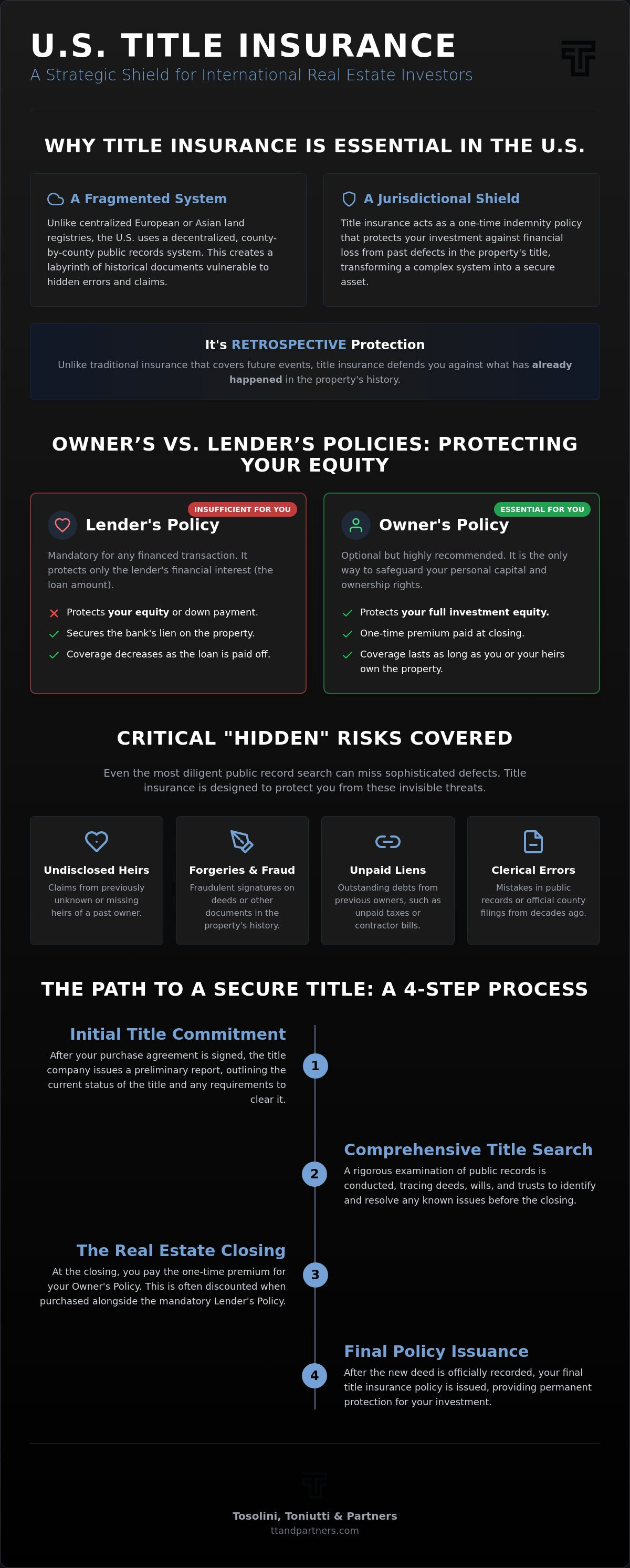
Unlike the centralized land registries found across much of Europe or Asia, the United States operates on a fragmented, county level recording system. This decentralization creates a unique risk profile for international investors who are accustomed to state guaranteed titles. In the American context, title insurance serves as an indemnity policy that protects against financial loss resulting from defects in the property’s title that existed before the policy was issued. While traditional insurance models for health or property damage manage future risks, this retrospective model looks backward. Understanding What is Title Insurance? requires shifting your perspective from what might happen to what has already occurred in the property's chain of ownership.
One of the most distinct advantages of this protection is the cost structure. Investors pay a one time premium at the moment of the real estate closing, which then provides coverage for as long as they or their heirs hold an interest in the property. There are no monthly renewals or annual fees. This single payment acts as a permanent safeguard for your capital, ensuring that historical errors in public records don't manifest as modern financial liabilities. For those seeking title insurance for foreign buyers in USA, this policy is the primary mechanism for transforming a localized, paper based recording system into a secure, institutional grade asset.
The Role of the Title Search in US Acquisitions
Before a policy is ever issued, a rigorous examination of public records is performed to establish a marketable title. This term signifies that the property is free from reasonable doubt and can be sold again without the threat of litigation. The search traces deeds, wills, and trusts back through decades to ensure every previous transfer was lawful. However, even the most diligent search cannot uncover hidden defects. Forgery, undisclosed heirs, or clerical errors in a county office can remain dormant for years. Title insurance exists specifically to bridge the gap between what a search reveals and the risks that remain invisible to the naked eye.
Why Foreign Nationals Face Unique Title Challenges
International transactions introduce layers of complexity regarding identity verification and corporate authority. Verifying the legitimacy of a seller’s documents from across the globe is a significant hurdle for US title companies. This is particularly true when dealing with absentee owners or entities that lack a physical footprint in the States. Many investors choose to mitigate these risks by purchasing through a US LLC, which provides a structured legal framework for the acquisition. In these scenarios, title insurance for foreign buyers in USA becomes an essential component of the investment architecture, providing the necessary peace of mind to deploy capital into an unfamiliar legal environment.
Owner’s vs. Lender’s Policies: Protecting Your Investment Equity
Investors often encounter a critical point of confusion during the closing process: the distinction between the mandatory lender's policy and the highly recommended owner's policy. While both fall under the same insurance category, their functions are diametrically opposed. A lender's policy is a non-negotiable requirement for any financed transaction in the United States. It exists solely to ensure the bank's lien remains the primary claim against the property. Conversely, an owner's policy is the only instrument that protects your personal capital. For those navigating title insurance for foreign buyers in USA, understanding that the bank's protection doesn't extend to the purchaser is the first step in a secure acquisition strategy.
One of the most compelling financial advantages of the American system is the "Simultaneous Issue" rate. When you purchase an owner's policy at the same time as the lender's policy, the title company often provides a significant discount on the combined premium. This strategic move allows you to secure comprehensive protection for a fraction of the cost of buying them separately. It's a precise way to maximize your closing budget while ensuring total coverage.
Lender's Title Insurance: The Bank's Safeguard
U.S. financial institutions require this policy to protect their mortgage interest against title defects that could invalidate their security. It's a diminishing form of coverage. As you pay down your mortgage, the policy's value decreases proportionally. It's vital to recognize that this policy offers zero protection for your down payment or any equity you build through market appreciation. If a title defect emerges, the bank's loan is covered, but your investment could vanish without a separate owner's policy.
Owner's Title Insurance: The Investor's Shield
An owner's policy is the definitive safeguard for your full purchase price. It remains in force for as long as you or your heirs retain an interest in the property. Beyond simple reimbursement for losses, it covers the legal fees required to defend your title in court. This is particularly relevant for international investors who may not have the local presence to manage complex litigation. For cash buyers, owner's coverage is the only legal barrier between your capital and historical property disputes. It's a lifetime of protection for a one time cost.
Ensuring your equity is fully shielded requires a precise approach to the closing table. If you're coordinating a high value acquisition, it's wise to consult with a specialist who understands the intersection of title law and international investment. This level of oversight ensures that your vision for a U.S. portfolio is built on a foundation of absolute legal certainty.
Critical Risks Covered: Fraud, Liens, and Undisclosed Heirs
The allure of the U.S. market often masks the intricate legal vulnerabilities inherent in property ownership. While a title search identifies many visible issues, the real danger lies in the hidden defects that no amount of public record scrutiny can reveal. For those securing title insurance for foreign buyers in USA, the policy acts as a financial backstop against these invisible threats. These risks aren't merely theoretical; they represent real world legal battles that can result in the total loss of property rights or significant financial settlements. In a system where the government doesn't guarantee title accuracy, the burden of protection rests entirely on the investor.
Protection Against Forgery and Impersonation
Sophisticated international scams frequently target remote transactions where the buyer and seller never meet. The scale of this risk is significant. In 2022, the FBI reported 11,727 victims of real estate fraud, resulting in $350 million in losses. A criminal might impersonate a property owner, forging a signature on a deed that appears perfectly legitimate to a county clerk. Without title insurance, a buyer who unwittingly purchases a property from a fraudster has no legal claim to the land once the true owner emerges. Your policy ensures that even if the deed is proven fraudulent, your financial investment is protected. This is indispensable for international investors who can't physically verify every notary or document in a distant jurisdiction.
Resolving Historical Liens and Encumbrances
Property in the U.S. often carries the legal baggage of its previous owners. These encumbrances can remain dormant for years before surfacing as a demand for payment. Common issues include:
Mechanic’s Liens: Unpaid bills for construction or renovations that attach to the property itself.
Tax Liens: Unpaid municipal or federal taxes that can lead to foreclosure if not cleared.
Undisclosed Heirs: Missing relatives from a past succession who emerge to claim their share of the estate.
Boundary Disputes: Errors in historical surveys that create conflicts with neighboring parcels.
The presence of these encumbrances can do more than just drain your finances; they can jeopardize your legal standing in the country. Maintaining a pristine title is especially relevant when your property acquisition is the basis for an E-2 Visa investment. U.S. immigration authorities require proof of a real and active investment. A title clouded by litigation or fraud can stall an application or lead to a denial. Securing title insurance for foreign buyers in USA ensures that your path to residency isn't blocked by a lien you didn't even know existed. It's a strategic choice to protect both your capital and your future vision in the United States.
The Closing Process: How to Secure Title Insurance
The transition from a signed purchase agreement to the final transfer of ownership is the most critical phase of your U.S. acquisition. This period, often called escrow or the closing process, is where the abstract promises of a contract are transformed into concrete legal protections. For those finalizing title insurance for foreign buyers in USA, the timeline typically spans 30 to 45 days. During this window, the title company acts as a neutral third party, coordinating the flow of funds and documents while conducting a deep forensic dive into the property's history.
While title insurance rates are often regulated at the state level, you shouldn't assume the choice of provider is outside your control. In states like Texas, Florida, and New Mexico, premiums are mandated by law. For example, Texas implemented new mandated rates on March 1, 2026. Despite these fixed costs, the buyer generally retains the right to select the title agent or attorney under federal law. For those investing in Texas, Massingill Attorneys & Counselors at Law can assist with the business and probate complexities that often accompany international acquisitions. Choosing a provider with specific expertise in international transactions ensures that nuances like FIRPTA withholding and cross-border entity verification are handled with professional precision.
Reviewing the Title Commitment
Before the final closing, you'll receive a Title Commitment or Preliminary Report. This document is a conditional promise to issue a policy, provided certain requirements are met. It also lists "exceptions," which are specific encumbrances or rights the policy won't cover, such as local utility easements or existing restrictive covenants. Your legal counsel must review these carefully. Clearing title defects, such as an unresolved lien from a previous contractor, is a non-negotiable prerequisite. You shouldn't initiate an international wire transfer until you've received confirmation that the title is "clear" and ready for insurance.
Who Pays for Title Insurance?
Responsibility for the title premium is a matter of local custom and negotiation. In many parts of Florida, the seller traditionally pays for the owner's policy, though this varies in counties like Miami-Dade. In Texas, it's frequently a seller expense, whereas in other jurisdictions, the buyer may shoulder the entire cost. Typically, these fees range from 0.5% to 1.0% of the purchase price. It's essential to include these figures in your initial investment budget to avoid surprises at the closing table. If you're preparing for a high-value acquisition, we recommend you contact our legal team to ensure your closing costs are accurately projected and your interests are fully represented.
Strategic Legal Oversight for International Transactions
While a real estate agent is vital for identifying market opportunities, they aren't a substitute for legal counsel when it comes to the structural integrity of your acquisition. Attorneys provide a level of fiduciary duty that agents simply don't, especially when interpreting the fine print of a title commitment. For an international investor, the intersection of title insurance for foreign buyers in USA and tax compliance is where the most significant risks reside. A primary example is the Foreign Investment in Real Property Tax Act (FIRPTA). If a previous foreign seller failed to comply with the 15% withholding requirement on a sale over $1 million, the IRS can pursue the property itself to satisfy the debt. Your title policy, backed by professional legal oversight, ensures that these historical tax liabilities don't become your personal burden.
Strategic foresight also dictates that you plan for the exit before you even close the entry. A clear title is the absolute prerequisite for any future resale or property refinancing. U.S. lenders will refuse to provide capital for a refinance if the title reflects unresolved encumbrances, and sophisticated buyers will walk away from a deal if the chain of ownership is broken. By securing a robust owner's policy today, you're essentially pre-clearing the path for your future liquidity. This protection connects directly to your broader asset protection goals, ensuring that your U.S. holdings remain a stable component of your global estate.
Coordinating with Cross-Border Legal Experts
The efficacy of your title protection depends heavily on how well it aligns with your LLC structure. If the policy isn't correctly titled in the name of your specific entity, you risk a gap in coverage that could prove fatal during a claim. There's an immense strategic advantage in having a single firm manage both your immigration strategy and your real estate closing. This holistic approach ensures that your property records perfectly mirror the requirements for your visa status, creating a seamless narrative for federal authorities. To ensure your investment architecture is sound, we invite you to use this link to contact Tosolini, Toniutti & Partners for dedicated closing support.
Title Insurance as a Foundation for US Investment
Ultimately, title insurance for foreign buyers in USA represents the definitive peace of mind in a decentralized legal environment. When you consider that combined lender and owner fees can be as low as $358 in some jurisdictions, the premium is negligible compared to the catastrophic risk of a total loss of title. It's a one time investment that secures a lifetime of legal defense. Before you sign the final settlement statement, ensure a comprehensive legal review of all closing documents has been performed. This final layer of scrutiny transforms a simple real estate transaction into a resilient, vision driven asset within your portfolio.
Executing a Protected US Investment Strategy
The U.S. property market rewards those who prioritize legal precision over speed. By distinguishing between mandatory lender requirements and your personal equity protection, you've already mitigated the most significant financial risks. Integrating title insurance for foreign buyers in USA into your broader acquisition strategy ensures that historical liens or sophisticated forgery attempts don't compromise your capital. This foundation of clarity is essential not just for immediate ownership, but for the long term viability of your portfolio and future residency goals.
Navigating these cross-border complexities requires more than just a standard closing service. Our firm brings specialized expertise in US-Italy real estate, ensuring your title policy aligns perfectly with your LLC formation and immigration needs. Whether you require comprehensive litigation support or strategic asset structuring, we're here to guide your transition. Secure your US real estate investment with expert legal counsel—contact Tosolini, Toniutti & Partners today. Your journey into the American market deserves the certainty that only professional foresight can provide.
Common Inquiries Regarding U.S. Title Protection
Is title insurance mandatory for foreign buyers in the USA?
Title insurance is legally mandatory for any buyer obtaining a mortgage from a U.S. financial institution to secure the lender's position. While cash buyers aren't strictly required by law to purchase an owner's policy, it's considered an essential investment standard for international capital. Skipping this protection leaves your entire down payment and equity vulnerable to historical claims that a standard deed cannot block.
How much does title insurance typically cost for a US property?
You should budget between 0.5% and 1.0% of the property's purchase price for the total title insurance premium. Industry data indicates the national average is approximately $1,337 for a home priced at $318,000. In states like Texas, Florida, and New Mexico, these rates are regulated by the government; for instance, Texas implemented updated premium schedules on March 1, 2026.
Can I use an international insurance company for my US title policy?
No, you must use a title insurance provider licensed within the specific U.S. state where the property is located. U.S. real estate law is highly localized. Only domestic insurers have the direct access to county records required to perform a valid search and issue an enforceable policy. Using a domestic provider ensures your coverage meets the legal standards for title insurance for foreign buyers in USA.
Does title insurance cover the physical condition of the house?
Title insurance doesn't cover the physical structure, appliances, or environmental condition of the property. Its sole purpose is to protect the legal ownership rights to the land and buildings. You'll need a separate homeowners insurance policy and a professional property inspection to address risks like fire, flooding, or structural defects discovered after the purchase.
How long does a title insurance policy remain in effect?
An owner's title policy remains in full effect for as long as you or your heirs retain an interest in the property. Unlike other insurance products, there are no annual premiums or renewal fees after the initial payment at closing. The protection is permanent. It even covers you after you sell the property if a future buyer sues you for a defect that existed during your ownership.
What happens if a title defect is discovered years after the purchase?
If a hidden defect like a forged signature or an undisclosed heir emerges years later, the title company is contractually obligated to defend your ownership. They'll either pay the legal costs to clear the title in court or reimburse you for the financial loss up to the policy limit. This retrospective protection is why title insurance for foreign buyers in USA is a prerequisite for institutional grade investing.
Will title insurance protect me if the seller didn't pay their US taxes?
Yes, an owner's policy protects you from financial loss due to unpaid property taxes or federal tax liens that weren't discovered during the initial title search. If the IRS or a local municipality attempts to foreclose on your property for the previous owner's debts, the insurer must resolve the claim. This is a critical shield against the hidden liabilities of the U.S. tax system.
Do I need a new title policy if I transfer my property into a US LLC?
You should consult with legal counsel before transferring a property into a U.S. LLC, as this may require a specific endorsement to keep the policy active. While many modern policies include "permitted transferees," a change in the legal entity can sometimes be viewed as a transfer of title that terminates original coverage. Ensuring your LLC is correctly named as an additional insured preserves your asset protection framework.
Similarly, when dealing with California real estate, ensuring that assets are properly titled within a trust is vital for estate continuity; if a property was unintentionally left out, HEGGSTAD HELP provides the specialized Heggstad petition services needed to transfer it back into the trust without probate.


Comments