

Travel Permit for Green Card Applicants: Rules, Risks, and Next Steps

Could a document that lets you travel still leave your return uncertain? A travel permit for green card applicants can mean different documents, and approval does not guarantee admission to the United States. If your Form I-485 is pending, leaving without approved advance parole will generally put your application at risk of being treated as abandoned.
That uncertainty is understandable: a trip may be important, but the consequences can extend beyond travel plans. Advance parole may allow you to travel and seek parole at a U.S. port of entry. It does not assure re-entry, which is decided by U.S. Customs and Border Protection. Some people maintaining valid H-1B or L-1 status may be able to travel under an exception, but the details matter.
This guide explains which travel-document category may fit your immigration status, how advance parole differs from a re-entry permit or refugee travel document, and what risks and exceptions to assess before departure. It also outlines what to confirm in current USCIS instructions and with an immigration attorney, including whether you need an approved document in hand and how your individual history could affect your decision.
Table of Contents
What Is a Travel Permit for Green Card Applicants?
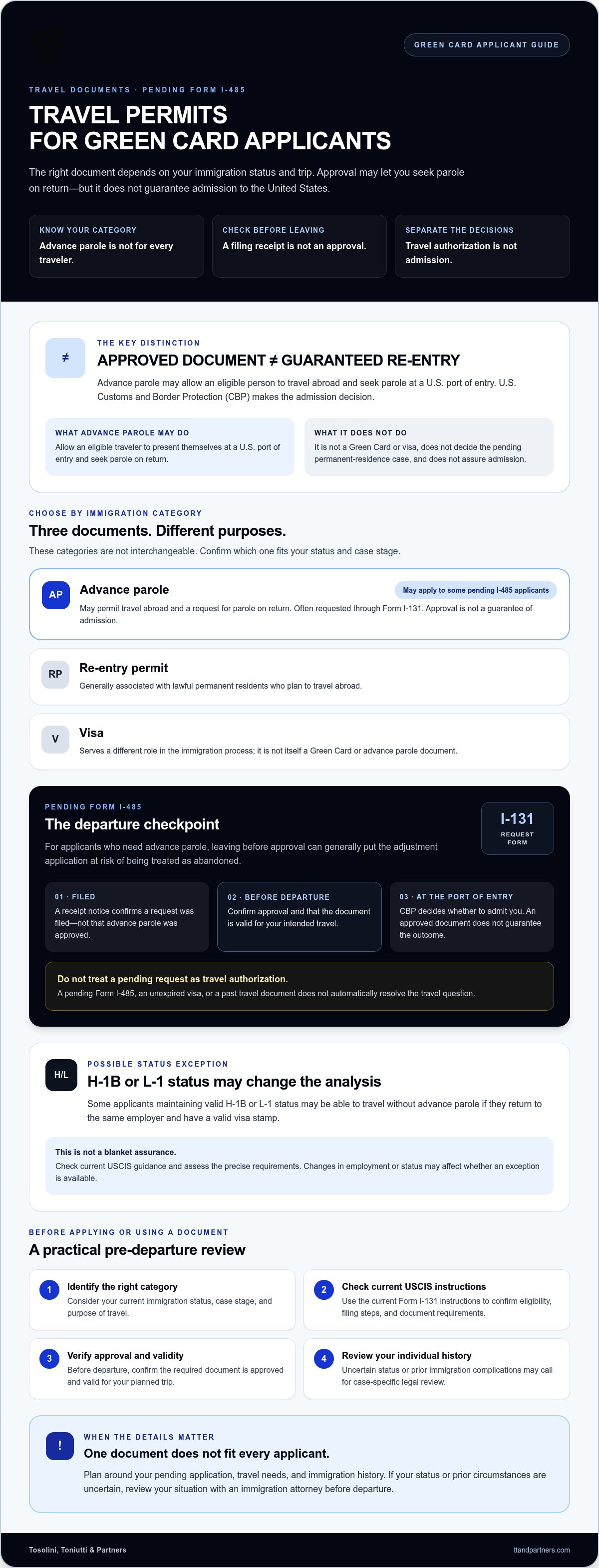
Advance parole is a travel document that may allow certain people with a pending adjustment of status application to leave the United States and seek parole upon return. It is not a Green Card, a visa, or a guarantee of admission. In this context, “travel permit for green card applicants” commonly refers to advance parole, but the appropriate document depends on your immigration category and the stage of your case.
People with a pending Form I-485 may be among those who request advance parole, generally through Form I-131. Filing the form, however, is not the same as receiving travel authorization. Before making plans, confirm your eligibility and current filing requirements with USCIS. A temporary travel document is distinct from an application for permanent residence; obtaining one does not determine whether that application will be approved.
What does advance parole allow a green card applicant to do?
Advance parole may allow an eligible applicant to travel abroad and present themselves at a U.S. port of entry to seek parole on return. It does not grant permanent resident status or decide the pending Green Card case. U.S. Customs and Border Protection (CBP) officers make the admission decision at the port of entry, so an approved document does not guarantee that a traveler will be allowed to return.
Keep these decisions separate when planning a trip: travel authorization and the final decision on permanent residence are different matters. Before departure, confirm that the document is approved and valid for your intended travel.
Is advance parole the same as a reentry permit or visa?
No. These documents serve different purposes and are not interchangeable. Advance parole may be relevant to some people seeking adjustment of status. A reentry permit is generally associated with lawful permanent residents who plan to travel abroad. A visa serves a different role in the immigration process and is not itself a Green Card or advance parole document.
The right category depends on your current status, case stage, and travel circumstances. Do not choose a document based only on its familiar name or someone else’s experience. Check the current USCIS Form I-131 instructions and confirm which category applies to your case before applying or departing.
How a Pending Green Card Application Affects Travel
A pending Form I-485 does not, by itself, authorize international travel. For applicants who need advance parole, leaving the United States before that authorization is approved can generally lead USCIS to treat the adjustment application as abandoned. The key distinction is that filing Form I-131 is only a request, not proof that advance parole has been granted.
The Cornell Law School Legal Information Institute describes advance parole as permission to re-enter the U.S. for certain people with pending immigration applications. For a travel permit for green card applicants, the practical checkpoint is whether the required document has actually been approved and is valid before departure, not simply whether a request is in progress.
Can leaving the United States affect Form I-485?
It can. If advance parole is required in your circumstances, departing before approval may put your pending Form I-485 at risk. A Form I-131 receipt notice confirms that you filed a request, not that it was approved. Check your case status and current USCIS instructions before booking travel, and confirm that the approved document covers your planned departure and return.
Do not assume that a pending case, an unexpired visa, or a past travel document automatically resolves the question. The relevant rule may depend on your current immigration category and case details. Verify those facts before leaving the country.
Do H-1B or L-1 status change the travel analysis?
Potentially. Some applicants maintaining H-1B or L-1 status may be able to travel without advance parole if they return to the same employer and have a valid visa stamp. These are conditions to assess, not a blanket assurance. Check current USCIS guidance to confirm the precise requirements and how they apply to a pending adjustment case.
If your status, employment, visa documentation, or adjustment application may overlap, obtain case-specific legal review before departure. A change in employment or status, for example, may affect whether an exception is available. For help assessing how travel could affect a Green Card case, consider seeking Green Card case guidance.
Individual facts can change the travel analysis. Prior immigration complications, the basis of the pending application, and the documents you hold may all matter. Confirm the rules for your situation with USCIS or an immigration attorney before making travel plans.
Advance Parole and Other Travel Options: What Applicants Should Compare
Start with your current immigration status and case stage. A pending adjustment applicant, a lawful permanent resident, and someone traveling with a visa may face different requirements. These documents serve distinct purposes, and choosing the wrong category can leave a gap in your travel plans. Use the USCIS Travel Documents page and current Form I-131 instructions to check which options may apply.
Which travel document may apply to your immigration category?
If you’re waiting for a Form I-485 decision, advance parole may be the category to investigate, but a pending application alone does not establish eligibility or authorize travel. A lawful permanent resident considering international travel is in a different position and may need to assess a reentry permit instead. The travel permit for green card applicants is not one universal document: confirm your category, case stage, and current USCIS instructions before applying or making plans.
Why approval still does not guarantee admission
An approved advance parole document is not a promise of admission. Consider three separate questions: Is the document valid for the planned travel? Could admissibility concerns affect the traveler? What will happen during inspection at the U.S. port of entry? U.S. Customs and Border Protection officers make admission decisions, and a comparison chart cannot predict the outcome in an individual case.
Travel urgency and case details also shape what to ask. Before deciding, verify the document’s validity, whether your current status changes the analysis, and whether your immigration history raises concerns that need individual review. A document’s purpose is not the same as a guarantee that every travel risk is resolved.
How to Prepare Before Applying for or Using a Travel Permit
Careful preparation can help you identify the right document and avoid treating a pending request as travel authorization. Form I-131 has different categories and requirements, so use the current USCIS instructions as your reference. Keep travel dates flexible until you have confirmed which document applies and, if required, received approval.
What should you verify before filing Form I-131?
Before submitting a request, confirm that the category matches your immigration status and the stage of your pending case. Check the latest USCIS travel document guidance and Form I-131 instructions for the applicable evidence, filing method, and submission requirements. Requirements can vary by category, so do not rely on an old checklist or another applicant’s experience.
1. Identify your category. Confirm whether you’re seeking advance parole based on a pending adjustment application or applying under another travel-document category.
2. Review your case stage. Check your Form I-485 status and gather relevant notices so you can assess how the request relates to your pending case.
3. Follow current instructions. Verify the required evidence and submission procedure against the latest USCIS materials before filing.
4. Keep plans provisional. Do not treat a submitted Form I-131 or an anticipated decision as permission to travel. Avoid fixed, nonrefundable plans until authorization is confirmed.
What should you check before departure and return?
Approval is only one part of preparation. Before leaving, confirm that the travel document is in hand and valid for your planned travel. Review your passport, immigration-status documents, and pending-case notices, and make sure you understand what you may need to present during your return journey. If your passport is nearing expiration and you need assistance updating it before departure, click here to explore passport renewal services. Keep relevant records accessible while traveling.
5. Recheck the details. Confirm the document’s validity dates and any instructions that apply to your travel before departure.
6. Consider personal risk factors. If you have prior immigration complications, a criminal record, or uncertainty about your status, seek individualized legal advice before traveling.
Travel plans can change, and a permit does not resolve every issue connected to a pending Green Card case. Reviewing your broader Green Card strategy and travel circumstances can help clarify which questions to address before departure. For case-specific Green Card guidance, contact the firm.
When Green Card Applicants Should Seek Immigration Counsel
A travel document can support travel in some circumstances, but it does not guarantee admission to the United States or protect every pending Green Card application from consequences related to departure. The right analysis depends on your status, case stage, travel documents, and immigration history. Case-specific legal advice can help you assess those facts, understand available options, and consider timing before you decide. It cannot guarantee a particular result.
When is a case-specific review especially important?
Seek individualized review before acting if you’re considering travel before authorization is confirmed, your immigration status may have changed, or you’re unsure whether an exception applies. A prior overstay, removal proceeding, or other immigration complication may also warrant careful assessment. None of these facts alone determines the outcome, but each could affect how travel interacts with your case.
The phrase “travel permit for green card applicants” can make the process sound straightforward. In practice, an attorney can help identify which details need verification and whether your proposed travel dates raise additional concerns. Avoid relying solely on another person’s experience or assuming an approved document resolves every issue.
What information should you bring to a consultation?
A clear record of your case makes the discussion more useful. Gather relevant documents and be prepared to explain your current status, travel plans, and prior immigration history. Consider bringing:
Receipt notices and other correspondence related to pending applications.
Current immigration documents, including any travel authorization you hold.
Your proposed departure and return dates, plus any flexibility in those plans.
A timeline of prior immigration events, including any overstay, removal proceeding, or status change.
Share relevant facts accurately, even if you’re unsure whether they matter. That context can help counsel identify questions to verify, potential risks to discuss, and appropriate next steps for your circumstances.
If you’re weighing travel while a Green Card case is pending, consider discussing your facts with the firm’s immigration team before making plans. Contact the immigration team to request a discussion about your case.
Make Your Travel Decision With Clarity
The right travel permit for green card applicants depends on your immigration category, case stage, and travel plans. Advance parole, a visa, and a reentry permit serve different purposes, so confirm which document applies before acting. If your pending adjustment case requires travel authorization, filing a request is not the same as having an approved, valid document.
Even with authorization, returning to the United States is not guaranteed. Review your documents, timing, and personal immigration history, and verify current USCIS instructions. If your status is uncertain, you have prior immigration complications, or you’re unsure whether an exception applies, case-specific advice can help you understand the questions and options relevant to your situation.
Tosolini, Toniutti & Partners handles Green Card and U.S. immigration matters, including cross-border legal services involving the United States and Italy. Discuss your immigration travel questions with the firm’s team. A review of your circumstances can help clarify the next steps to consider.
Frequently Asked Questions
Can I travel while my Green Card application is pending?
It depends on your adjustment application, immigration status, and whether you have required travel authorization or qualify for a verified exception. For many applicants with a pending Form I-485, leaving before advance parole approval can put the application at risk. A filed Form I-131 or receipt notice is not approval. The travel permit for green card applicants that may apply depends on your case, so check current USCIS guidance before booking or departing.
Do I need advance parole to travel outside the United States?
Some people with pending adjustment applications generally need approved advance parole before leaving the United States, but a status-based exception may apply in particular cases. Your current immigration category and case details determine what to verify. Do not treat a visa, pending application, or receipt notice as a substitute for travel authorization without confirmation. Review current USCIS guidance and get case-specific advice before setting travel plans.
Does filing Form I-131 mean I can travel?
No. Filing Form I-131 is a request for a travel document, not confirmation that it has been approved. Before departing, verify that the required authorization has been granted and remains valid for your planned travel, unless a confirmed exception applies to your case. Leaving before approval may have serious consequences for a pending adjustment application. Check current USCIS instructions and consult an immigration attorney if your situation is unclear.
Does advance parole guarantee that I can reenter the United States?
No. Advance parole may allow you to travel and seek parole when you return, but it does not guarantee admission to the United States. You remain subject to inspection, and case-specific admissibility concerns may be relevant. Keep the document’s validity, the inspection process, and the decision on your pending Green Card application separate. An immigration attorney can review relevant facts before you travel, though no one can promise a particular border decision.
Can H-1B or L-1 holders travel while a Green Card application is pending?
Some applicants maintaining qualifying H-1B or L-1 status may be treated differently under travel rules, but this is not a blanket exception. The details of your status, employment, travel documents, and case history matter. Verify current requirements before relying on an exception, including whether your circumstances meet them. If your status or travel plans are uncertain, seek individualized legal advice before departure rather than assuming your visa category makes travel risk-free.
Is advance parole the same as a reentry permit?
No. Advance parole is commonly relevant to certain people who are not yet permanent residents, including some applicants with pending adjustment cases. A reentry permit is generally associated with lawful permanent residents planning travel abroad. The documents have different purposes and eligibility rules, so they are not interchangeable. Check your current immigration category and the latest USCIS instructions to determine which travel document, if any, may apply to your situation.
What should I do if I need to travel urgently before my case is decided?
Contact USCIS or an immigration attorney promptly to ask whether emergency advance parole may apply and what current evidence or appointment procedures are required. Explain your circumstances and proposed travel dates, then confirm the decision and document status before leaving the United States. An urgent need does not guarantee authorization, and an unapproved application is not permission to travel. Keep plans flexible while you verify the process for your case.


Comments