

US Italy Business Dispute Lawyer: Strategic Litigation in 2026
- Gianni Mendes Toniutti, Esq.

- Aug 5
- 11 min read
With annual bilateral trade between the United States and Italy now surpassing $100 billion, the complexity of managing cross-border interests has reached a new peak. For many executives, the sudden realization that a contractual disagreement could trigger years of litigation or compromise a hard-won E-2 visa is a heavy burden. Partnering with a specialized US Italy business dispute lawyer isn't just a defensive move; it's a strategic necessity in a landscape where 2026 regulations, such as mandatory AI governance policies and updated Golden Power filings, dictate the terms of engagement.
You've likely felt the pressure of deciding which country's laws should apply while worrying about the high costs of international court battles. This article provides the expert strategies you need to master these legal conflicts and safeguard your commercial reputation. We'll preview the essential roadmap for dispute resolution in 2026, focusing on how to minimize financial exposure and protect your immigration standing through precise, visionary legal planning that bridges the gap between these two distinct legal traditions.
Table of Contents
Navigating the Complexity of US-Italy Business Disputes in 2026
A US-Italy business dispute is a conflict involving parties, assets, or contracts spanning both jurisdictions. As bilateral trade between these nations has surpassed $100 billion in 2026, the stakes for resolving these disagreements have never been higher. These conflicts require a specialized transatlantic approach because they exist at the intersection of two radically different legal philosophies. A professional US Italy business dispute lawyer must account for the 2026 Beneficial Ownership Register enforcement and the mandatory AI governance policies that took effect in March. Relying on a generalist often leads to procedural paralysis when you can least afford it.
Corporate transparency now plays a pivotal role in litigation. Since Q2 2026, the Registro dei Titolari Effettivi has been fully operational and subject to active enforcement. This means foreign entities with Italian branches face immediate administrative sanctions for outdated filings, a vulnerability that opposing counsel will quickly exploit. Understanding how the US-Italy tax treaty interacts with these new transparency mandates is essential for protecting your financial standing and business reputation during a conflict. This proactive alignment ensures that your corporate structure remains a shield rather than a liability.
The Legal Cultural Gap: Civil Law vs. Common Law
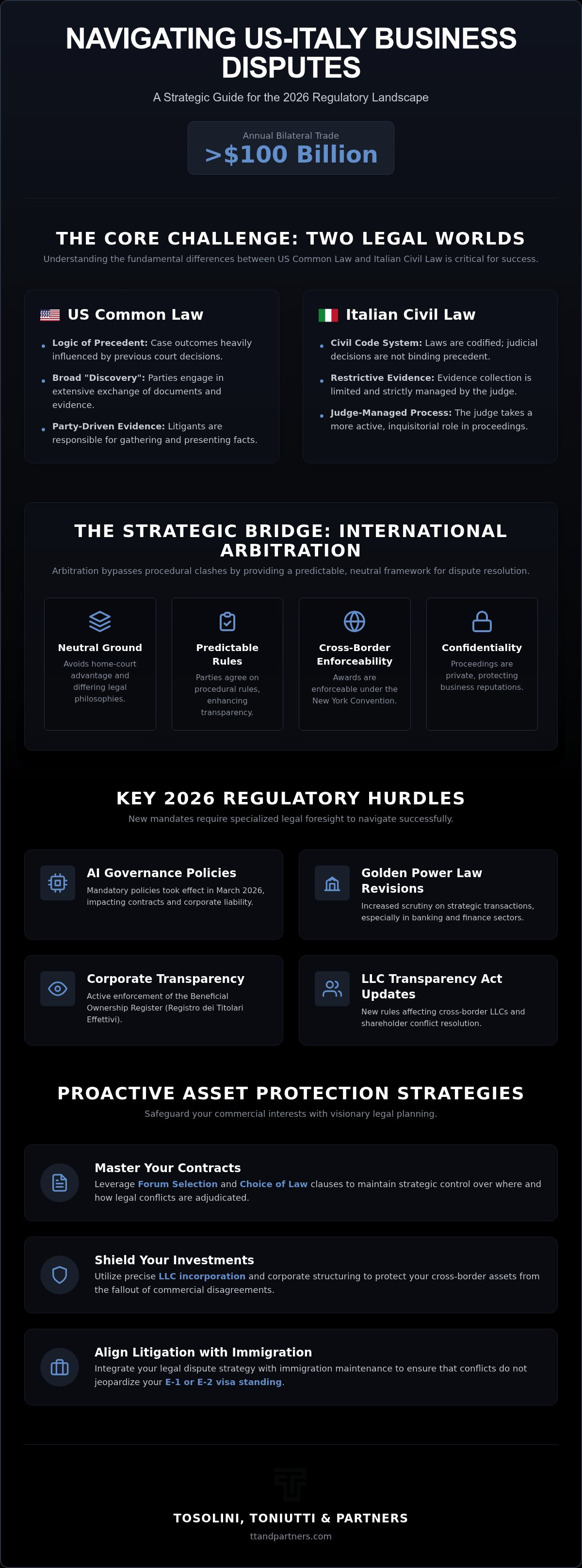
The friction between Italian civil law and US common law logic often defines the outcome of a case. In the US, the logic of precedent and broad "discovery" allows for an extensive exchange of documents. Italy's civil code system is much more restrictive; evidence is typically managed by the judge rather than the parties. This fundamental difference can shock US investors who expect a level of transparency that simply doesn't exist in the Italian court system. To bypass these procedural clashes, many firms lean toward international commercial arbitration. It offers a neutral ground where rules are predictable and awards are enforceable across borders under the New York Convention, providing a harmony that traditional courts may lack.
Common Triggers for Transatlantic Legal Conflicts
Most disputes in 2026 stem from specific operational shifts and regulatory updates. For instance, supply chain disruptions related to the Pax Silica initiative have tightened security and compliance for critical sectors like energy and semiconductors. We also see frequent shareholder conflicts within cross-border LLCs, often exacerbated by the 2026 updates to the LLC Transparency Act. Finally, real estate investment fallout remains a significant trigger, where FIRPTA requirements and local Italian property laws create complex tax liabilities that can derail a closing. If you're currently facing these challenges, reaching out to a US Italy business dispute lawyer is the first step toward a strategic resolution that protects both your assets and your long-term vision.
Strategic Jurisdictional Challenges and Choice of Law
The battle for jurisdictional control often begins long before a lawsuit is filed. In 2026, the Italian government's revision of the Golden Power Law on January 15 has added new layers to how strategic transactions are reviewed, particularly in the banking and financial sectors. These shifts mean that where you litigate is no longer just a matter of convenience; it's a matter of regulatory survival. A well-drafted choice of law clause can prevent years of jurisdictional litigation. It provides the clarity needed to bypass the "Forum Selection" battle, ensuring that parties aren't left guessing which legal system will govern their disagreement.
Determining the Competent Jurisdiction
When a contract is silent, US courts analyze "Personal Jurisdiction" by looking for "minimum contacts" an Italian entity has within a specific state. This often involves a deep dive into digital presence, physical offices, or the volume of trade. If a court finds the venue inappropriate, it may invoke the "Forum Non Conveniens" doctrine, dismissing the case in favor of a more suitable Italian court. Navigating these waters requires the precision of an experienced US Italy business dispute lawyer who understands the Hague Convention's strict requirements for cross-border service of process. Small procedural errors in serving an Italian defendant can derail a case for months.
Enforcing Foreign Judgments: From Italy to the US
Securing a victory in an Italian court is only half the battle. The next challenge is domestication. The United States doesn't have a federal treaty for the recognition of foreign judgments, meaning each state's individual laws apply. Common defenses against enforcement include claims that the original court lacked jurisdiction or that the judgment violates local public policy. According to the U.S. State Department on Italian Dispute Settlement, understanding the local judicial system's nuances is vital for any investor. Seeking expert international litigation support early in the process ensures that your Italian judgment is actually collectible in the US. The proactive guidance of a US Italy business dispute lawyer can help you manage these risks before they escalate into irreparable financial losses.
Alternative Dispute Resolution (ADR) vs. Traditional Litigation
Traditional litigation in the United States is often a public, protracted affair that can strain even the most robust commercial budgets. In 2026, federal court backlogs continue to extend timelines, making the courtroom a less-than-ideal venue for urgent business matters. An expert US Italy business dispute lawyer will often advise against the public eye in favor of more agile, private methods. ADR provides a confidential forum where sensitive commercial secrets and proprietary technologies remain shielded from the public record. This privacy is particularly vital for Italian firms aiming to protect their brand reputation while resolving high-stakes conflicts.
International arbitration has emerged as the gold standard for resolving transatlantic disagreements. Its primary strength lies in the New York Convention, which ensures that arbitration awards are generally easier to enforce across borders than standard court judgments. The Chambers and Partners guide to Italian arbitration highlights how recent legal reforms have further streamlined these proceedings. Arbitration allows parties to handpick arbitrators with specific knowledge of US-Italy commercial law, ensuring the decision-makers actually understand the industry context of the dispute.
The Benefits of International Arbitration
Neutrality is the cornerstone of the arbitration process. It effectively eliminates the "home court advantage" that might otherwise favor a domestic party in local courts. By selecting a neutral seat, businesses ensure a balanced playing field where procedural rules are predictable and fair. Speed is another undeniable factor; while Italian civil litigation can take 2 to 7 years to reach a final resolution through appeals, institutional commercial arbitration typically concludes within 6 to 18 months. This efficiency minimizes operational downtime and allows executives to return their focus to growth.
Mediation as a Strategic Tool for Italian Investors
Mediation offers a less adversarial path that prioritizes the preservation of long-term business partnerships. For those operating under an E-2 visa, a public legal battle can be more than just a financial drain. It can jeopardize the "active" status of an investment or raise concerns during visa renewals. A bilingual US Italy business dispute lawyer acts as a cultural and linguistic bridge during these sessions, navigating the subtle differences in negotiation styles between Manhattan and Milan. This approach often leads to enforceable settlement agreements that provide closure without the scorched-earth fallout of traditional litigation. If you're sensing friction in a partnership, it's prudent to consult with counsel to explore mediation before a formal complaint is served.
Protecting Your Interests: Proactive Measures for Cross-Border Operations
Preventive law is the most effective shield against the volatility of international commerce. In a landscape where bilateral trade exceeds $100 billion, waiting for a conflict to arise before seeking counsel is a high-risk strategy. A robust dispute resolution clause acts as insurance for international investments, providing a clear exit ramp when negotiations fail. By working with a US Italy business dispute lawyer during the contract drafting phase, you ensure that your corporate structure is designed to weather legal storms. This includes strategic LLC incorporation to isolate liabilities and protect your broader portfolio from localized operational risks.
The 2026 regulatory environment has introduced stricter enforcement of the LLC Transparency Act and the Beneficial Ownership Register. These updates mean that corporate anonymity is no longer a viable defense. Instead, protection comes from the intellectual content of your agreements and the precision of your corporate architecture. Managing intellectual property disputes also requires a forward-thinking framework, especially as AI governance policies in Italy now mandate board-level accountability for algorithmic decision-making. Your contracts must reflect these 2026 realities to remain enforceable in both New York and Rome.
Drafting Precision in International Contracts
Precision in your choice of dispute resolution method can save millions in legal fees. While we've discussed the speed of arbitration, your contract must also define "Force Majeure" with extreme clarity. In 2026, geopolitical instability is the leading threat to business, so generic clauses are insufficient. You need specific triggers related to sanctions, payment defaults, and supply chain disruptions. Additionally, currency risk and payment dispute clauses are essential for US-Italy trade. These provisions ensure that fluctuations in the Euro-Dollar exchange rate don't turn a profitable deal into a litigation nightmare.
Evidence Collection and Discovery Readiness
If a dispute moves toward a US court, you must be prepared for the rigors of "discovery." This process, including the "Notice of Deposition" and "Request for Production," is often foreign to Italian business culture. Navigating GDPR while complying with US discovery requests is a delicate balancing act that requires expert oversight. Maintaining bilingual records is not just a best practice; it's a strategic necessity for potential litigation. Clear, documented evidence in both languages ensures that your narrative remains consistent across jurisdictions. To secure your business against these complexities, it's vital to consult a US Italy business dispute lawyer before signing your next major transatlantic agreement.
Tosolini, Toniutti & Partners: Your Strategic Bridge in International Litigation
A business dispute across the Atlantic is never just about a contract; it's about the continuity of your vision. At Tosolini, Toniutti & Partners, we serve as a bicultural bridge, translating the complexities of two distinct legal systems into a single, cohesive strategy. Our team understands that for an Italian investor, a legal conflict in the US isn't a static event. It's a dynamic risk that touches corporate structure, real estate holdings, and immigration standing. Engaging a US Italy business dispute lawyer who possesses deep roots in both cultures ensures that the nuance of Italian business etiquette isn't lost in a US courtroom or a high-stakes negotiation.
Integrated Legal and Immigration Strategy
A significant gap in traditional legal counsel is the failure to recognize how litigation impacts an investor's right to remain in the country. A commercial lawsuit can inadvertently threaten the status of an E-1 visa or E-2 visa if it suggests the business is no longer a viable, going concern. We prioritize protecting the "substantial investment" requirement during a dispute, ensuring that your operational friction doesn't lead to the loss of a Green Card or a denied renewal. Our approach synchronizes corporate litigation with your long-term immigration goals, providing a holistic defense that generalist firms simply cannot offer.
Comprehensive Support for US-Italy Business Operations
Our reach extends across the entire United States, supporting Italian investors from the initial phase of LLC incorporation to high-stakes courtroom representation. We handle complex real estate and commercial conflicts with the technical precision required to navigate 2026 regulatory shifts. Whether you're facing a breach of contract or a partnership disagreement, our bilingual counsel provides the clarity needed to make informed decisions. We don't just resolve conflicts; we build the structures that prevent them from recurring. To discuss your specific situation, we invite you to request a tailored strategy session via our contact page. Partnering with a specialized US Italy business dispute lawyer is the most decisive step you can take to secure your transatlantic legacy.
Securing Your Transatlantic Vision in 2026
Cross-border success requires more than just a presence in two markets; it demands a legal strategy that anticipates the friction of two distinct systems. By prioritizing precise contract drafting and leveraging the strategic advantages of international arbitration, you can navigate the 2026 regulatory environment with confidence. Protecting your commercial assets must happen in tandem with safeguarding your immigration standing, ensuring that a single dispute doesn't compromise your treaty investor status. This holistic approach turns potential liabilities into manageable business hurdles.
Partnering with a specialized US Italy business dispute lawyer provides the bicultural foresight necessary to bridge these complex gaps. Our team at Tosolini, Toniutti & Partners brings decades of cross-border litigation experience and a unique integration of business and immigration law to every case. We translate technical legal challenges into a clear roadmap for stability. Protect your transatlantic interests—contact our US-Italy legal experts today. Your international legacy deserves a foundation built on precision and bicultural intelligence.
Frequently Asked Questions
What is the first step I should take if an Italian partner breaches a contract in the US?
The first step is to immediately review the "Choice of Law" and "Forum Selection" clauses in your agreement to determine which jurisdiction applies. You should preserve all bilingual communications and digital records before the conflict escalates. Consulting a specialized US Italy business dispute lawyer early allows you to assess whether the dispute can be resolved through mediation or if formal international litigation is necessary to protect your assets.
Can a US court enforce a judgment against a company located in Italy?
Yes, but the process is complex because there's no bilateral treaty between the US and Italy for the automatic recognition of judgments. You must petition an Italian Court of Appeal for an "exequatur" to have the US judgment recognized. The Italian court will verify that the US proceedings respected due process and didn't violate local public policy before allowing you to seize assets located in Italy.
How long does a typical US-Italy business litigation case take in 2026?
Litigation timelines vary significantly depending on the chosen venue and the complexity of the evidence. In 2026, a US federal court case might take 18 to 36 months to reach a verdict. In contrast, complex civil litigation in Italy can span 2 to 7 years through various levels of appeal. Choosing institutional commercial arbitration remains the most efficient path, typically concluding within 6 to 18 months.
Will a lawsuit against my US company affect my E-2 investor visa status?
It can, particularly if the dispute threatens the "active" or "substantial" nature of your investment. If a lawsuit suggests that your enterprise is no longer viable or is losing its operational capacity, US immigration authorities may question your eligibility during a visa renewal. Strategic legal planning ensures that your litigation defense doesn't inadvertently compromise the immigration standing of your key executives or owners.
Is it better to choose arbitration or litigation for a US-Italy business agreement?
Arbitration is often the superior choice for cross-border agreements due to its confidentiality and the ease of enforceability under the New York Convention. It eliminates the "home court advantage" and allows parties to select decision-makers with specific transatlantic commercial expertise. While litigation is a public process subject to backlogged court schedules, arbitration offers a private, streamlined roadmap that's better suited for sensitive business partnerships.
How do I serve legal papers to a business located in Italy?
Service must be executed strictly according to the Hague Service Convention to be valid in a US court. This involves submitting the legal documents through the Italian Central Authority, which then handles the formal delivery to the defendant. Any procedural error during this technical process can lead to the immediate dismissal of your case or prevent the future enforcement of a judgment.
What are the costs associated with hiring a US Italy business dispute lawyer?
Fees are determined by the scope of the international conflict and the jurisdictional hurdles your case presents. Engaging a US Italy business dispute lawyer involves investing in bilingual expertise and a bicultural understanding of two distinct legal systems. This specialized counsel is essential for minimizing your overall financial exposure and preventing the high costs associated with prolonged, uncoordinated litigation in multiple countries.
Does the US-Italy tax treaty provide any protection during a business dispute?
The treaty doesn't offer direct protection against a breach of contract, but it's vital for managing the financial fallout of a dispute. It provides the framework for how settlement payments or court-ordered damages are taxed across borders. Understanding these tax implications ensures that you don't face double taxation on recovered funds, which is a critical component of a successful resolution strategy.


Comments