

US-Italy Commercial Arbitration: 2026 Strategic Guide

Updated: Sep 22
The assumption that a well-drafted contract prevents legal friction often crumbles when an ocean separates the parties. For enterprises bridging the Atlantic, the choice isn't just about jurisdiction; it's about whether you trust a foreign court or a private, predictable process. Relying on international commercial arbitration US Italy allows you to bypass the unpredictability of local litigation while securing your business interests through a structured, confidential framework.
You likely recognize that a single legal misstep in a cross-border deal can drain resources and stall growth for years. We understand that the fear of unenforceable awards or spiraling costs is a significant burden for any strategic investor. This 2026 strategic guide, brought to you by Tosolini, Toniutti & Partners, promises to provide a clear path through the complexities of dispute resolution between these two distinct legal cultures. We'll analyze the June 2026 ICC Rules, the recent implementation of Italy's Cartabia Reform, and how the New York Convention ensures your awards hold weight across both the United States and Italy. By the end of this analysis, you'll have the framework needed to protect your confidential information and maintain control over your international ventures.
Table of Contents
The Strategic Importance of Arbitration in US-Italy Commercial Agreements
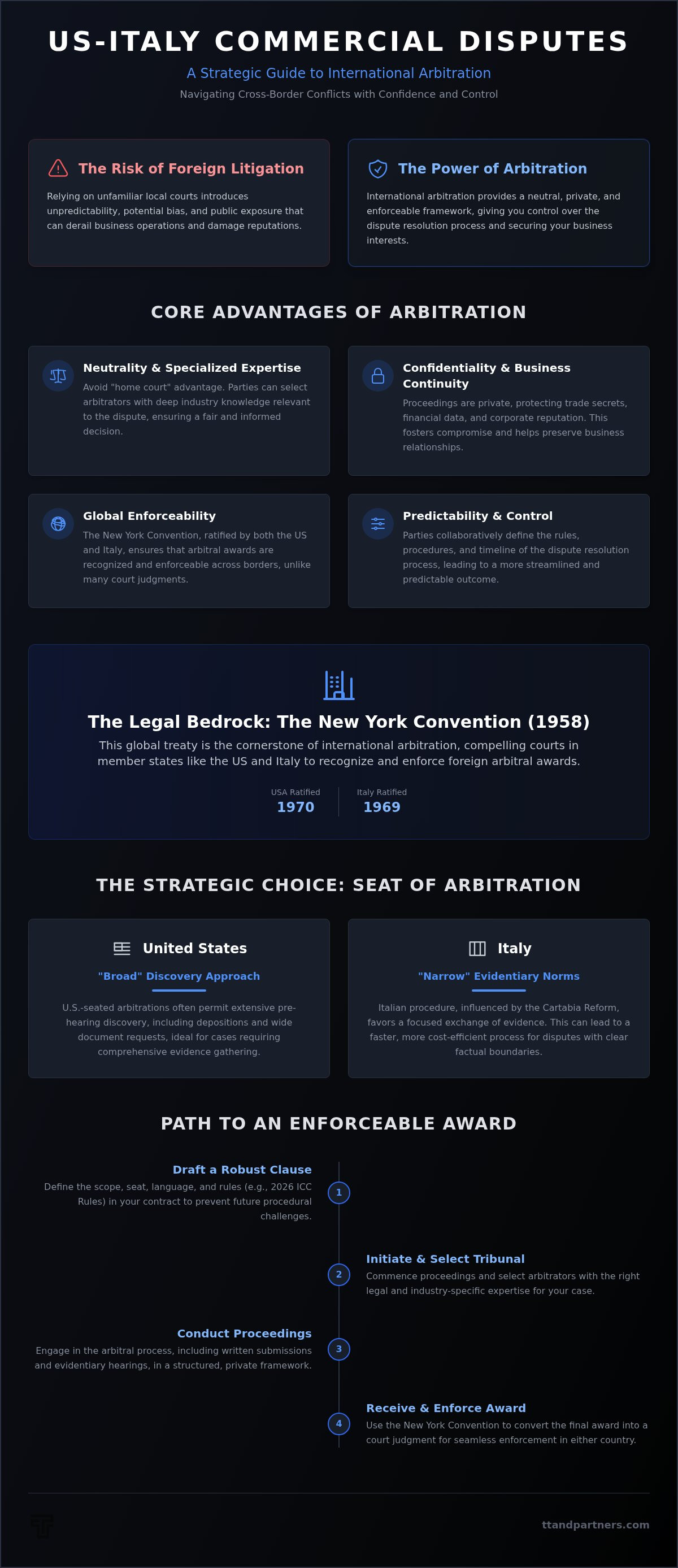
Transatlantic commerce between the United States and Italy has reached new levels of complexity, demanding a dispute resolution framework that matches the sophistication of the underlying deals. When a conflict arises, the immediate concern for any executive is the unpredictability of a foreign judicial system. Traditional litigation often forces parties into unfamiliar procedural rules or subjects them to the perceived biases of local courts. For these reasons, international commercial arbitration US Italy has emerged as the preferred mechanism for safeguarding investments. It provides a structured environment where outcomes are dictated by contractual intent rather than jurisdictional quirks. This preference is anchored in the security provided by the New York Convention, which ensures that an award rendered in one nation is respected and enforced in the other.
Neutrality and Specialized Expertise
Selecting a forum that offers a level playing field is essential for maintaining the balance of power in cross-border transactions. In international commercial arbitration US Italy, the neutrality principle serves as a foundational safeguard; it is a procedural doctrine ensuring that neither party is subjected to the idiosyncratic laws or potential judicial favoritism of their opponent's home country. Beyond mere fairness, arbitration allows parties to appoint decision-makers with specific industry knowledge. Whether the dispute involves complex fashion licensing, advanced manufacturing, or tech-sector intellectual property, having an expert tribunal ensures the technical nuances aren't lost in translation. This specialized approach eliminates the home court advantage and replaces it with a rigorous, merit-based analysis of the facts.
Confidentiality and Business Continuity
Public litigation can be a liability for brands that rely on trade secrets or sensitive financial data. Arbitration offers a private alternative where the details of the conflict remain shielded from the public record. This privacy is vital for several reasons:
Data Protection: It keeps proprietary manufacturing processes or client lists away from competitors.
Reputation Management: It allows firms to resolve disagreements without the scrutiny of the media or public filings.
Relationship Preservation: The private nature of the proceedings often fosters a more collaborative atmosphere, making it easier to maintain long-term business partnerships.
When proceedings aren't a matter of public record, parties find it easier to reach compromises that prioritize business continuity. It's about resolving the friction without burning the bridge. By choosing a private forum, companies ensure that their legal battles don't become permanent stains on their corporate identity or operational history.
The Legal Framework: New York Convention and Local Statutes
The legal architecture supporting international commercial arbitration US Italy is built upon a sophisticated hierarchy of international treaties and domestic statutes. This framework ensures that the private resolution of disputes isn't just a matter of contractual trust but a process backed by the full force of the law. At the apex is the 1958 New York Convention, which creates a seamless path for awards to move between the Italian and American legal systems. Beneath this treaty, the Federal Arbitration Act (FAA) in the U.S. and the Italian Code of Civil Procedure provide the granular rules that govern the validity of the arbitration agreement itself. Together, these layers of law prevent parties from retreating into jurisdictional loopholes when a conflict arises.
The Primacy of the New York Convention
The Convention serves as the definitive global standard for the recognition and enforcement of foreign arbitral awards, acting as the primary bridge between Rome and Washington. Both Italy, which ratified the treaty on January 31, 1969, and the United States, which followed on September 30, 1970, are deeply committed to its principles. This treaty mandates that domestic courts stay any litigation if a valid arbitration agreement exists. It also limits the grounds for refusing to enforce an award to a very narrow list, such as a lack of proper notice or a violation of public policy. By standardizing these rules, the Convention provides the commercial stability required for high-stakes transatlantic investments, ensuring that an award won in one country is just as powerful in the other.
Bilateral Nuances in US and Italian Law
While the Convention sets the stage, local statutes provide the procedural script that parties must follow. In the United States, the FAA establishes a strong national policy favoring arbitration, often preempting state laws that might otherwise restrict its scope. Conversely, the Italian Code of Civil Procedure, specifically under Libro IV, Titolo VIII, has undergone significant modernization to align with global standards. These local laws often draw inspiration from the UNCITRAL Model Law on International Commercial Arbitration, ensuring that the procedural gaps left by international treaties are filled with predictable, business-friendly rules. Recent updates, such as the Italian "Cartabia Reform," have further refined these domestic processes, enhancing the efficiency of interlocutory proceedings and streamlining first-instance court procedures.
Understanding the concept of arbitrability is also crucial, as certain disputes involving public interest or specific labor rights may be restricted from private resolution depending on the jurisdiction. Navigating these differences requires a strategic approach to contract design. If you're preparing a cross-border agreement, it's prudent to consult with counsel experienced in both jurisdictions to ensure your arbitration clause is fully optimized for enforcement under both the FAA and the Italian Code. This proactive legal architecture is what ultimately transforms a simple contract into a durable, cross-border asset.
Selecting the Seat: Comparing US and Italian Procedural Norms
The choice of the seat is perhaps the most consequential decision in the architecture of international commercial arbitration US Italy. While the physical location might be chosen for its aesthetic appeal or logistical convenience, the "legal seat" functions as the anchor for the entire proceeding. It determines the lex arbitri, which is the procedural law governing the arbitration, and identifies which national courts have the power to intervene or set aside an award. Whether you select a venue in the United States or Italy, the New York Convention ensures that the resulting award remains enforceable across borders, yet the path to that award differs significantly between these two jurisdictions.
Discovery and Evidence Production
One of the sharpest contrasts lies in how parties gather information. In a US-seated arbitration, parties often expect a "broad" discovery process similar to federal litigation, involving extensive document production and even depositions. This approach provides a high degree of transparency but can lead to escalating costs. Conversely, Italian proceedings follow the civil law tradition of "narrow" discovery. Here, the tribunal typically takes a more active role in determining which documents are necessary. This is guided by the principle of Iura Novit Curia, where the arbitrators are presumed to know the law and require only specific factual evidence to apply it. Balancing these expectations is vital to avoid procedural friction during the evidentiary phase.
Costs, Fees, and Finality
The financial philosophy of the seat also dictates the strategic leverage of the parties. In the United States, the "American Rule" usually prevails, meaning each side bears its own legal fees unless the contract specifies otherwise. Italy adheres to the "Loser Pays" principle, where the prevailing party is generally entitled to recover its costs. This can act as a powerful deterrent against frivolous claims but also increases the stakes for every motion filed. Timeline expectations have also shifted with the introduction of the 2026 ICC Rules, which now offer an ultra-expedited procedure for document-only disputes. This allows for an award to be rendered in just three months, a pace that complements the streamlined court procedures introduced by Italy's Cartabia Reform through 2025.
Choosing between institutions like the American Arbitration Association (AAA) and the Milan Chamber of Arbitration (CAM) involves comparing their respective administrative fee structures and case management styles. While the AAA is often praised for its robust digital infrastructure, CAM offers a deep understanding of the local civil law nuances that can be critical for Italian-centric contracts. Understanding these procedural norms allows you to design a dispute resolution process that is both efficient and culturally aligned with your business objectives.
Drafting Robust Arbitration Clauses for Transatlantic Success
A well-constructed arbitration clause is the foundational architecture of any cross-border agreement. In the landscape of international commercial arbitration US Italy, relying on vague or "pathological" clauses can lead to jurisdictional paralysis. A robust clause doesn't just mention arbitration; it defines the rules of engagement with surgical precision. You must specify the arbitral institution, the number of arbitrators, the legal seat, and the governing law. While some firms opt for ad hoc proceedings to avoid administrative fees, the complexity of transatlantic trade usually favors the structured oversight and predictability of a recognized institution.
Choosing the Right Arbitral Institution
The choice of institution often dictates the procedural rhythm and the level of administrative support you'll receive. The International Chamber of Commerce (ICC) is a global leader, and its 2026 Rules of Arbitration have introduced significant efficiencies for modern commerce. For agreements concluded on or after June 1, 2026, the threshold for the automatic Expedited Procedure has been raised to $4 million, allowing for faster resolutions in mid-market disputes. The removal of mandatory Terms of Reference in these new rules reflects a broader shift toward accelerated case management. For US entities, the International Centre for Dispute Resolution (ICDR) remains a standard choice, while the Chamber of Arbitration of Milan (CAM) offers specialized civil law expertise for Italian-centric disputes. With the ICC reaching a milestone of 30,000 registered cases in late 2025, the scale and reliability of these bodies provide a necessary safety net for high-value contracts.
Language and Governing Law Selection
Strategic drafting requires you to anticipate how different legal cultures will interpret your substantive rights. Choosing between New York law and Italian law involves weighing common law flexibility against civil law structure. This choice shouldn't be made in a vacuum; it must align with the operational realities of the deal and the location of your primary assets. Language is another critical pillar of the clause. Specifying a single language for the proceedings prevents the ambiguity that often arises from dual-language contracts. It ensures that the tribunal's interpretation of technical terms remains consistent throughout the dispute. When you define these parameters clearly, you eliminate the potential for a "conflict of laws" before a disagreement ever surfaces.
The synergy between your corporate structure and your dispute resolution plan is the key to long-term stability. If you're currently negotiating a cross-border deal, it's essential to contact our legal team to review your arbitration clauses and ensure they're optimized for enforcement. By investing in precise drafting today, you protect your business continuity for the future.
Enforcement and Litigation Support: Bridging the US-Italy Gap
Winning an award in international commercial arbitration US Italy is a significant milestone, but it doesn't automatically result in the transfer of funds or the fulfillment of obligations. The true value of the process lies in the efficiency with which that award is converted into an enforceable court judgment. This transition requires a deep understanding of the procedural nuances in both the United States and Italy. It's here that the synergy between your corporate structure and your legal strategy becomes apparent. For instance, a well-planned LLC incorporation provides the vessel for your American operations, but it's your firm's international litigation expertise that ensures those operations remain protected when a counterparty defaults on an arbitral decision.
Recognition of Foreign Awards in US Courts
In the United States, the confirmation of a foreign award is typically handled through a summary proceeding in federal court. Unlike a full trial, this process is designed to be streamlined, focusing on the validity of the award under the New York Convention rather than the merits of the original dispute. However, success isn't guaranteed. Debtors often attempt to stall enforcement by raising defenses related to public policy or procedural irregularities. Preempting these challenges requires specialized counsel who can demonstrate that the arbitration was conducted with rigorous adherence to due process. This phase is critical because an unconfirmed award is merely a piece of paper; only a court judgment allows for the legal seizure of assets to satisfy the debt. Furthermore, identifying and tracing attachable assets across borders often calls for private intelligence resources like International Investigative Group to ensure collection is viable. Strategic enforcement is the final, essential pillar of international commercial arbitration US Italy.
Strategic Counsel for Cross-Border Disputes
Securing your commercial interests involves looking beyond the immediate conflict to the broader horizon of your investment. For many Italian entrepreneurs, a dispute resolution plan is an integral part of their E-2 visa and long-term residency strategy. Ensuring that your business can survive and thrive despite legal friction is essential for maintaining your treaty investor status. This holistic approach requires a legal partner that doesn't just react to crises but builds a resilient business architecture from the outset. By integrating your corporate setup with a proactive enforcement plan, you create a seamless bridge between your Italian heritage and your American ambitions. If you're ready to secure your transatlantic future, you should contact our team for a tailored arbitration strategy that aligns with your specific commercial goals.
Securing Your Transatlantic Commercial Future
Successful cross-border expansion requires more than just a bold vision; it demands a legal architecture that anticipates friction before it occurs. Selecting international commercial arbitration US Italy ensures that your disputes are resolved in a neutral, expert forum rather than left to the unpredictability of foreign courtrooms. By leveraging the 2026 ICC updates and the enduring strength of the New York Convention, you transform potential legal liabilities into manageable business risks. It's this precision in drafting today that prevents jurisdictional paralysis tomorrow.
The quality of your counsel defines your outcome when you're navigating procedural differences or converting an award into a confirmed judgment. We provide the dual-jurisdiction expertise and strategic litigation support necessary to bridge the gap between Rome and New York. Our team delivers bespoke legal solutions for international entrepreneurs who value intellectual depth and professional precision. Contact Tosolini, Toniutti & Partners for expert international arbitration counsel to begin building your resilient transatlantic strategy. Your vision deserves a foundation of unwavering protection and global reach.
Frequently Asked Questions
Is international commercial arbitration faster than litigation in Italy?
Arbitration is significantly faster than traditional litigation in Italy; where court cases can span several years. The 2026 ICC Rules introduce an ultra-expedited procedure allowing awards in just three months for specific, document-only disputes. While the Cartabia Reform has improved first-instance court speed through 2025, arbitration remains the most predictable path for maintaining business momentum and preventing capital from being locked in long-term legal uncertainty.
Can I enforce a US arbitration award in Italy under the New York Convention?
You can absolutely enforce a US arbitration award in Italy because both nations are long-standing signatories to the New York Convention. Italy ratified this treaty in 1969, which requires Italian courts to recognize foreign awards with very limited exceptions. This framework ensures that your legal victories in the United States have real-world consequences for assets located in Italy, providing a seamless bridge for cross-border asset recovery.
What are the typical costs associated with US-Italy commercial arbitration?
Costs vary based on the chosen institution and the complexity of the dispute; but they generally include administrative fees and arbitrator compensation. In international commercial arbitration US Italy, you must also consider the cost-shifting rules. Italy follows the "Loser Pays" principle, while the U.S. often uses the "American Rule" where each side pays its own fees. Drafting a clear provision on fee allocation can prevent unexpected financial burdens.
Should I choose the ICC or the AAA for my transatlantic contract?
Choosing between the ICC and the AAA depends on your strategic priorities and the comfort level of your Italian counterpart. The ICC is often perceived as more culturally neutral for European entities; especially with its June 2026 procedural updates. The AAA's international division, the ICDR, is highly efficient for US-based operations. We recommend selecting the institution whose rules best align with your specific industry's typical dispute profile and evidentiary needs.
Can an arbitration clause affect my eligibility for an E-2 or E-1 visa?
An arbitration clause doesn't directly dictate visa eligibility, but it strengthens the "substantiality" and "operational" requirements for an E-2 or E-1 visa application. A robust dispute resolution plan demonstrates that your investment is real, active, and professionally managed. It shows US immigration authorities that you've built a sophisticated business architecture capable of protecting its assets, which is a hallmark of a serious and committed treaty investor.
What happens if the other party refuses to participate in the arbitration?
If a party refuses to participate, the arbitration can still proceed to a final award through what's known as "ex parte" proceedings. The tribunal will ensure the non-participating party received proper notice to protect the award's enforceability. Once the award is rendered, it remains valid and enforceable under the New York Convention, allowing you to pursue assets even if the counterparty chose to ignore the initial arbitration summons.
How do I choose the right governing law for a US-Italy business agreement?
Selecting the right governing law requires balancing the flexibility of US common law with the structured predictability of the Italian Civil Code. New York law is frequently chosen for its vast body of commercial precedent and sophisticated treatment of complex contracts. Italian law might be more appropriate if the contract's performance is entirely centered in Italy. This choice should always be made in tandem with selecting the appropriate legal seat.
Are arbitral awards final, or can they be appealed in US or Italian courts?
Arbitral awards are final and binding; with almost no opportunity for a merit-based appeal in either US or Italian courts. Judicial intervention is strictly limited to narrow procedural grounds, such as a lack of proper notice or a violation of public policy. This finality is a primary advantage of international commercial arbitration US Italy, as it prevents the "perpetual litigation" cycle often found in traditional court systems across different jurisdictions.


Comments