

US Italy Cross-Border Business Lawyer: Strategic Legal Counsel for 2026
- Gianni Mendes Toniutti, Esq.

- May 5
- 12 min read
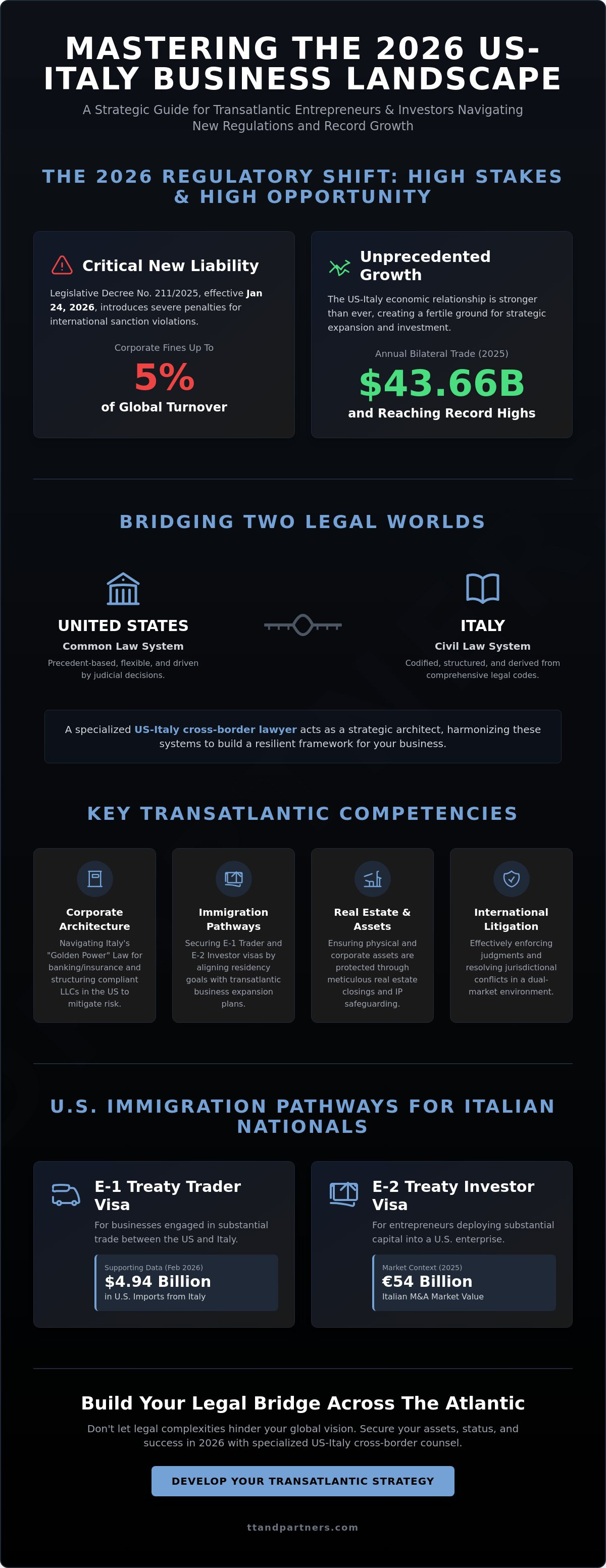
Did you know that as of January 24, 2026, Legislative Decree No. 211/2025 imposes corporate fines up to 5% of global turnover for international sanction violations? Many entrepreneurs view the Atlantic as a legal divide, but true success comes from treating it as a unified structural challenge. You're likely concerned about the friction of dual-jurisdiction compliance or the risk of a visa rejection during a critical expansion. It's a valid fear when the Italian "Golden Power" Law now includes a broad economic security test for banking and insurance sectors.
By engaging a specialized US Italy cross-border business lawyer, you can harmonize these complex legal frameworks into a single, resilient strategy. This guide explores how to master the 2026 regulatory environment, from securing E-2 visas with substantial investments to navigating the Corporate Sustainability Reporting Directive. We'll provide the clarity needed for real estate closings and LLC incorporations while ensuring your transatlantic operations remain both compliant and visionary. You'll learn how to protect your assets and status in a year where US-Italy trade continues to reach record highs.
Key Takeaways
Learn how the evolving 2026 regulatory landscape demands the precision of a US Italy cross-border business lawyer to navigate new corporate liabilities and investment screenings.
Identify the most effective immigration pathways, including E-1 and E-2 visas, to align your residency goals with your transatlantic business expansion.
Explore how to structure LLCs and manage real estate closings to ensure your physical and corporate assets are protected across both legal systems.
Understand the nuances of international litigation to effectively enforce judgments and resolve jurisdictional conflicts in a dual-market environment.
Table of Contents Navigating the Legal Landscape as a US-Italy Cross-Border Business Lawyer Immigration Pathways for Italian Investors and Entrepreneurs Corporate Architecture and Real Estate in a Cross-Border Context Mitigating Risk: International Litigation and Compliance Strategic Partnership: Why Tosolini, Toniutti & Partners
Navigating the Legal Landscape as a US-Italy Cross-Border Business Lawyer
The role of a US Italy cross-border business lawyer in 2026 transcends traditional legal representation. It's about designing a functional framework that supports the $43.66 billion in annual trade recorded in 2025 while respecting two distinct legal philosophies. Generalist firms often offer a broad reach across 100 countries, yet they frequently lack the granular precision required to handle the specific friction between Italian civil law and US common law. A specialist acts as a strategic architect, ensuring that every corporate element fits within the local context and the global vision.
For those understanding foreign direct investment, the stakes have shifted significantly. New regulations like Legislative Decree No. 211/2025, which came into force on January 24, 2026, now link corporate criminal liability directly to global turnover. This makes jurisdictional optimization a necessity rather than a luxury. Our primary objectives center on risk mitigation and asset protection, creating a "legal bridge" that harmonizes conflicting statutes. We don't just solve problems; we build structures that prevent them from arising.
Risk Mitigation: Aligning with the January 2026 Golden Power Law amendments to protect financial sector transactions.
Asset Protection: Securing intellectual and physical property across New York and Rome jurisdictions.
Jurisdictional Optimization: Choosing the right legal seat to minimize tax friction and regulatory overlap.
The Strategic Advantage of Dual-Jurisdiction Expertise
Managing the interplay between Italian residency and US visa status requires a deep understanding of how one affects the other. Cross-border counsel prevents conflicting legal obligations that often arise when a business owner holds an E-2 visa while maintaining significant interests or tax residency in Italy. A US Italy cross-border business lawyer serves as a strategic architect of international growth, balancing the requirements of two nations to create a seamless path for expansion. This expertise ensures that your global mobility doesn't compromise your corporate standing in either country.
Core Competencies for Transatlantic Operations
Bridging the gap between the Italian Permesso di Soggiorno and the US Green Card involves more than just filing paperwork; it requires a holistic view of the client's global footprint. Corporate governance must also be harmonized between New York’s rigorous standards and Rome’s statutory requirements. When disputes arise, having a strategy for International Litigation 2026 ensures that contracts remain enforceable across borders. This precision-based approach is essential for protecting the €54 billion M&A market value seen in Italy during 2025. We ensure that every document, from an LLC operating agreement to a real estate contract, maintains its integrity regardless of the court that reviews it.
Immigration Pathways for Italian Investors and Entrepreneurs
For Italian citizens, the ability to reside and operate in the United States is anchored in a long history of U.S.-Italy Bilateral Economic Relations. These treaties provide the legal architecture for the E-1 and E-2 visa categories, which remain the most effective tools for transatlantic expansion in 2026. A specialized US Italy cross-border business lawyer views these immigration pathways not as mere administrative hurdles, but as the foundational infrastructure of a global enterprise. Choosing the wrong status can lead to conflicting tax obligations or operational restrictions that hinder long-term growth.
The E-1 Treaty Trader visa is particularly relevant for businesses leveraging the substantial flow of goods between the two nations. In February 2026, the U.S. imported $4.94 billion from Italy, reflecting a robust supply chain that supports trade-based residency. While the E-1 requires the applicant to engage in "substantial trade," the E-2 focuses on the deployment of capital. Both pathways offer a renewable status that allows entrepreneurs to manage their US interests while maintaining their Italian heritage. If you're ready to define your transatlantic status, you can consult with our strategic partners to map your journey.
E-2 Visa: Strategic Framework for Treaty Investors
The E-2 visa remains the premier choice for Italian entrepreneurs because it doesn't mandate a statutory minimum investment. However, 2026 trends show that successful applications typically involve at least $100,000 in "at risk" capital. This investment must pass a proportionality test, proving the funds are sufficient to ensure the business's success. Our E-2 Visa Guide 2026 details how to develop a business plan that meets these rigorous standards while protecting your financial interests.
The O-1 Visa: A Pathway for Italian Talent
For Italian scientists, artists, and tech innovators, the O-1 visa offers a route based on "extraordinary ability" rather than capital investment. This category is ideal for those who have achieved national or international acclaim and wish to sponsor their own US operations through an agent or a US entity. You can explore the nuances of this category in our guide on the O-1 Visa for Entrepreneurs. It's a sophisticated alternative for talent-driven ventures that don't fit the traditional investor mold.
The final objective for many is the transition from non-immigrant status to a permanent US Green Card. This move requires a deliberate long-term strategy, ensuring that your corporate structure—such as an LLC or C-Corp—supports immigrant visa petitions like the EB-1 or EB-2 National Interest Waiver. By harmonizing your current visa with your future residency goals, we ensure your presence in the US is as enduring as the businesses you build.
Corporate Architecture and Real Estate in a Cross-Border Context
Building a business across borders is akin to architectural design; every structural choice must balance aesthetic vision with functional stability. While many firms isolate tax compliance from corporate formation, a US Italy cross-border business lawyer integrates these elements into a cohesive strategy. This approach is vital when navigating the Italy Investment Climate Statement, which highlights the specific nuances of the local legal system and bureaucracy. By aligning US corporate vehicles with Italian ownership goals, we create a resilient foundation for both commercial operations and private investments.
Our methodology focuses on creating a "living" corporate structure that adapts to changing regulations in both jurisdictions. In 2026, this means moving beyond simple incorporation to a model that prioritizes asset protection and jurisdictional optimization. We don't just file papers; we design the legal environment where your capital can thrive. If you're ready to lay the first stone of your transatlantic venture, you can consult with our legal architects to ensure your foundation is secure.
LLC Formation for Non-Resident Italian Nationals
The Limited Liability Company (LLC) remains the premier structural choice for Italian investors because of its flexibility and pass-through taxation benefits. However, 2026 brings new layers of complexity with the LLC Transparency Act, which mandates rigorous beneficial ownership reporting to combat financial opacity. Our LLC Incorporation Guide explains how to maintain compliance while leveraging the LLC's ability to shield personal assets from corporate liabilities. This dual-market precision ensures that your US business architecture respects both Delaware or New York governance and Italian regulatory expectations.
Transatlantic Real Estate: Closing the Deal
Acquisition of real property in the US requires a level of due diligence that goes beyond mere title searches. For the Italian investor, managing the escrow process and ensuring clear title involves coordinating between two very different legal cultures. We oversee every phase of the real estate closing, from the initial letter of intent to the final deed transfer. Effective asset protection for real estate portfolios often involves:
Corporate Siloing: Holding individual properties in separate LLCs to limit cross-liability.
Anonymity Structures: Utilizing trusts or holding companies to maintain privacy and security.
Tax Harmonization: Aligning depreciation schedules with both US and Italian tax reporting.
Selling property is equally complex due to specific federal regulations that catch many foreign investors off guard. FIRPTA withholding represents a critical financial hurdle for Italian sellers, requiring a mandatory 15% hold on the gross sale price unless specific exemptions are documented before the closing date. Without a specialized US Italy cross-border business lawyer to facilitate a withholding certificate, these funds can be tied up in IRS bureaucracy for months. We ensure that your exit strategy is as meticulously planned as your entry, maintaining the harmony of your global portfolio.
Mitigating Risk: International Litigation and Compliance
Legal disputes across the Atlantic aren't merely about who is right; they're about which system holds the power to enforce a decision. A US Italy cross-border business lawyer must anticipate these conflicts before a single contract is signed. By 2026, the complexity of these interactions has deepened, especially with the full implementation of the ETIAS (European Travel Information and Authorisation System) for US citizens traveling to Italy for business. While ETIAS is an administrative requirement, it reflects a broader trend toward the rigorous monitoring of international business travel and the need for a unified compliance strategy.
Conflict of laws often creates a paradox where a contract is valid in Rome but unenforceable in New York. We mitigate this through precise choice-of-forum and choice-of-law clauses that respect both the Italian Civil Code and US common law principles. This isn't just about litigation; it's about jurisdictional harmony. Without these safeguards, a business risks being caught in a procedural vacuum where neither court accepts responsibility for the dispute.
Enforcing Italian Judgments in the United States
Enforcing an Italian court's decision in a US state typically involves the Uniform Foreign-Country Money Judgments Recognition Act. This isn't an automatic process. US courts will examine whether the Italian proceeding provided due process and whether the judgment conflicts with local public policy. Strategic defenses often hinge on procedural hurdles, making the initial drafting of arbitration or forum-selection clauses the most critical step in your international business architecture. We focus on ensuring that your Italian victories are recognized and collectible in the US market.
Tax Treaty Compliance and Reporting
Risk mitigation also extends to the fiscal relationship between nations. The US-Italy Tax Treaty is designed to prevent double taxation, but it requires active management of Permanent Establishment (PE) risks. Italian companies operating in the US frequently overlook the threshold at which their activities trigger a US tax presence. For dual residents, FBAR and FATCA reporting remain non-negotiable requirements to avoid substantial penalties. Our counsel coordinates with specialized tax professionals to ensure your corporate governance remains as transparent and efficient as a well-designed building.
If you face a jurisdictional dispute or need to audit your compliance framework, contact our legal strategists for a comprehensive review of your cross-border standing.
Strategic Partnership: Why Tosolini, Toniutti & Partners
Success in the transatlantic market is rarely a product of chance; it is the result of deliberate, high-precision planning. While larger firms may offer a broad global reach, they often lack the specialized focus required to bridge the specific cultural and legal gaps between New York and Rome. A US Italy cross-border business lawyer at Tosolini, Toniutti & Partners operates with the mindset of an architect. We understand that every legal structure must be both aesthetically sound in its logic and functionally resilient against the shifts of the 2026 regulatory environment. Our firm doesn't just provide answers; we provide a vision that respects the historical weight of Italian enterprise while embracing the digital speed of the US market.
Our integrated service model eliminates the friction that occurs when immigration, corporate law, and real estate are handled by separate entities. We've seen how a lack of coordination can lead to visa delays or unforeseen tax liabilities under the 2026 LLC Transparency Act. By centralizing your legal strategy, we ensure that your E-2 investment, your corporate governance, and your real estate closings all move in harmony. This holistic approach is essential for navigating a trade relationship that saw US exports to Italy reach $43.66 billion in 2025.
The TT&P Methodology: Precision and Vision
We act as strategic partners rather than mere legal vendors. Our team speaks the language of law and the language of business with equal fluency, allowing us to translate complex requirements like Legislative Decree No. 211/2025 into actionable growth strategies. We prioritize the "partnership" in our name, believing that the best legal solutions emerge from a continuous dialogue with our clients. Our commitment to the 2026 landscape includes:
Cultural Fluency: Deep roots in the Italian business community combined with decades of US legal practice.
Rigorous Precision: A proven track record in securing E-1, E-2, and O-1 visas where others see only obstacles.
Future-Proofing: Constant monitoring of Golden Power amendments and EU-level directives to protect your interests.
Securing Your Cross-Border Future
The first steps in your transatlantic expansion are the most critical. A well-structured initial consultation serves as the blueprint for your entire operation, identifying potential jurisdictional conflicts before they become costly disputes. We help you determine whether an LLC or a C-Corp better serves your 2026 goals while ensuring your personal residency status remains secure. Don't leave your international legacy to a generalist firm that views your business as just another file. Schedule a consultation with our US-Italy cross-border experts today to begin building a legal structure that is as enduring as it is innovative.
Architecting Your Transatlantic Legacy
Navigating the complexities of the 2026 legal landscape requires more than just compliance; it demands a visionary approach to corporate and personal status. Success depends on the strategic harmonization of Italian civil law with the US common law system, ensuring that your E-1, E-2, or O-1 visa pathway aligns perfectly with your long-term business goals. Whether you're managing complex real estate closings or mitigating risks in international litigation, the integrity of your structural choices will define your resilience in the global market.
With decades of specialized experience, a US Italy cross-border business lawyer at Tosolini, Toniutti & Partners provides the precision necessary to bridge these two worlds. We ensure your expansion respects the $54.7 billion stock of Italian FDI in the United States while preparing you for future shifts in regulatory standards. Your growth deserves a partner who values harmony and innovation as much as you do. Contact Tosolini, Toniutti & Partners for a Strategic Consultation and secure the foundation of your international future. We look forward to building this journey with you.
Frequently Asked Questions
Do I need a lawyer in both the US and Italy for my cross-border business?
Engaging a single firm with dual-market expertise is more efficient than managing separate legal teams in two different time zones. A US Italy cross-border business lawyer harmonizes conflicting legal standards into a unified strategy, preventing the fragmentation that occurs when a Rome-based firm and a New York firm offer contradictory advice. This integrated approach ensures that your corporate architecture respects both the Italian Civil Code and US common law principles simultaneously.
What is the most common reason for E-2 visa denials for Italian investors?
The primary reason for E-2 denials is "marginality," which occurs when a business fails to prove it can generate more than a minimal living for the investor and their family. In 2026, consular officers look for a five-year business plan showing the capacity to hire US workers. Your application must demonstrate that the investment is substantial relative to the total cost of the enterprise, often requiring at least $100,000 to be considered viable.
Can an Italian citizen apply for a US Green Card while on an E-2 visa?
Italian citizens can transition to a Green Card, but the E-2 visa does not lead directly to permanent residency. You must qualify for a separate immigrant category, such as the EB-1 for extraordinary ability or the EB-2 National Interest Waiver. It's essential to manage the timing of these filings carefully to avoid "dual intent" issues that could complicate your E-2 status during future renewals or international travel.
How does the US-Italy Tax Treaty prevent double taxation for entrepreneurs?
The treaty prevents double taxation by allowing taxpayers to claim a foreign tax credit for taxes paid to one nation against the liability in the other. It also establishes "tie-breaker" rules to determine a single country of residency for tax purposes. This mechanism is vital for protecting profits generated within the $1.6 trillion US M&A market or the €54 billion Italian deal environment from being taxed twice.
What are the legal requirements for an Italian national to start an LLC in the US?
Italian nationals can form a US LLC without physical residency or a specific visa. The process requires appointing a registered agent in the state of formation and obtaining an Employer Identification Number (EIN) from the IRS. A specialized US Italy cross-border business lawyer ensures your operating agreement accounts for Italian tax reporting requirements, preventing future compliance friction between the two jurisdictions.
Is it possible to enforce an Italian court judgment in the United States?
Enforcement is possible through the Uniform Foreign-Country Money Judgments Recognition Act, which has been adopted by a majority of US states. The US court must verify that the Italian tribunal provided a fair trial and had proper jurisdiction over the defendant before recognizing the judgment. Most procedural defenses focus on whether the judgment contradicts the specific public policy of the US state where enforcement is sought.
How has the LLC Transparency Act changed reporting for foreign owners in 2026?
As of January 1, 2026, the LLC Transparency Act requires all foreign owners to file Beneficial Ownership Information (BOI) reports with FinCEN. This mandate applies to any individual holding at least 25% ownership or exercising substantial control over the entity. Failure to report accurate data to the federal government can result in civil penalties of $500 per day, making precise corporate record-keeping a non-negotiable requirement for international owners.
What legal protections are necessary for an Italian investor purchasing US real estate?
Italian investors should prioritize title insurance and the use of separate LLCs to silo liability for each individual property. Planning for FIRPTA is also critical, as the IRS requires a 15% withholding on the gross sales price when a foreign seller exits the market. Coordinating these protections ensures that your real estate portfolio remains a secure and functional component of your global assets without facing unexpected bureaucratic delays.


Comments